



 Best Camping Generator Overall
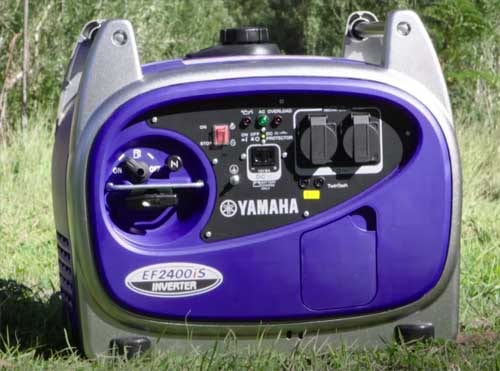
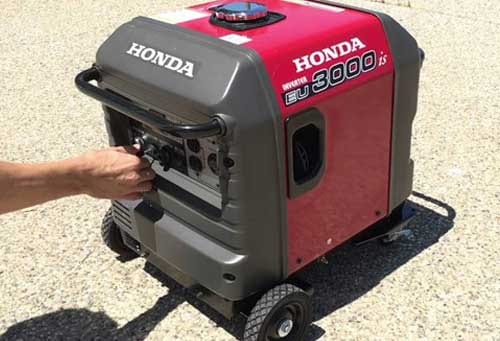
Honda EU2200i
- Running watts: 1800 W
- Peak watts: 2200 W
- Engine: 121cc Honda GXR120
- Noise: 48 to 57 dBA
- Run time: up to 8.1 hr at 25 percent
- Tank: 0.95 gal
- Weight: 46.5 lb
- Start: recoil
Bottom Line : The buy-it-for-life gold standard: a big, relaxed engine, genuinely clean power and years of service, at a premium price.
Pros
- Big 121cc engine loafs where rivals scream
- Clean pure sine wave for CPAPs and electronics
- Very quiet in Eco mode
- Built to outlast the camper
Cons
- Premium price
- CO sensor can trip in cold or still air
- Pull cord frays if not pulled straight
- Carb still needs draining for storage
Most 2000W-class inverters run a small 79cc engine. Honda fits a 121cc GXR120 in the same size shell, so it doesn't have to scream to carry a heavy load. Owners report running a modern 12,000 BTU inverter air conditioner, a fridge and lights together with the Honda's app showing a 600W draw, and getting around 8 hours from a gallon in Eco mode.
The clean-power claim holds up, too. Independent oscilloscope tests show a clean pure sine wave, and it runs sensitive CPAP machines and UPS battery backups without tripping them.
Owners on Reddit have three complaints. The new CO-Minder carbon monoxide sensor can shut the engine off in near-freezing weather, or when the generator sits in a dip where the exhaust doesn't clear quickly. Ethanol fuel left in the carburettor for around three months causes surging even on a Honda, so drain it before winter. And the pull-cord housing is sharp enough to fray the cord if you don't pull straight out. It scores 88 out of 100.
The undisputed, buy-it-for-life gold standard.
Ryan, tester
Read our full Honda EU2200i review →
 Best Silent Power Station For Camping
Bluetti AC180 Portable Power Station
- Capacity: 1152Wh LiFePO4
- AC output: 1800 W, 2700 W peak
- Cycle life: 3,500 cycles
- Fuel: none, recharge from wall, car or solar
- Noise: silent in use
Bottom Line : Zero gas and zero noise for tent campers and CPAP users, as long as you switch off Eco mode before you trust it with a fridge.
Pros
- Silent, no fuel, no fumes
- Long-life LiFePO4 battery
- Coated circuit boards resist damp tents
- Runs a 12V chest fridge for days with a panel
Cons
- Ships with Eco mode on, which can switch it off overnight
- Idles the battery flat if AC is left on
- Battery gauge can drift until recalibrated
The ultimate silent all-rounder. Its LiFePO4 battery is rated for 3,500 cycles, and owners report running a 12V chest fridge for 3 to 4 days straight when it is paired with a single 100W solar panel. Bluetti is also one of the few brands that coats its internal boards, which helps in a damp tent at dawn.
Change one setting before you rely on it. It ships with Eco mode on, which shuts the unit down after four hours of very low draw. Owners report spoiled fridge food, and flooded basements when it was backing up a sump pump, because the load didn't cycle on for four hours and the Bluetti put itself to sleep. Turn Eco mode off in the app.
Two smaller quirks. Leave the AC output on with nothing plugged in and the inverter will drain the battery flat in a couple of days. And a known firmware quirk can make the display jump from 100% to 0% within an hour. Nothing is broken: run it fully flat, then charge to 100% from a wall outlet to recalibrate. It scores 88 out of 100.
Read our full Bluetti AC180 review →
 Best Value Dual Fuel Generator
WEN 3600-Watt Dual Fuel RV-Ready Inverter
Bottom Line : The bigger sibling of the WEN it replaces: 650 more running watts on gas, a TT-30R RV plug and a CO shutdown sensor, on gas or propane.
Pros
- 2900 running watts on gas
- Runs on gas or propane
- TT-30R RV outlet
- Watchdog CO shutdown
Cons
- No published dBA figure
- Bigger than the unit it replaces
- About 58 dBA in our test
The WEN 2800 Dual Fuel that held this spot is no longer available, so the award moves to its bigger sibling, the WEN 3600-Watt Dual Fuel. For camping, the step up mostly helps. You get 650 more running watts on gas, and a TT-30R outlet means a travel trailer’s 30 amp shore-power cord plugs straight in, no adapter.
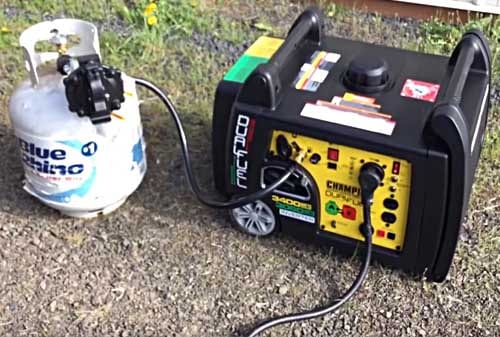
The case for dual fuel is unchanged. Propane keeps for years where gasoline goes stale in a few months, and the 20 lb grill tank already in the truck becomes fuel. Our testers have now run it as storm backup at home: about 58 dBA, 8.5 hours on gas, and an easy start on gas or propane. The 84 is still the slot’s score, carried over, not re-earned. Our Champion 2500 dual fuel review stays up for owners of the original pick.
Read our full WEN 3600-Watt Dual Fuel RV-Ready Inverter review →

EcoFlow DELTA 2 Max Power Station
- Capacity: 2048Wh LiFePO4
- AC output: 2400 W continuous
- Wall charging: 0 to 80 percent in about 70 min in our test
- Charge rate: adjustable in the app
- Fuel: none
Bottom Line : The premium battery for heavy RV use, with the fastest charging here, but it needs warmth to charge and its casing scratches easily.
Pros
- Runs 1800W microwaves and hair dryers
- 0 to 80 percent from the wall in about 70 minutes in our test
- Charge rate can be dialled down for weak campsite hook-ups
- Most advanced app and ecosystem
Cons
- Screen flashes all night with a cycling fridge
- Won't charge until its cells warm up after a freezing night
- Casing scratches easily
- Heavy
The EcoFlow ecosystem is the most advanced on the market. X-Stream charging is the fastest here: our testers saw this 2,048Wh battery go from 0 to 80% in about 70 minutes on a wall socket, and the app lets you dial the charge rate down from 1200W to 200W for a breaker-limited campsite hook-up.
It pushes 2,400W continuously, and owners run 1800W RV microwaves, hair dryers and coffee makers on it without a hiccup.
Three quirks. Van-lifers report the screen waking and flashing bright white all night whenever a 12V fridge cycles. The battery needs to be above about 5°C (41°F) to charge, so after a freezing night in the car it will refuse solar until the cells warm up. And the silver and black casing scratches easily, so keep it away from toolboxes and firewood. It scores 87 out of 100.
Read our full EcoFlow DELTA 2 Max Power Station review →

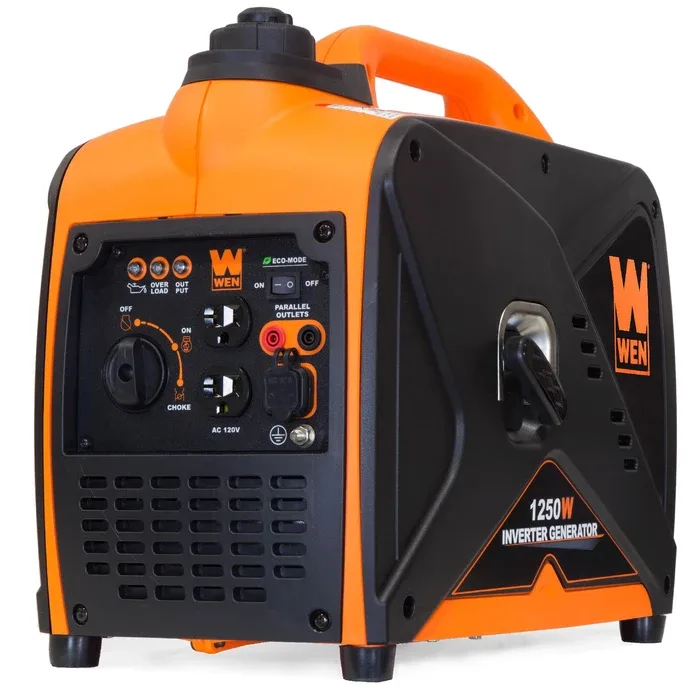
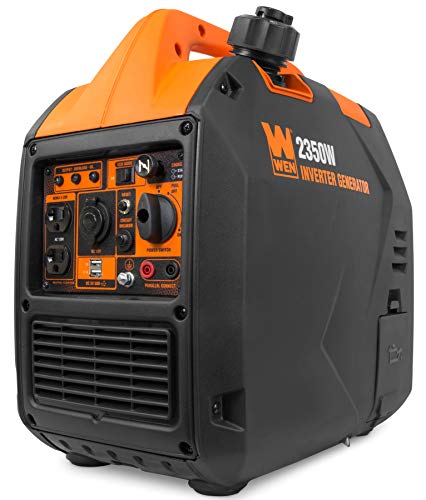
WEN 56235i Super Quiet Inverter
- Peak watts: 2350 W
- Fuel: gasoline
- Fuel shut-off: burns the carburettor dry
- Build: ultra-lightweight
Bottom Line : A light budget inverter with one brilliant trick for storage, but it needs a jet kit at altitude and quality varies.
Pros
- Fuel shut-off dial runs the carburettor dry
- Very light
- WEN's customer service is well regarded
Cons
- Bogs down above about 4,000 ft without a jet kit
- Some units arrive leaking oil
- Some inverter modules fail in year one
It feels a little cheaper out of the box, but it has a trick the far pricier Honda lacks: a Fuel Shutoff setting. Turn the dial at the end of a trip and it keeps running until it has burned every drop out of the carburettor bowl, so the fuel lines don't gum up in storage.
Camp in the mountains and it will bog down above about 4,000 ft. WEN sells an inexpensive high-altitude jet kit that leans out the mixture; without it, it can overload trying to start a small air conditioner.
Quality is a lottery. Plenty of owners run them for years, but a fair share of reviewers report units leaking oil out of the box or an inverter module failing in the first year. WEN's customer service gets strong praise for replacing them quickly. It scores 79 out of 100.
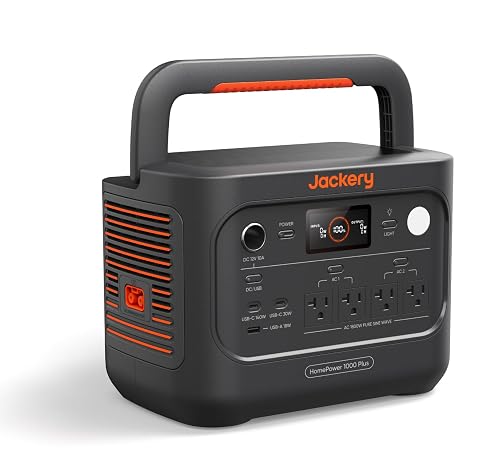
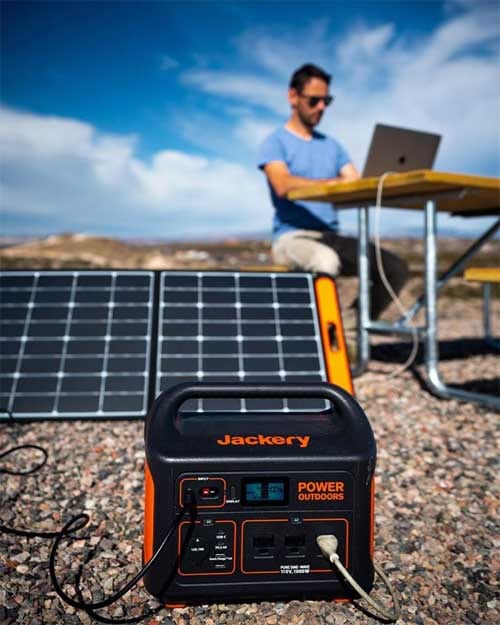
Jackery 1000 Plus Power Station
Bottom Line : The simplest, most dependable power station here, with a couple of quirks every family should know.
Pros
- Dead simple to use
- Long-life LiFePO4 battery
- Best-regarded customer service in the category
Cons
- Buttons can switch the output to 50Hz by accident
- Solar charging can stay throttled after a cloud
Jackery doesn't charge as fast as EcoFlow, but it has the best reputation for reliability and customer service in the category. It is rugged, runs on three buttons, and the Plus models moved to 4,000-cycle LiFePO4 cells. Jackery now sells this unit as the HomePower 1000 Plus v2.
Two quirks worth knowing. Parents report kids mashing the buttons and switching the AC output from 60Hz to 50Hz, which makes fans and appliances throw errors or sound like they're dying. Hold the AC button for 3 seconds to switch it back.
And on a single solar panel, a passing cloud can make the charge controller throttle the input hard, and it stays throttled after the sun returns until you unplug and re-plug the panel. It scores 85 out of 100.
Read our full Jackery 1000 Plus Power Station review →

Firman Dual Fuel Inverter Generator
Bottom Line : A budget dual-fuel powerhouse with clean power for RV air conditioning, once you learn its cold-propane start routine.
Pros
- Gas or propane
- Enough power for an RV air conditioner
- Clean pure sine wave output
Cons
- Hates starting on cold propane
- Heavy
- Check it for shipping damage on arrival
Ryan's notes cover the 3,200W version Costco sells; on Amazon, Firman's equivalent dual-fuel inverter is the WH03041 at 3,300 starting and 3,000 running watts. Ryan's notes have the 3,200W version running a 14,000 BTU air conditioner in 105-degree heat, and Firman's pure sine wave output is clean enough for electronics.
It hates starting on cold propane. The owners' workaround is to put a splash of gasoline in the tank, start it on gas, let it warm up for 3 minutes, then switch the dial over to propane. It runs smoothly after that.
These are heavy units in adequate packaging, and many owners report cracked muffler housings or broken panels from rough handling in transit. Inspect it as soon as it arrives. It scores 78 out of 100.

Anker SOLIX C1000 Power Station
- Capacity: 1056Wh
- AC output: 1800 W continuous
- Weight: 26.7 lb
- Size: about 15 percent smaller than rivals
- Charging: UltraFast from the wall
Bottom Line : The compact, fast-charging dark horse with the best app, but it roars on fast charge and can't combine wall and solar.
Pros
- About 15 percent smaller than rival 1kWh units
- 1800W continuous output
- Most stable app in the category, with charge scheduling
Cons
- Very loud while fast-charging
- Ignores solar when plugged into AC
- Still a dense 26.7 lb
Anker packs a 1,056Wh battery into a case roughly 15% smaller than the Bluetti or EcoFlow equivalents, though it still weighs a dense 26.7 lb. It pushes 1,800W continuously, and owners rate its app as the most stable and bug-free in the category, with charge scheduling to use off-peak electricity.
On UltraFast wall charging it sounds like a jet taking off, noticeably louder than its rivals. And it can't charge from AC and solar at once: when it detects AC it ignores the panels, which frustrates anyone building a load-shifting setup. It scores 83 out of 100.
Read our full Anker SOLIX C1000 review →
Champion 4000-Watt Dual Fuel RV Generator
- Running watts: 3000 W gas
- Peak watts: 4000 W gas
- Propane output: 2700 W running
- Noise: 64 dBA at 23 ft
- Fuel: gas or propane
- Weight: under 55 lb
- Run time: up to 10 hr gas at 25 percent
- Start: electric plus recoil
Bottom Line : Enough real running power to start most single RV rooftop air conditioners, at the cost of more noise and weight.
Pros
- Real 3000W runs one RV A/C
- Dual fuel and electric start
- 30A RV outlet built in
- 3-year warranty
Cons
- Loud at 64 dBA
- Heavier to move
- Retailer running-watt claims conflict
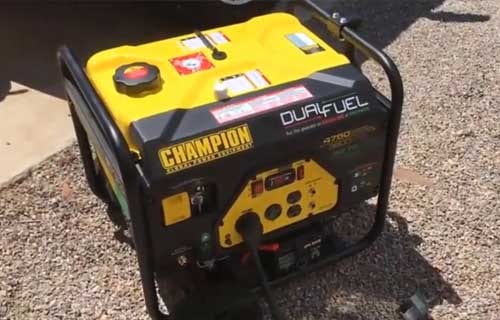
A 4000W surge dual fuel inverter with a 30A RV outlet, sized so one unit can actually run a 13,500 BTU rooftop A/C. Champion and Amazon spec 4000W starting and 3000W running on gasoline, 2700W running on propane. Some retailer listings advertise 3300W running, so treat the higher number with caution and plan around 3000W.
Under 55 lb but heavier and bulkier than the small inverters. Enough real running power to start most single RV rooftop air conditioners, at the cost of more noise and weight. It scores 84 out of 100.
Owners report reliable air conditioner starting, though it is loud and a few note propane regulator fussiness in cold.
Read our full Champion 4000-Watt Dual Fuel RV Generator review →
Westinghouse iGen2550 Inverter Generator
- Running watts: 1900 W gas
- Peak watts: 2550 W gas
- Propane output: 1700 W running
- Noise: from 52 dBA
- Fuel: gas or propane
- Weight: about 42.4 lb
- Run time: up to 12 hr on gas
Bottom Line : A cheap, light step up from the bottom tier with a handy data display, once you swap the spark plug.
Pros
- LED display shows hours, voltage and runtime left
- Very fuel efficient on light loads
- Light and easy to carry
Cons
- Factory spark plug causes misfires and hard starts
- Inverter board can whistle under load
- Some units arrive with fuel leaks
The iGen2550 replaced the iGen2500 that Ryan's notes cover, and it keeps the feature budget rivals from Champion and WEN left out: an LED data centre that cycles through lifetime hours, voltage and remaining runtime. It is also very frugal on a light overnight load.
Long-term owners agree on one thing: replace the factory spark plug with a genuine NGK before the first start, because the stock plug causes misfires and hard starts.
Some owners hear a high-pitched whistle under load. That is coil whine from the inverter electronics, not the engine. Quality control is patchy too, with reports of cracked fuel lines or leaking carburettors out of the box. It scores 80 out of 100.
Read our full Westinghouse iGen2550 review →
How Ryan Tested These Generators and Power Stations
Our tester Ryan spent six months running these units in muddy campgrounds, on deep-woods trips and from the back of his truck. He then checked what he found against owner communities on r/Generator, r/Ecoflow_community and r/Jackery, long-term Amazon reviews and YouTube teardowns, to catch the quirks and fixes that only show up after months of use. Where a point comes from owners rather than his own testing, we say so.
The list runs from the best overall down to budget backups, and it mixes gas, dual-fuel and battery options, because the right answer depends on whether you need silence, runtime or raw power for an air conditioner.
Buyers Guide:
How To Choose The Best Camping Generator
Not sure which of these you actually need? Tick your fridge, your kettle and everything else you plan to plug in, and the generator size calculator works out your running and starting watts, then filters our reviewed generators down to the ones that clear both.
Different Types Of Generators
There are three main types of generator:
- Portable / recreational generators
- Stand by or emergency backup generators
- Industrial stationary generators
In this review, we focus on portable models that can be used for a range of recreational activities such as camping, fishing, road trips, and even for trips in your RV.
Portable generators are usually inverter generators, which convert the DC power back into 120Volt, 60Hz AC power. They also keep the Total Harmonic Distortion (THD) levels to less than 6%. That makes them perfectly safe for electronic devices with sensitive microprocessors.
Portable generators should have carry handles and wheels to make them easier to transport and move. They may also have an extension cord.
RVs and caravans may also be set up with onboard generators meaning you can switch to it when you’re not connected to mains.
Generators can also be solar-powered or battery powered.
Features To Look Out For
Input and Output Ports
Most smaller generators will have two 120V AC outlets, and might also have DC ports and USB charging ports. On larger generators (over 4000 watts) you’ll find 240V plugs. The number of ports and the type will determine how you can charge your devices and what you can charge.
Fuel Supply
You need to decide if you’re looking for a small solar-powered battery to charge your phones, a diesel generator, a regular gasoline generator, or a high-end propane option. Diesel fuel tends to be more expensive than gasoline but will deliver more power per gallon. Propane is cleaner and more efficient.
On the other hand, gasoline is a more environment-friendly option.
Fuel Tank Size
The size of the fuel tank will determine how long you can go between refueling.
Most compact generators give a run time of around 6 to 8 hours at 50% load.
Depending on what you’re running, this may last longer.
Do keep in mind that a larger fuel tank will also add to the overall weight and dimensions.
Starter
Don’t fancy a recoil pull cord to get your generator going?
Worry not.
Portability
Given that generators - even portable generators - can be pretty heavy, look for a lift bar to make carrying it easier. Most heavier models come with a wheel or two for easy movement.
Wheel kits might be an optional extra, but if this is a concern for you, look for a generator with built-in wheels to make it easier to move around.
These Are Things To Consider
What Size Do I Need?
This all comes down to power consumption.
What are you using your generator for?
Do you just need to charge your phone, or are you powering lights?
What kitchen devices are you bringing?
Having a good idea of what you are going to be powering will help you decide which generator will suit you the best. For example:
- Portable TV: 60 watts
- Laptop: 60 watts
- Fan: 75 watts
- Fridge: 100-250 watts
- Microwave: 800 watts
- Kettle: 1200 watts
Knowing what you’ll be using the generator for will help determine which size you need.
Noise
Consider the dBA (decibel) rating. Some run much louder than others, while some, such as the ones with solar chargers, are silent. Generators that come within the 50 to 60-decibel range are good for camping. They can even be used in National Parks.
Durability
Having your generator break down can cause a major headache when you’re out and about. Look for higher-end models that won’t disrupt power supply and will last a long time.
At the same time, a camping generator should be sturdy enough to withstand a few knocks. Metal frames and high-quality plastics are materials that make a model durable.
Size
Keep in mind the size and weight too. If you’re going to be moving it around a lot, you’ll want a very portable one.
If you’ve got an army of people helping you, size and weight might be less of a factor. In case you’re planning to use it in an RV, check the overall dimensions to make sure space won’t be an issue.
Accessories
Bear in mind that not all camping generators come complete with accessories.
Optional extras might include automatic voltage regulators or circuit breakers, which could be important if you have devices that are sensitive to power surges, such as laptops.
Price
Lastly, the cost is obviously a significant factor when choosing your generator. They come in at a wide range of prices, from budget models to premium ones
This is why it’s crucial to know exactly what specifications you’re looking for and what you’ll use it for so that you don’t end up disappointed, or overspending.
Guarantee/ Warranty
Like any piece of equipment you’ve invested in, you want to make sure you’re covered in terms of a warranty. This will vary according to the manufacturer and the model, but generally, the premium brands will provide up to five years warranty, whereas cheaper brands might only provide a 12-month warranty.
Look for warranties that cover failures resulting from defects or faults in the unit. The warranty will not cover accidental damage or negligence, which can include inferior repairs or using non-approved replacement parts.
Jargon Buster
Here are a few terms that you need to learn about while picking a generator:
Harmonic distortions
The harmonics are higher frequency waveforms that can distort the fundamental wave frequency of a circuit. These waveforms have an adverse effect on sensitive electronic circuits, including phones and laptops that you might be charging.
Ideally, any generator should produce a current with low harmonic distortions as that means more power factor, lower peak currents, and better efficiency.
Kilowatt (kW) and Kilowatt-hour (kWh)
A kilowatt is a measure of the power of 1,000 watts. A kilowatt-hour (kWh) is a measure of energy.
A kW is the rate of electricity usage, whereas kWh reflects the total amount of electricity used.
dBA
Decibels, or dBA, are a measurement of noise in terms of the relative loudness as perceived by the human ear. In this scale, the lowest audible sound is 0 decibel. A sound ten times louder is 10 decibels and another 100 times louder is 20 decibels. Sounds that cross 85 decibels can lead to hearing loss.
TopNotch Top Tips
So you’re now equipped with all the basic guidelines for buying the perfect camping generator.
Next, it is time for some effective tips for buying your camping generators.
- A generator can run on diesel, petrol or gas and there are some that can run on dual fuel. So the choice of fuel depends on the dual factors of cost and availability. Keep in mind any local rules and guidelines that might impact your fuel choice.
- Make sure you determine how much power you need from the generator. To start with, you can sum up all the running wattage of all the appliances you use. Then, you can add the start-up wattage of the largest motor you have. If this seems complicated, you can talk to a dealer or an experienced user.
- Obviously, the key to making any generator work efficiently is correct maintenance. It’s important to learn about the maintenance and the service issues. A brand that offers an annual service maintenance contract is definitely a good choice. If you lack time, a hardy device that needs the least maintenance is the best option.
Frequently Asked Questions (FAQs)
Q: What is the best generator to buy for camping?
Q: What is the quietest generator for camping?
Q: Can you run a generator overnight?
Q: What is the difference between a generator and an inverter generator?
Q: How can I make my camping generator quieter?
Q: Is it cheaper to run a generator on propane or gas?
Q: What size generator do I need to run my AC?
A 13,500 BTU AC unit will need 2800 to 3000 starting watts and 1500 to 2000 running watts.
A 15,000 BTU AC unit will require 3300 to 3500 starting watts and 1300 to 1800 running watts.
There you have it.
You now have all the knowledge you need to buy that all-important camping generator with confidence.
We want you to know you're buying the right camping generator for your needs.
To help you out, we've reviewed our Top 10 choices to satisfy you. We’ve included links to the Top 3 at the beginning and the end of this review.
We’ve done the research - now we’re passing the baton to you to choose which suits you best!
Our Analysis, Comparisons & Test Results
We scored every generator and power station on this list against the same six things that decide which one earns its place.
Noise Output
The Honda EU2200i leads the field for noise output at 10 out of 10, and the Champion 4000-Watt Dual Fuel RV Generator trails at 6.
| Generator | Noise Output |
|---|---|
| Honda EU2200i | 10/10 |
| Bluetti AC180 Portable Power Station | 10/10 |
| EcoFlow DELTA 2 Max Power Station | 9/10 |
| Jackery 1000 Plus Power Station | 9/10 |
| WEN 3600-Watt Dual Fuel RV-Ready Inverter | 8/10 |
| WEN 56235i Super Quiet Inverter | 8/10 |
| Westinghouse iGen2550 Inverter Generator | 8/10 |
| Firman Dual Fuel Inverter Generator | 7/10 |
| Anker SOLIX C1000 Power Station | 7/10 |
| Champion 4000-Watt Dual Fuel RV Generator | 6/10 |
Power Output
The EcoFlow DELTA 2 Max Power Station leads the field for power output at 9 out of 10, and the Westinghouse iGen2550 Inverter Generator trails at 6.
| Generator | Power Output |
|---|---|
| EcoFlow DELTA 2 Max Power Station | 9/10 |
| Champion 4000-Watt Dual Fuel RV Generator | 9/10 |
| Firman Dual Fuel Inverter Generator | 8/10 |
| Jackery 1000 Plus Power Station | 7/10 |
| Anker SOLIX C1000 Power Station | 7/10 |
| WEN 3600-Watt Dual Fuel RV-Ready Inverter | 7/10 |
| Honda EU2200i | 6/10 |
| Bluetti AC180 Portable Power Station | 6/10 |
| WEN 56235i Super Quiet Inverter | 6/10 |
| Westinghouse iGen2550 Inverter Generator | 6/10 |
Ease of Use
The Jackery 1000 Plus Power Station leads the field for ease of use at 10 out of 10, and the Firman Dual Fuel Inverter Generator trails at 7.
| Generator | Ease of Use |
|---|---|
| Jackery 1000 Plus Power Station | 10/10 |
| Honda EU2200i | 9/10 |
| Bluetti AC180 Portable Power Station | 8/10 |
| EcoFlow DELTA 2 Max Power Station | 8/10 |
| WEN 56235i Super Quiet Inverter | 8/10 |
| Anker SOLIX C1000 Power Station | 8/10 |
| Westinghouse iGen2550 Inverter Generator | 8/10 |
| Champion 4000-Watt Dual Fuel RV Generator | 8/10 |
| WEN 3600-Watt Dual Fuel RV-Ready Inverter | 7/10 |
| Firman Dual Fuel Inverter Generator | 7/10 |
Durability
The Honda EU2200i leads the field for durability at 10 out of 10, and the Westinghouse iGen2550 Inverter Generator trails at 6.
| Generator | Durability |
|---|---|
| Honda EU2200i | 10/10 |
| Jackery 1000 Plus Power Station | 9/10 |
| Bluetti AC180 Portable Power Station | 8/10 |
| Anker SOLIX C1000 Power Station | 8/10 |
| Champion 4000-Watt Dual Fuel RV Generator | 8/10 |
| WEN 3600-Watt Dual Fuel RV-Ready Inverter | 7/10 |
| EcoFlow DELTA 2 Max Power Station | 7/10 |
| WEN 56235i Super Quiet Inverter | 6/10 |
| Firman Dual Fuel Inverter Generator | 6/10 |
| Westinghouse iGen2550 Inverter Generator | 6/10 |
Weight & Portability
The WEN 3600-Watt Dual Fuel RV-Ready Inverter, the WEN 56235i Super Quiet Inverter and the Westinghouse iGen2550 Inverter Generator lead the field for weight & portability at 9 out of 10, and the Firman Dual Fuel Inverter Generator trails at 5.
| Generator | Weight & Portability |
|---|---|
| WEN 3600-Watt Dual Fuel RV-Ready Inverter | 9/10 |
| WEN 56235i Super Quiet Inverter | 9/10 |
| Westinghouse iGen2550 Inverter Generator | 9/10 |
| Honda EU2200i | 8/10 |
| Anker SOLIX C1000 Power Station | 8/10 |
| Bluetti AC180 Portable Power Station | 7/10 |
| Jackery 1000 Plus Power Station | 6/10 |
| Champion 4000-Watt Dual Fuel RV Generator | 6/10 |
| EcoFlow DELTA 2 Max Power Station | 5/10 |
| Firman Dual Fuel Inverter Generator | 5/10 |
Accessories
The EcoFlow DELTA 2 Max Power Station leads the field for accessories at 9 out of 10, and the WEN 56235i Super Quiet Inverter trails at 6.
| Generator | Accessories |
|---|---|
| EcoFlow DELTA 2 Max Power Station | 9/10 |
| Bluetti AC180 Portable Power Station | 8/10 |
| Westinghouse iGen2550 Inverter Generator | 8/10 |
| Champion 4000-Watt Dual Fuel RV Generator | 8/10 |
| Honda EU2200i | 7/10 |
| WEN 3600-Watt Dual Fuel RV-Ready Inverter | 7/10 |
| Jackery 1000 Plus Power Station | 7/10 |
| Firman Dual Fuel Inverter Generator | 7/10 |
| Anker SOLIX C1000 Power Station | 7/10 |
| WEN 56235i Super Quiet Inverter | 6/10 |
Our Final Verdict: 10 Best Camping Generators
After testing the field, three stood out.
The Honda EU2200i is our best camping generator overall. A big, unstressed engine and genuinely clean power make it the one to buy once and keep for decades.
The Bluetti AC180 is our best silent power station for camping. No fuel and no noise for tents and CPAP users, once you turn off its Eco mode.
The WEN 3600-Watt Dual Fuel is our best value dual fuel generator. Run it on propane and it all but maintains itself.
Conclusion: Best Camping Generators
If you want one generator for decades of camping, buy the Honda EU2200i and drain the carburettor before winter. If you would rather have no fuel and no noise at all, the Bluetti AC180 is the pick for tents and CPAP users, as long as you switch Eco mode off.
On a budget, the WEN 3600 Dual Fuel is the best value here, and running it on propane only sidesteps most of the maintenance. For heavy RV use, the EcoFlow DELTA 2 Max is the battery to beat, and if you need to run a rooftop air conditioner, the Champion 4000 Dual Fuel has the real running watts and a 30A RV outlet to do it.
Whatever you choose, the quirks above are the ones owners only discover after a few trips. Set the right modes, swap the plugs and dipsticks, and each of these will serve you well.
Camping in an RV or travel trailer? See our best generators for RVs, tested on real RV air conditioners at Lake Tahoe.
Not sure a campground will let you run one? Read can you use a generator on a campsite for the federal 60 dB rule and how park hours work, look up your park in the national park generator rules, and how long a solar generator lasts if you are weighing a battery instead.
Want something quieter? See our best quiet generators. For more gas inverters from 1,000 to 4,000 watts, see our best inverter generators, and read the full reviews of the WEN 56235i and the FIRMAN 3200W Dual Fuel. To pair a power station with panels, see best portable solar panels for camping.
Older reviews: Honda EU3000iS, Champion 3800W, Champion 3400W, Briggs & Stratton P3000, Generac GP2200i and Pulsar PG1202S.
Our Testers
This guide was edited by Sean Williams, with field notes from our lead tester.
- Sean Williams, Editor-in-Chief. Sean built the team of researchers and testers behind our reviews and edits every guide. His rule: we say what we actually found.
- Ryan Williams, Lead Tester. An aggressive, heavy charger who hunts for steep, punishing terrain. Ryan has led our field tests from Whistler Blackcomb to the shore of Lake Louise.
![10 Best Quiet Generator [UPDATED 2026] Definitive Review](/images/2020/10/sportsman-generator-1024x1024.jpg)