

 Best for Solo Campers
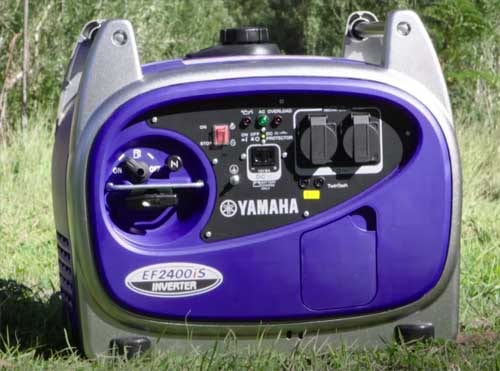
Honda EU2200i
- Output: 1,800 W running
- RV outlet: None: needs an adapter
- Our noise reading: 48 to 53 dBA
- Weight: about 47 lb (Honda)
Bottom Line : The quietest and lightest gas generator we ranked. Up high it needs a soft starter, or a second unit in parallel, for a 15,000 BTU AC.
Pros
- 48 to 53 dBA at 23 ft
- About 47 lb: the easiest solo carry
- Pairs with a second unit for 3,000 W and more
- App monitoring and CO-MINDER
Cons
- Will not start a 15,000 BTU AC up high on its own
- No RV outlet; gas only
- Premium price for its output
Who it's best for
Solo campers, and anyone who cannot lift a 100 lb generator into a truck bed, with a soft starter on the AC or a second unit to pair. Sean did the carrying.
Why we love it
The sound profile is practically non-existent. You can stand right beside it and talk at normal conversational volume.
Ryan Williams, Lead Tester
It read 48 to 53 dBA at 23 ft, the quietest gas engine we ranked. At about 47 lb it is also the lightest; Sean called it the gold standard for single-person portability.
Ryan's tip for bigger rigs: run two in parallel and you get over 3,000 W without ever lifting a 110 lb machine into the truck bed.
What we didn't like
Up at 6,225 ft it makes roughly 1,450 running watts, and it will not start a 15,000 BTU air conditioner on its own unless the AC has a soft starter fitted.
It has household outlets only, so a 30 amp RV cord needs an adapter, and it runs on gas only. The 0.95 gallon tank gave 4 to 9.5 hours depending on load.
Owners report it is premium-priced for the watts you get, and that it starts first pull and runs for 1,000 hours and more with basic maintenance.
Should you buy it?
Yes, if you camp alone or travel light and your AC has a soft starter, or you will add a second unit with a parallel kit. If you need to start a 15,000 BTU AC with one generator, the GENMAX or Westinghouse iGen4500DF will; for more power from one Honda, the EU3200i.
Read our full Honda EU2200i review →
 Best for 50 Amp RVs
EcoFlow DELTA Pro 3
- Output: 4,000 W from 4,096 Wh
- RV outlets: 14-50 and L14-30
- Our noise reading: 42 dBA at 23 ft
- Weight: about 114 lb
Bottom Line : The only unit we ranked that ran a 50 amp fifth wheel at altitude with no engine noise at all. Plan on two people to load it.
Pros
- Started a 15,000 BTU AC with no soft starter
- No power lost to altitude
- 42 dBA at 23 ft at full draw
- 50 amp and 30 amp outlets on the front
Cons
- About 114 lb: a two-person lift
- Hours on one AC, not days
- A 30 amp RV cord needs an adapter
Who it's best for
Fifth wheel and big travel trailer owners who camp where quiet hours are enforced, or high up where gas engines lose power. Sean and Ryan ran it on the 50 amp Grand Design Reflection.
Why we love it
A gas engine at 6,225 ft makes about a fifth less power than its sticker. A battery makes the same at the lake as at the coast, and that is why the DELTA Pro 3 was the strongest unit we ranked at Tahoe.
At 6,200 feet, every gas engine on this lake is choking for air and losing a fifth of its horsepower. The Delta Pro 3 doesn't care about elevation.
Sean Williams, Editor-in-Chief
Sean plugged the Reflection's 50 amp cord straight into its 14-50 socket and switched on both 15,000 BTU air conditioners, then Ryan ran the microwave. Nothing dropped out. It also started a single 15,000 BTU air conditioner with no soft starter while a 1,100 W microwave ran.
At full draw the only noise was the cooling fan: 42 dBA at 23 ft. EcoFlow claims as low as 30 dB, which matches light loads, where it was silent.
What we didn't like
It is heavy. At about 114 lb it rolls well over packed dirt on its wheels, but lifting it into Ryan's F-250 took two people.
A battery runs for hours, not days. It kept one 15,000 BTU air conditioner going for 4.2 hours flat out, and 7.5 hours overnight with the AC cycling. Beyond that you need sun, a shore post or a generator to refill it.
Should you buy it?
Yes, if you camp under quiet-hour rules or at altitude and can set it up with a second pair of hands. If you need power for a week off-grid with no sun, a dual fuel generator like the Champion 4500 goes further on a propane bottle. EcoFlow lists an L14-30 rather than the TT-30 most 30 amp RV cords use, so budget for an adapter.
Read our full EcoFlow DELTA Pro 3 review →
 Best for Fume-Free Boondocking and Quiet Hours
Jackery Explorer 2000 Plus
- Output: 3,000 W from 2,042 Wh
- RV outlet: TT-30R (30 amp)
- Our noise reading: under 45 dBA
- Weight: about 61.5 lb
Bottom Line : Starts a 15,000 BTU AC with no soft starter, plugs straight into a 30 amp cord and rolls like luggage. Two hours of AC, not a night.
Pros
- Started a 15,000 BTU AC with no soft starter
- No power lost to altitude
- TT-30R outlet: a 30 amp cord plugs straight in
- One person can move it
Cons
- 2.2 hours on one AC running flat out
- No 50 amp outlet
- Needs sun or a hookup to refill
Who it's best for
Travel trailer owners on 30 amp who want generator-free quiet and can recharge from solar or a hookup. Ryan ran it at Tahoe.
Why we love it
No fumes, no pull cord, and no power lost to altitude: that was the testers' summary of running a battery at 6,225 ft.
It started the 15,000 BTU air conditioner with no soft starter and ran a coffee maker alongside it with no sag in the voltage. A battery makes the same power at 6,225 ft as at sea level, so altitude cost it nothing.
The fans stayed under 45 dBA even at heavy load, and the TT-30R outlet takes a 30 amp RV cord with no adapter. At about 61.5 lb on wheels, one person can move it.
What we didn't like
It is a battery, so the clock runs fast with the AC on: 2.2 hours with the compressor running flat out, or 6 hours and more with it cycling in eco mode. Jackery sells extra battery packs if you need longer.
There is no 50 amp outlet, so a fifth wheel with two air conditioners needs the DELTA Pro 3.
Should you buy it?
Yes, if you have a 30 amp trailer, run the AC in short bursts, and can top it up from solar or a hookup. For a full night of AC, the Champion 4500 on a propane bottle goes much further; for 50 amp, buy the DELTA Pro 3.
Read our full Jackery Explorer 2000 Plus review →
Westinghouse iGen4500DF Dual Fuel
- Output: 3,700 W running, as tested
- Our runtime: 18 hr on 20 lb propane
- Our noise reading: 58 dBA with the AC on
- Weight: about 105 lb
Bottom Line : The quietest dual fuel generator we ranked, and an 18 hour night on a propane bottle. Start it from the trailer with the fob.
Pros
- 58 dBA at 23 ft with the AC running
- 18 hours on a 20 lb propane bottle
- Remote fob worked from 65 ft away
- Display shows fuel, runtime left and voltage
Cons
- AC plus the water heater tripped it on propane
- About 105 lb: a borderline solo lift
- Owners report a messy oil change
Who it's best for
Travel trailer owners on 30 amp who want dual fuel without the noise. It was Ryan's workhorse on the Winnebago.
Why we love it
This was our primary workhorse for the 30-amp Winnebago. Still plenty to fire up the 15k A/C and keep the residential fridge running.
Ryan Williams, Lead Tester
On propane it ran 18 hours on a 20 lb bottle with the air conditioner cycling overnight, and on gas its 3.4 gallon tank lasted 15.5 hours at light load.
It was the quietest dual fuel unit we ranked: 54 dBA at idle and 58 dBA at 23 ft with the AC running, with a deep, low exhaust note. The wireless fob started it from inside the trailer 65 ft away, and the display cycles through fuel left, runtime left and voltage.
What we didn't like
On propane at altitude, starting the AC while the electric water heater element was on tripped the breaker. Switching the water heater off fixed it.
At about 105 lb it rolls easily on its telescoping handle and wheels, but getting it into a truck bed alone is borderline. Owners report the oil drain needs a flexible funnel to avoid spills.
Should you buy it?
Yes, if you want dual fuel, a full night on propane and a generator the next site will barely hear. If you need two big loads at once on propane up high, the GENMAX has more headroom. We tested the iGen4500DF; the button goes to its current version, the Westinghouse 5000 Peak Dual Fuel, which has the same 3.4 gallon tank, remote fob, TT-30R outlet and display, rated at 3,900 running watts.
Read our full Westinghouse iGen4500DF Dual Fuel review →
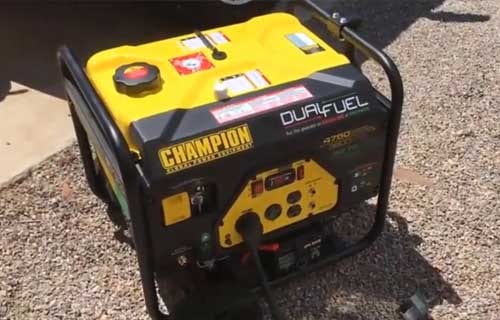
Champion 4500-Watt Dual Fuel Inverter
- Output: 3,500 W gas, 3,150 W propane
- Our runtime: 19 hr on 20 lb propane
- Our noise reading: 61 dBA with the AC on
- Weight: about 97 lb
Bottom Line : The longest night on a propane bottle of anything we ranked, and the easiest cold-morning start. Mind your loads on propane up high.
Pros
- 19 hours on a 20 lb propane tank
- Started a 15,000 BTU AC on gas, no soft starter
- EZ Start dial works with cold hands
- CO auto shutoff
Cons
- Toaster plus AC overloaded it on propane at altitude
- Higher-pitched than the Honda
- About 97 lb
Who it's best for
Travel trailer owners who boondock and would rather plug into a propane bottle than haul gas. Ryan did most of its running.
Why we love it
On a 20 lb propane tank it ran 19 hours, the longest of any generator we ranked and close to Champion's claimed 21. On gas it managed 13 hours from its 2.3 gallon tank at a quarter load.
Champion's EZ Start dial is great when your hands are freezing in the morning.
Ryan Williams, Lead Tester
On gas it started the 15,000 BTU air conditioner with no soft starter. It has a TT-30R outlet, so a 30 amp RV cord plugs straight in, and CO auto shutoff.
What we didn't like
Propane costs power, and altitude takes more. On propane at Tahoe the AC started, but adding a 1,200 W toaster pushed it over the edge. Up high on propane, run one big load at a time.
At 61 dBA under AC load it is one of the louder units we ranked, with a higher pitch than the Honda. It still sits well inside campground limits.
Should you buy it?
Yes, if you boondock for several nights and want propane as your main fuel. If silence matters more than runtime, the Honda EU3200i is quieter and much lighter. The unit we tested also had a wireless remote start fob; the button goes to the electric start dual fuel version, which carries the same 3,500 W gas rating.
Read our full Champion 4500-Watt Dual Fuel Inverter review →
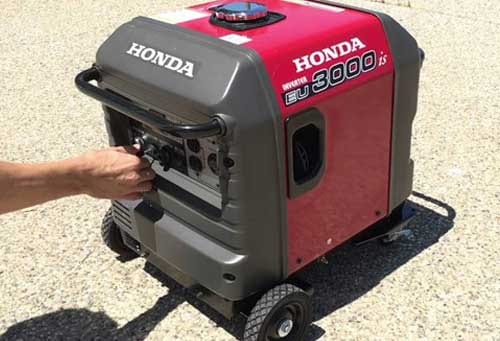
Honda EU3200i
- Output: 2,600 W running
- RV outlet: None: needs an adapter
- Our noise reading: 52 dBA under load
- Weight: 59.1 lb
Bottom Line : Quiet, fuel-injected and light enough to load alone. It needs a soft starter for a 15,000 BTU AC up high.
Pros
- 52 dBA at 23 ft under load
- Fuel injection adjusts itself for altitude
- At 59.1 lb, one person can load it
- App monitoring and CO shutoff
Cons
- Would not start a 15,000 BTU AC at 6,225 ft without a soft starter
- Cannot run the AC and a microwave together
- No RV outlet; gas only
Who it's best for
Campervan and pop-up owners, and anyone who loads the generator alone. Sean did the carrying at Tahoe.
Why we love it
Most carbureted generators run rich and bog down at altitude until you change the main jet. The EU3200i's fuel injection sorted itself out on the first pull at 6,225 ft.
This is where Electronic Fuel Injection (EFI) shines. Standard carburetors get rich and bog down at high elevation unless you swap the main jet.
Sean Williams, Editor-in-Chief
It was the second-quietest gas engine we ranked, after the EU2200i, at 52 dBA at 23 ft under load, with a low note that fades into campground noise. At 59.1 lb dry it is the second-lightest gas generator here, after the EU2200i, and Sean loaded it on his own.
What we didn't like
Up at the lake it would not start a 15,000 BTU air conditioner. Honda itself rates it for most 13,500 BTU units, so this was always a stretch at altitude. Once we wired a Micro-Air EasyStart soft starter to the compressor, it started every time. Even then, AC plus microwave was too much.
There is no RV outlet, only 20A sockets, so a 30 amp RV cord needs an adapter. It runs on gas only.
Should you buy it?
Yes, if your RV has a 13,500 BTU AC or a soft starter, or no AC at all, and you value quiet and a light lift over raw power. If you run a 15,000 BTU AC with no soft starter, or camp up high, the Champion 4500 has more headroom.
Read our full Honda EU3200i review →
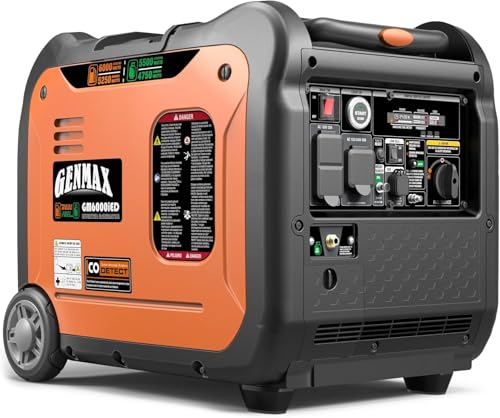
GENMAX 5500W Dual Fuel Inverter
- Output: 5,000 W running, as tested
- RV outlet: TT-30R (30 amp)
- Our noise reading: 62 dBA with the AC on
- Weight: about 105 lb as tested
Bottom Line : The most power of any gas generator we ranked: the AC and a microwave together at 6,225 ft. The trade is noise and weight.
Pros
- Ran the 15,000 BTU AC and a microwave together
- Most headroom at altitude of any gas unit
- TT-30R outlet, data center display, CO cut-off
- Dual fuel
Cons
- 62 dBA under AC load: the loudest we ranked
- Two people to load it
- Owners report a stiff pull cord if the battery runs down
Who it's best for
RV owners who want to run the AC and the kitchen at the same time on 30 amp. Sean and Ryan both ran it.
Why we love it
At 6,225 ft, Sean reckoned it still had about 3,900 running watts on gas. That was enough to run the 15,000 BTU air conditioner and a high-draw microwave together without sweating, the only gas generator we ranked that did.
You can feel the extra punch over 4,500W units. When the A/C kicked on, the motor barely revved up.
Ryan Williams, Lead Tester
Its 3.6 gallon tank ran 13 hours at light load, it connects to an RV propane supply, and the TT-30R outlet, digital data center and CO cut-off are all on the panel.
What we didn't like
It is the loudest generator we ranked under load: 62 dBA at 23 ft with the AC running. It stays quiet at idle and revs up at full draw.
At about 105 lb it rolls well, but it is a two-person lift into a truck bed. Owners report the pull cord gets stiff if the electric start battery is not kept charged over winter.
Should you buy it?
Yes, if you want the AC and the microwave on together at altitude without a battery bank. If quiet matters more, the Westinghouse iGen4500DF is 4 dBA quieter under the same load. We tested the GM5500i; the button goes to GENMAX's current 6000W dual fuel model, which has the same 3.6 gallon tank, data center and CO cut-off, rated at 5,250 running watts and listed at 117.9 lb.
Read our full GENMAX 5500W Dual Fuel Inverter review →
Pulsar 4500W Dual Fuel Inverter
- Output: 3,700 W running, as tested
- Our runtime: 14 hr on 3.2 gal at 25% load
- Our noise reading: 59 dBA with the AC on
- Weight: about 108 lb
Bottom Line : A solid mid-range dual fuel generator: it started the 15,000 BTU AC on gas with no soft starter and rolls like a suitcase.
Pros
- Started a 15,000 BTU AC on gas, no soft starter
- 14 hours on gas at a quarter load
- Remote start fob and TT-30R outlet
- Suitcase-style handle
Cons
- Two people to load it
- Owners report budget-feeling plastic wheels
- Not as quiet as the Westinghouse
Who it's best for
Travel trailer owners who want dual fuel and a remote start without stepping up to the priciest units. Sean ran it at Camp Richardson.
Why we love it
At 6,225 ft it started the 15,000 BTU air conditioner on gas with no soft starter and kept small battery chargers going alongside it. Sean put its running power at about 2,900 W up at the lake.
Its 3.2 gallon tank ran 14 hours at a quarter load, and the dual fuel selector switched cleanly. Under AC load it read 59 dBA at 23 ft with a low-pitched hum.
The extendable handle rolled it cleanly over the pine-needle paths at Camp Richardson, and it has a wireless remote start fob, a TT-30R outlet and a digital meter.
What we didn't like
At about 108 lb it rolls on its own, but it took two people to load it into the truck bed.
Owners report the plastic wheels feel budget next to Champion's, though the engine and fob hold up over multi-week trips.
Should you buy it?
Yes, if you want dual fuel, a remote fob and a 30 amp outlet from a mid-range generator. For a quieter night, the Westinghouse iGen4500DF; for the longest night on propane, the Champion 4500. We tested the P4500i; the button goes to Pulsar's current PG5000BiSRCO, a dual fuel, 30 amp, remote start model rated at 4,000 running watts on gas.
Read our full Pulsar 4500W Dual Fuel Inverter review →
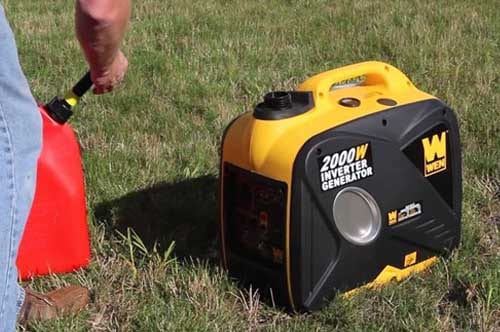
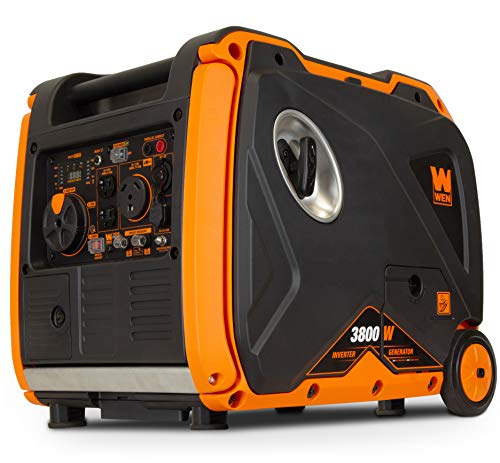
WEN 56380i Super Quiet 3800-Watt
- Output: 3,400 W running
- RV outlet: TT-30R (30 amp)
- Our noise reading: 57 dBA with the AC on
- Weight: about 99 lb
Bottom Line : Starts a 15,000 BTU AC and stores well between trips, thanks to a fuel shutoff that empties the carburetor. Gas only.
Pros
- Started a 15,000 BTU AC with no soft starter
- Fuel shutoff runs the carburetor dry for storage
- 57 dBA at 23 ft under AC load
- TT-30R outlet and electric start
Cons
- AC plus a 1,000 W microwave lit the overload light
- Gas only
- About 99 lb
Who it's best for
RV owners who camp a few weekends a year and store the generator in between. Ryan ran it at Tahoe.
Why we love it
It started the 15,000 BTU air conditioner on gas with no soft starter, and at 57 dBA at 23 ft it was quieter under that load than the Champion.
The mechanical fuel shut-off feature on the WEN is fantastic for RVers. Before we packed up camp, I turned off the fuel valve and let the engine run the carburetor dry.
Ryan Williams, Lead Tester
That matters more than it sounds. Stale fuel left in the float bowl is what gums up a generator that sits in the garage for months.
What we didn't like
Run the AC and then a 1,000 W microwave and the overload light comes on. Ryan had to manage his loads.
It is gas only, and the 8.5 hours we got came at half load, so a long night with the AC cycling means a refill.
Should you buy it?
Yes, if you camp a few times a year and want a 30 amp generator that starts your AC and stores without fuss. If you boondock for days, the Champion 4500 on propane goes much further.
Read our full WEN 56380i Super Quiet 3800-Watt review →
FIRMAN 3200W Dual Fuel Inverter
- Output: 3,200 W gas, 2,900 W propane
- Our runtime: 10.5 hr on 20 lb propane
- Our noise reading: 60.5 dBA with the AC on
- Weight: about 90 lb
Bottom Line : The budget way into dual fuel, with a propane hose and regulator in the box. It needs help starting a 15,000 BTU AC on propane up high.
Pros
- Propane hose with regulator included
- 10.5 hours on a 20 lb tank
- TT-30R outlet and electric start
- Lighter than most dual fuel units here
Cons
- Marginal starting a 15,000 BTU AC on propane at altitude
- Higher revs and pitch under load
- Benefits from a soft starter
Who it's best for
Entry-level travel trailer owners who want dual fuel without premium money. Sean ran it on propane.
Why we love it
Everything you need to run on propane is in the box: the hose has a built-in regulator, and it ran 10.5 hours on a 20 lb tank with the AC cycling.
It has a TT-30R outlet and an electric start button, and at about 90 lb it was the lightest gas generator we ranked after the two Hondas.
What we didn't like
It struggled to start the 15,000 BTU A/C on propane until we flipped the A/C fan to manual low and turned off all interior lights.
Sean Williams, Editor-in-Chief
It revs harder under heavy draw, and at 60.5 dBA at 23 ft it was one of the louder units we ranked. A soft starter on the AC would take most of the strain off.
Should you buy it?
Yes, if you want dual fuel on a budget and your AC has a soft starter, or you camp lower down. If you run a 15,000 BTU AC on propane at altitude, step up to the Champion 4500. We tested the version sold at warehouse clubs; the button goes to Firman's WH02942, its 3,200 W electric start dual fuel model with the same RV outlet.
Read our full FIRMAN 3200W Dual Fuel Inverter review →
How We Tested
An RV generator has one hard job: start the air conditioner, keep it running with the rest of the camper switched on, and do it quietly enough that the next site does not complain.
Sean and Ryan tested at D.L. Bliss State Park and Camp Richardson on Lake Tahoe in August 2026, at 6,225 ft. They used two rigs: a 2024 Grand Design Reflection 31MB fifth wheel (50 amp, two 15,000 BTU air conditioners) and a 2023 Winnebago Micro Minnie 2108FBS travel trailer (30 amp, one 15,000 BTU air conditioner). Ryan's Ford F-250 was the loading test: could one person get each unit into its bed?
Altitude was the point. A gas engine loses roughly 3.5% of its power for every 1,000 ft, which works out at about 21% at the lake. A battery loses nothing. We scored every unit on five things:
- RV Power (25%): did it start a 15,000 BTU AC with no soft starter, and could it add a microwave or kettle on top?
- Noise (20%): decibels at 23 ft, at idle and with the AC running
- Fuel & Runtime (20%): hours from one tank, and from a 20 lb propane bottle on dual fuel units
- RV Hookup & Features (15%): an RV outlet (TT-30R or 14-50), electric or remote start, CO shutoff and the display
- Portability & Setup (20%): could one person load it, and how quickly was it running?
Sean and Ryan scored each unit out of 10 on every quality. The overall score out of 100 weights those scores as above, so a generator cannot win on noise alone if it cannot start your AC. Wattages and weights come from each maker; the decibels, runtimes and pass or fail results are ours.
We then checked our week against what owners report on RV forums and Reddit, and say so wherever we use it. You can meet the testers at the bottom of this page.
Which Generator Suits Your RV?
| If you are… | Buy |
|---|---|
| Running a 30 amp travel trailer, AC and kitchen together | GENMAX 5500W Dual Fuel |
| Camping fume-free, or where quiet hours are strict | Jackery Explorer 2000 Plus |
| Camping alone, or unable to lift 100 lb | Honda EU2200i |
| Running a 50 amp fifth wheel or motorhome with two ACs | EcoFlow DELTA Pro 3 |
| A quiet dual fuel generator for a 30 amp trailer | Westinghouse iGen4500DF Dual Fuel |
| Dual fuel and a remote fob, mid-range | Pulsar 4500W Dual Fuel |
| Boondocking for days on propane | Champion 4500-Watt Dual Fuel |
| Wanting more than one small Honda can give, in a light package | Honda EU3200i |
| Camping a few weekends a year with a 30 amp trailer | WEN 56380i |
| After dual fuel on a budget | FIRMAN 3200W Dual Fuel |
Our Analysis & Test Results
Where each quality was tested, what separated the units, and what living with them was like. Each unit's score for that quality is in the table; its full set is in its product box above.
RV Power: Starting a 15,000 BTU AC at 6,225 ft
Where we tested it. Every unit went on a 15,000 BTU air conditioner with no soft starter, then took a second load on top: a microwave or a toaster. The DELTA Pro 3 also ran the Reflection's two air conditioners on 50 amp.
What separated them. Altitude sorted them. On gas, the Westinghouse, GENMAX, Pulsar, Champion and WEN, each rated 3,400 running watts or more at sea level, started the AC cleanly. The two Hondas could not: the EU3200i, rated 2,600, started it once we fitted a Micro-Air EasyStart soft starter, and the 1,800 W EU2200i needs a soft starter or a second unit in parallel. The FIRMAN on propane only managed it with the AC fan on low and the lights off.
Second loads were where most of them ran out. The WEN lit its overload light when the microwave joined the AC, the Champion tripped on propane when a toaster did, and the Westinghouse tripped on propane with the water heater element on. The GENMAX was the one gas generator that ran a high-draw microwave alongside the AC. The two batteries took a second load without a flicker: the DELTA Pro 3 a 1,100 W microwave, the Jackery a coffee maker.
What it felt like. On the two batteries you stopped thinking about loads. On the gas units, one person in the camper had to know what else was switched on.
| Generator | What we found |
|---|---|
| EcoFlow DELTA Pro 3 | AC plus microwave; both ACs on 50 amp |
| Honda EU2200i | needs a soft starter or a parallel pair |
| Jackery Explorer 2000 Plus | AC plus coffee maker |
| GENMAX 5500W Dual Fuel | AC plus microwave on gas |
| Westinghouse iGen4500DF | AC on gas; water heater tripped it on propane |
| Pulsar 4500W Dual Fuel | AC plus small chargers |
| Champion 4500-Watt Dual Fuel | AC on gas; toaster overloaded it on propane |
| Honda EU3200i | needed a soft starter for the AC |
| WEN 56380i | AC yes; AC plus microwave overloaded |
| FIRMAN 3200W Dual Fuel | marginal on propane |
Noise at 23 ft
Where we tested it. We read decibels at 23 ft, the distance most makers quote, at idle and with the air conditioner running. National parks set a limit of 60 dB(A) at 50 ft under 36 CFR 2.12, and sound falls off with distance, so every unit here should pass at 50 ft.
What separated them. The batteries won by a distance: 42 dBA for the DELTA Pro 3 and under 45 for the Jackery, and that was cooling fans at heavy draw. Among the gas engines, the Honda EU2200i was quietest at 48 to 53 dBA, then the Honda EU3200i at 52 dBA under load, then the WEN at 57.
Among the dual fuel units, the Westinghouse was quietest at 58 dBA with the AC running, then the Pulsar at 59, the FIRMAN at 60.5 and the Champion at 61, though the Champion idled at 53.5. The GENMAX, the most powerful, was loudest at 62 dBA under heavy AC load.
What it felt like. The Hondas' low note faded into the campground. The Westinghouse's deep exhaust note was nearly as easy to live with. The higher pitch of the Champion and FIRMAN, and the GENMAX revving at full draw, were not.
| Generator | What we found |
|---|---|
| EcoFlow DELTA Pro 3 | 42 dBA, fan only |
| Jackery Explorer 2000 Plus | under 45 dBA, fans only |
| Honda EU2200i | 48 to 53 dBA |
| Honda EU3200i | 52 dBA under load |
| WEN 56380i | 57 dBA with the AC |
| Westinghouse iGen4500DF | 54 idle, 58 with the AC |
| Pulsar 4500W Dual Fuel | 59 dBA with the AC |
| Champion 4500-Watt Dual Fuel | 53.5 idle, 61 with the AC |
| FIRMAN 3200W Dual Fuel | 60.5 dBA with the AC |
| GENMAX 5500W Dual Fuel | 62 dBA under heavy AC load |
Fuel & Runtime
Where we tested it. We ran each unit from a full gas tank or a full 20 lb propane bottle and logged the hours, mostly overnight with the air conditioner cycling.
What separated them. Propane won the long nights. The Champion ran 19 hours on a 20 lb bottle, the Westinghouse 18 with the AC cycling overnight, and the FIRMAN 10.5. On gas, the Westinghouse gave 15.5 hours from 3.4 gallons at light load, the Pulsar 14 from 3.2 gallons and the Champion and GENMAX 13 each, the Honda EU3200i 8.5 hours from just 1.2 gallons, and the EU2200i 4 to 9.5 hours from 0.95 gallons, depending on load.
The WEN also gave 8.5 hours, but at half load. The batteries are a different animal. The DELTA Pro 3 ran one AC flat out for 4.2 hours, or 7.5 hours overnight with it cycling; the Jackery, with half the capacity, managed 2.2 hours flat out and 6 hours and more cycling. Then both need recharging.
What it felt like. Nineteen hours on one bottle means the Champion outlasts a night and most of the next day. The WEN and the batteries need watching on a long, hot night.
| Generator | What we found |
|---|---|
| Champion 4500-Watt Dual Fuel | 19 hr on 20 lb propane |
| Honda EU2200i | 4 to 9.5 hr on 0.95 gal |
| Westinghouse iGen4500DF | 18 hr on 20 lb propane; 15.5 on gas |
| Pulsar 4500W Dual Fuel | 14 hr on 3.2 gal |
| GENMAX 5500W Dual Fuel | 13 hr on 3.6 gal |
| FIRMAN 3200W Dual Fuel | 10.5 hr on 20 lb propane |
| Honda EU3200i | 8.5 hr on 1.2 gal |
| WEN 56380i | 8.5 hr at half load |
| EcoFlow DELTA Pro 3 | 4.2 hr one AC flat out; 7.5 hr cycling |
| Jackery Explorer 2000 Plus | 2.2 hr flat out; 6+ hr cycling |
RV Hookup & Features
Where we tested it. We plugged each rig's own shore cord in, used every start method each unit has, and read every display.
What separated them. The DELTA Pro 3 is the only unit we ranked with a 50 amp outlet, and its app shows live wattage. The Jackery and every gas unit except the two Hondas have a TT-30R, so a 30 amp cord plugs straight in. The Westinghouse, Pulsar and the Champion we tested had remote fobs; the Westinghouse started from inside the trailer at 65 ft, and its display cycles through fuel left, runtime left and voltage.
The two Hondas have household outlets only, so a 30 amp cord needs an adapter. They make up some ground with app monitoring and CO shutoff.
What it felt like. On cold Tahoe mornings, Ryan rated the Champion's EZ Start dial the easiest start of the group.
| Generator | What we found |
|---|---|
| EcoFlow DELTA Pro 3 | 14-50 and L14-30, app control |
| Honda EU2200i | adapter needed; app and CO-MINDER |
| Jackery Explorer 2000 Plus | TT-30R, app control |
| Westinghouse iGen4500DF | TT-30R, remote fob at 65 ft, runtime display |
| Champion 4500-Watt Dual Fuel | TT-30R, remote start, CO shutoff |
| GENMAX 5500W Dual Fuel | TT-30R, data center, CO cut-off |
| Pulsar 4500W Dual Fuel | TT-30R, remote fob |
| WEN 56380i | TT-30R, electric start |
| FIRMAN 3200W Dual Fuel | TT-30R, electric start |
| Honda EU3200i | adapter needed for 30 amp |
Portability & Setup
Where we tested it. Everything went in and out of Ryan's F-250 bed and over the pine needles and packed dirt at Camp Richardson.
What separated them. The Honda EU2200i, at about 47 lb, was the easiest carry of all. The Honda EU3200i, at 59.1 lb, and the Jackery, at about 61.5 lb on wheels, were the next easiest. The FIRMAN, Champion and WEN, at about 90 to 99 lb, went into the truck bed with one person, but it was work; on the ground they roll easily on their wheels.
The Westinghouse, GENMAX and Pulsar, at 105 to 108 lb, roll well on their handles and wheels but were two-person lifts (the Westinghouse borderline). The DELTA Pro 3 is the heaviest at about 114 lb, easy to roll and a two-person lift.
What it felt like. Loading either Honda was a one-person job without a second thought. The DELTA Pro 3 always needed both testers.
| Generator | What we found |
|---|---|
| Honda EU2200i | about 47 lb, easiest carry |
| Honda EU3200i | 59.1 lb, the easy lift |
| Jackery Explorer 2000 Plus | about 61.5 lb, wheels and handle |
| Champion 4500-Watt Dual Fuel | about 97 lb, one-person lift |
| WEN 56380i | about 99 lb, one-person lift |
| FIRMAN 3200W Dual Fuel | about 90 lb, one-person lift |
| Westinghouse iGen4500DF | about 105 lb, borderline solo |
| GENMAX 5500W Dual Fuel | about 105 lb, two people |
| Pulsar 4500W Dual Fuel | about 108 lb, two people |
| EcoFlow DELTA Pro 3 | about 114 lb, two people |
RV Generator FAQ
What size generator do I need for a 15,000 BTU RV air conditioner?
Around 3,400 running watts or more if your AC has no soft starter, more at altitude. At 6,225 ft every gas unit we ranked rated 3,400 W or above started a 15,000 BTU AC on gas, and only the GENMAX added a microwave on top; the 2,600 W Honda EU3200i needed a soft starter first, and the 1,800 W EU2200i needs one or a second unit in parallel. Our what size generator for a camper guide works through the sums, and the camp power calculator adds up your appliances.
Does altitude affect an RV generator?
Yes. A gas engine loses roughly 3.5% of its power per 1,000 ft, about 21% at Lake Tahoe. Carbureted engines can also run rich and surge until they are adjusted; the Honda's fuel injection adjusted itself. A battery power station like the DELTA Pro 3 or the Jackery loses nothing.
Is propane or gasoline better for an RV generator?
Propane runs longer and stores better, but it makes less power. The Champion ran 19 hours on a 20 lb propane bottle against 13 on its gas tank, yet on propane at altitude it could not take a toaster on top of the AC. If you camp high on propane, fit a soft starter and run one big load at a time.
Should I use the generator built into my motorhome instead?
It is convenient but loud. The Cummins Onan QG 4000 in our Class C control rig started the AC and ran the converter, and it draws from the motorhome's own fuel tank, shutting off at a quarter tank. It measured 68.5 dBA at 23 ft outside, louder than anything we ranked, and the vibration came through the bed and floor. At Tahoe it also needed its altitude dial set to 6,000 ft to stop it surging.
Our Final Verdict: Best Generators for RVs 2026
For a 30 amp travel trailer, buy the GENMAX 5500W Dual Fuel: it ran the AC and a microwave together at altitude. For fume-free boondocking and quiet hours, the Jackery Explorer 2000 Plus. If you camp alone, our top scorer, the 47 lb Honda EU2200i, with a soft starter on the AC or a second unit in parallel. For a proven dual fuel workhorse with a remote fob, the Westinghouse iGen4500DF or Champion 4500. For a 50 amp rig with two air conditioners, the EcoFlow DELTA Pro 3.
Our Testers
This guide was edited by Sean Williams and tested at Lake Tahoe by Sean and our lead tester, Ryan Williams.
- Sean Williams, Editor-in-Chief and Tester. Sean built the team of researchers and testers behind our reviews and edits every guide. At Tahoe he ran the 50 amp fifth wheel. His rule: we say what we actually found.
- Ryan Williams, Lead Tester. Ryan leads our field tests and runs our generator and solar testing. At Tahoe his Ford F-250 was our loading test.