![10 Best Quiet Generator [UPDATED 2026] Definitive Review](/images/2020/10/sportsman-generator-1024x1024.jpg)


 Longest Runtime Quiet Generator
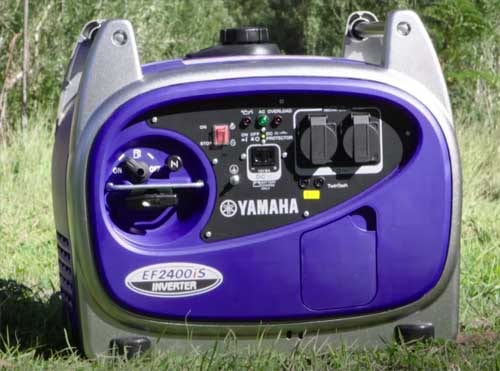
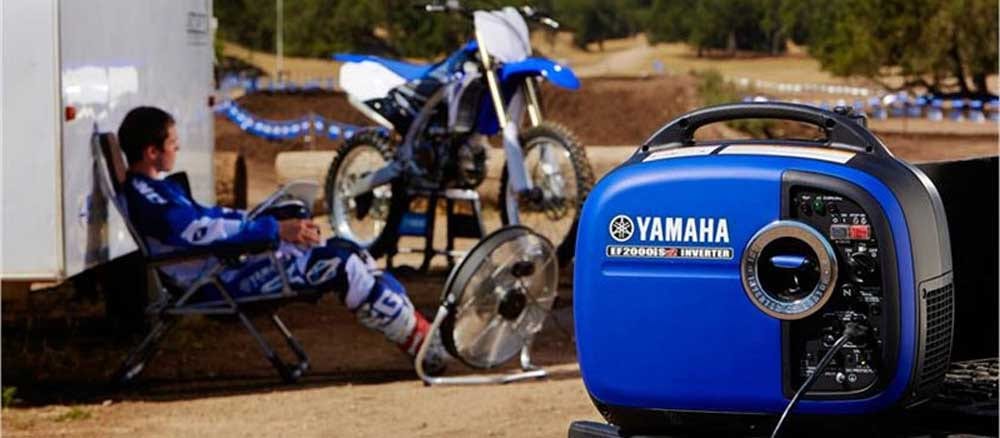
Yamaha EF2200iS
- Running watts: 1800 W
- Peak watts: 2200 W
- Noise: 57 to 65 dBA at 23 ft
- Runtime: up to 10.5 hr at 25 percent load
- Fuel tank: 1.24 gal gasoline
- Engine: 79cc Yamaha
- Weight: about 55 lb
- Warranty: 3 year residential
Bottom Line : The Honda rival that runs longer per tank, with a slightly higher noise floor under load.
Pros
- Longest runtime in class
- Yamaha commercial engine
- Fuel gauge and Smart Throttle
- Costs less than the Honda
Cons
- Heaviest 2200W unit here
- Gas only
- Louder than Honda at full load
A 79cc Yamaha engine with Smart Throttle and a large 1.24 gallon tank gives it the longest runtime in the 2200W class. Yamaha commercial engine heritage earns the same 10 as Honda from testers. At about 55 lb it is one of the heavier 2200W units, partly from a heavier build.
Rated 1800 running watts and 2200 starting watts. The Honda rival that runs longer per tank, with a slightly higher noise floor under load. It scores 89 out of 100.
Owners report long, trouble free service and a fuel gauge that budget units skip. It is one of the heavier 2200W units, so lifting it takes some effort.
Read our full Yamaha EF2200iS review →
 Best Quiet Generator For Camping
Honda EU2200i
- Running watts: 1800 W
- Peak watts: 2200 W
- Noise: 48 to 57 dBA at 23 ft
- Runtime: 3.2 to 8.1 hr per tank
- Fuel tank: 0.95 gal gasoline
- Engine: 121cc Honda GXR120
- Weight: about 47 lb
- Warranty: 3 year residential
Bottom Line : The quietest and most trusted 2000W class inverter you can buy, if you accept the price.
Pros
- Quietest at low load
- Commercial Honda engine
- Strong resale and warranty
- Clean sub 1 percent THD power
Cons
- Highest price by far
- Gas only, no propane
- 1800W continuous is modest
A 121cc Honda GXR120 engine paired with true inverter output makes this the campsite and RV benchmark other 2200W units are measured against. Honda GXR120 commercial grade engine is the main reason for the 10 score. Owners on RV and camping forums report units running past a decade with basic oil changes.
Street price usually sits well above every other unit on this list, often two to three times the WEN or Westinghouse. The quietest and most trusted 2000W class inverter you can buy, if you accept the price. It scores 88 out of 100.
Owners report units running past a decade with basic oil changes, and Eco Throttle keeps it conversation quiet at light load. The 1800W ceiling is modest, so an RV air conditioner is marginal without a soft start.
Read our full Honda EU2200i review →
 Best Quiet Dual Fuel Generator
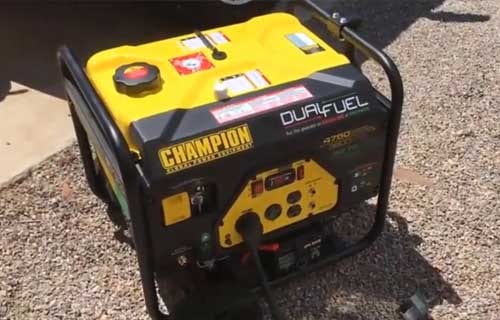
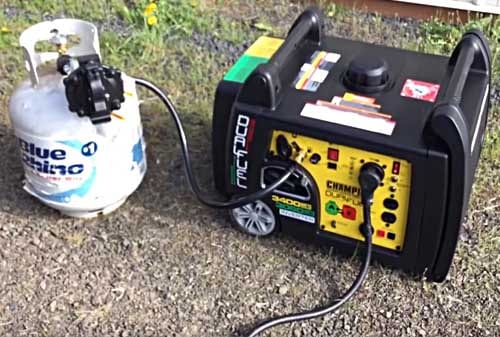
Champion 4000-Watt Dual Fuel RV Generator
Bottom Line : A lot of power and dual fuel flexibility for the money, but not truly quiet under load.
Pros
- Strong 3000 running watts
- Runs on gas or propane
- Excellent power per dollar
- 3 year warranty
Cons
- Louder than the class leaders
- Propane starts can be fussy
- Heavier open frame build
A 149cc dual fuel engine that runs on gas or propane and pushes 3000 running watts, enough for a real RV air conditioner. Costs a fraction of the Honda while delivering far more running power. Ships with a 3 year warranty, generous for the price bracket.
Champion rates it 64 dBA at 23 feet, which is normal conversation level not whisper quiet. A lot of power and dual fuel flexibility for the money, but not truly quiet under load. It scores 84 out of 100.
Owners report it has the running watts for a rooftop RV air conditioner. It gets noticeably louder when loaded near capacity, and some find propane starts fussy.
Read our full Champion 4000-Watt Dual Fuel RV Generator review →
Westinghouse iGen2550 Super Quiet Inverter
- Running watts: 1900 W gas
- Peak watts: 2550 W
- Noise: as low as 52 dBA
- Runtime: up to 12 hr per gas tank
- Fuel tank: 1.14 gal gas or LP
- Weight: about 43 lb
- Outlet: 30A RV ready
- Safety: CO sensor
Bottom Line : A quiet, light dual fuel inverter that undercuts Honda while adding propane and a CO sensor.
Pros
- Quiet and light at 43 lb
- Dual fuel with CO sensor
- 30A RV ready outlet
- Strong value price
Cons
- 1900W continuous is modest
- Engine lacks premium pedigree
- Shorter proven track record
A 43 lb suitcase inverter that runs on gas or propane, with a 30A RV outlet and a long tank runtime. Priced far below the Honda and Yamaha for similar low load noise. Adds propane capability and a CO sensor the premium units skip at this size.
Westinghouse engine is decent but does not have the commercial pedigree of Honda or Yamaha, hence a 7. A quiet, light dual fuel inverter that undercuts Honda while adding propane and a CO sensor. It scores 80 out of 100.
Owners report reliable starts and quiet, neighborhood friendly running at light load. Some gripe about plastic controls, and the 1900W output is modest.
Read our full Westinghouse iGen2550 Super Quiet Inverter review →
Westinghouse 5000 Peak Watt Super Quiet Portable
- Running watts: 3900 W
- Peak watts: 5000 W
- Noise: as low as 52 dBA at idle
- Runtime: up to 18 hr at 25 percent load
- Fuel tank: 3.4 gal gasoline
- Engine: 224cc Westinghouse OHV
- Weight: about 105 lb
- Start: remote electric
Bottom Line : The highest output here with remote electric start, but a big heavy unit that is only quiet at idle.
Pros
- Highest 3900 running watts
- Remote electric start
- Very long runtime
- Wheels and handle included
Cons
- Heaviest unit at about 105 lb
- Only quiet at idle
- Gas only
A 224cc inverter with wheels, remote start and 3900 running watts, built for home backup and large RVs. Rated 3900 running watts and 5000 starting watts, the highest here, earning the 10. 3900W runs a large RV air conditioner plus a fridge and lights together.
Westinghouse rates it as low as 52 dBA, but that is an idle low load figure. The highest output here with remote electric start, but a big heavy unit that is only quiet at idle. It scores 82 out of 100.
Owners report reliable starting from the remote key fob and long runtime for outages. At around 105 lb it is a heavy unit, and it is only really quiet at idle.
Read our full Westinghouse 5000 Peak Watt Super Quiet Portable review →
WEN 3600-Watt Dual Fuel RV-Ready Inverter
Bottom Line : WEN’s smallest current dual fuel inverter, with an RV outlet and a CO shutdown sensor. WEN gives no decibel figure, so it has to earn its place on a quiet list.
Pros
- 2900 running watts on gas
- Runs on gas or propane
- TT-30R RV outlet
- Watchdog CO shutdown
Cons
- No published dBA figure
- Bigger than the unit it replaces
- About 58 dBA in our test
This slot has changed hands twice. The Champion 2500 Dual Fuel won it, the WEN 2800 Dual Fuel replaced it in September, and the 2800 is no longer available either. The WEN 3600-Watt Dual Fuel is the smallest dual fuel inverter we could find from WEN today, so it takes the award with a caveat: it is a size up.
On a quiet-generator list, that caveat matters. WEN describes it as about as loud as a normal conversation but publishes no decibel number, so we can’t set it beside the Honda’s rated 48 to 57 dBA. Our testers read about 58 dBA on it, and the 78 carries over from the slot because we have not re-scored it. If a smaller dual fuel unit with a published noise rating matters more than the extra watts, the Westinghouse iGen2550 at number four is the one to look at.
Read our full WEN 3600-Watt Dual Fuel RV-Ready Inverter review →
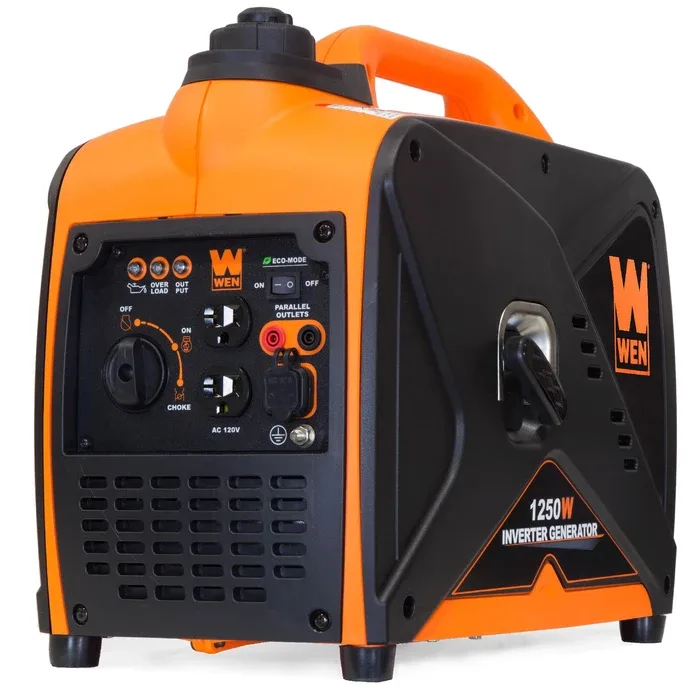
WEN 56125i Super Quiet 1250-Watt Inverter
- Running watts: 1000 W
- Peak watts: 1250 W
- Noise: 51 dBA at 22 ft
- Runtime: about 5 hr at 50 percent load
- Fuel tank: 0.69 gal gasoline
- THD: under 1.2 percent
- Weight: about 31.6 lb
- Warranty: 2 year
Bottom Line : A tiny 31 lb inverter that is cheap and quiet, but only for small loads.
Pros
- Lightest at 31.6 lb
- Very quiet for the class
- Clean sub 1.2 percent THD power
- Low price
Cons
- Only 1000W running
- Small 0.69 gal tank
- Not for fridges or AC
A sub 32 lb inverter with clean power for phones, lights and small tools, at one of the lowest prices here. One of the cheapest inverters on this list, strong value for light duty. Clean under 1.2 percent THD power despite the low price.
Rated 1000 running watts and 1250 starting watts, the smallest here, earning the 5. A tiny 31 lb inverter that is cheap and quiet, but only for small loads. It scores 76 out of 100.
Owners report easy starts and very quiet running for a small load. It tops out at 1000 running watts, so it will not handle fridges or an air conditioner.
Read our full WEN 56125i Super Quiet 1250-Watt Inverter review →

WEN 4800-Watt Dual Fuel RV-Ready Inverter
- Running watts: 4000 W gas, 3600 W propane
- Peak watts: 4800 W gas, 4320 W propane
- Noise: 62 dBA
- Runtime: about 7 hr gas, 12 hr propane at 50 percent load
- Fuel tank: 1.9 gal gas or 20 lb LP
- Weight: about 78.5 lb
- Outlet: TT-30R RV ready
- Start: electric
Bottom Line : A high output dual fuel RV unit with electric start, quiet at idle but average under load.
Pros
- 4000 running watts on gas
- RV ready TT-30R outlet
- Electric start and CO Watchdog
- Dual fuel flexibility
Cons
- Average 62 dBA under load
- Short 7 hr runtime for its size
- Newer model, less proven
A dual fuel inverter with a TT-30R RV outlet, electric start and 4000 running watts on gas. On gasoline it delivers 4000 running watts and 4800 starting watts, earning the 9. On propane it drops to 3600 running and 4320 starting watts.
WEN rates it 62 dBA, average for a 4800W dual fuel unit. A high output dual fuel RV unit with electric start, quiet at idle but average under load. It scores 79 out of 100.
Owners report reliable starts and enough gas power for a rooftop RV air conditioner. Runtime is on the short side for its size, and it gets louder under real load.
Read our full WEN 4800-Watt Dual Fuel RV-Ready Inverter review →
Pulsar PGD40ISCO Ultra Light Quiet 4000W
- Running watts: 3200 W
- Peak watts: 4000 W
- Noise: 59 dBA
- Runtime: about 4.5 hr at 50 percent load
- Fuel tank: 1 gal gasoline
- Weight: about 46 lb
- THD: under 3 percent
- Safety: CO Sentry shutoff
Bottom Line : A light 46 lb 4000W inverter with good power, held back by short runtime.
Pros
- Light 46 lb for 4000W
- 3200 running watts
- CO Sentry safety
- Clean under 3 percent THD
Cons
- Short 4.5 hr runtime at half load
- Recoil start only
- Gas only
A gas inverter that packs 3200 running watts into a 46 lb frame with CO Sentry safety. Mid price for a 4000W class inverter, competitive on watts per dollar. Light 46 lb build makes it easier to move than heavier rivals.
Pulsar rates it 59 dBA, average for a 4000W inverter. A light 46 lb 4000W inverter with good power, held back by short runtime. It scores 74 out of 100.
Owners report it is light for the power and starts reliably. The small tank means frequent refills on longer stays.
Read our full Pulsar PGD40ISCO Ultra Light Quiet 4000W review →
PowerSmart 3800-Watt Dual Fuel Inverter
Bottom Line : PowerSmart's current budget inverter adds propane, a CO sensor and a 30 amp twist-lock outlet to what the 3600 offered.
Pros
- 3300 running watts on gas
- Gas or propane
- 30A twist-lock RV outlet
- CO sensor and low oil shutdown
Cons
- Likely loud at full load, like the 3600
- Two year warranty, shorter than rivals
- About 59 dBA in our test
The PowerSmart 3600 that held this spot is now listed as the PowerSmart 4000 Watt, with 4,000 peak and 3,200 rated watts. PowerSmart's newer model in the same budget class is the 3800 Watt Dual Fuel, which keeps the slot because our testers have run it, and on paper it's a straight upgrade: 3300 running watts on gas against the 3600's 3200, plus propane, a CO sensor and a 30 amp twist-lock outlet.
PowerSmart quotes 59 dBA at quarter load in Eco mode, the same idle figure the 3600 carried. Expect it to get loud near full load, as the older model did. Our testers have now run the 3800 and read about 59 dBA at a quarter load, the same as PowerSmart quotes. The 72 is the old model's score and we have not re-scored it. Our PowerSmart 3600 review covers what it replaces.
Read our full PowerSmart 3800-Watt Dual Fuel Inverter review →
Buyers Guide:
How To Choose The Best Quiet Generator
What are the different types of quiet generators?
Generators provide a means to get the topside of frequent power outages or to keep your gadgets juiced up at the campsite.
But they sometimes aren’t the quietest of machines.
Point to be noted: there are no set standards to measure the acceptable noise level of generators.
Now, quiet generators can come in various types. So let’s look at some common ones.
- Portable generators come with an internal combustion engine that’s mostly powered by gas or diesel. Naturally, the best part is you can carry them around anywhere, on and off your property. At the same time, they’re mostly plug-and-play without any need for installation.
- Inverter generators convert AC power to DC and then back to AC. Basically, this is done through the combination of alternator and rectifier. More importantly, the output power has fewer harmonic distortions, making them great for sensitive electronics. The portable inverter generators are not only more efficient but also quieter.
- Standby generators are larger units that automatically take over when the grid power supply fails. They are large capacity generators with special muffler designs. Mostly, they are used in apartments, hospitals, and various commercial establishments. For even larger places, ruggedly designed industrial generators are used.
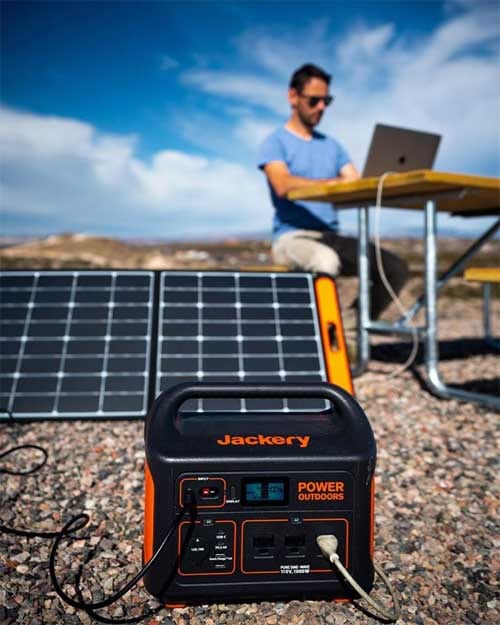
- Lastly, we come to solar generators that generate power through solar cells. The truth is, they’re the quietest generators of the lot as they come without any engine. The main component is a battery to store the power and the same is delivered through an inverter. However, they don’t give the same power levels as gas-powered generators.
Features to look out for
With a variety of options on the market, things can get confusing for a first-time buyer. That’s why we’ve provided options from a wide price range in our Top Ten List.
So let’s take a look at some important features.
- The first step is to understand how noise level is measured and what values define loudness. Normal breathing is just 10 dB and a soft whisper is around 30dB. Normal conversation is usually around the 60dB mark. Any noise beyond 70dB can be uncomfortable. In case it crosses the 80 dB mark, it can cause hearing damage. Generally, with a higher engine speed the noise level will rise.
- Keep a note of the decibel levels. Most sound levels are measured at a distance of 23 feet (7 meters). As a basic rule of physics, sound levels decrease by 6 dB, every time the distance from the source doubles. Does the decibel levels of a generator tell the entire story of its noise level? Not always. In many cases, the quoted numbers are at a fraction of the power capacity. So, make sure to check the noise levels at full power.
- Check out the features used to control the noise level. Most portable inverter generators have low noise levels. Some brands use special muffler designs to limit the noise. In many cases, the casing is lined with insulation, or anti vibration pads are used.
- The simple truth is, noise levels will depend on power output. Still, even at the same power output, the noise level of two different generator brands can vary. The reason? The engine quality and muffler design. A top-class Yamaha engine will definitely operate at a lower noise level. At the same time, the load placed on the generator will also determine the noise output.
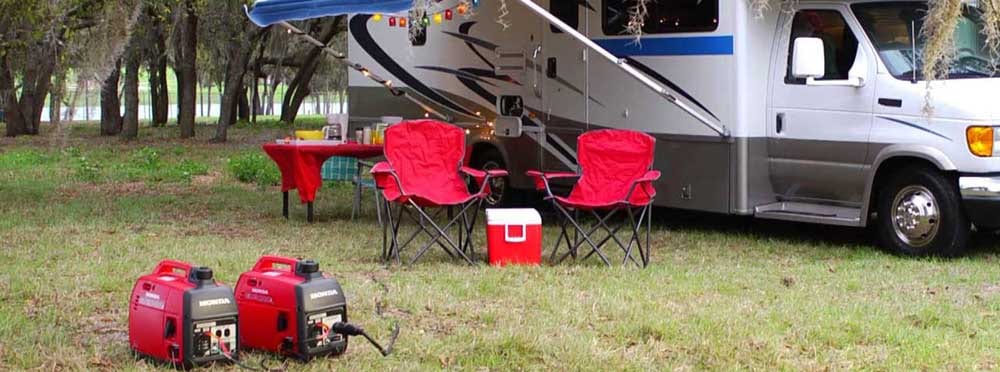
Product and specifications explained
Obviously, there are some details that many buyers may not be familiar with. To make the right choice you need to know the most important ones.
Let’s start with the unit of noise level measurement- the decibel. The higher the decibel (dB) value, the louder the noise level. The scale starts with 0 dB which indicates total silence. Basically, when the decibel level increases by 10, the sound is 10 times more intense.
Now, engine specifications are an important part of inverter generators and “OHV engine” is a term you’ll come across a lot. It stands for overhead valve engine and these valves are located at the top of the engine combustion chamber. This allows the fuel mixture to enter the chamber more smoothly and results in better combustion. Final outcome - better fuel efficiency and enhanced engine lifespan.
As I already mentioned, the noise levels will vary according to engine power output and load placed on it. In reality, most engines are specified by two power output figures - peak and continuous. The peak or surge power is the highest power a generator can deliver in short bursts. This is useful for running equipment needing high starting watts. The continuous power is the output a generator can supply for longer periods.
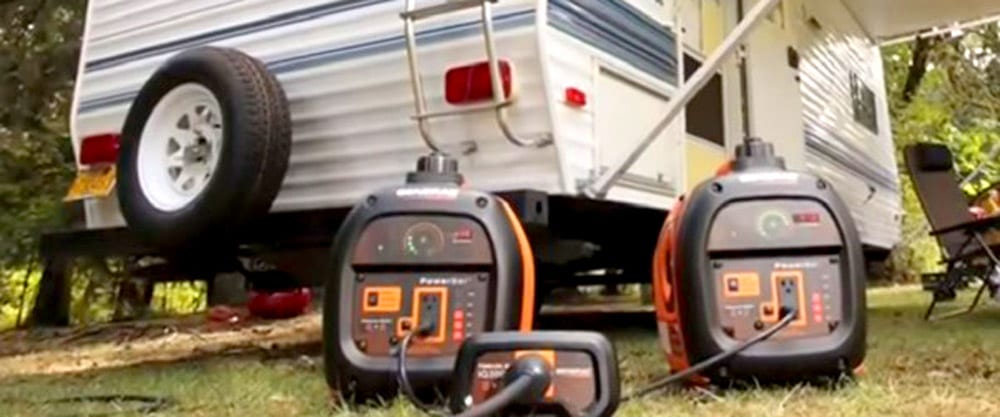
These are things to consider
Many first time buyers must be wondering…
What exactly are the points to consider before buying a portable inverter generator? Here, we list the most important ones.
- Basically, inverter generators are electro-mechanical. So, to get the best performance, periodic maintenance is a must. Follow the manufacturer’s instructions to keep yours in tip-top condition.
- Make sure to use the right type of fuel. Also, check the oil levels periodically and refill as needed. Choose portable generators that come with integrated oil gauges.
- Weight is an important consideration for portable generators. At the same time, it's directly proportional to power output. If you want to use a generator at home as well as for camping, consider picking a product with wheels.
- Safety is one aspect you simply can’t ignore while running generators. Even a quiet generator will need to be operated in an open environment to prevent any chance of carbon monoxide poisoning. Operating in wet environments is also a strict no-no - to prevent electrical hazards.
Jargon Buster
Honestly, jargon can make any buying process complicated. I’ve been there. So to make the process of buying a super quiet generator simple, here’s our TopNotch jargon buster for you.
Electrical overload breaker - This is a common term related to the safety of portable generators. Any electrical circuit design is based on a specific current flow. If more current flows through it, the wiring can overheat and create a safety risk. A circuit breaker is designed to trip when the current exceeds a certain level. As a result, the power supply is cut off and the circuit stays safe.
Fuel petcock - This is a fuel valve used to control the fuel flow to and from the carburetor. By regulating the valve you can prevent any fuel flow to the engine when the generator isn’t running. This’ll prevent any issues related to stale gas jamming up the carburetor.
Spark arrestor - Bear in mind that even the most fuel efficient engines release unburnt carbon particles through the exhaust. Warning: they’re a major cause of fire hazards. The spark arrestor is a small mechanical device to trap such particles before they come out of the exhaust. Even though their design may vary, the basic function of spark arrestors remains the same.
Pure sine wave output - You already know that an inverter converts DC power into AC. The AC voltage moves up and down like a standard sine wave curve moving smoothly. Due to low harmonic distortions, this output is great for sensitive electronics. But keep in mind, portable generators with a modified sine wave aren’t so good for delicate electronics.
Top Tips
Lastly, a few top tips to round off our TopNotch quiet generator buying guide.
- Even though the concept of noise is subjective, all outdoor lovers need to bear in mind the NPS guidelines. As per this, operating a motorized generator that crosses the 60dB limit is prohibited in a National Park environment.
- Try to choose a generator that has an acoustic enclosure. What’s that? It’s a special casing with a design that reduces the engine noise. It may be constructed of materials that reflect or absorb the noise.
- If you find a generator with Electronic Fuel Injection (EFI), go for it. You’ll be avoiding a carburetor. They also have a smooth start even at freezing temperatures. However, it’ll cost you a few more bucks.
- Selecting a quiet generator for camping isn’t enough. You need to make sure it follows the EPA guidelines regarding emission levels. For frequent travelers, inverter generators meeting the CARB regulations are the best choice.
Frequently Asked Questions (FAQs)
Q.What is the quietest generator on the market?
Having said that, this review is for users seeking the right balance between overall performance and noise. On top of that, we chose portable generators offering the lowest noise level. So the Honda EU2200i is our best quiet generator for camping, and the Yamaha EF2200iS is our longest runtime quiet generator.
Q.What is the quietest 3000 watt generator?
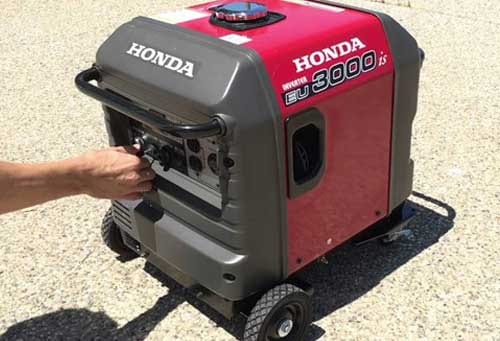
Our pick in the 3000 watt class is the Honda EU3000iS, our best 3,000 watt inverter with electric start. Read our Honda EU3000iS review. If you want dual fuel, the Champion 4000-Watt Dual Fuel here has the running watts, but it is not truly quiet under load.
Q.What dB level is considered quiet?
The concept of a quiet environment can vary between people. However, a quiet natural spot with no wind measures around 20dB. A whisper can be anywhere between 25dB to 30dB. The best quiet generators are designed to provide a noise level of around 50dB to 55dB at 50% load.
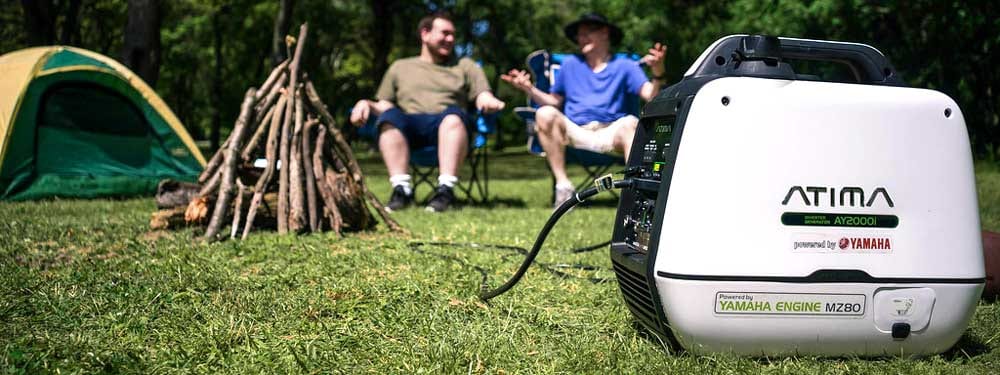
Round-Up
There you go…
… All the details you need for choosing a quiet generator are here at your fingertips.
My thanks go to the TopNotch office team for gathering up all the data for this in-depth review.
Whether it's an off-grid location or a sudden outage, your comfort, and even survival can depend on the availability of power. The good news is, technology has made even the use of gas-powered generators super quiet.
So, can you really afford not to choose one?
Moreover, we’ve done all the legwork to present the top three best choices in this category to you.
Now, you really don’t want to miss this next part…
Here’s the comparative analysis of the products under all the metrics.
Our Analysis, Comparisons & Test Results
We tested every quiet generator on this list against the same five things that decide which one earns its place.
Here is how the field compared on each.
Value for Money
The Champion 4000-Watt Dual Fuel RV Generator leads the field for value for money at 9 out of 10, and the Honda EU2200i trails at 7.
| Quiet Generator | Value for Money |
|---|---|
| Champion 4000-Watt Dual Fuel RV Generator | 9/10 |
| Westinghouse iGen2550 Super Quiet Inverter | 9/10 |
| WEN 56125i Super Quiet 1250-Watt Inverter | 9/10 |
| PowerSmart 3800-Watt Dual Fuel Inverter | 9/10 |
| Yamaha EF2200iS | 8/10 |
| Westinghouse 5000 Peak Watt Super Quiet Portable | 8/10 |
| WEN 3600-Watt Dual Fuel RV-Ready Inverter | 8/10 |
| WEN 4800-Watt Dual Fuel RV-Ready Inverter | 8/10 |
| Pulsar PGD40ISCO Ultra Light Quiet 4000W | 8/10 |
| Honda EU2200i | 7/10 |
Output Power
The Westinghouse 5000 Peak Watt Super Quiet Portable leads the field for output power at 10 out of 10, and the WEN 56125i Super Quiet 1250-Watt Inverter trails at 5.
| Quiet Generator | Output Power |
|---|---|
| Westinghouse 5000 Peak Watt Super Quiet Portable | 10/10 |
| Champion 4000-Watt Dual Fuel RV Generator | 9/10 |
| WEN 4800-Watt Dual Fuel RV-Ready Inverter | 9/10 |
| Honda EU2200i | 8/10 |
| Yamaha EF2200iS | 8/10 |
| Pulsar PGD40ISCO Ultra Light Quiet 4000W | 8/10 |
| PowerSmart 3800-Watt Dual Fuel Inverter | 8/10 |
| Westinghouse iGen2550 Super Quiet Inverter | 7/10 |
| WEN 3600-Watt Dual Fuel RV-Ready Inverter | 7/10 |
| WEN 56125i Super Quiet 1250-Watt Inverter | 5/10 |
Durability & Workmanship
The Honda EU2200i leads the field for durability & workmanship at 10 out of 10, and the PowerSmart 3800-Watt Dual Fuel Inverter trails at 6.
| Quiet Generator | Durability & Workmanship |
|---|---|
| Honda EU2200i | 10/10 |
| Yamaha EF2200iS | 10/10 |
| Champion 4000-Watt Dual Fuel RV Generator | 8/10 |
| Westinghouse 5000 Peak Watt Super Quiet Portable | 8/10 |
| WEN 3600-Watt Dual Fuel RV-Ready Inverter | 8/10 |
| Westinghouse iGen2550 Super Quiet Inverter | 7/10 |
| WEN 56125i Super Quiet 1250-Watt Inverter | 7/10 |
| WEN 4800-Watt Dual Fuel RV-Ready Inverter | 7/10 |
| Pulsar PGD40ISCO Ultra Light Quiet 4000W | 7/10 |
| PowerSmart 3800-Watt Dual Fuel Inverter | 6/10 |
Dependability & Reliability
The Honda EU2200i leads the field for dependability & reliability at 10 out of 10, and the PowerSmart 3800-Watt Dual Fuel Inverter trails at 6.
| Quiet Generator | Dependability & Reliability |
|---|---|
| Honda EU2200i | 10/10 |
| Yamaha EF2200iS | 10/10 |
| Champion 4000-Watt Dual Fuel RV Generator | 8/10 |
| Westinghouse iGen2550 Super Quiet Inverter | 8/10 |
| Westinghouse 5000 Peak Watt Super Quiet Portable | 8/10 |
| WEN 3600-Watt Dual Fuel RV-Ready Inverter | 8/10 |
| WEN 56125i Super Quiet 1250-Watt Inverter | 7/10 |
| WEN 4800-Watt Dual Fuel RV-Ready Inverter | 7/10 |
| Pulsar PGD40ISCO Ultra Light Quiet 4000W | 7/10 |
| PowerSmart 3800-Watt Dual Fuel Inverter | 6/10 |
Noise
The Honda EU2200i leads the field for noise at 10 out of 10, and the PowerSmart 3800-Watt Dual Fuel Inverter trails at 7.
| Quiet Generator | Noise |
|---|---|
| Honda EU2200i | 10/10 |
| Yamaha EF2200iS | 9/10 |
| Westinghouse iGen2550 Super Quiet Inverter | 8/10 |
| WEN 3600-Watt Dual Fuel RV-Ready Inverter | 8/10 |
| WEN 56125i Super Quiet 1250-Watt Inverter | 8/10 |
| Champion 4000-Watt Dual Fuel RV Generator | 7/10 |
| Westinghouse 5000 Peak Watt Super Quiet Portable | 7/10 |
| WEN 4800-Watt Dual Fuel RV-Ready Inverter | 7/10 |
| Pulsar PGD40ISCO Ultra Light Quiet 4000W | 7/10 |
| PowerSmart 3800-Watt Dual Fuel Inverter | 7/10 |
Those scores are ours. The makers’ own decibel claims are messier, and the reason is the load each one was rated at: two generators on this page both advertise 52 dBA, and only one of them admits that means at idle. Every claim is in the generator noise database with its rating condition next to it.
Our Final Verdict: 10 Best Quiet Generator
After testing the field, three quiet generators stood out.
The Honda EU2200i is our best quiet generator for camping. The quietest and most trusted 2000W class inverter you can buy, if you accept the price.
The Yamaha EF2200iS is our longest runtime quiet generator. The Honda rival that runs longer per tank, with a slightly higher noise floor under load.
The Champion 4000-Watt Dual Fuel RV Generator is our best quiet dual fuel generator. A lot of power and dual fuel flexibility for the money, but not truly quiet under load.
Conclusion: Best Quiet Generator
So here you have the complete TopNotch buying guide for the best quiet generator.
I know that’s a lot to take in, but now you should be confident to choose a quiet generator that’s right for you.
Whether you want to head outdoors or power up your home, we've got you covered in terms of performance, value, durability, and dependability.
In addition, we dug deep to highlight the tips and tricks of buying quiet generators.
Coming back to our results, here’s a recap.
The Honda EU2200i is our best quiet generator for camping. The Yamaha EF2200iS is our longest runtime quiet generator, and the Champion 4000-Watt Dual Fuel is our best quiet dual fuel generator, though not truly quiet under load.
Most importantly, we loved bringing this buying guide to you. If you enjoyed this, look out for more TopNotch reviews to choose the best kit for your next outdoor adventure.
Now it’s time for you to make your choice - which is right for you today?
Need a quiet generator for an RV? Our best generators for RVs guide logged decibels at 23 ft with a 15,000 BTU AC running.
Quiet matters most where the rules are strict: read can you use a generator on a campsite for the 60 dB federal limit and typical park generator hours, or check the posted hours for your park in our national park generator rules.
Comparing the two top picks? Read Honda EU2200i vs Yamaha EF2200iS. For more models in the same size class, see our best inverter generators, for tent camping see our best camping generators, and for silent battery power see our best solar generators and power stations.