



What Ryan Measured at Lake Louise
High-altitude sun reflecting off glacial water is close to ideal for solar, so these numbers show what each panel can do at its best. Expect less on a hazy day at sea level.
| Panel | Rated | Measured | Weight |
|---|---|---|---|
| EcoFlow 220W Bifacial | 220W | 194W | 21 lb |
| JJN Bifacial 200W | 200W | 185W | 25 lb |
| Renogy 200W Portable | 200W | 175W | 14.9 lb |
| BougeRV Arch Pro 200W | 200W | 168W | 6.5 lb |
| FlexSolar 100W | 100W | 72W | 4.1 lb |
The other five were judged on setup, handling and build in the field, alongside what owners report after months of use.
How Ryan Tested These Panels
Ryan set the panels up at Lake Louise in Alberta’s subalpine zone, at about 1,600 metres (5,200 feet). Conditions there are a hard test for portable solar: intense UV reflected off glacial water, strong wind off the Victoria Glacier, and weather that changes within the hour.
He measured real output where he could, carried each panel between vehicle, campsite and trail, and noted how each stand, hinge and connector coped as the sun moved across the peaks. We then read long-term owner reviews and forum threads for each panel, looking for problems that repeat rather than one-off bad luck, and combined both into the scores below.
Three Things the Mountain Taught Us
The box rating is a best case. Even in near-perfect alpine light, only the rigid JJN and the bifacial EcoFlow came close to their rated watts. Ryan’s rule of thumb: expect a typical folding panel to deliver 15 to 20 percent less than the number on the box.
Portable does not mean hikeable. A 20 lb panel goes from the trunk to the picnic table, not up a trail. If you want power on the move, drop to a small 100W folder like the FlexSolar.
The kickstand matters more than you think. The mountain sun kept moving, so the panels needed re-aiming through the day. Panels with rigid, adjustable legs, like the Renogy and Anker, gathered noticeably more power over a day than those propped on a floppy bag or fabric straps, like the EcoFlow and ZOUPW.
 Best Overall
Renogy 200W Portable Solar Panel
- Rated output: 200W
- Measured at Lake Louise: 175W
- Weight: 14.9 lb
- Cells: N-Type 16BB
- Stand: Integrated adjustable legs
- Weather rating: IP65, splash resistant
Bottom Line : The panel we would hand most campers: close to its rating in real mountain sun, and the steadiest legs in the wind, as long as you pack it away when rain comes.
Pros
- 175W measured, close to its 200W rating
- Sturdy integrated legs held against glacier wind
- Owners report it handles campsite shade well
- Strong value for the watts
Cons
- Lower weather rating, pack it away in showers
- Owners report damaged boxes on delivery
- Similar to cheaper generic panels
In the bright, cold air at Lake Louise, Ryan measured the Renogy delivering 175 of its rated 200 watts, the best real-world result of the standard folding panels. At 14.9 lb it is a car-to-campsite panel, not a trail one, but its sturdy integrated legs were the best of the folders at holding it steady in the wind off the lake.
The weak spot showed up when a shower rolled in. Its weather rating is lower than the IP68 panels here, so Ryan had to scramble to pack it away. It is a pack-it-away-when-it-rains panel, which most campers do anyway.
Owners back up the rest: they report it handles partial shade from campsite trees well and expect a long service life. The common complaints on Reddit and Amazon are flimsy shipping boxes, with a fair number arriving damaged, and the observation that it is close to a generic panel, like the HQST, sold under a bigger name. Even so, the watts you get for the money are hard to beat. It scores 90 out of 100.
The sturdy, integrated legs were excellent at resisting the alpine winds coming off the lake.
Ryan, tester
Read our full Renogy 200W Portable Solar Panel review →
 Best Weatherproof Panel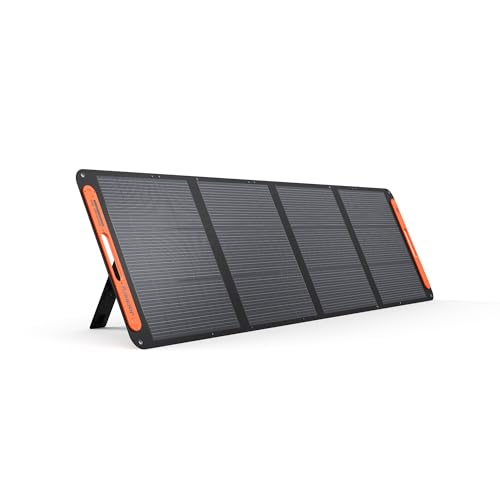
Jackery SolarSaga 200W Portable Solar Panel
- Rated output: 200W
- Weight: 14.1 lb
- Weather rating: IP68
- Design: Bifacial folding panel
- Best use: Basecamp, left out for days
Bottom Line : The basecamp panel you can leave out in the weather, and owners say it keeps working for more than a year. You pay a premium for that.
Pros
- True IP68 weather resistance
- Owners report near-maximum output on bright days
- 14.1 lb, easy to carry from the car
- Survives long-term outdoor use
Cons
- Premium price for the watts
- Exposed connectors need DIY protection
At 14.1 lb, Ryan found the SolarSaga hit the basecamp sweet spot: easy to carry 50 feet from the vehicle to a patch of sun, though not something you would haul up Mount Fairview.
Its real strength is weather. Owners rave about its true IP68 rating, and several long-term users report leaving it out in rain and wind for more than a year with no loss in output, still hitting close to full wattage on bright days.
The trade-offs are cost and cables. It sits at the premium end per watt, and owners recommend tidying the exposed connectors with zip ties and rubber caps so they stay clean in the rain. Do that once and it is the panel you can forget about outside. It scores 86 out of 100.
Read our full Jackery SolarSaga 200W Portable Solar Panel review →
 Highest Output
EcoFlow 220W Bifacial Portable Solar Panel
- Rated output: 220W, bifacial
- Measured at Lake Louise: 194W
- Weight as tested: 21 lb
- Folded: About the footprint of a 100W panel
- Rear side: Owners report 5 to 15 percent extra from reflection
- Weather rating: IP68
Bottom Line : The most power from any folding panel Ryan tested, if you can live with its weight and a floppy bag stand that slouches in the wind.
Pros
- 194W measured, highest of any folder tested
- Rear face adds real watts off snow or sand
- Folds to the size of a 100W panel
Cons
- Heavy for a folder at 21 lb
- Bag-and-carabiner stand slouches in wind
- Owners worry about bending the flexible body
In the crisp alpine sun, the EcoFlow pulled 194W, the highest actual output of any folding panel Ryan tested, and it still folds down to the footprint of a 100W panel.
The bifacial claim holds up. Owners confirm the rear face realistically adds 5 to 15 percent, roughly 5W to 22W, when there is something bright underneath it like snow or pale sand.
The trade-offs are physical. At 21 lb it is heavy for a folder, and the stand is the most common owner complaint: it uses the carry bag and carabiners instead of rigid legs, so it can slouch in wind. Prop it against something solid on gusty days and you get the most output of any folder here. Some long-term owners also worry that the flexible body could crack if it is bent past about 30 degrees. It scores 85 out of 100.
Read our full EcoFlow 220W Bifacial Portable Solar Panel review →
Anker SOLIX PS200 Bifacial Portable Solar Panel
Bottom Line : Beautifully designed and the fastest to aim at the sun, but owners report fussy charging that can need a reset.
Pros
- Set up and angled in about 45 seconds
- Preset angle points make re-aiming easy
- Rugged, portable build
Cons
- Owners report finicky voltage behaviour
- Can drop to about 75W or stop charging until reset
The physical design is excellent. Its preset adjustment points let Ryan dial in the angle perfectly, and he had it set up in about 45 seconds as the sun moved across the peaks. Owners love the build quality and portability too.
The catch is electrical. Owners widely report it being finicky with voltage: when conditions are not ideal it can refuse to charge, or drop to as little as 75W in midday sun, and need unplugging and replugging to wake it up. Check it is charging, not just set up. It scores 80 out of 100.
Read our full Anker SOLIX PS200 Bifacial Portable Solar Panel review →
JJN Bifacial 200W Solar Panel
- Rated output: 200W, bifacial
- Measured at Lake Louise: 185W
- Weight: 25 lb
- Build: Rigid panel
- Weather rating: IP68
- Connectors: Hardwired MC4
Bottom Line : The closest to its rating of anything on the mountain and the best value per watt, but it is a roof panel, not a portable one.
Pros
- 185W measured, closest to its rating
- Best value per watt in this guide
- IP68 and built for years outdoors
Cons
- Rigid and 25 lb, not portable in practice
- Hardwired MC4 connectors are hard to detach
This was the most efficient panel on the mountain: Ryan measured 185W from its claimed 200W. It is also the best value per watt in this guide and carries an IP68 rating.
Van builders and RV owners recommend it heavily for permanent roof mounts, and owners report it surviving years of hard weather.
It is a portable panel in name only. It is rigid, weighs 25 lb and its hardwired MC4 connections are notoriously hard to detach. It is terrible for a temporary ground camp and ideal bolted to a rig. It scores 78 out of 100.
Terrible for a temporary ground camp, but perfect for bolting to an RV parked on the Trans-Canada Highway.
Ryan, tester
Read our full JJN Bifacial 200W Solar Panel review →
BougeRV Arch Pro 200W Flexible Solar Panel
- Rated output: 200W, flexible
- Measured at Lake Louise: 168W
- Weight: 6.5 lb
- Weather rating: IP68
- Stand: None, made to mount
- Mounting: Owners use industrial VHB tape
Bottom Line : Featherlight and weatherproof for curved roofs, but it has no stand for ground use and flexible panels age faster in heat.
Pros
- Only 6.5 lb for 200W
- 168W measured
- IP68 shrugged off mountain downpours
- Thin enough to walk on once mounted
Cons
- No kickstand for ground camping
- Flexible panels degrade faster from heat
- Roof adhesive can fail in hot sun
Ryan measured 168W from the BougeRV, from a panel that weighs just 6.5 lb, and its IP68 rating easily handled the mountain downpours.
Owners love sticking them to curved teardrop trailers and van roofs with industrial VHB tape, and they are thin enough to walk on.
Because it is fully flexible it has no kickstand, so it is a poor ground panel. Long-term owners also warn that flexible panels degrade faster from heat build-up than rigid glass ones, and roof adhesives can let go under direct summer sun. It scores 76 out of 100.
Read our full BougeRV Arch 200W Flexible Solar Panel review →
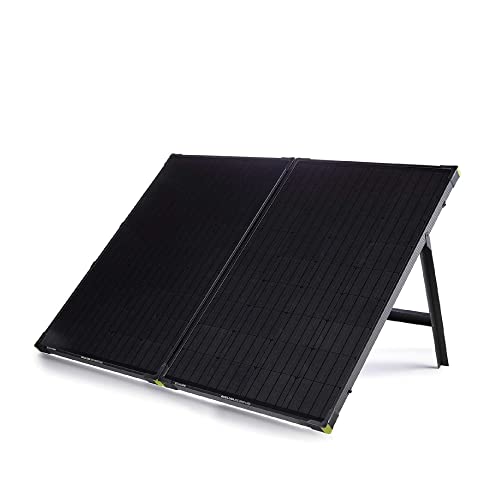
Goal Zero Boulder 200 Briefcase
- Rated output: 200W, monocrystalline
- Weight: 43 lb
- Surface: Tempered glass
- Frame: Heavy-duty aluminium
- Stand: Integrated kickstand
Bottom Line : Built to survive almost anything, but at 43 lb and a premium price it is a chore to deploy.
Pros
- Tempered glass and aluminium frame
- Very stable integrated kickstand
- Owners describe it as close to indestructible
Cons
- 43 lb, heavy to move around camp
- Costs close to twice comparable 200W briefcases
At 43 lb, Ryan found dragging the Boulder around the Lake Louise campground a real chore next to modern fabric folding panels.
Owners love it for exactly that heft: tempered glass, a heavy-duty aluminium frame and a very stable built-in kickstand. It is the one to buy if it will live in a truck and take abuse.
The common complaint is what owners call the Goal Zero tax: it costs close to twice what comparable 200W briefcase panels do, and the weight makes every setup a job. It scores 68 out of 100.
Dragging this around the Lake Louise campground was incredibly cumbersome compared to modern fabric-folding panels.
Ryan, tester
Read our full Goal Zero Boulder 200 Briefcase review →
Bluetti PV200 200W Solar Panel
Bottom Line : A dependable 200W folder with a better stand than EcoFlow's, if you own a Bluetti or buy an adapter.
Pros
- Owners routinely see 170W to 175W
- Snap-button adjustable kickstand
- Solid plastic handle
Cons
- Early units lost handle screws
- MC4 only, needs an adapter for non-Bluetti stations
It did not stand out on efficiency in Ryan's short test window, but it held its own. Owners routinely record 170W to 175W in real use.
Its snap-button adjustable kickstand is a real upgrade on EcoFlow's bag-and-carabiner stand, and it has a solid plastic handle instead of fabric straps.
Two things to know: early units had handle screws that were too short and fell out, and it only comes with MC4 connectors, so if you do not own a Bluetti power station you will need an aftermarket DC adapter. It scores 66 out of 100.
Read our full Bluetti PV200 200W Solar Panel review →

FlexSolar 100W Portable Solar Panel
- Rated output: 100W
- Measured at Lake Louise: 72W
- Weight: 4.1 lb
- Outputs: DC, USB-C, USB-A
- Folds: 10 sections, about laptop size
- Stand: None
Bottom Line : The only panel here Ryan would carry up a trail, trading watts for weight, but it has no stand and is fiddly to fold.
Pros
- Just 4.1 lb
- Charges devices directly from USB-C and USB-A
- Folds to about the size of a laptop
Cons
- No kickstand, loses power lying flat
- 10 sections are tedious to pack
- 72W measured from its 100W rating
At 4.1 lb this is the one panel Ryan would actually carry up a trail. It gave up some power for its size, measuring 72W, and it is good value for the watts.
Owners love that it folds to about the size of a laptop and has a DC, USB-C and USB-A hub for charging phones and gadgets directly.
It folds into 10 sections, which is tedious to pack, and critically it has no kickstand. Lying flat on the ground cuts its output hard, especially in winter or at high latitudes when the sun sits low. It scores 62 out of 100.
The only panel tested that we'd actually carry up the switchbacks to the Lake Agnes Tea House.
Ryan, tester
Read our full FlexSolar 100W Portable Solar Panel review →
ZOUPW 200W Portable Solar Panel
Bottom Line : The cheapest way into 200W class solar for casual campers, with watts and a stand that fall short of the badge.
Pros
- Low barrier to entry for high-wattage solar
- Fine for casual fair-weather weekends
Cons
- Fabric kickstands flapped and failed in wind
- Owners report output well below 200W
The ZOUPW struggled to hold its shape in the alpine wind: its fabric kickstands flapped and never kept the panel taut.
Casual weekend campers like it as a low-cost way into high-wattage solar. But like many white-label budget panels, owners report the wattage claim is overstated, often peaking 30 to 40 percent below 200W even in perfect summer sun. Buy it for the price, and plan around a smaller number. It scores 60 out of 100.
More Panels We Have Reviewed
These did not make Ryan’s top ten, but each has a full review if one suits your setup better:
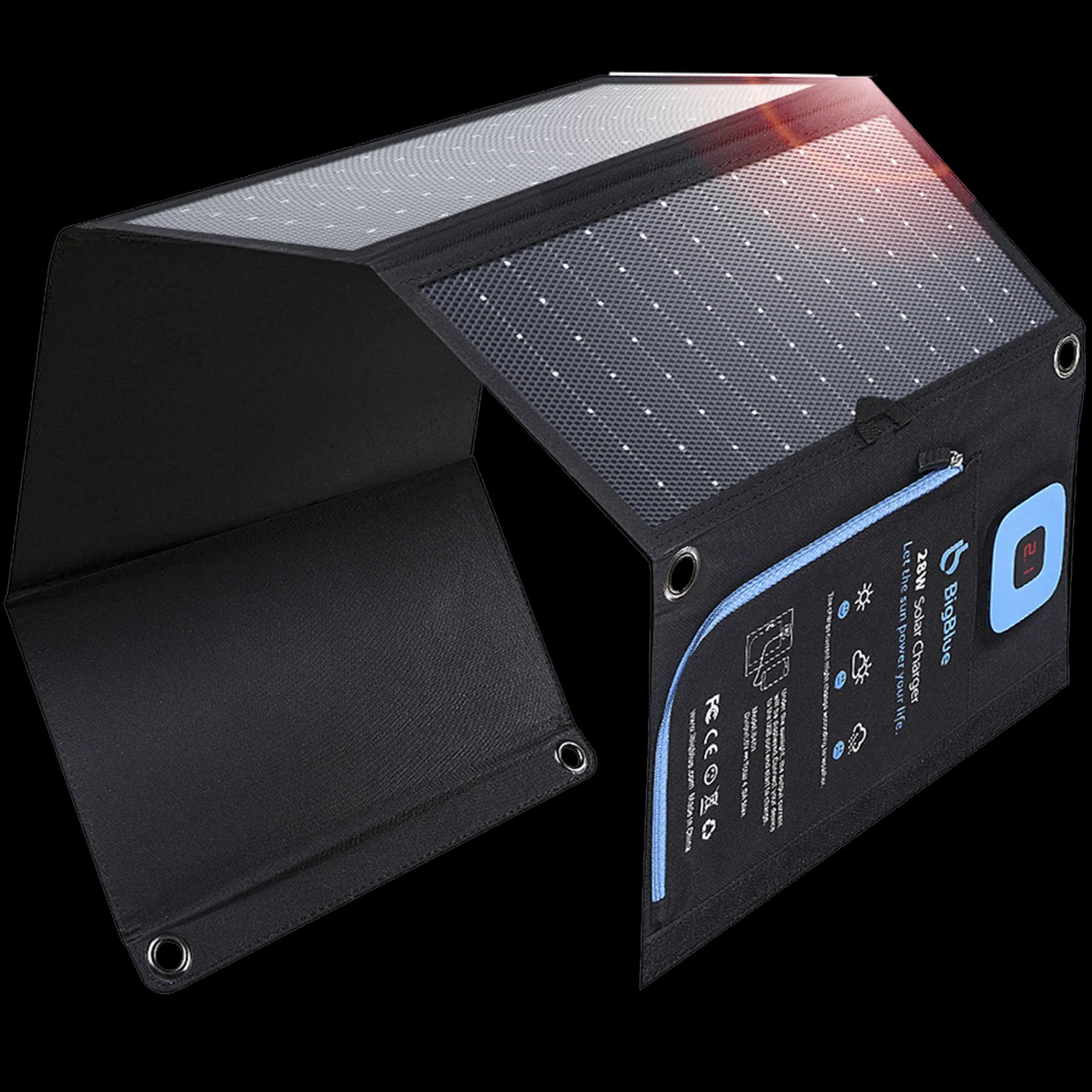
- BigBlue 28W Foldable Solar Charger: a phone and gadget charger with built-in USB ports.
- Renogy 100W Portable Solar Panel Suitcase: a rigid 100W briefcase.
- EcoFlow 110W Portable Solar Panel: a lighter EcoFlow folder.
- Jackery SolarSaga 100W Air: Jackery’s light 100W panel.
- Anker SOLIX PS100 Bifacial: the 100W sibling of the PS200.
- ALLPOWERS 21W Foldable Solar Panel Charger: a small USB charger.
Buyer’s Guide: How to Choose a Portable Solar Panel for Camping
Buying a camping solar panel comes down to five things. Get these right and you will not be caught short off-grid.
Here is what actually matters:
Real output versus rated watts
A 200W panel almost never delivers 200W in the field. Sun angle, cloud, heat, and cable loss knock a real share off the rating. Even in bright alpine sun at Lake Louise, Ryan found a typical folding panel gave 15 to 20 percent less than its box figure, and cloud or a low winter sun takes far more. Plan for the real number, not the box number, and size up if you rely on the power.
Match the panel to your battery
A 100W panel keeps phones, headlamps, and a small power station topped up. A 200W class panel is the sweet spot for charging a mid-size power station in a day. Step up to 400W only if you are running a fridge or refilling a big battery fast.
Folding, rigid, or flexible
Folding panels pack small and travel well, which suits most campers. Rigid briefcase panels are tougher but heavy. Flexible panels are light and stick to a van or boat roof, but they run hotter and lose a little efficiency.
Connectors and compatibility
Check the plug. Most panels use MC4, then adapt to XT60, Anderson, or a barrel plug for your power station. Confirm your station brand accepts the panel voltage before you buy, or budget for an adapter.
Weather and weight
Look for an IP65 rating or higher and ETFE cells for real weather resistance. Then weigh that against how you travel. What rides fine in a car is a burden on a backpacking trip, so match packed size and weight to your trip style.
Portable Solar Panel for Camping FAQ
How many watts of solar do I need for camping?
For phones and small devices, 20W to 100W is plenty. To keep a mid-size power station charged over a day, aim for 100W to 200W. For a fridge or a large battery, 200W to 400W.
Will a portable solar panel charge my phone directly?
Only if it has USB ports built in, like the FlexSolar 100W or the BigBlue 28W. Most 100W and larger panels output DC through MC4 and need a power station or battery in between.
Do solar panels work on cloudy days?
Yes, but output drops sharply, often to 10 to 25 percent of rated watts under heavy cloud. Angle the panel at the brightest part of the sky and expect slower charging.
Can I leave a solar panel out in the rain?
An IP68 panel like the Jackery SolarSaga 200W can live outside; owners report leaving theirs out for more than a year. IP65 panels like the Renogy handle splashes but should be packed away in real rain. Either way the exposed connectors are the weak point, so cap them or keep them out of standing water.
Is a foldable or rigid panel better for camping?
Foldable panels suit most campers because they pack small and set up fast. Rigid panels are tougher and better for a fixed basecamp or a roof mount where you leave them in place.
Our Analysis, Comparisons & Test Results
Here is how Ryan tested each rating at Lake Louise, what he found, and what each panel was like to live with. The table under each one ranks all ten panels.
Power Efficiency
How we tested it. Ryan measured real output in bright, high-altitude sun at about 1,600 metres, with UV reflecting off the glacial water, which is close to the best light any panel will see. He set each panel up at the angle it allowed and noted what it actually delivered against its rating. Where he could not measure a panel, we weighed long-term owner reports instead.
What we found. The rigid and bifacial panels came closest to their ratings. The EcoFlow 220W Bifacial pulled 194W, the most of any folding panel, and the rigid JJN Bifacial 200W measured 185W. The Renogy 200W delivered 175W and the BougeRV Arch Pro 168W. Owners report the Bluetti PV200 routinely reaching 170W to 175W.
The weakest results were the smallest and cheapest panels. The FlexSolar 100W measured 72W, trading watts for its tiny size, and owners report the budget ZOUPW often peaking 30 to 40 percent below its 200W rating. Owners also report the Anker PS200 dropping to about 75W or stopping until it is reset when conditions are not ideal.
What it looked like in practice. A panel that holds a steady angle keeps its output steady. The panels on floppy stands dipped every time the wind moved them, and even the best folding panels gave about 15 to 20 percent less than the box figure.
| Solar Panel | Power Efficiency |
|---|---|
| EcoFlow 220W Bifacial Portable Solar Panel | 10/10 |
| JJN Bifacial 200W Solar Panel | 10/10 |
| Renogy 200W Portable Solar Panel | 9/10 |
| Jackery SolarSaga 200W Portable Solar Panel | 8/10 |
| BougeRV Arch Pro 200W Flexible Solar Panel | 8/10 |
| Bluetti PV200 200W Solar Panel | 8/10 |
| Goal Zero Boulder 200 Briefcase | 7/10 |
| Anker SOLIX PS200 Bifacial Portable Solar Panel | 6/10 |
| FlexSolar 100W Portable Solar Panel | 5/10 |
| ZOUPW 200W Portable Solar Panel | 4/10 |
Portability
How we tested it. Ryan carried every panel the way campers actually move them: from the vehicle to a sunny patch of the campsite, and, where it made sense, up a trail. The Lake Agnes Tea House switchbacks were the real test.
What we found. The FlexSolar 100W is the only panel Ryan would carry up a trail, at 4.1 lb and folding to the size of a laptop. The BougeRV Arch Pro is even lighter for its power at 6.5 lb, but it has no stand, so it is a roof panel rather than one you carry to camp.
The 200W folders sit in a basecamp sweet spot. The Jackery SolarSaga 200W at 14.1 lb and the Renogy 200W at 14.9 lb are easy to carry 50 feet from the car, though not up a mountain. The EcoFlow is heavier at 21 lb, the rigid JJN is 25 lb, and dragging the 43 lb Goal Zero Boulder around the campground was a chore.
What it felt like. The FlexSolar disappeared into a daypack. The Goal Zero felt like carrying a suitcase full of books.
| Solar Panel | Portability |
|---|---|
| FlexSolar 100W Portable Solar Panel | 10/10 |
| BougeRV Arch Pro 200W Flexible Solar Panel | 9/10 |
| Anker SOLIX PS200 Bifacial Portable Solar Panel | 8/10 |
| Renogy 200W Portable Solar Panel | 7/10 |
| Jackery SolarSaga 200W Portable Solar Panel | 7/10 |
| Bluetti PV200 200W Solar Panel | 7/10 |
| ZOUPW 200W Portable Solar Panel | 7/10 |
| EcoFlow 220W Bifacial Portable Solar Panel | 5/10 |
| JJN Bifacial 200W Solar Panel | 2/10 |
| Goal Zero Boulder 200 Briefcase | 1/10 |
Ease of Use
How we tested it. The mountain sun kept moving across the peaks, so every panel had to be set up and then re-aimed through the day. Ryan timed setups, adjusted angles as the light changed, and noted every cable, connector and stand that made the job harder.
What we found. The Anker PS200 was the fastest: its preset angle points had it set up and aimed in about 45 seconds. The Renogy 200W’s integrated legs were quick to set and the steadiest in the wind, and owners rate the Bluetti PV200’s snap-button kickstand well above bag-style stands.
Stands made the biggest difference. The EcoFlow relies on its carry bag and carabiners, which slouch in wind; the ZOUPW’s fabric kickstands flapped and never held the panel taut; and the FlexSolar has no stand at all, so it lies flat. Connectors matter too: the JJN’s hardwired MC4 cables are hard to detach, and Jackery owners add zip ties and caps to manage exposed connectors.
What it felt like. Re-aiming the Renogy or Anker was quick and simple. Re-aiming the bag-stand panels meant wrestling fabric and straps in the wind.
| Solar Panel | Ease of Use |
|---|---|
| Anker SOLIX PS200 Bifacial Portable Solar Panel | 10/10 |
| Renogy 200W Portable Solar Panel | 9/10 |
| Jackery SolarSaga 200W Portable Solar Panel | 7/10 |
| Bluetti PV200 200W Solar Panel | 7/10 |
| Goal Zero Boulder 200 Briefcase | 6/10 |
| EcoFlow 220W Bifacial Portable Solar Panel | 5/10 |
| FlexSolar 100W Portable Solar Panel | 5/10 |
| ZOUPW 200W Portable Solar Panel | 5/10 |
| JJN Bifacial 200W Solar Panel | 4/10 |
| BougeRV Arch Pro 200W Flexible Solar Panel | 4/10 |
Durability & Build Quality
How we tested it. Lake Louise tested durability for us: strong wind off the Victoria Glacier and sudden showers that rolled in with little warning. We paired what Ryan saw with long-term owner reports, because a weekend cannot show you year two.
What we found. The Jackery SolarSaga 200W and Goal Zero Boulder 200 led here. Jackery owners report leaving theirs out in rain and wind for more than a year with no loss in output, and the Goal Zero’s tempered glass and aluminium frame are built to take abuse. The JJN’s IP68 rating is backed by owners who run them on RV roofs for years.
The weaker scores came from specific flaws. The Renogy’s IP65 rating handles splashes but not a downpour, and owners report boxes arriving damaged. Early Bluetti PV200s had handle screws that were too short. Owners warn that flexible panels like the BougeRV degrade faster from heat than rigid glass, and some worry the EcoFlow’s flexible body could crack if bent too far.
What it felt like. The IP68 panels could be left alone when the weather turned. The others meant a dash to pack them away.
| Solar Panel | Durability & Build Quality |
|---|---|
| Jackery SolarSaga 200W Portable Solar Panel | 10/10 |
| Goal Zero Boulder 200 Briefcase | 10/10 |
| JJN Bifacial 200W Solar Panel | 9/10 |
| Anker SOLIX PS200 Bifacial Portable Solar Panel | 8/10 |
| Renogy 200W Portable Solar Panel | 7/10 |
| EcoFlow 220W Bifacial Portable Solar Panel | 7/10 |
| FlexSolar 100W Portable Solar Panel | 7/10 |
| BougeRV Arch Pro 200W Flexible Solar Panel | 6/10 |
| Bluetti PV200 200W Solar Panel | 6/10 |
| ZOUPW 200W Portable Solar Panel | 4/10 |
Our Final Verdict: 10 Best Portable Solar Panels for Camping 2026
Three panels stood out at Lake Louise.
The Renogy 200W Portable Solar Panel is our best overall pick: 175W measured and the steadiest legs in the wind, for campers who drive to their site.
The EcoFlow 220W Bifacial Portable Solar Panel is the one to buy for maximum output, with 194W measured, if you can accept its weight and bag stand.
The FlexSolar 100W Portable Solar Panel is the only panel Ryan would carry up a trail, at 4.1 lb with USB ports for charging devices directly.
Conclusion: Best Portable Solar Panels for Camping
Start with how far the panel has to travel. If it goes from the car to the campsite, the Renogy 200W gives you the most dependable power for the effort, and the Jackery SolarSaga 200W is the one to leave out in the weather. If it goes up a trail, carry the FlexSolar 100W and accept fewer watts.
For a van or trailer, skip portability altogether: bolt on the JJN for the most watts for the money, or tape down the BougeRV for a curved roof.
Whatever you buy, plan around 15 to 20 percent less than the box rating, and choose a panel with legs you can re-angle. On the mountain, those two things mattered more than the badge.
Our Testers
This guide was edited by Sean Williams and field tested at Lake Louise, Alberta, by our lead tester.
- Sean Williams, Editor-in-Chief. Sean built the team of researchers and testers behind our reviews and edits every guide. His rule: we say what we actually found.
- Ryan Williams, Lead Tester. An aggressive, heavy charger who hunts for steep, punishing terrain. Ryan has led our field tests from Whistler Blackcomb to the shore of Lake Louise.

![10 Best Quiet Generator [UPDATED 2026] Definitive Review](/images/2020/10/sportsman-generator-1024x1024.jpg)