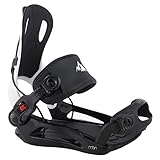
Ryan's 215 lb slipped the System MTN Rear Entry's plastic strap adjusters by one tooth in both of our summer glacier tests, though its rear entry works and it's the budget pick in our step-in guide. It scores 75 out of 100 and ranks #10 in our best step-in & quick-entry snowboard bindings guide as our best budget step-in snowboard binding.
It also ranks #9 in our best budget snowboard bindings guide under the same award.

What is the best budget step-in snowboard binding?
The best budget step-in snowboard binding is the System MTN Rear Entry, which gave James straightforward rear entry on mellow resort laps at 920 g.

System MTN Rear Entry
- Weight: 920 g
- Heel stack: 18 mm
- Flat entry: 6.5 s
- Boots: Most standard boots
Bottom Line : Simple, no-fuss rear entry for casual riding. It was the slowest to enter here, the heel lifted on hard carves, and its strap adjusters slipped a tooth under a 215 lb rider.
Pros
- Straightforward rear entry for casual riding
- Broad coverage from the molded 3D strap
- Full EVA padding on the highback and dense dampening in the footbed, per the maker
- 920 g and an 18 mm heel stack
Cons
- Slowest entry of the ten in every kind of snow
- Loose downward instep clamp: heel lift on hard heelside carves and toe-side edge lag
- Plastic slide-lock strap adjusters slipped one tooth under Ryan's 215 lb
- Wide boot outsoles wedge against the side rails on entry
On the Mountain
Two summer tests, one rider who is hard on hardware: Ryan led both of our System MTN tests on Horstman Glacier in June and July 2026, the step-in test and the budget test, with James co-testing.
Entry took 6.5 seconds on the flat, 11.8 on a steep traverse and 14.6 in slush, each the average of three timed entries. The highback reclining cable and locking lever worked reliably on flat terrain, but on steep slopes or in wet slush James had to wrestle the boot in with two hands.
The one-piece 3D molded strap covers the instep broadly. Setup took 12 minutes, because the rear cable tension needed trial and error to balance entry clearance against the riding lock.
It held together. The cable linkages, locking levers and chassis took heavy laps without a component failure, and our budget testers scored its value and durability 9.0.
It was a size Large with US men's 10 to 10.5 test boots, and the universal disc mounted to both 2x4 and 4x4 patterns without issue. At 920 g with an 18 mm heel stack it's lighter than everything except the two Step On bindings.
Where It Asks Something of You
The strap is a narrow margin. It lacks contouring: the heel lifted on hard heelside carves with noticeable toe-side edge lag, and tightening it enough to stop that created an uncomfortable pressure point across the top of the foot.
The hardware is the other complaint. The plastic slide-lock strap adjusters slipped one tooth under Ryan's 215 lb in both tests and had to be reset and clamped down, and the chassis showed moderate flex and creaking when Ryan torqued it.
And it's the slowest binding of the ten to get into, in every kind of snow.
Spec Sheet vs Our Test
Rear entry, step-in style. It's one, and it works. The comparison that matters is the LT Supermatic's 3.1 seconds on the flat, which shows what step-in style can mean.
Multi-disc base plate. The maker says it mounts to standard four-hole and Burton Channel boards. The disc mounted to 2x4 and 4x4 patterns without issue. We didn't test the Channel pattern.
Full EVA padding and high-density dampening. The maker says the highback has full EVA padding and the footbed high-density dampening. We didn't score vibration or landings on this binding, so we can't confirm it. We can say the chassis creaked and flexed under Ryan.
3D molded ankle strap, maximum comfort and instant response. The maker promises maximum comfort and instant response from the molded strap. James found a loose clamp, toe-side edge lag and heel lift on hard carves, and the budget testers found a pressure point when it was tightened. It covers the foot broadly, and that's where the claim ends.
Sizing. The maker lists Medium as US men's 6 to 9, Large as 9 to 11 and XL as 11 to 14. Our 10 to 10.5 boots sit in the middle of the Large, and it fit them. If you're a 9 or an 11 you're on a boundary, so check the chart before you order.
Should You Buy the System MTN Rear Entry?
Ride mellow resort laps and want the simplest rear-entry binding? The System MTN is clearly the budget pick, the only budget-tier binding in our step-in guide, and that's its whole case: every other binding here entered faster and held better.
Skip it if you carve hard, because the heel lifted. If the strap adjusters slip a tooth, reset them and clamp them down.
The mid-price Flow Fenix is the nearest step up: it enters faster, 5.8 seconds on the flat against 6.5, and holds better.
Beginners will find it easy to understand, and heavy or hard-riding riders will find its limits fast.
Compare With
- Nidecker LT Supermatic: our best overall step-in snowboard binding.
- Bent Metal Lightning Supermatic: our best step-in snowboard binding for carving.
- Bent Metal Speed-In Pro: our best step-in snowboard binding for freeride.
- Flow Fuse Hybrid: our best step-in snowboard binding for freestyle.
- K2 Cinch GT: our best step-in snowboard binding for heavy riders.
- Flow Fenix: our best step-in snowboard binding for beginners.
- Flow NX2: our best step-in snowboard binding for high-speed riding.
- Burton Step On Genesis Re:Flex: our best step-in snowboard binding for comfort.
- Burton Step On Re:Flex: our best lightweight step-in snowboard binding.
See all ten, and how we tested them, in our best step-in & quick-entry snowboard bindings guide.
Ranked in our Best Step-In Snowboard Bindings, Best Budget Snowboard Bindings guides. All our tested picks, guides and reviews are in our Best Snowboard Bindings hub.
Editor's Note, 11 November 2026: New review. In June and July 2026 Ryan and James rode the System MTN Rear Entry on Horstman Glacier at Whistler Blackcomb and again for our budget guide, timed entry three times on the flat, on a steep traverse and in slush, weighed it, and scored it on entry, instep hold, boot compatibility, and weight and bulk.
Our Testers
This review was edited by Sean Williams and tested on Horstman Glacier at Whistler Blackcomb by Ryan Williams and James Ward.
- Sean Williams, Editor-in-Chief. A former commercial outdoor copywriter and gear journalist who runs Top-Notch Outdoor as an independent publisher. He checks every tester's field notes against the maker's claims before a score goes live.
- Ryan Williams, Lead Tester. A heavy fleet equipment mechanic and commercial vehicle technician. At 6 ft 2 and 215 lb he is our heavy, high-impact user, and he works hardware hard to find weak welds, stripped adjusters and plastic that fatigues. Ryan led the testing of the System MTN Rear Entry.
- James Ward, Alpine Ski & Fat Bike Tester. On skis since he was 3 and a former regional alpine racer, now a ski tuner and dryland fitness coach. He ran the stopwatch and the boot swaps for every binding in our step-in test. James co-tested the System MTN Rear Entry.