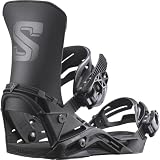

What is the best overall freestyle snowboard binding?
The best overall freestyle snowboard binding is the Salomon District, whose soft rubberized heel loop let the ankle roll through nose blunts and tweaked grabs for a perfect 10.0 on lateral tweak over 40 park laps.
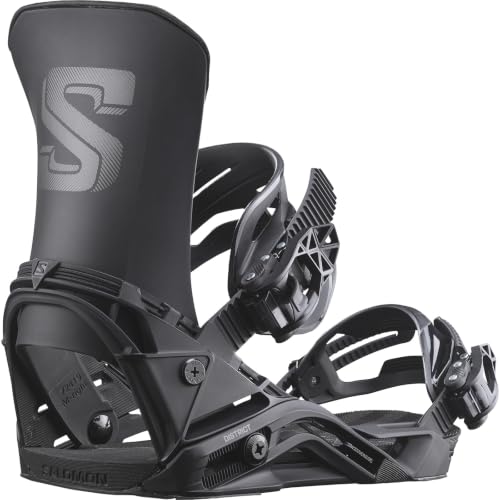
Salomon District
- Weight: 845 g
- Board contact: 178 mm
- Park laps: 40
- Hardware: Lean screw, ½ turn
Bottom Line : The freest ankle of the ten, on a base that lets a park board bend through presses. The forward-lean screw backed out half a turn once, and the soft heel loop needs a hand to clear when you step in.
Pros
- Perfect 10.0 for lateral tweak: the soft heel loop moves with your ankle through blunts and grabs
- In Amy's laps the board bent in one smooth arc through presses, with no rigid side rails in the way
- Full EVA pads took the jolt out of flat landings off the 25-foot kicker, with no heel sting
- The wire in the heel loop showed no stretch after 40 laps
Cons
- The forward-lean screw backed out half a turn on the jump approach and needed retightening at lunch
- The soft heel loop sags inward when your boot is out and needs a hand to clear
Who it's best for
Amy led the testing and Shaun co-tested. It's for park riders, rail specialists and creative freestyle riders who care more about deep presses and grab tweakability than heelside hold, and it's the wrong pick for anyone who wants a rigid heelside response.
Why we love it
Lateral Tweak (10.0). In Amy's laps the soft rubberized heel loop gave unrestricted side-to-side ankle movement, so she could push nose blunts and tweaked grabs to the limit without her boot cuff digging into a rigid wall. It's the only perfect score in the guide.
Board Feel (9.5). With no rigid structural side rails, Amy found the base let her Capita Defenders of Awesome bend in a smooth, continuous arc through presses, with no stiff, dead plateau underfoot. Direct board contact is 178 mm.
Landing (9.0). The full EVA pads under the front and rear foot took the jolt out of flat landings off the 25-foot kicker and dampened hard rail drops with no heel sting.
What we didn't like
Hardware needed one fix-up (8.5). The wire in the heel loop didn't stretch in 40 laps, but the rear forward-lean screw backed out half a turn on the chattery run-in to the jumps and needed a quick retightening at lunch. The second flaw is small and daily: the soft heel loop sags inward when your boot is out, so you pull it clear with a hand as you step in. Neither is a dealbreaker. Check that screw at lunch, and flick the loop clear before you step in.
Should you buy it?
Buy it if you ride park for the tricks and want the freest ankle in the test. It's mid-price, which is a fair ask for a perfect Lateral Tweak score. Land big? The Union Ultra ties it at 93, scored 0.5 higher for Landing and weighs 5 g more. Want a tougher build and a locked-in heel? The Burton Malavita Re:Flex scored 1.0 higher for Hardware. We tested size Large.
Read our full Salomon District review →

What is the best freestyle snowboard binding for jumps?
The best freestyle snowboard binding for jumps is the Union Ultra, which took Ryan's 215 lb flat off the 25-foot kicker with zero bone bruise and has the softest landings of the ten.

Union Ultra
- Weight: 850 g
- Board contact: 148 mm
- Park laps: 42
- Hardware: Nothing loosened
Bottom Line : The softest landings in the guide, from a bushing chassis with the shortest board contact of the ten. Lateral tweak is its weakest area, a full point behind the Salomon District.
Pros
- Best Landing score here (9.5), which the testers credit to multi-density EVA and TPE cushioning
- Only 148 mm of board contact, the shortest of the ten
- Padded ankle strap flexes without biting the top of the foot
- 42 park laps with no hardware movement and no ladder tooth wear
Cons
- Lateral tweak, at 9.0, trails the Salomon District by a full point
Who it's best for
Amy led testing, with Ryan co-testing, and Ryan's 215 lb flat landings put the cushioning to work. It's for jump and rail riders who want the most shock absorption in this guide, and for heavier riders in particular.
Why we love it
Landing (9.5). The testers credit the multi-density EVA and TPE cushioning for taking Ryan's 215 lb frame off the 25-foot kicker flat with zero bone bruise. That's the best Landing score in the guide, 2.5 points above the Flux DS.
Board Feel (9.5). The maker says it has a next-generation suspension with a Molecular Bushing. Amy found the board flexed uninterrupted around the small mini disc, with only 148 mm of board contact.
Hardware (9.0). Over 42 park laps the magnesium ratchets worked smoothly in wet slush, and the mini-disc screws stayed torqued after one check in the morning. We saw no hardware movement.
What we didn't like
Lateral Tweak is joint-lowest at 9.0, level with Hardware. The highback twisted smoothly for lateral bone-outs and the padded strap never bit, but the Salomon District gave Amy a full point more ankle freedom, and the maker rates the Ultra's flex at 6 out of 10. The maker also says it's the most comfortable snowboard binding ever built. We rode it in the park against nine others, so what we can say is that it had the softest landings here, and no more than that.
Should you buy it?
Jumps are the reason to buy this one, and heavier riders will get the most from it. It's mid-price, and the softest landings in the group come at that tier. If you want the loosest ankles, take the Salomon District, which ties it at 93. If you hit more boxes than kickers, the Flux DS scored the same 9.5 for Board Feel and 0.5 higher for Lateral Tweak. We tested size Large.
Read our full Union Ultra review →

What is the best all-mountain freestyle snowboard binding?
The best all-mountain freestyle snowboard binding is the Burton Malavita Re:Flex, which locked its ladders and ratchets down with zero slippage over 40 park laps and scored 9.5 for hardware.

Burton Malavita Re:Flex
- Weight: 890 g
- Board contact: 172 mm
- Park laps: 40
- Hardware: Nothing loosened
Bottom Line : A strap wrap our testers called class-leading, hardware that never moved, and a cushion that stayed springy on cold mornings. Wet slush packs the angled ladder teeth and makes them squeak.
Pros
- Hardware 9.5, tied best here: the ladders and ratchets locked instantly with zero slippage
- The testers called the strap wrap class-leading
- FullBED platform with B3 Gel didn't pack out on cold, salted mornings
- James found the Heel Hammock held the heel securely
Cons
- Angled ladder teeth pack with wet summer slush and can squeak
- Replacement ladders are proprietary if one cracks on a rail
Who it's best for
James led and Ryan co-tested. It suits all-mountain freestyle and slopestyle riders who want a comfortable strap, proven hardware and a locked-in heel, and who aren't chasing the loosest ankle in the park.
Why we love it
Hardware (9.5). Over 40 park laps the ladders and ratchets locked down instantly with zero ladder slippage, and every disc screw stayed seated. Nothing moved.
Landing (9.0). The FullBED EVA platform with integrated B3 Gel didn't pack out on cold, salted mornings, and it cushioned heavy flat drops off the 20-foot wide flat box without foot fatigue.
Board Feel (9.0). James found the Re:Flex baseplate flexed with the board, so nose and tail presses stayed clean with little dead spot underfoot.
What we didn't like
It trades a little freedom for security. Lateral Tweak scored 8.5, 1.5 points behind the Salomon District. The ankle strap and mid-flexing highback gave dependable lateral give for grabs, and the maker says the feel is medium stiff, so expect dependable give. The ladders are the other catch: the angled teeth pack with wet summer slush and can squeak, and replacement ladders are proprietary if one ever cracks on a rail. Knock the slush out of the teeth before you strap in, and ask about spares when you buy.
Should you buy it?
Pick it for all-mountain freestyle when you'd rather the binding stayed put and held your heel. It's a mid-price binding, and what you're paying for is strap comfort and hardware that never moved. For looser ankles, the Salomon District scored 1.5 higher for Lateral Tweak and is 45 g lighter. For bigger kickers, the Union Ultra scored 0.5 higher for Landing. We tested size Large, which the maker sizes for US men's 10 and up.
Read our full Burton Malavita Re:Flex review →
What is the best freestyle snowboard binding for jibbing?
The best freestyle snowboard binding for jibbing is the Flux DS, with a highback that twists sideways almost freely, giving Amy deep tail presses and tweaked nose grabs over 45 park laps, the most of any binding.

Flux DS
- Weight: 910 g
- Board contact: 182 mm
- Park laps: 45
- Hardware: Nothing loosened
Bottom Line : A skate-feel connection to the board and a highback that twists almost as freely as the Salomon District, with hardware that stayed locked for 45 laps. The footbed is thin, so flat landings go straight into the heels.
Pros
- Lateral Tweak 9.5: the highback twists with minimal resistance
- Amy felt the baseplate contact the board's edges directly, with little dead spot under the arch (182 mm)
- The most park laps of any binding (45), with nothing loosened or shifted
- The testers liked the built-in bottle openers on the ratchets
Cons
- Thin footbed: noticeable heel shock on flat landings and harsh box drops (Landing 7.0)
- Forward lean takes a #3 Phillips screwdriver: loosen the screws on both sides and slide the highback to the next notch
- At 910 g it's the third heaviest here
Who it's best for
Amy led the park laps on this one, with Shaun alongside. It's for technical park riders, butter specialists and jibbers who want a direct, skate-like board connection, and it isn't for riders who land big jumps flat.
Why we love it
Lateral Tweak (9.5). The highback twists laterally with minimal resistance, so Amy could lean her ankle wide for deep tail presses and tweaked nose grabs.
Board Feel (9.5). Amy felt the baseplate contact the board's edges directly while leaving little dead spot under the arch, so the board pressed smoothly.
Hardware (9.5). Over 45 park laps, more than any other binding in the guide, the lever cams stayed locked and the ratchets, bottle openers included, engaged smoothly with no ladder wear. Nothing loosened or shifted.
What we didn't like
The footbed is where the DS pays for its board feel (Landing 7.0). It sheds snow well, but with so little EVA under the heel, flat landings and harsh box drops send noticeable shock into the heels. That's a fair trade for a jibber and a poor one for a jump rider. Forward lean is the other chore. The lean is set by stepped blocks at the two highback pivots on the heel cup, in 2.5 degree steps, so you loosen the screws on both sides with a #3 Phillips screwdriver, slide the highback to the notch you want and screw it back down. The straps, toe-strap ladders and footbed ramps adjust without tools. If your sessions are mostly boxes and rails, this is the one. If they're mostly kickers, ride the Union Ultra, which scored 2.5 points higher for Landing.
Should you buy it?
If your session is boxes, rails and butters, the Flux DS gives you a direct, skate-like feel. At mid-price, you're paying for board feel and hardware, not cushioning. Want cushioning as well? The Union Ultra, also mid-price, matches its Board Feel at 9.5 and lands 2.5 points softer. Want the loosest ankles? The Salomon District scored 0.5 higher for Lateral Tweak and is 65 g lighter. We tested size Large.
Read our full Flux DS review →
What is the best freestyle snowboard binding for buttering?
The best freestyle snowboard binding for buttering is the Union Strata, whose loose lateral flex made presses, rail locks and flat-ground reverts feel effortless for Amy.

Union Strata
- Weight: 895 g
- Board contact: 154 mm
- Park laps: 40
- Hardware: Disc screws, ½ turn
Bottom Line : A surfy, loose-flexing mini-disc binding with plush landings, held back by screws that backed out under rail hits.
Pros
- Loose lateral flex that makes presses, rail locks and flat-ground reverts feel effortless
- The shock-absorbing bushing took flat landings and box drops without joint sting (Landing 9.0)
- The mini disc lets the board flex into deep press arcs: 154 mm of contact, the second shortest here
Cons
- The rear mini-disc screws backed out half a turn after heavy rail sessions (Hardware 7.0, the lowest here)
- The foam at the edges of the bushing started to chew up from rail hits
Who it's best for
It's for freestyle riders who love buttering, side hits and park jumps and who will check their screws. Amy led its testing, with Shaun co-testing.
Why we love it
Lateral Tweak (8.5). The highback gives loose lateral give, which makes presses, rail locks and flat-ground reverts feel effortless.
Board Feel (9.0). The mini-disc chassis let the board flex into deep press arcs with little chassis deadening.
Landing (9.0). Amy found the bushing isolated harsh box drops and absorbed flat landings without joint sting.
What we didn't like
The screws are the catch (Hardware 7.0), the lowest score here. After heavy rail sessions the mini-disc center screws on the rear foot backed out half a turn, and the foam at the edges of the bushing started to chew up from rail hits. The maker says the Strata is Union's number one men's park and freestyle binding. Its ride scores are strong (9.0 for Board Feel and Landing), but the Union Ultra beat it on all three ride scores, and on hardware the Strata was the weakest here. The fix is a habit: check the rear screws at lunch and after every rail session. The Union Ultra, which uses the same style of mini disc, kept its screws torqued for 42 laps after one check in the morning.
Should you buy it?
Think of it as a ride you'll love and a binding you'll have to check. It suits riders who butter, hit side hits and will look at the screws. Both it and the Union Ultra are mid-price, so if you want more cushioning without the checks, the Ultra, which scored 9 points higher overall, is the better use of that money. Want hardware you can forget? The Flux DS scored 2.5 points higher for Hardware but 2.0 lower for Landing. We tested size Large.
Read our full Union Strata review →
What is the best freestyle snowboard binding for intermediate riders?
The best freestyle snowboard binding for intermediate riders is the Bent Metal Joint, thanks to a pliable nylon highback that twists easily for presses and grabs and a four-position Cube lean adjuster that stayed in its notch for 38 laps.

Bent Metal Joint
- Weight: 930 g
- Board contact: 190 mm
- Park laps: 38
- Hardware: Nothing loosened
Bottom Line : An easy-flexing highback and a quick lean adjuster that never slipped, ridden a size too big for our boots. The Large is cut for US 11 to 14 boots.
Pros
- Pliable nylon highback twists easily across the ankle without biting the calves
- The four-position Cube forward-lean adjuster (10, 14, 18 or 22 degrees, the maker says) stayed in its notch for 38 laps
- Ankle strap mounting screws stayed tight
Cons
- The Large tray is built for US 11 to 14 boots, so our US 10 and 10.5 boots left side-to-side dead space and the straps had to be cranked down
- Firm flat stomps onto hard glacier snow sent sharp feedback to the heels (Landing 7.5)
- The second heaviest binding here, at 930 g
Who it's best for
It's for park riders and progressing freestyle riders who want an easy-flexing binding with a fast lean adjuster, as Amy and Ryan found. Check the size first: the Large isn't for a 10.5 boot.
Why we love it
Lateral Tweak (8.5). The pliable nylon highback twists easily across the ankle, giving plenty of room for presses and stylish grabs without biting the calves.
Hardware (8.5). Over 38 park laps the Cube adjuster stayed in its notch, the ankle strap mounting screws stayed tight, and nothing slipped.
Board Feel (8.0). The boron fiber drive plate gives the board a continuous flex surface, so it bent decently into presses.
What we didn't like
Size is the honest flaw. Bent Metal sizes the Large for US men's 11 to 14 boots, and we rode it in US 10 and 10.5. With the toe ramp pulled fully back there was still side-to-side clearance, and we tightened the ankle straps an extra notch to take it up. Firm flat stomps onto hard glacier snow also sent sharp feedback to the heels (Landing 7.5). The fix is the right size: the Medium, which our button goes to, is sized for US men's 8 to 11. Because we rode the wrong size, read its scores with that in mind.
Should you buy it?
Check your boot size before anything else. The Large suits a US 11 or bigger boot, and our button goes to the Medium, which Bent Metal sizes for US men's 8 to 11. At mid-price, it's only good value in the right size. Want a similar easy flex with softer landings? The Salomon District scored 1.5 higher for Landing and is 85 g lighter. We tested size Large, in US 10 and 10.5 boots.
Read our full Bent Metal Joint review →
What is the best freestyle snowboard binding for heavy riders?
The best freestyle snowboard binding for heavy riders is the Ride C-4, with an aluminum heel cup that stayed tight through 36 park laps in our freestyle test and footbed glue that didn't peel.

Ride C-4
- Weight: 940 g
- Board contact: 188 mm
- Park laps: 36
- Hardware: Tight in park laps
Bottom Line : A rugged, mid-soft binding for riders who are hard on gear, with an aluminum heel cup that stayed tight. It's the heaviest here, and that rigid cup limits ankle roll on rails.
Pros
- The aluminum heel cup stayed tight for 36 laps, and the footbed glue held with no peeling
- Ratchets worked smoothly with zero back-out
- The composite tray bends cleanly into presses (188 mm of contact)
- The testers found the highback damped vibration
Cons
- The rigid heel cup stops deep lateral ankle roll when you lock onto rails (Lateral Tweak 7.5)
- The heaviest binding here, at 940 g
- The short-throw ratchet levers need stiff thumb pressure to release with cold hands
- Heavy stomps send moderate vibration through the composite tray
Who it's best for
Ryan, our 6 ft 2, 215 lb tester, led testing, with Amy co-testing. It's for heavy or aggressive park riders who regularly crack composite heel cups, and for anyone who wants a rugged mid-soft chassis more than ankle freedom.
Why we love it
Hardware (8.5). Over 36 park laps the aluminum heel cup stayed completely tight, the ratchets worked smoothly with zero back-out, and the footbed EVA glue held with no peeling.
Landing (8.0). The canted EVA footbed (2.5 degrees, the maker says) absorbed small kicker landings cleanly.
Board Feel (8.0). The composite tray gave clean board bend on presses.
What we didn't like
The rigid heel cup that survived the laps also limits Lateral Tweak (7.5). The maker says the flex is mellow, but when locking onto rails the aluminum cup stopped deep lateral ankle roll, even though the highback itself twisted smoothly. Heavy stomps also sent moderate vibration through the composite tray, and the short-throw ratchet levers need stiff thumb pressure to release when your hands are cold. The heel cup stayed tight through the park laps, but in our budget test the heel-cup bolts backed out half a turn under Ryan's heavy carving, so use blue threadlocker. If you're hard on gear, buy it for the cup. If you tweak grabs, the Salomon District scored 2.5 points higher for Lateral Tweak.
Should you buy it?
Hard on gear? Then the heel cup is what you're buying. It's a budget-tier binding, which makes that cup good value for heavy riders and anyone who wants a rugged mid-soft binding. If you want ankle freedom instead, take the Salomon District, which scored 2.5 points higher for Lateral Tweak and is 95 g lighter. We tested size Large, which the maker sizes for US men's 10.5 and up.
Read our full Ride C-4 review →
What is the best freestyle snowboard binding for beginners?
The best freestyle snowboard binding for beginners is the Salomon Rhythm, whose soft, asymmetric highback twists easily for grabs and 50-50s without resistance.

Salomon Rhythm
- Weight: 830 g
- Board contact: 192 mm
- Park laps: 35
- Hardware: Toe ladder, 1 click
Bottom Line : A soft, forgiving first park binding with a plush ankle strap and a light 830 g. The ratchets feel spongy, and the toe ladder slipped a click once.
Pros
- A soft, asymmetric highback twists easily for grabs and 50-50s
- Plush, lightweight ankle strap
- 830 g, the second lightest here
- Amy found the EVA footbed cushioned small box drops and transition landings
Cons
- Spongy plastic ratchets feel cheap and lack a crisp release
- The toe ladder slipped one click after catching a box lip
- Bottoms out hard on flat landings off jumps (Landing 7.5)
Who it's best for
James led testing, as our crossover baseline, with Amy co-testing. It's for budget-conscious park beginners and casual rail riders who want a soft, forgiving binding.
Why we love it
Lateral Tweak (8.0). The soft asymmetric highback twists easily, so beginner and intermediate park riders can tweak grabs and lock 50-50s without fighting it. The plush ankle strap and forgiving flex also make progression gentle on the wallet.
Board Feel (8.0). On James's board the baseplate flexed predictably, so a soft park board still bent into presses and didn't feel like a rigid block.
Landing (7.5). Amy found the EVA footbed cushioned small box drops and transition landings.
What we didn't like
The hardware shows its tier (8.0). The ratchets feel spongy and plastic next to the crisp snap of the higher-tier metal ratchets, and over 35 laps the toe ladder slipped one click after catching a box lip. It also bottoms out on flat landings off jumps (Landing 7.5). Learn on boxes, rails and small hits, check the toe strap after any big catch, and step up when you start landing bigger kickers.
Should you buy it?
It's a fair first park binding if you're learning and watching the budget, and it's a budget binding. To land bigger, the mid-price Union Ultra scored 2.0 higher for Landing. For the lightest binding, the Union Flite Pro is 90 g lighter. For sturdier hardware at the entry level, the Flux PR scored 0.5 higher for Hardware. We tested size Large; the maker sizes it for boots from 28.0 to 31.5 cm.
Read our full Salomon Rhythm review →
What is the best lightweight freestyle snowboard binding?
The best lightweight freestyle snowboard binding is the Union Flite Pro, which weighs 740 g, 90 g less than any other binding here, and whose ultra-soft highback made nose and tail presses on boxes feel effortless.
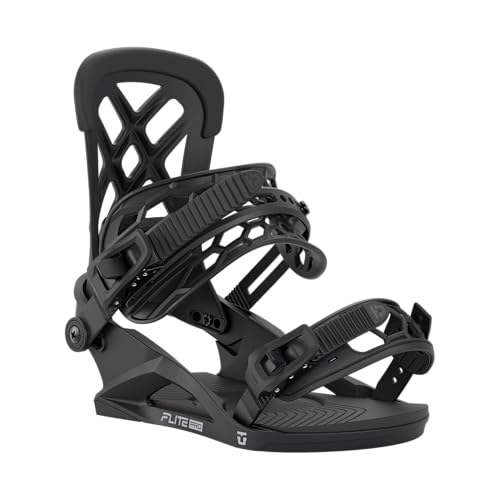
Union Flite Pro
- Weight: 740 g
- Board contact: 185 mm
- Park laps: 35
- Hardware: Toe strap slipped x2
Bottom Line : The lightest binding here and one of the softest, which makes a board feel weightless in spins. The footbed is sparse, and the toe strap slid off blunt boot caps twice.
Pros
- 740 g, the lightest of the ten
- An ultra-soft highback allows extreme ankle roll and easy nose and tail presses on boxes
- James found the minimal baseplate let the board bend naturally
- The ratchets held tight over 35 laps
Cons
- The sparse EVA footbed gave sharp heel sting on flat landings off the 15-foot kicker (Landing 7.0)
- The minimalist toe strap slipped forward off blunt boot caps twice on rail dismounts
- The soft chassis can feel unstable when pushed hard
- James felt a stiff center circle from the standard full-size disc
Who it's best for
It's for budget jibbers, rail riders and park beginners who want the lightest soft binding, and not for anyone who lands flat off big kickers. James led its testing, with Amy co-testing.
Why we love it
Lateral Tweak (8.5). The ultra-soft highback is flexy enough for extreme ankle roll, so nose and tail presses on boxes felt effortless.
Board Feel (8.0). James found the baseplate let the board bend naturally, though the full-size disc left a stiff center circle. Direct board contact is 185 mm.
Weight. At 740 g it's 90 g lighter than anything else here, and it made the board feel weightless in spins and rail hops.
What we didn't like
Landing (7.0) and Hardware (7.5) are the weak spots. The testers found the footbed a sparse layer of EVA, and flat landings off the 15-foot kicker came with sharp heel sting. The maker promises upgraded straps and highback, but on rail exits the minimalist toe strap slid forward off blunt boot caps twice in 35 laps. The ratchets themselves held tight. The soft chassis can also feel unstable when pushed hard. Keep it to boxes, rails and small jumps, and test the toe strap on your own boots before you rely on it.
Should you buy it?
Count grams, stay on boxes, rails and small jumps, and the Flite Pro makes sense. It's budget-tier, the second cheapest of the ten, and the missing cushioning is where the saving shows. For cushioning, the Union Ultra is 110 g heavier and scored 2.5 points higher for Landing. For steadier hardware, the Salomon Rhythm is 90 g heavier and scored 0.5 higher for Hardware. We tested size Large.
Read our full Union Flite Pro review →
What is the best budget freestyle snowboard binding?
The best budget freestyle snowboard binding is the Flux PR, with a plain nylon build that had no mechanical failures and no loose screws over 35 park laps.

Flux PR
- Weight: 880 g
- Board contact: 198 mm
- Park laps: 35
- Hardware: Nothing loosened
Bottom Line : Rugged, no-nonsense hardware at the entry level. It's stiffer than the maker suggests, and the very thin heel pad makes flat landings hard.
Pros
- No mechanical failures and no loose mounting screws in 35 laps (Hardware 8.5)
- James and Shaun describe a durable nylon build and secure strap hold
- The Honeycomb ankle strap and Trigger Buckle ratchets engaged without slipping
Cons
- A very thin EVA heel pad: flat landings off the jump line gave immediate heel shock and arch fatigue (Landing 6.5, the lowest here)
- James and Shaun felt a flat spot under the foot from the full-contact nylon baseplate in deep nose presses (198 mm, the longest contact here)
- The highback is stiffer and less playful than the Flux DS (7.5 against 9.5)
- Forward lean takes a #3 Phillips screwdriver, as on the Flux DS
Who it's best for
Led by James with Shaun co-testing, it's for entry-level park riders on a strict budget who want rugged, no-nonsense hardware and secure strap hold above all else.
Why we love it
Hardware (8.5). Over 35 park laps the mounting screws held their torque, the buckles engaged without slipping, and we had zero mechanical failures.
Lateral Tweak (7.5). The testers found the basic nylon highback gave moderate lateral flex, noticeably stiffer than the Flux DS.
What we didn't like
It's rugged and unforgiving (Landing 6.5, Board Feel 7.5, Lateral Tweak 7.5). The maker says the highback is soft-flexing and that the binding grows with you from first turns to real terrain. In the park, the testers found moderate lateral flex that felt noticeably stiffer and less playful than the Flux DS highback, and landings off the jump line sent immediate heel shock and arch fatigue through the very thin EVA heel pad. The nylon baseplate, they added, also left a flat spot underfoot in deep nose presses. Forward lean is set the same way as on the Flux DS, with a #3 Phillips screwdriver at the highback pivots; the maker's tool-less adjustment covers the straps. Keep your first park days gentle, and if cushioning matters on a tight budget, look at the Salomon Rhythm.
Should you buy it?
For plain, rugged hardware at the entry level, the Flux PR does the job, as long as you can live with firm landings. It's the cheapest binding here, and the thin heel pad is the price of that. For a softer landing, the Salomon Rhythm scored 1.0 higher and is 50 g lighter. For the loosest highback, the Flux DS scored 2.0 higher for Lateral Tweak. We tested size Large.
Read our full Flux PR review →
How did we test the freestyle snowboard bindings?
We tested the freestyle snowboard bindings by riding all ten for 35 to 45 laps each through the kickers, boxes and rails of the summer terrain park on Horstman Glacier at Whistler Blackcomb in June and July 2026, then scoring lateral tweak, board feel, landing absorption and hardware toughness.
A freestyle binding has three jobs: let your ankle move so you can tweak a grab, get out of the way of the board so it can press, and survive landings and rail hits without coming loose. Four testers rode them, two on each binding: a terrain park builder and action sports videographer, a 215 lb heavy-impact rider, a former banked slalom racer and an alpine crossover tester. The lead and co-tester for each binding are named in its section above.
The park had 15-foot and 25-foot tabletop jumps with salted takeoffs and firm knuckle transitions, a 20-foot wide flat box and a 24-foot flat-down street box, and a 20-foot round down-rail and a 16-foot flat square tube. The snow was salted glacier hardpack on the morning run-ins, then wet corn at midday, then deep, heavy slush in the troughs around the rail dismounts. Every binding was size Large, on a 2x4 mount. Amy rode a Capita Defenders of Awesome 154 cm at 21.5 in, a true duck at +12° and -12°. Ryan rode a Lib Tech Terrain Wrecker 157 cm at 23 in, +18° front and -12° back. Shaun rode a Capita The Black Snowboard of Death 159 cm and James a Salomon Assassin 158 cm, both at 22.5 in with +15° front and -9° back.
Amy wore Vans Hi-Standard Pro boots in US men's 10. Ryan, Shaun and James wore the Ride Fuse and Burton Ion in US men's 10.5. A few park terms in plain English: the highback is the plate behind your calf, a press bends the board over its nose or tail, a butter is a flat-ground slide or spin, a 50-50 is sliding a rail or box with the board straight, and a tweak is pushing a grab further. Every binding was scored out of 10 on four qualities:
- Lateral Tweak: presses and grabs on the flat and off a small kicker, and how far the highback and heel cup give before they stop the ankle
- Board Feel: whether the binding lets the board bend under your foot in a nose or tail press, or feels like a stiff block, plus the length of baseplate that touches the board, in millimeters (measured by the testers, not scored)
- Landing Absorption: the same flat landing off a kicker and the same drop off a box, noting any heel sting or foot ache
- Hardware Toughness: after a counted number of box and rail laps (35 to 45), whether any screw loosened and how far, and whether straps or buckles were damaged
The overall score out of 100 is the plain average of the four scores, times 10, rounded to the nearest whole number, so no single quality outweighs another. Weight, board contact length and lap counts are measured and shown in tables, not scored. James took the bench measurements, weighing one binding with its disc and hardware on the same Ohaus Valor 1000 bench scale as our other binding tests, and the testers measured board contact length. Specs such as flex ratings and mounting patterns come from the maker; every weight, length, lap count and result is ours. You can meet the testers at the bottom of this page.
Which freestyle snowboard bindings suit your riding?
The right freestyle snowboard binding depends on what you land and what you tweak: pick by the row that matches you.
| If you are… | Buy |
|---|---|
| Riding park for the tricks and wanting the freest ankle | Salomon District |
| Hitting jumps, or a heavier rider who wants the softest landings | Union Ultra |
| Riding all-mountain freestyle and wanting a comfortable strap and hardware that stays put | Burton Malavita Re:Flex |
| Jibbing boxes and rails and wanting a direct, skate-like board feel | Flux DS |
| Buttering and hitting side hits, and willing to check your screws | Union Strata |
| Progressing, and buying the size that fits your boot (Medium for US 8 to 11) | Bent Metal Joint |
| Heavy or hard on gear, and happy to give up some ankle freedom | Ride C-4 |
| Learning to ride park on a tight budget | Salomon Rhythm |
| Wanting the lightest soft binding for boxes, rails and small jumps | Union Flite Pro |
| Starting out at the entry level and wanting plain, rugged hardware | Flux PR |
What did our freestyle snowboard binding tests show?
Our freestyle snowboard binding tests showed that landing absorption split the field the most, with a 3.0 point gap between the best and the worst,.
Where each quality was tested, what separated the bindings, and what riding them was like. Each binding's four scores are also in its card above.
How much lateral tweak do freestyle snowboard bindings give?
The freestyle snowboard binding with the most lateral tweak was the Salomon District, the only perfect 10.0 in the test, ahead of the Flux DS at 9.5 and the Union Ultra at 9.0.
Where we tested it. Each lead tester pressed and grabbed on the flat and off a small kicker, then took the binding onto the boxes and rails, noting how far the highback and heel cup gave before they stopped the ankle.
What separated them. Soft heel loops and loose highbacks won. The District and Flux DS gave the most ankle freedom, the Union Ultra followed at 9.0, and four bindings sat at 8.5: the Burton Malavita Re:Flex, Union Strata, Bent Metal Joint and Union Flite Pro. At the bottom the Ride C-4 and Flux PR both scored 7.5. The C-4's highback twisted smoothly, but its rigid aluminum heel cup stopped deep ankle roll on rails, and the PR's highback, which James and Shaun describe as basic nylon, gave only moderate flex, stiffer than the Flux DS.
What it felt like. The difference showed at the end of a grab. On the District nothing pushed back at the end of a grab, while on the C-4 the heel cup stopped the ankle when locking onto rails.
| Binding | What we found |
|---|---|
| Salomon District | Soft heel loop, unrestricted ankle roll for blunts and grabs; the only 10.0 |
| Flux DS | Highback twists with minimal resistance; wide ankle lean for tail presses |
| Union Ultra | Highback twists smoothly; padded strap doesn't bite |
| Burton Malavita Re:Flex | Dependable give from the strap and mid-flexing highback; Heel Hammock holds the heel |
| Union Strata | Loose lateral give; presses and rail locks feel effortless |
| Bent Metal Joint | Pliable nylon highback; room for presses without biting the calves |
| Union Flite Pro | Ultra-soft highback; extreme ankle roll on boxes |
| Salomon Rhythm | Soft asymmetric highback; grabs and 50-50s without resistance |
| Ride C-4 | Highback twists smoothly, but the rigid aluminum heel cup stops deep ankle roll |
| Flux PR | Basic nylon highback; moderate flex, stiffer than the Flux DS |
Which freestyle snowboard bindings let the board flex best?
The freestyle snowboard bindings that let the board flex best were the Salomon District, Union Ultra and Flux DS, which each scored 9.5 for Board Feel.
Where we tested it. Each tester used one board for every binding they rode, with the same nose and tail press on the flat: does the binding let the board bend under your foot, or does it feel like a stiff block? The testers also measured how long the baseplate is where it touches the board, in millimeters, shown in the table below.
What separated them. Contact length drew a clean line. Every binding with under 183 mm of board contact scored 9.0 or higher for Board Feel, and every binding with 185 mm or more scored 8.0 or lower. The two mini-disc bindings have the shortest contact, the Union Ultra at 148 mm and the Union Strata at 154 mm, and the Flux PR has the longest, 198 mm, with the lowest Board Feel score, 7.5.
Length isn't the whole story. Inside the under-183 group, the District (178 mm) and Flux DS (182 mm) scored 9.5 while the shorter Re:Flex (172 mm) and Strata (154 mm) scored 9.0, because the District has no rigid structure along its sides and the DS leaves little dead spot under the arch.
What it felt like. On a nose press the good ones bent in one even arc. The Flux PR left a flat spot under the foot, and the Flite Pro's full-size disc left a stiff circle in the middle.
| Binding | Board contact | What we found |
|---|---|---|
| Salomon District | 178 mm | No rigid side rails; one smooth bend through presses |
| Union Ultra | 148 mm | Suspended chassis on a small mini disc; board flexes uninterrupted |
| Flux DS | 182 mm | Direct contact at the board edges, little dead spot under the arch |
| Burton Malavita Re:Flex | 172 mm | Baseplate flexes with the board; clean nose and tail presses |
| Union Strata | 154 mm | Mini-disc chassis; deep press arcs with little deadening |
| Bent Metal Joint | 190 mm | Boron fiber drive plate; a continuous flex surface, decent bend |
| Ride C-4 | 188 mm | Composite tray; clean bend on presses |
| Salomon Rhythm | 192 mm | Full-contact baseplate flexes predictably; no rigid block |
| Union Flite Pro | 185 mm | Minimal baseplate bends naturally; the full-size disc leaves a stiff center circle |
| Flux PR | 198 mm | Full-contact nylon baseplate; flat spot underfoot in deep nose presses |
Which freestyle snowboard bindings take flat landings best?
The freestyle snowboard binding that took flat landings best was the Union Ultra at 9.5 for Landing, and the worst was the Flux PR at 6.5.
Where we tested it. Testers landed flat off the 15-foot and 25-foot kickers and dropped off the boxes, noting any heel sting or foot ache. Ryan, at 215 lb, is our heavy-impact rider.
What separated them. Foam did the work here. The Ultra led, the Salomon District, Burton Malavita Re:Flex and Union Strata followed at 9.0, and the Flux DS and Union Flite Pro scored 7.0 with the Flux PR at 6.5, all three with thin footbeds and heel shock on flat landings. The 3.0 point gap from top to bottom is the widest of the four metrics.
The Flux DS is the odd one. It scored 9.5 for Lateral Tweak, Board Feel and Hardware and 7.0 here, a 2.5 point spread that's the biggest inside any one binding in the guide.
What it felt like. Flat landings are where you feel the foam. The Ultra erased them, and the DS, Flite Pro and PR sent them to the heels.
| Binding | What we found |
|---|---|
| Union Ultra | Multi-density EVA and TPE; Ryan's 215 lb flat off the 25-foot kicker, zero bone bruise |
| Salomon District | Full EVA pads; no heel sting off the 25-foot kicker |
| Burton Malavita Re:Flex | FullBED with B3 Gel; didn't pack out in cold salt, heavy box drops without fatigue |
| Union Strata | Shock-absorbing bushing; box drops and flat landings without joint sting |
| Ride C-4 | Canted EVA footbed; small kickers clean, heavy stomps send moderate vibration |
| Bent Metal Joint | EVA footbed; transitions clean, firm flat stomps sting the heels |
| Salomon Rhythm | Full EVA; small drops fine, bottoms out on flat landings off jumps |
| Flux DS | Thin footbed; noticeable heel shock on flat landings and box drops |
| Union Flite Pro | Sparse EVA footbed; sharp heel sting off the 15-foot kicker |
| Flux PR | Very thin EVA heel pad; immediate heel shock and arch fatigue |
Which freestyle snowboard bindings are the most durable?
The most durable freestyle snowboard bindings in our park laps were the Burton Malavita Re:Flex and Flux DS, which scored 9.5 for Hardware with nothing loosening.
Where we tested it. After 35 to 45 laps on the boxes and rails (counts in the table below), we checked whether any screw had loosened and by how much, and whether any strap or buckle was damaged.
What separated them. Six bindings finished with no hardware movement at all: the Union Ultra, Burton Malavita Re:Flex, Flux DS, Bent Metal Joint, Ride C-4 and Flux PR. The Flux DS did the most laps, 45, and moved nothing. Four had something. The Salomon District's forward-lean screw and the Union Strata's rear mini-disc screws each backed out half a turn, the Salomon Rhythm's toe ladder slipped one click, and the Union Flite Pro's toe strap slipped off the boot cap twice.
The Strata scored lowest at 7.0, then the Flite Pro at 7.5. The Ultra uses the same style of mini disc as the Strata and its screws stayed torqued for 42 laps after one check in the morning.
What it felt like. The Malavita and the DS never asked for a second look. The District needed one retightening at lunch, and the Strata wants regular checks.
| Binding | Park laps | What we found |
|---|---|---|
| Burton Malavita Re:Flex | 40 | Ladders and ratchets locked instantly; zero slippage, all disc screws seated |
| Flux DS | 45 | Lever cams stayed locked; ratchets smooth, no ladder wear |
| Union Ultra | 42 | Ratchets smooth in wet slush; mini-disc screws stayed torqued after a morning check |
| Salomon District | 40 | Rear forward-lean screw backed out half a turn; retightened at lunch |
| Bent Metal Joint | 38 | Cube adjuster stayed in its notch; strap screws tight |
| Ride C-4 | 36 | Heel cup tight, ratchets smooth, footbed glue held |
| Flux PR | 35 | Mounting screws held torque; buckles engaged without slipping |
| Salomon Rhythm | 35 | Ratchets held tension; toe ladder slipped one click on a box lip |
| Union Flite Pro | 35 | Ratchets held; toe strap slipped off blunt boot caps twice |
| Union Strata | 40 | Rear mini-disc screws backed out half a turn after rail sessions; bushing edges chewing up |
How much do freestyle snowboard bindings weigh?
A single freestyle snowboard binding in our test weighed between 740 g and 940 g with its disc and hardware; the lightest was the Union Flite Pro and the heaviest the Ride C-4.
Where we tested it. James weighed one binding, with its disc and hardware, on the same Ohaus Valor 1000 bench scale as our other binding tests. Weight is measured and isn't part of the overall score, so it has a table and no rating chart.
What separated them. The Flite Pro at 740 g is 90 g lighter than the next lightest binding, the Salomon Rhythm at 830 g. Weight and quality didn't move together: the Salomon District (845 g) and Union Ultra (850 g), the two 93s, are the third and fourth lightest, so cushioning and ankle freedom didn't need extra grams. The three heaviest are the Flux DS (910 g), Bent Metal Joint (930 g) and Ride C-4 (940 g).
What it felt like. The testers noticed weight most on the Flite Pro, which made the board feel weightless in spins and rail hops.
| Binding | Weight |
|---|---|
| Union Flite Pro | 740 g |
| Salomon Rhythm | 830 g |
| Salomon District | 845 g |
| Union Ultra | 850 g |
| Flux PR | 880 g |
| Burton Malavita Re:Flex | 890 g |
| Union Strata | 895 g |
| Flux DS | 910 g |
| Bent Metal Joint | 930 g |
| Ride C-4 | 940 g |
What do people ask about freestyle snowboard bindings?
These are the questions riders ask most about freestyle and park snowboard bindings, answered from our own test results.
What is the best snowboard binding angle for park?
There's no single best angle, but our testers rode three setups. Amy ran a true duck, +12° front and -12° back, on a 21.5 in stance. Ryan ran +18° front and -12° back at 23 in. Shaun and James ran +15° front and -9° back at 22.5 in. Start with the stance you already ride and move it a few degrees at a time.
How soft should freestyle snowboard bindings be?
Soft to medium. The two bindings with the most lateral tweak, the Salomon District (10.0) and Flux DS (9.5), were the loosest, and the two lowest, the Ride C-4 and Flux PR at 7.5, had a rigid aluminum heel cup and a basic highback. The makers rate the Union Ultra at 6 out of 10 flex and the Union Strata and Bent Metal Joint at 5, and all three scored 8.5 or better for Lateral Tweak.
Do freestyle snowboard bindings need a cushioned footbed?
They do if you land jumps. The Union Ultra scored 9.5 for Landing after Ryan's 215 lb flat landings off the 25-foot kicker, while the Flux PR scored 6.5 and sent immediate heel shock and arch fatigue to the rider. If you ride mostly boxes and rails, a thin footbed such as the Flux DS's costs you less, though it still sent noticeable shock into the heels on harsh box drops.
What size freestyle snowboard binding do I need?
Match the maker's chart to your boot, because sizes differ between brands. We rode size Large in every binding, with US men's 10 to 10.5 boots. The Bent Metal Joint Large is cut for US men's 11 to 14 boots and left clearance we had to strap out. The makers size the Burton Malavita Re:Flex Large for US men's 10 and up, the Ride C-4 Large for 10.5 and up, and the Salomon Rhythm Large for 28.0 to 31.5 cm.
What is the lightest freestyle snowboard binding?
The lightest freestyle snowboard binding we weighed was the Union Flite Pro at 740 g for a single binding with its disc and hardware. The Salomon Rhythm (830 g) and Salomon District (845 g) were next. The heaviest was the Ride C-4 at 940 g.
What are the 10 best freestyle snowboard bindings?
The 10 best freestyle snowboard bindings are the ten ranked above, led by the Salomon District and Union Ultra, which tie at 93.
For most park riders, buy the Salomon District if you tweak and press, or the Union Ultra if you land big. The Burton Malavita Re:Flex is the all-rounder that stays put, the Flux DS is the jibber's pick, and the Ride C-4 is the one for riders who break things. On a tight budget, start with the Salomon Rhythm, or the Flux PR if plain, rugged hardware matters most.
Editor's Note, 9 November 2026: In June and July 2026 Amy, Ryan, James and Shaun rode ten freestyle and park snowboard bindings for 35 to 45 laps each on Horstman Glacier at Whistler Blackcomb, weighed and measured each binding, and scored each on lateral tweak, board feel, landing absorption and hardware toughness.
Our Testers
This guide was written from the field notes of Amy Carter, Ryan Williams, James Ward and Shaun Taylor.
- Sean Williams, Editor-in-Chief. A former commercial outdoor copywriter and gear journalist who runs Top-Notch Outdoor as an independent publisher, with no brand-funded trips and no supplied ad copy.
- Ryan Williams, Lead Tester. A heavy fleet equipment mechanic and commercial vehicle technician. At 6 ft 2 and 215 lb he is our heavy, high-impact user, and here he led testing of the Ride C-4 and co-tested the Union Ultra, Burton Malavita Re:Flex and Bent Metal Joint.
- Amy Carter, Freestyle Snowboard Tester. An action sports videographer and terrain park builder, and our strongest snowboarder. Amy led testing of the Salomon District, Union Ultra, Flux DS, Union Strata and Bent Metal Joint, and co-tested the Ride C-4, Salomon Rhythm and Union Flite Pro.
- James Ward, Alpine Ski & Fat Bike Tester. On skis since he was 3 and a former regional alpine racer, now a ski tuner and dryland fitness coach. James led testing of the Burton Malavita Re:Flex, Salomon Rhythm, Union Flite Pro and Flux PR, and took the bench measurements.
- Shaun Taylor, Freeride Snowboard Tester. Raced banked slalom and halfpipe in the late 1980s and 1990s before turning to backcountry freeriding, and a finish carpenter by trade. Shaun co-tested the Salomon District, Flux DS, Union Strata and Flux PR.


