What is the best overall step-in snowboard binding?
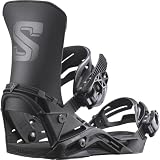
The best overall step-in snowboard binding is the Nidecker LT Supermatic, which took Ryan 3.1 seconds from standing to locked in on the flat, with no heel lift.

Nidecker LT Supermatic
- Weight: 1,215 g
- Heel stack: 22 mm
- Flat entry: 3.1 s
- Boots: Any standard boot
Bottom Line : Assisted entry that Ryan found hands-free on ordinary boots, the quickest of any binding that takes them, with no heel lift. It's one of the two heaviest bindings here.
Pros
- Quickest entry of the ordinary-boot bindings on the flat, on a steep traverse and in slush
- Drops in on a steep traverse without rolling onto your knees
- No heel lift, ankle roll or toe-edge lag on hard salted ice
- Worked with all three standard test boots with no clearance trouble
Cons
- 1,215 g with a 22 mm heel stack, heavier underfoot than a strap binding
Who it's best for
Ryan, our 6 ft 2, 215 lb heavy rider, tested it hardest for lock durability and flat-landing impact, with James co-testing boot swaps and timing. It suits all-mountain resort riders who want quick, assisted entry without being forced into proprietary boots.
Why we love it
Entry (9.5). Ryan's runs came in at 3.1 seconds on the flat, 5.6 on a steep traverse and 7.2 in slush. In his runs, pushing the heel pedal with the boot heel triggered the roller cam without any hands, so on a steep traverse he dropped straight in without rolling onto his knees. The best thing Ryan found was stepping in smoothly while sliding away from the T-bar, with no ratchet to touch and no need to sit down. The maker calls it an assisted entry design that keeps a classic strapped feel.
Instep (9.5). The strap presses down across the top of the foot instead of only gripping at the sides. Ryan had no heel lift, no ankle roll and no lag before the toe edge engaged on hard, salted ice.
Boots (10.0). One of two perfect scores in this guide. The Ride Fuse, Burton Ion and Vans Hi-Standard Pro all went in with no clearance friction.
What we didn't like
Weight and bulk is the price (8.0). At 1,215 g with a 22 mm heel stack it's heavier underfoot than a strap binding. Nothing else drew a complaint: the roller cam and heel latch cleared wet summer slush with no icing jams, and nothing broke or loosened.
Should you buy it?
Grams are the catch with the LT Supermatic, and at the premium tier the speed is what you pay for. If you want assisted entry that Ryan found hands-free on the boots you already own, it's the one we'd buy first. The Burton Step On Re:Flex is 355 g lighter but needs Step On boots, and the Flow Fuse Hybrid is 235 g lighter and takes 2.0 seconds longer on the flat. New riders get a binding that needs no ratchet work, and hard riders get no heel lift on hard, salted ice. We tested size Large.
Read our full Nidecker LT Supermatic review →

What is the best step-in snowboard binding for carving?
The best step-in snowboard binding for carving is the Bent Metal Lightning Supermatic, which took Ryan 3.2 seconds from standing to locked in on the flat and gave him sharp toe-side carves.

Bent Metal Lightning Supermatic
- Weight: 1,230 g
- Heel stack: 22 mm
- Flat entry: 3.2 s
- Boots: Any standard boot
Bottom Line : Heel-pedal entry as fast as the LT Supermatic, with an asymmetric highback and a forward lean Ryan found easy to set without tools. It's the heaviest binding here and its chassis is thick.
Pros
- Heel-pedal entry in 3.2 seconds on the flat and 7.4 in slush
- Dual-band ankle strap wraps the instep firmly with no hot spots
- Ryan found the forward lean adjusts without tools
- All hardware stayed torqued through aggressive park laps
Cons
- Heaviest binding here at 1,230 g
- Thick chassis stiffens board flex right under your feet
Who it's best for
Ryan rode it for lock durability and downward instep pressure, with Amy co-testing through park laps. It suits aggressive carvers and freeriders who want Supermatic step-in speed with an asymmetric highback and a forward lean Ryan could set without tools.
Why we love it
Entry (9.5). Standing to locked in took 3.2 seconds on the flat, 5.8 steep and 7.4 in slush. The maker says you step in through the back, push down on the heel pedal, and the highback and straps close automatically. It shut with a firm mechanical thud.
Instep (9.5). The dual-band ankle strap combines two bands with different flex and coverage, and it wrapped Ryan's instep with no hot spots. Downward clamp was instant, which gave him sharp toe-side carves. He also found the forward lean adjusts without tools.
Boots (10.0). The Ride Fuse, Burton Ion and Vans Hi-Standard Pro all fit with no trouble. The maker says the toe strap flips to suit different boot shapes.
What we didn't like
Weight and bulk is the price (8.0). At 1,230 g it's the heaviest binding in the guide, 15 g over the LT Supermatic, and the thick chassis stiffens the board underfoot. The hardware stayed torqued and the ratchets held their position through aggressive park laps.
Should you buy it?
If you carve or freeride, the Lightning is our pick: it has the LT Supermatic's entry speed plus an asymmetric highback and, in Ryan's hands, a forward lean you can set without tools. Skip it if weight matters, since it shares the premium tier with the LT Supermatic. The Flow Fuse Hybrid is 250 g lighter but slower to enter. The Lightning and the LT tie at 93 and were within 0.2 seconds of each other in every kind of snow, so choose between them on the highback shape, the forward lean and 15 g. We tested size Large.
Read our full Bent Metal Lightning Supermatic review →

What is the best step-in snowboard binding for freeride?
The best step-in snowboard binding for freeride is the Bent Metal Speed-In Pro, whose aluminum heel cup and stiff 8 out of 10 highback gave Ryan instant heelside power with zero heel slop.

Bent Metal Speed-In Pro
- Weight: 1,090 g
- Heel stack: 19 mm
- Flat entry: 4.2 s
- Boots: Any standard boot
Bottom Line : A stiff rear-entry binding for hard riding on standard boots, with a strap that opens itself and a button to ease instep tension between laps. The highback lever is hard to open in cold gloves.
Pros
- Upper strap pulls open as the highback drops, leaving a clear boot throat
- A button eases instep tension while you wait at the T-bar
- Aluminum heel cup and stiff highback: zero heel slop
- Heel cup hardware and cable guides stayed rigid under heavy load
Cons
- Highback locking lever needs strong thumb pressure to open in cold gloves
- Entry is slower than the Supermatic pair: 4.2 seconds on the flat
Who it's best for
Ryan rode it for instep pressure and chassis flex, with Shaun co-testing heelside carve bite. It suits aggressive freeriders and technical carvers who want a stiff, responsive quick-entry binding that works with standard boots.
Why we love it
Entry (8.5). As the highback drops, the upper strap pulls itself open and leaves an unobstructed boot throat, and the times were 4.2 seconds on the flat, 7.1 steep and 9.8 in slush. A button also lets you ease instep tension off between laps in the T-bar line.
Instep (9.0). The ankle strap and toe cap clamp the boot down tight. With the aluminum heel cup and the stiff 8 out of 10 highback, Ryan got instant heelside power and zero heel slop.
Boots (9.5). It works with standard boots. The maker puts the Large at US men's 10 to 12, which covers our test boots.
What we didn't like
The highback locking lever takes strong thumb pressure to pop open with cold gloves. Entry is also a step slower than the Supermatic pair: 4.2 seconds on the flat against 3.1 and 3.2. At 1,090 g it's the fourth heaviest of the ten (Weight & Bulk 7.5). The aluminum heel cup hardware stayed rigid.
Should you buy it?
Hard riders on standard boots should look here first: the Speed-In Pro is our freeride pick, stiff and rear-entry. It's wrong for anyone who wants the quickest entry or rides in thick gloves all day, because the lever takes a firm thumb and entry took 4.2 seconds on the flat. The way around both is the LT Supermatic, which is 1.1 seconds quicker on the flat and 125 g heavier. The LT is premium and the Speed-In Pro upper-mid, so the Flow Fuse Hybrid is the mid-price way to get rear entry on standard boots. Newer riders will find the Flow Fenix gentler. We tested size Large.
Read our full Bent Metal Speed-In Pro review →
What is the best step-in snowboard binding for freestyle?
The best step-in snowboard binding for freestyle is the Flow Fuse Hybrid, which Amy timed at 5.1 seconds on the flat between park laps, with minimal lag before the toe edge bit.

Flow Fuse Hybrid
- Weight: 980 g
- Heel stack: 18 mm
- Flat entry: 5.1 s
- Boots: Any standard boot
Bottom Line : Rear entry with a familiar toe-cap strap and a forgiving, lively flex for park laps. Closing the highback is hard when wet snow packs behind the heel.
Pros
- Straps lift out of the way as the highback reclines, so the boot throat opens wide
- Separate toe cap and ankle strap give a secure wrap
- Glass-filled nylon baseplate with a forgiving, lively lateral flex
- No mechanical issues: ratchets and strap alignment stayed true
Cons
- Highback lever needs a firm hand to close when wet snow packs behind the heel
- Slush entry took 11.2 seconds, well behind the Supermatic pair
Who it's best for
Amy rode it between park laps, timing quick entries and checking lateral ankle give and slush clearance, with James co-testing fit. It suits all-mountain freestyle riders who want rear-entry convenience with the familiar wrap and security of a toe-cap strap.
Why we love it
Entry (8.0). Amy's quick entries between park laps ran 5.1 seconds on the flat, 8.6 steep and 11.2 in slush. The straps lift out of the way as the highback reclines, which gave much more boot throat clearance than older Flow bindings.
Instep (8.5). The separate toe cap and ankle strap pull the boot back into the heel pocket, with solid downward hold and minimal toe lag.
Boots (9.5). Standard boots fit cleanly, with no pinching across the toe box.
Weight & Bulk (8.0). It weighs 980 g with an 18 mm heel stack, and the glass-filled nylon baseplate gave a forgiving lateral flex that suited park laps and slush butters.
What we didn't like
Locking the highback lever takes a firm hand once wet snow packs behind the heel, and slush entry was slow at 11.2 seconds. Nothing mechanical went wrong.
Should you buy it?
Wet snow is where the Fuse Hybrid struggles: the highback took a firm hand to close and slush entry took 11.2 seconds. The way around that's the LT Supermatic, whose roller cam cleared wet slush with no icing jams and which is 2.0 seconds quicker on the flat. If you ride freestyle or all-mountain and want rear entry with a strap you can trust, though, this is our freestyle pick, and it's mid-price, two tiers below the premium Supermatic bindings. For the lightest setup, the Burton Step On Re:Flex is 120 g lighter but needs Step On boots. We tested size Large.
Read our full Flow Fuse Hybrid review →
What is the best step-in snowboard binding for heavy riders?
The best step-in snowboard binding for heavy riders is the K2 Cinch GT, whose cable linkage held up under Ryan's 215 lb in test drops without slop.

K2 Cinch GT
- Weight: 1,180 g
- Heel stack: 20 mm
- Flat entry: 4.8 s
- Boots: Any standard boot
Bottom Line : The tight, locked-down hold of a traditional ratchet binding in a quick-entry chassis. It's heavy and complex, and the rear lever is hard to close when slush packs the heel pad.
Pros
- A linkage pulls the ankle strap onto the instep, so hold is firm, not a loose slip-fit
- Held up under Ryan's 215 lb in test drops without slop
- Fits standard boot shapes with no toe deformation
- Entry in 4.8 seconds on the flat
Cons
- 1,180 g with a 20 mm heel stack, the third heaviest here
- Rear lever takes high hand effort to close when wet slush packs under the heel pad
Who it's best for
Ryan rode it with Shaun co-testing, and tested it under his 215 lb in drops. It suits heavy riders and traditionalists who want rear-entry speed but demand an aggressive downward ankle clamp.
Why we love it
Entry (8.0). A cable linkage tilts the highback back while it lifts the ankle strap, and snapping the highback up clamps the strap back down. Times were 4.8 seconds on the flat, 7.9 steep and 10.5 in slush.
Instep (8.5). The linkage physically pulls the ankle strap onto the instep rather than relying on a loose slip-fit. That gives the hold of a traditional ratchet binding, and the cables and glass-fiber chassis held up under Ryan's test drops without slop.
Boots (9.5). Every standard boot profile fit with no toe deformation. The maker puts the Large at US men's 9 to 11.
What we didn't like
It's heavy and complex. At 1,180 g with a 20 mm heel stack it's the third heaviest binding here, and the testers marked Weight & Bulk down to 6.5 for the cables and hinge brackets. Closing the rear lever also took high hand effort when wet slush packed beneath the heel pad.
Should you buy it?
Heavy riders are who the Cinch GT is for: it's our mid-price pick for anyone who wants the hold of a ratchet binding with rear entry. Count the weight before you buy, because Weight & Bulk scored 6.5. The Flow Fuse Hybrid is 200 g lighter and 0.3 seconds slower on the flat, and the LT Supermatic is the faster choice. We tested size Large.
Read our full K2 Cinch GT review →
What is the best step-in snowboard binding for beginners?
The best step-in snowboard binding for beginners is the Flow Fenix, whose forgiving, pressure-free strap wrap avoided foot cramps for James over long cruising sessions.

Flow Fenix
- Weight: 940 g
- Heel stack: 17 mm
- Flat entry: 5.8 s
- Boots: Most standard boots
Bottom Line : A mellow, forgiving rear-entry binding with a strap that never cramped the foot. It lacks downward bite and flexes too much for fast, hard riding.
Pros
- Forgiving strap wrap with no pressure and no foot cramps on long sessions
- Reclining highback drops smoothly on the flat
- Mid-soft flex, 4 out of 10 per the maker
- Zero failures: the auto-locking buckles held their tension
Cons
- Too much chassis and highback flex for charging on salted morning ice
- A noticeable fraction-of-a-second lag before toe-side turns engage
- Wide-outsole boots rub the side rails on entry
Who it's best for
James rode it, with Amy co-testing. It suits progression-focused riders and cruising resort riders who want low-fuss rear entry with a mellow, forgiving flex. The maker lists it for beginner and intermediate riders.
Why we love it
Entry (7.5). Flat entry took 5.8 seconds, steep ground 9.4 and slush 12.5, and the reclining highback dropped smoothly on the flat.
Instep (7.5). The one-piece Fusion strap spreads pressure over a broad area, which is why James had no foot cramps during long cruising sessions.
Boots (9.0). It fits most boots.
Weight & Bulk (8.0). It weighs 940 g with a 17 mm heel stack.
What we didn't like
It gives up bite for comfort. The one-piece strap lacks aggressive downward bite, with a noticeable fraction-of-a-second lag before toe-side turns engage. On steep, tilted ground the softer nylon chassis flexed when James tried to kick a boot in, and wide-outsole boots rubbed against the nylon side rails on entry. It also flexes too much for charging on salted morning ice. The maker says the Fusion strap delivers direct edge power. James found a noticeable lag before toe-side turns engaged, so we wouldn't call it direct.
Should you buy it?
The Fenix is our mid-price beginner pick: a forgiving, low-fuss rear-entry binding for mellow resort days, and the maker lists it for beginner and intermediate riders. It's the wrong choice if you ride fast or on ice, because it lacks downward bite and flexes too much on salted morning ice. The step up is the Bent Metal Speed-In Pro, which scored 9.0 for instep hold against the Fenix's 7.5 and has a stiff 8 out of 10 highback. We tested size Large.
Read our full Flow Fenix review →
What is the best step-in snowboard binding for high-speed riding?
The best step-in snowboard binding for high-speed riding is the Flow NX2, whose aluminum-alloy baseplate gave Shaun immediate heelside carve power once he was locked in.

Flow NX2
- Weight: 1,020 g
- Heel stack: 17 mm
- Flat entry: 5.4 s
- Boots: Any standard boot
Bottom Line : Fast to open on flat snow and stiff once shut, with strong heelside power. Getting back in on steep, icy ground or in deep slush takes a lot of force.
Pros
- Rockered aluminum-alloy baseplate: immediate, unyielding heelside power
- A cable pulls the highback into the boot spine and locks out heelside slop
- Wide strap pocket clears bulky boot profiles
- Drops open quickly on flat snow
Cons
- Shoving the heel into the rear strap pocket on steep, icy traverses takes a lot of force
- In deep slush the highback needs kicking and tugging to get the lever over center
- Forward-lean cable barrel vibrated a quarter-turn loose on chattery morning ice
- Lowest Weight & Bulk score here (6.0)
Who it's best for
Shaun rode it for heelside carve bite and steep-ground entry, with Ryan co-testing. It suits heavy carvers and high-speed riders who want rear-entry speed but won't give up the stiffness of an aluminum baseplate.
Why we love it
Entry (7.5). Rear entry opens quickly on flat snow, in 5.4 seconds, then slows to 9.0 on the steep traverse and 12.0 in slush.
Instep (8.5). The wide Fusion strap spreads downward clamp evenly, and a cable pulls the highback into the boot spine to lock out heelside slop. Once locked, the rockered aluminum-alloy baseplate gave Shaun immediate, unyielding heelside carve power.
Boots (9.5). The wide strap pocket clears bulky boot profiles easily.
What we didn't like
Getting back in is the cost. On steep, icy traverses, shoving the heel into the rear strap pocket took a lot of force, and in deep slush Shaun had to kick and tug the highback to get the lever over center. The forward-lean cable barrel also vibrated a quarter-turn loose on chattery morning ice, and he re-tightened it with a driver. Weight & Bulk scored 6.0, the lowest here, at 1,020 g and a 17 mm heel stack. Ryan, who co-tested it, felt that bulk wasn't earned: for what is still a manual slip-in, the aluminum baseplate, cables and big highback lever felt like deadweight.
Should you buy it?
Entry speed is the price of the NX2's heelside power. If that trade suits you, it's our pick for high-speed riding, and it sits in the upper-mid tier. Steep, icy ground and slush are where it hurts: getting back in took a lot of force and 12.0 seconds in slush. The LT Supermatic is 2.3 seconds quicker on the flat and 4.8 seconds quicker in slush, and the Flow Fuse Hybrid is the gentler, mid-price rear-entry choice. If you buy the NX2, re-check the forward-lean cable barrel after a chattery morning, as Shaun had to with a driver. We tested size Large.
Read our full Flow NX2 review →
What is the best step-in snowboard binding for comfort?
The best step-in snowboard binding for comfort is the Burton Step On Genesis Re:Flex, whose suspended highback removed calf bite for Shaun and still got him locked in in 1.9 seconds on the flat.

Burton Step On Genesis Re:Flex
- Weight: 880 g
- Heel stack: 14 mm
- Flat entry: 1.9 s
- Boots: Step On boots only
Bottom Line : Step On speed with a suspended highback that takes out calf bite and soaks up vibration. It works only with Step On boots, so the full setup costs more once you buy them.
Pros
- 1.9 seconds on the flat and the fastest steep entry of the ten, at 5.0
- Kickback Hammock highback cradles the heel and removes calf bite
- Full-length cushioning and a suspended highback that cut vibration
- 880 g and a 14 mm heel stack, the second lightest and second lowest here
Cons
- Works only with Step On boots, so Boots scored 3.0
- Needs its own Step On boots, so the full setup costs more
Who it's best for
Shaun rode it for edge response and steep-ground entry, with Amy co-testing. It suits carvers and freeriders who want Step On speed, strong vibration damping and all-day calf comfort, and who are willing to buy Step On boots.
Why we love it
Entry (9.0). The Kickback Hammock highback acts as an elastic spring that guides the boot heel into the rear cleat a little more smoothly than the standard Step On Re:Flex. Shaun got in in 1.9 seconds on the flat, 5.0 steep (the quickest steep time of the ten) and 8.7 in slush.
Instep (9.5). There are no straps. The two-piece suspended highback cradles the boot spine, takes out the rigid, jarring feedback of standard step-in systems and removes highback calf bite, and Shaun kept instant edge bite.
Weight & Bulk (9.5). It weighs 880 g with a 14 mm heel stack, with no straps or ratchets to carry.
What we didn't like
Boots are the catch (3.0). It works only with Step On boots, so your current pair won't do. We rode the Burton Photon Step On and Ion Step On, both US men's 10.5. Because it needs its own Step On boots, the full setup costs more.
Should you buy it?
Anyone who will buy Step On boots and wants a ride without the jarring feedback of the standard Step On, in the fastest class of binding, should pick the Genesis, our comfort pick. Keep your own boots and it's the wrong binding. The binding itself is mid-price, but count the Step On boots when you weigh value, because the full setup costs more; the Check Latest Prices button shows the current figure. The LT Supermatic takes your boots, 1.2 seconds slower on the flat and 335 g heavier. The maker puts the Medium at US men's 8.5 to 10.5, which covers our 10.5 test boots. We tested size Medium.
Read our full Burton Step On Genesis Re:Flex review →
What is the best lightweight step-in snowboard binding?
The best lightweight step-in snowboard binding is the Burton Step On Re:Flex, which weighs 860 g, the lightest binding here, and which took Shaun 1.8 seconds from standing to locked in on the flat.
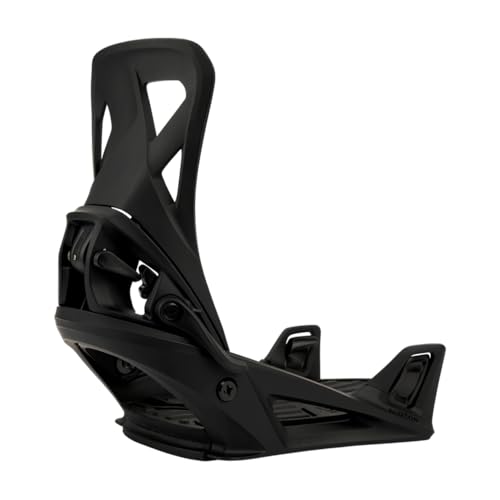
Burton Step On Re:Flex
- Weight: 860 g
- Heel stack: 13 mm
- Flat entry: 1.8 s
- Boots: Step On boots only
Bottom Line : The fastest binding on the flat and the lightest, with direct, lag-free edge response. It takes only Step On boots, and slush in the heel pocket can stop the heel clicking home.
Pros
- 1.8 seconds on the flat, the fastest of the ten
- 860 g and a 13 mm heel stack: the lightest and lowest binding here
- Zero heel lift and instant toe-edge response
- Cleat latches and release levers worked with no looseness
Cons
- Works only with Step On boots, so Boots scored 3.0
- On steep ground or in wet slush the heel cleat needs deliberate downward hip pressure to reach its second click
- Slush or ice packed into the heel pocket can stop that second click
Who it's best for
Shaun rode it for edge-to-edge lag and steep-ground entry, with James co-testing. It suits resort riders who will invest in a boot-and-binding system and put low weight and instant carve response first.
Why we love it
Entry (9.0). On the flat you drop the heel cleat in, click down on the toes and go: 1.8 seconds, then 5.2 steep and 8.9 in slush.
Instep (9.0). There are no straps. The boot locks into the binding at three points, two at the toe and one at the heel, and Shaun had zero heel lift and instant, lag-free toe-edge response.
Weight & Bulk (9.5). At 860 g and 13 mm, with no straps or ratchets, it's the lightest and sits the lowest of the ten.
What we didn't like
Boots are the catch (3.0). It takes Step On boots only; we rode the Burton Photon Step On and Ion Step On, both US men's 10.5, and ordinary boots won't fit. Getting the heel cleat into its second safety click on steep ground or in wet slush took deliberate downward hip pressure, and slush or ice packed into the heel pocket could stop it engaging.
Should you buy it?
Lightest and quickest on the flat, the Step On Re:Flex is our lightweight pick for anyone who will commit to Step On boots, and it's mid-price before you add the boots. Steep ground and wet slush are where it struggles: the heel cleat needed deliberate hip pressure, and slush or ice in the heel pocket could stop the second click, so check the pocket is clear before you step in. For a smoother, more damped ride for 20 g more at the same price, look at the Burton Step On Genesis Re:Flex. If you want to keep your boots, the LT Supermatic is the one. Check the maker's size chart against your boot size before you order. We tested size Medium.
Read our full Burton Step On Re:Flex review →
What is the best budget step-in snowboard binding?
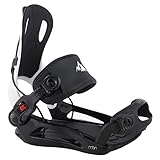
The best budget step-in snowboard binding is the System MTN Rear Entry, which gave James straightforward rear entry on mellow resort laps at 920 g.

System MTN Rear Entry
- Weight: 920 g
- Heel stack: 18 mm
- Flat entry: 6.5 s
- Boots: Most standard boots
Bottom Line : Simple, no-fuss rear entry for casual riding. It was the slowest to enter here, the heel lifted on hard carves, and its strap adjusters slipped a tooth under a 215 lb rider.
Pros
- Straightforward rear entry for casual riding
- Broad coverage from the molded 3D strap
- Full EVA padding on the highback and dense dampening in the footbed, per the maker
- 920 g and an 18 mm heel stack
Cons
- Slowest entry of the ten in every kind of snow
- Loose downward instep clamp: heel lift on hard heelside carves and toe-side edge lag
- Plastic slide-lock strap adjusters slipped one tooth under Ryan's 215 lb
- Wide boot outsoles wedge against the side rails on entry
Who it's best for
Ryan rode it for chassis flex and strap slippage under heavy load, with James co-testing. It suits budget-conscious weekend cruisers who want a straightforward rear-entry binding for mellow resort laps.
Why we love it
Entry (6.5). Slowest of the ten: 6.5 seconds on the flat, 11.8 steep and 14.6 in slush, though the highback does drop open and the binding works as a plain rear-entry design.
Instep (6.5). The molded 3D strap gives broad coverage over the instep.
Boots (8.5) and Weight & Bulk (8.5). Standard boots fit, though wide outsoles wedge against the side rails. At 920 g with an 18 mm heel stack it's lighter than everything except the two Step On bindings.
What we didn't like
Entry and hold are the problems. The one-piece strap stays low, so on steep slopes or in wet slush James had to wrestle the boot in with two hands. The downward instep clamp is loose: the heel lifted on hard heelside carves, with noticeable toe-side edge lag. The plastic slide-lock strap adjusters also slipped one tooth under Ryan's 215 lb and had to be reset and clamped down. The maker promises instant response from the molded strap. James found a loose clamp, toe-side edge lag and heel lift on hard carves instead.
Should you buy it?
Budget is the whole case for the System MTN: it's clearly the budget pick, costing far less than any other binding here, and every other binding here entered faster and held better. It suits mellow resort laps and the simplest rear-entry design, and it's wrong for anyone who carves hard, because the heel lifted. If the strap adjusters slip a tooth, reset them and clamp them down. The Flow Fenix enters faster (5.8 seconds on the flat against 6.5), holds better and is the nearest step up. The maker puts the Large at US men's 9 to 11. We tested size Large.
Read our full System MTN Rear Entry review →
How did we test the step-in snowboard bindings?
We tested the step-in snowboard bindings by timing all ten three times on the flat, on a steep traverse and in slush on Horstman Glacier at Whistler Blackcomb in June and July 2026, then scoring entry, instep hold, boot compatibility, and weight and bulk.
Step-in here covers two kinds of binding. Burton's Step On has no straps: a special boot clicks into the binding. The rest take ordinary snowboard boots and open from the back, with a heel pedal (the two Supermatic bindings) or a reclining highback (the rest) that clears the boot throat. Either way, a step-in binding has one job: get you locked in fast, hold your foot down once you're, and still work with the boots you own. Four testers rode them, a mix of a heavy, high-impact rider, a freestyle park builder, a former racer and an alpine crossover tester. Three terms you'll see: the highback is the support behind your calf, the roller cam is the part that shuts the binding when your heel pushes the pedal, and heel stack is how high your heel sits above the board.
The snow ranged from salted morning glacier hardpack and firm training lanes to midday corn and heavy, wet afternoon slush. James held the stopwatch, a Seiko S056, and timed every binding three times in each of three places: flat ground at the T-bar exit, a steep side traverse and a deep slush run-out, and every time we print is the average of the three. Every binding was size Large except the two Burton Step On bindings, which were Medium. Non-Step On bindings sat on 2x4 mounts. Ryan rode a Lib Tech Terrain Wrecker 157 cm at 23 in, +18° front and -12° back. Amy rode a Capita Defenders of Awesome 154 cm at 21.5 in, true duck at +12° and -12°. James rode a Salomon Assassin 158 cm and Shaun a Capita The Black Snowboard of Death 159 cm, both at 22.5 in with +15° front and -9° back. The two Step On bindings went on a Burton Custom 158 cm with the Burton Channel mount, ridden by Shaun and James.
Standard-boot testing used the Ride Fuse (lace plus a tongue BOA dial) and the Burton Ion (lace), both in US men's 10.5, and the Vans Hi-Standard Pro in US men's 10. For the Step On bindings we wore the Burton Photon Step On and Burton Ion Step On, both US men's 10.5. Every binding was scored out of 10 on four qualities:
- Entry Time & Ease: average seconds from standing to locked in, over three timed entries on the flat, on a steep traverse and in slush
- Instep Hold: whether it presses down on the top of the foot or only grips the sides, any heel lift, and any lag before the toe edge bites
- Boot Compatibility: whether it works with any snowboard boot or needs a special one, and how well ordinary boots fit
- Weight & Bulk: one binding with its disc and hardware on an Ohaus Valor 1000 bench scale, plus heel stack height measured from the board topsheet to the top of the footbed under the center of the heel cup
The overall score out of 100 is the plain average of the four scores, times 10, so no single quality outweighs another. Entry times, weights and heel stack heights are measured and shown in tables, not as scores. Specs such as flex rating and mounting patterns come from the maker; every time, weight and result is ours. Each binding was ridden by one lead tester and one co-tester, listed in each section above. You can meet the testers at the bottom of this page.
Which step-in snowboard bindings suit your riding?
If you will not buy new boots, choose from the eight standard-boot bindings; the two Burton Step On bindings need Step On boots. Pick by the row that matches you.
| If you're… | Buy |
|---|---|
| Wanting assisted entry on ordinary boots, and happy to carry the weight | Nidecker LT Supermatic |
| Carving hard and wanting an asymmetric highback | Bent Metal Lightning Supermatic |
| Freeriding with a stiff highback and a strap you can ease off in the T-bar line | Bent Metal Speed-In Pro |
| Riding freestyle and wanting a toe-cap strap with rear entry | Flow Fuse Hybrid |
| Heavy, or wanting the hold of a traditional ratchet binding | K2 Cinch GT |
| Learning and wanting a forgiving, mellow rear-entry binding | Flow Fenix |
| Carving fast on an aluminum baseplate, and happy to work to get back in | Flow NX2 |
| Ready to buy Step On boots and wanting a damped, calf-friendly ride | Burton Step On Genesis Re:Flex |
| Ready to buy Step On boots and wanting the lightest binding, quickest on the flat | Burton Step On Re:Flex |
| Riding mellow resort laps and wanting the simplest rear-entry binding | System MTN Rear Entry |
What did our step-in snowboard binding tests show?
Our step-in snowboard binding tests showed that entry speed split the field in slush, boot compatibility split it into two Step On outliers and eight standard-boot bindings, and weight ran from 860 g to 1,230 g.
Where each quality was tested, what separated the bindings, and what riding them was like. Each binding's four scores are also in its card above.
How fast is entry on step-in snowboard bindings?
The fastest step-in snowboard binding to enter was the Burton Step On Re:Flex, at 1.8 seconds on the flat, and the fastest on ordinary boots was the Nidecker LT Supermatic, at 3.1 seconds.
Where we tested it. James timed every binding three times with a Seiko S056 stopwatch, from standing to locked in, on flat ground at the T-bar exit, on a steep side traverse and on a deep slush run-out. Each time we print is the average of the three timed entries.
What separated them. The two Supermatic bindings scored 9.5, the Burton Step On pair 9.0. The Step On pair were quickest on the flat, at 1.8 and 1.9 seconds, but in slush they took 8.9 and 8.7 seconds, against 7.2 for the LT Supermatic and 7.4 for the Lightning. The Step On Re:Flex needed deliberate downward hip pressure to reach its second heel click on steep ground and in wet slush.
Every binding was slowest in slush. The LT Supermatic lost the least going from the flat to slush, 4.1 seconds, and the System MTN the most, 8.1 seconds. The System MTN took 6.5 seconds on the flat, 11.8 on the steep traverse and 14.6 in slush, with two-handed wrestling to get a boot in. The Flow Fenix and Flow NX2 scored 7.5, and both were slow once the snow got wet.
What it felt like. Packed snow behind the heel was the common enemy. It made the highback lever hard to close on the Flow Fuse Hybrid and K2 Cinch GT, and the Flow NX2 needed kicking and tugging in deep slush. The LT Supermatic's roller cam and heel latch cleared wet summer slush with no icing jams.
| Binding | Flat (avg s) | Steep (avg s) | Slush (avg s) |
|---|---|---|---|
| Burton Step On Re:Flex | 1.8 | 5.2 | 8.9 |
| Burton Step On Genesis Re:Flex | 1.9 | 5.0 | 8.7 |
| Nidecker LT Supermatic | 3.1 | 5.6 | 7.2 |
| Bent Metal Lightning Supermatic | 3.2 | 5.8 | 7.4 |
| Bent Metal Speed-In Pro | 4.2 | 7.1 | 9.8 |
| K2 Cinch GT | 4.8 | 7.9 | 10.5 |
| Flow Fuse Hybrid | 5.1 | 8.6 | 11.2 |
| Flow NX2 | 5.4 | 9.0 | 12.0 |
| Flow Fenix | 5.8 | 9.4 | 12.5 |
| System MTN Rear Entry | 6.5 | 11.8 | 14.6 |
How well do step-in snowboard bindings hold your instep?
The step-in snowboard bindings with the best instep hold were the Nidecker LT Supermatic, Bent Metal Lightning Supermatic and Burton Step On Genesis Re:Flex, which each scored 9.5.
Where we tested it. Each tester judged hold on the board they rode all session, checking whether the binding pressed down on the top of the foot or only gripped the sides, whether the heel lifted, and whether there was any lag before the toe edge bit. Ryan's clearest read came on hard, salted ice.
What separated them. Three different designs tied at 9.5. The LT Supermatic's strap presses across the top of the foot, and Ryan had no heel lift, no ankle roll and no toe-edge lag on hard salted ice. The Lightning's dual-band strap gave instant downward clamp. The Genesis has no straps at all: the boot locks in at the toe and heel and a suspended highback cradles the spine. The Bent Metal Speed-In Pro and Burton Step On Re:Flex followed at 9.0.
At the bottom, the Flow Fenix scored 7.5, with a fraction-of-a-second lag before toe-side turns engaged, and the System MTN 6.5, with heel lift on hard heelside carves and toe-side edge lag.
What it felt like. Heel lift was the thing we watched for. The LT Supermatic and Step On Re:Flex showed none, the Speed-In Pro showed zero heel slop, and the System MTN was the one that lifted.
| Binding | What we found |
|---|---|
| Nidecker LT Supermatic | Strap presses down across the instep; no heel lift or toe-edge lag |
| Bent Metal Lightning Supermatic | Dual-band strap, instant downward clamp, sharp toe-side carves |
| Burton Step On Genesis Re:Flex | No straps; suspended highback, no calf bite, instant edge bite |
| Bent Metal Speed-In Pro | Strap and toe cap clamp tight; aluminum heel cup, zero heel slop |
| Burton Step On Re:Flex | Boot locks at three points; zero heel lift, instant toe-edge response |
| Flow Fuse Hybrid | Toe cap and ankle strap pull the boot back; minimal toe lag |
| K2 Cinch GT | Linkage pulls the strap onto the instep; ratchet-binding hold |
| Flow NX2 | Wide strap and cable lock out heelside slop |
| Flow Fenix | Broad wrap, little downward bite; slight toe-side lag |
| System MTN Rear Entry | Broad strap, loose clamp; heel lift on hard heelside carves |
Which step-in snowboard bindings work with any boot?
Every step-in snowboard binding here except the two Burton Step On models worked with ordinary snowboard boots, and the Nidecker LT Supermatic and Bent Metal Lightning Supermatic scored a perfect 10.0.
Where we tested it. James ran the boot swaps: the Ride Fuse, the Burton Ion lace boot and the Vans Hi-Standard Pro on the standard-boot bindings, and the Burton Photon Step On and Ion Step On on the two Step On bindings.
What separated them. The LT Supermatic and Lightning took all three standard boots with no clearance friction. The Speed-In Pro, Flow Fuse Hybrid, K2 Cinch GT and Flow NX2 all scored 9.5: the Fuse caused no pinching across the toe box, the Cinch GT no toe deformation, and the NX2's wide strap pocket cleared bulky boot profiles.
The Flow Fenix scored 9.0 and the System MTN 8.5 because wide-outsole boots rubbed or wedged against their side rails on entry. The two Step On bindings scored 3.0: they need Step On or officially licensed Step On boots and won't take anything else.
What it felt like. On a standard-boot binding the only trouble was wide outsoles catching on the side rails. On the Step On pair, the question was never fit, it was whether you own the boots.
| Binding | What we found |
|---|---|
| Nidecker LT Supermatic | Universal; three boots, zero clearance friction |
| Bent Metal Lightning Supermatic | Universal; flawless on all three boots |
| Bent Metal Speed-In Pro | Universal for standard boots |
| Flow Fuse Hybrid | Standard boots fit with no toe-box pinching |
| K2 Cinch GT | Every standard profile, no toe deformation |
| Flow NX2 | Wide strap pocket clears bulky boots |
| Flow Fenix | Most boots; wide outsoles rub the side rails |
| System MTN Rear Entry | Standard boots; wide outsoles wedge on the side rails |
| Burton Step On Genesis Re:Flex | Step On boots only |
| Burton Step On Re:Flex | Step On boots only, ordinary boots won't fit |
How much do step-in snowboard bindings weigh?
A single step-in snowboard binding in our test weighed between 860 g and 1,230 g with its disc and hardware; the lightest was the Burton Step On Re:Flex and the heaviest the Bent Metal Lightning Supermatic.
Where we tested it. We weighed one binding, with its disc and hardware, on an Ohaus Valor 1000 digital bench scale, and measured heel stack height from the board topsheet to the top of the footbed directly under the center of the heel cup. Weight & Bulk is scored out of 10 and counts toward the overall number, and the grams and millimeters are in the table below.
What separated them. The two Step On bindings were lightest and lowest: 860 g and 13 mm for the Re:Flex, 880 g and 14 mm for the Genesis, and both scored 9.5. With no straps or ratchets, the Re:Flex sits the lowest of the ten. The Lightning Supermatic was heaviest at 1,230 g, about 43% more than the Re:Flex, and both Supermatic bindings had the tallest heel stack, 22 mm.
Scores don't follow grams alone, because the Weight & Bulk score counts what the weight buys, not just the number on the scale. The K2 Cinch GT scored 6.5 for a heavy, complex build at 1,180 g with a 20 mm stack. The Flow NX2 scored 6.0, the lowest, at 1,020 g and 17 mm, while both Supermatic bindings scored 8.0 at 1,215 g and 1,230 g. Ryan, who tested the Supermatic and the NX2, explained the gap:
The Supermatic's extra grams earn their keep with an automatic hands-free roller cam, whereas the NX2's aluminum slab, steel cables, and massive highback lever feel like clunky deadweight for what is still a manual slip-in.
Ryan, Top-Notch test team
What it felt like. Testers felt the weight most on the two Supermatic bindings, the K2 Cinch GT and the Flow NX2, where Ryan felt it wasn't earned. On the Step On Re:Flex they called out the low, light feel.
| Binding | Weight | Heel stack |
|---|---|---|
| Burton Step On Re:Flex | 860 g | 13 mm |
| Burton Step On Genesis Re:Flex | 880 g | 14 mm |
| System MTN Rear Entry | 920 g | 18 mm |
| Flow Fenix | 940 g | 17 mm |
| Flow Fuse Hybrid | 980 g | 18 mm |
| Flow NX2 | 1,020 g | 17 mm |
| Bent Metal Speed-In Pro | 1,090 g | 19 mm |
| K2 Cinch GT | 1,180 g | 20 mm |
| Nidecker LT Supermatic | 1,215 g | 22 mm |
| Bent Metal Lightning Supermatic | 1,230 g | 22 mm |
What do people ask about step-in snowboard bindings?
These are common questions about step-in snowboard bindings, answered from our own test results.
How fast can you get into step-in snowboard bindings?
The fastest step-in snowboard binding to get into was the Burton Step On Re:Flex, at 1.8 seconds on the flat, and the Nidecker LT Supermatic was fastest on ordinary boots, at 3.1 seconds. In wet slush the quickest was the LT Supermatic at 7.2 seconds and the slowest the System MTN at 14.6 seconds.
Do step-in snowboard bindings work with any boots?
Eight of our ten step-in snowboard bindings take ordinary snowboard boots, though wide outsoles rubbed on the Flow Fenix and System MTN. The Nidecker LT Supermatic and Bent Metal Lightning Supermatic took the Ride Fuse, Burton Ion and Vans Hi-Standard Pro with no clearance friction, and scored a perfect 10.0. The two Burton Step On bindings don't: they need Step On boots, and we rode the Photon and Ion Step On.
Are step-in snowboard bindings heavy?
Step-in snowboard bindings in our test ranged from 860 g to 1,230 g for a single binding with its disc and hardware. The two Step On bindings were the lightest at 860 g and 880 g, and the two Supermatic bindings the heaviest, at 1,215 g and 1,230 g.
Do step-in snowboard bindings work in slush?
Step-in snowboard bindings do work in slush, but wet snow slows every one. The LT Supermatic lost only 4.1 seconds going from the flat to slush, and its roller cam and heel latch cleared wet summer slush with no icing jams. Slush packed behind the heel made the highback lever hard to close on the Flow Fuse Hybrid, K2 Cinch GT and Flow NX2, and slush or ice in the heel pocket can stop the Burton Step On Re:Flex clicking home.
What size step-in snowboard binding do I need?
Pick a step-in snowboard binding size by your boot size. Our testers rode size Medium on the two Burton Step On bindings and Large on the rest, with US men's boots in size 10 to 10.5. Sizes run by boot size and differ between makers, so check each maker's chart before you order; the buttons above go to each binding's page. For the Burton Step On bindings, match the size chart to your Step On boot.
What are the 10 best step-in snowboard bindings?
The 10 best step-in snowboard bindings are the ten ranked above, led by the Nidecker LT Supermatic.
For most riders, buy the Nidecker LT Supermatic, or the Bent Metal Lightning Supermatic if you carve. The Bent Metal Speed-In Pro is the stiff freeride choice, the Flow Fuse Hybrid the freestyle one, the Flow Fenix the gentle start and the System MTN Rear Entry the budget pick. If you'll buy Step On boots, the Burton Step On Re:Flex is the lightest and quickest on the flat, and the Burton Step On Genesis Re:Flex is the comfort pick. Prices move, so use the Check Latest Prices button on each card: the two Supermatics are premium, the Speed-In Pro and the NX2 upper-mid, the Fuse Hybrid, Cinch GT, Fenix and both Burton bindings mid-price, the System MTN the cheapest here by a distance, and a Step On binding needs boots on top. Need a board to mount them on? See our best snowboards guide.
Editor's Note, 9 November 2026: New guide. In June and July 2026 Ryan, Amy, James and Shaun rode ten step-in and quick-entry snowboard bindings on Horstman Glacier at Whistler Blackcomb, timed entry three times on the flat, on a steep traverse and in slush, weighed each binding, and scored each on entry, instep hold, boot compatibility, and weight and bulk.
Our Testers
This guide was written from the field notes of Ryan Williams, Amy Carter, James Ward and Shaun Taylor.
- Sean Williams, Editor-in-Chief. A former commercial outdoor copywriter and gear journalist who runs Top-Notch Outdoor as an independent publisher, with no brand-funded trips and no supplied ad copy.
- Ryan Williams, Lead Tester. A heavy fleet equipment mechanic and commercial vehicle technician. At 6 ft 2 and 215 lb he is our heavy, high-impact user, and here he led testing of the Nidecker LT Supermatic, Bent Metal Lightning Supermatic, Bent Metal Speed-In Pro, K2 Cinch GT and System MTN Rear Entry.
- Amy Carter, Freestyle Snowboard Tester. An action sports videographer and terrain park builder, and our strongest snowboarder. Amy led testing of the Flow Fuse Hybrid.
- James Ward, Alpine Ski & Fat Bike Tester. On skis since he was 3 and a former regional alpine racer, now a ski tuner and dryland fitness coach. James led testing of the Flow Fenix, and ran the stopwatch and the boot swaps for every binding.
- Shaun Taylor, Freeride Snowboard Tester. Raced banked slalom and halfpipe in the late 1980s and 1990s before turning to backcountry freeriding, and a finish carpenter by trade. Shaun led testing of the Flow NX2, Burton Step On Genesis Re:Flex and Burton Step On Re:Flex.