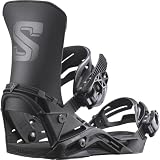
What is the best overall budget snowboard binding?
The best overall budget snowboard binding is the Burton Freestyle Re:Flex, whose ratchets bit with no slipped tooth at 26°F through frozen salt spray, and which took only 6 minutes to set up, the quickest of the eleven.

Burton Freestyle Re:Flex
- Weight: 830 g
- Setup time: 6 min
- Baseplate: Polycarbonate
- Cushioning: FullBED
Bottom Line : The best ratchets in the guide, edge-to-edge cushioning and the quickest setup, at 830 g. The highback is so soft it folds when you drive a heelside carve on firm snow.
Pros
- Best ratchets in the guide (8.5): no slipped pawl at 26°F with frozen salt on the ladders
- Cushioning runs edge to edge: tied for the most comfortable binding here (8.5)
- Quickest setup of the eleven, at 6 minutes, with the forward lean dialed in by hand
- No baseplate creaks under James, at 830 g
Cons
- The very soft highback folds when you drive heelside carves on firm snow
- Disc screws needed a quarter turn after day two on 4x4 inserts, so use blue threadlocker
Who it's best for
First-timers, mellow resort cruisers and lighter riders get the most from it, because the foot stays pain-free and the highback forgives. James led its testing and Amy co-tested. If you already drive heelside carves on firm snow, it's the wrong binding.
Why we love it
Ratchet & Build Quality (8.5). At 26°F, with frozen salt spray on the ladders, the levers cranked down with a deep bite and no pawl slipped. The testers called the aluminum ratchets the best buckles in the budget class, and the one-piece polycarbonate baseplate didn't creak under James.
All-Day Comfort (8.5). The ankle strap has no rigid seams, so it wraps the boot tongue without a pinch point. The maker says FullBED gives full underfoot support, and in the testers' hands it ran edge to edge and kept firm glacier chatter out of the soles far better than the hard trays on its peers.
Ease of Setup (8.5). Six minutes from box to riding, the quickest of the eleven. The disc dropped onto 2x4 and 4x4 boards without binding, and the testers dialed in the MicroFLAD forward lean by hand in seconds.
What we didn't like
Once the testers tried to drive heelside carves on firm snow, the highback folded. Its spine is ultra-soft: it forgives a beginner's edge catches completely, and that's the trade. When your carving outgrows it, move up; the K2 Indy has more backbone to grow into.
The disc mounting screws needed a quarter turn after day two on 4x4 inserts, which the testers put down to the plate flexing under load, so the maker's "bombproof" holds for creaks but not for screws. Put blue threadlocker on them before the first run.
Should you buy it?
Buy the Re:Flex if you want one budget binding that does nearly everything well and you're still learning to link turns: it scored 84, the top of the eleven, and it's still a budget binding. Skip it once your heelside carves outgrow the soft highback. The K2 Indy scored 4 points lower but has the backbone to keep up. We tested size Large.
Read our full Burton Freestyle Re:Flex review →

What is the best budget snowboard binding for intermediate riders?
The best budget snowboard binding for intermediate riders is the K2 Indy, whose strap lengths, toe ramp and forward lean all adjusted without a screwdriver, and whose chassis wouldn't twist or creak under Ryan's 215 lb.

K2 Indy
- Weight: 860 g
- Setup time: 7 min
- Flex (maker): 5/10
- Forward lean: No tools
Bottom Line : Every adjustment is tool-free, the ratchets cleared packed slush and nothing wore. The footbed is flat, and the testers felt mild knee fatigue after four hours on firm snow.
Pros
- Tool-free strap length, toe ramp and forward lean, set up in 7 minutes
- Ratchets with solid, distinct clicks that cleared packed slush
- Chassis refused to twist or creak under Ryan's 215 lb on the bench
- No stress whitening, and every locking pin held for the whole test
Cons
- The footbed is flat, and the testers felt mild knee fatigue after four hours on firm morning snow
- The plastic forward-lean lever looks vulnerable if you step on it in the T-bar queue
Who it's best for
Ambitious beginners and intermediate riders who want a daily binding with backbone to grow into are the target. Ryan led its testing and Shaun co-tested. Riders whose knees complain by the afternoon should look at the canted K2 Sonic.
Why we love it
Ratchet & Build Quality (8.0). The testers found the aluminum ratchets gave solid, distinct clicks and cleared packed slush cleanly. The fiberglass-reinforced chassis wouldn't twist or creak when Ryan leaned his full 215 lb into it on the bench.
Ease of Setup (8.5). Strap length, toe ramp and forward lean all adjusted with heavy-duty lever pins and no screwdriver, which the maker confirms for the lean. It went onto 4x4 and 2x4 boards cleanly in 7 minutes.
All-Day Comfort (7.5). The maker calls the CustomCaddi ankle strap its most padded and cushy, and the testers found it took the instep pressure points out.
Value & Durability (8.0). The chassis and heel cup showed no stress whitening, and the ladder teeth barely wore even after being yanked tight in cold mitts.
What we didn't like
After four hours on firm morning snow, Ryan and Shaun felt mild fatigue on the outside of their knees. They found the footbed a flat slab of dense foam with no canting. If your knees are the weak point, the canted K2 Sonic fits better. The plastic forward-lean lever also feels vulnerable to a boot in the T-bar queue, so watch your feet there.
Should you buy it?
Take the Indy if you want a binding to learn on and still enjoy in your second season: it scored 80, tied for second, on budget money, and the maker rates the flex 5 out of 10. Pass if your knees tire by afternoon. The K2 Sonic scored 2 points lower but has a canted footbed. Size Large is the maker's US 9 to 11.
Read our full K2 Indy review →

What is the best budget snowboard binding for heavy riders?
The best budget snowboard binding for heavy riders is the Ride C-4, whose aluminum heel cup and 2.5° canted footbeds scored a flat 8.0 on all four measures.

Ride C-4
- Weight: 940 g
- Setup time: 9 min
- Heel cup: Aluminum
- Footbed: 2.5° canted
Bottom Line : An aluminum heel cup, canted footbeds and an even 8.0 on every measure. It's the heaviest binding here, the heel-cup bolts backed out under heavy carving, and the ratchet levers are stiff in the cold.
Pros
- A flat 8.0 on all four measures
- Aluminum heel cup on a composite baseplate, stiffer than the all-plastic frames
- Canted footbeds (2.5°, the maker says) aligned the knees on a wider stance
- The urethane highback took chatter without biting into the calves
Cons
- The heaviest binding here, at 940 g
- Heel-cup bolts backed out half a turn under Ryan's heavy carving, so use blue threadlocker
- Short-throw ratchet levers need firm thumb pressure to release in the cold
- Centering the heel cup means loosening two side screws
Who it's best for
Heavier beginners and aggressive riders on a budget are the fit, with an aluminum heel cup and a forgiving highback. Ryan led and Amy co-tested. Gram-counters should look at the Union Flite Pro instead.
Why we love it
Ratchet & Build Quality (8.0). The aluminum heel cup anchored to the composite baseplate gave a rigidity the testers didn't find in the all-plastic frames, and the linkage ratchets bit the ladders securely in the cold.
All-Day Comfort (8.0). The maker lists 2.5° canted footbeds, and the testers found they aligned the knees on a wider stance. They also found the urethane highback absorbed chatter without biting into the lower calves.
Ease of Setup (8.0). The heel cup slides to center the boot to the millimeter, once you've loosened two side machine screws. The composite disc mounted cleanly on 2x4 and 4x4 inserts in 9 minutes.
Value & Durability (8.0). No heel cup cracked, which the testers credit to the aluminum loop, and the ladder teeth showed only slight surface scuffing.
What we didn't like
At 940 g it's the heaviest of the eleven, and the short-throw ratchet levers are stubborn to release when your thumbs are cold or the ladders are packed with snow; knock the snow off first. The bolts held tight through 36 park laps in our freestyle test, but under Ryan's heavy carving the heel-cup bolts backed out half a turn by midday, so use blue threadlocker from the start.
Should you buy it?
Pick the C-4 if you're heavy or hard on gear and want the aluminum cup: it scored 80 and sits in the budget tier. Skip it if grams matter. The Union Flite Pro is 200 g lighter and scored 2 points lower. The maker sizes Large for US men's 10.5 and up.
Read our full Ride C-4 review →
What is the best budget snowboard binding for long days?
The best budget snowboard binding for long days is the Salomon Rhythm, whose thick ankle strap wrapped the boot with no hot spots or numbing, at 830 g.

Salomon Rhythm
- Weight: 830 g
- Setup time: 8 min
- Baseplate: Asymmetric
- Flex (maker): Soft
Bottom Line : A pillowy ankle strap that tied the Re:Flex for comfort. The ratchets feel spongy and the toe strap slides off blunt boot toes.
Pros
- Tied for the most comfortable binding here (8.5)
- Thick, pillowy ankle strap with no hot spots or numbing
- Strap-length pins flip open on the snow
- Disc fit 4x4, 2x4 and Channel inserts without binding, and the screws stayed seated
Cons
- Spongy composite ratchets, with release tabs sticky in thick gloves at 26°F
- The toe strap slid off blunt boot toes on flat landings, and the toe ladder slipped one click
- The baseplate twists a lot by hand
Who it's best for
Foot pain is the worry this binding answers, for first-time riders and casual resort cruisers. James and Amy tested it. If you want a stiff, precise board feel, the baseplate will disappoint you.
Why we love it
All-Day Comfort (8.5). The strap is thick and pillowy and forms around the boot tongue with no hot spots or numbing. The maker says it's molded for a comfortable fit, and in this case the claim held up.
Ease of Setup (8.0). The strap-length pins flip open quickly on the snow, and the universal composite disc fit 4x4, 2x4 and Channel inserts without binding, in 8 minutes.
Value & Durability (7.5). The baseplate and highback came through five full days with no structural problem.
What we didn't like
At 26°F the Rhythm's release tabs were sticky to unlatch in thick gloves, and its composite ratchets, smooth when clean, felt spongy under high tension. The toe strap tended to slide off the front of blunt boot toes on flat landings, and the toe ladder slipped one click off-axis. We'd check the toe strap after every big landing.
Should you buy it?
The Rhythm is the binding for long days on tired feet: it scored 79 for budget money. Move on if you want firmer hardware. The Burton Freestyle Re:Flex scored 5 points higher with better ratchets, and the Union Flite Pro is 90 g lighter. Size Large is the maker's 28.0 to 31.5 cm.
Read our full Salomon Rhythm review →
What is the best lightweight budget snowboard binding?
The best lightweight budget snowboard binding is the Union Flite Pro, which weighs 740 g, 50 g less than any other binding here, and went on in 7 minutes.
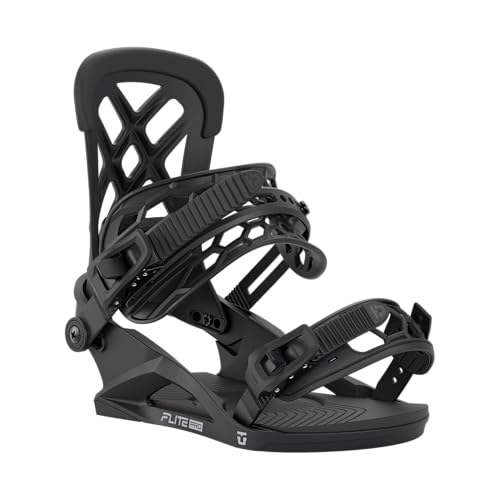
Union Flite Pro
- Weight: 740 g
- Setup time: 7 min
- Mounting: 4x4 and 2x4
- Toe strap: Slipped twice
Bottom Line : The lightest binding here by 50 g, with crisp ratchets and a 7-minute setup. The footbed is thin and the toe strap slid off the boot toe twice.
Pros
- 740 g, the lightest of the eleven and 50 g under the next
- Crisp, positive ratchet engagement in freezing conditions, the testers found
- Tool-free forward lean and quick-pin strap ladders
- The chassis stayed intact
Cons
- A thin footbed that buzzes into the heels on firm morning snow
- The toe strap slid off rounded boot toes twice
- The nylon chassis flexes under two-handed bench torsion, and heavier riders will overpower it
Who it's best for
Lighter riders, park learners and beginners who count grams are the fit. James led and Amy co-tested. Heavier riders will overpower the soft baseplate.
Why we love it
Weight. At 740 g it's 50 g lighter than the next binding, and the testers said it makes the board feel weightless through edge changes and spins.
Ratchet & Build Quality (7.5). The testers found the aluminum ratchets gave crisp, positive engagement that outclassed the plastic ones in the cold, although the nylon chassis flexed readily when twisted by hand.
Ease of Setup (8.5). The universal disc went onto 4x4 and 2x4 boards without fuss, and the tool-free forward lean and quick-pin strap ladders made it a 7-minute job.
What we didn't like
Riding firm morning hardpack sent a noticeable buzz into the heels through the sparse EVA, and boot soles felt raw after hours on chattery snow. The toe strap slid off rounded boot toes twice, which the testers logged in wet afternoon slush and on hard rail exits, and that falls short of the upgraded straps the maker promises. The chassis stayed intact. We'd test the toe strap on your own boots before you trust it, and recheck it after landings.
Should you buy it?
Count grams, ride light and the Flite Pro makes sense: it's budget-tier, and the thin footbed is where the saving shows. Look elsewhere if you're heavy or want padding. The Salomon Rhythm is 90 g heavier and scored 1 point higher, and the Ride C-4 is 200 g heavier and scored 2 higher. We tested size Large.
Read our full Union Flite Pro review →
What is the best budget snowboard binding for knee comfort?
The best budget snowboard binding for knee comfort is the K2 Sonic, which Ryan and James adjusted without tools in 7 minutes, and whose canted footbed kept knees aligned.

K2 Sonic
- Weight: 850 g
- Setup time: 7 min
- Chassis: Polycarbonate
- Footbed: Canted
Bottom Line : Tool-free adjustment, a canted footbed and no hardware back-out. The strap foam packs flat by late afternoon and the chassis twists under heavy lateral load.
Pros
- Strap and forward-lean adjustments need no tools, and setup took 7 minutes
- A canted footbed that kept the knees aligned and cut strain, which the testers say helps beginners
- Ratchet springs and mounting hardware stayed locked with zero back-out
- No structural damage in the test
Cons
- The ankle strap foam compresses flat under tight ratcheting, causing late-day instep pressure
- The chassis twisted moderately under heavy lateral load
- Ratchet levers felt slightly loose on their pivot pins
Who it's best for
Casual resort riders and newer riders who want to adjust the binding themselves, with a canted footbed for the knees, are the fit. Ryan led and James co-tested. A heavy, hard-charging rider may want a stiffer chassis, since Ryan, at 215 lb, felt moderate flex under heavy lateral load.
Why we love it
All-Day Comfort (7.5). The maker lists a canted footbed, and the testers called it a rare ergonomic bonus at this level that kept their knees aligned and cut the strain.
Ease of Setup (8.5). Strap adjustment and forward lean are tool-free, as the maker says, and the disc mounted cleanly on 4x4 and 2x4 boards in 7 minutes.
Value & Durability (7.5). There was no structural damage. The only wear was light scuffing where the highback's lean slide meets the heel cup track.
What we didn't like
The strap is the weak point. The maker says it's designed primarily with comfort in mind, and the die-cut foam does cushion reasonably well, but it compressed flat under tight ratcheting and left instep pressure by late afternoon. We'd loosen the strap a click once the foam flattens, rather than cranking harder. Separately, at 850 g with its disc and hardware the Sonic sits mid-pack for weight, 110 g heavier than the lightest binding here.
Should you buy it?
Choose the Sonic if you're new and want a binding you can adjust yourself, with a canted footbed for the knees: it scored 78 for budget money. It's the wrong choice for a heavy, aggressive rider. The Burton Freestyle Re:Flex scored 6 points higher and is the safer first binding, and the K2 Indy scored 2 higher. Size Large is the maker's US 9 to 11.
Read our full K2 Sonic review →
What is the best durable budget snowboard binding?
The best durable budget snowboard binding is the Ride C-2, whose aluminum heel cup showed no rear frame twist and no stripped ladder teeth. It's the durable pick for heavy riders because of its aluminum heel cup, though the System MTN scored higher on value and durability (9.0).

Ride C-2
- Weight: 890 g
- Setup time: 9 min
- Heel cup: Aluminum
- Footbed: Canted (maker)
Bottom Line : The aluminum heel cup is the reason to buy: no rear twist, no worn teeth. The footbed is thin, the release levers are stiff in mitts, and the C-4 scored 2 points higher.
Pros
- Aluminum heel cup on a composite tray with no rear frame twist
- No chassis flex fatigue or stripped ladder teeth
- Ratchets that bit the ladders securely in the cold
- 890 g, 50 g lighter than the C-4
Cons
- Thin padding let the firm morning refreeze buzz into Ryan's heels
- Release levers were stiff to pop open with cold mitts
- Heel-cup bolts needed checking after day one
- Centering the footprint means removing the heel-cup screws
Who it's best for
Riders who want an aluminum heel cup in a budget binding and don't mind a firmer, less padded footbed are the fit; Ryan led and James co-tested. The padding is thin, so it isn't the softest landing for a first-timer. If padding matters most, look at the Salomon Rhythm.
Why we love it
Ratchet & Build Quality (7.5). The composite tray with an aluminum heel cup made a solid platform with zero rear frame twist, and the ratchets bit the ladders securely in the cold.
Ease of Setup (8.0). The disc fit 2x4 and 4x4 patterns cleanly. Centering the footprint means removing the heel-cup machine screws, and the setup took 9 minutes.
Value & Durability (8.0). The testers saw no chassis flex fatigue and no stripped ladder teeth, and they credit the aluminum cup for a durability edge over the all-plastic bindings.
What we didn't like
Ryan felt the firm morning refreeze buzz straight into his heels through thin padding, even though the maker lists canted footbeds, and the molded one-piece ankle strap is contour-matched but barely padded. The release levers are also stiff to open in cold mitts, and the heel-cup bolts needed checking after day one, so tighten them before your first run. If the buzz bothers you, the Re:Flex cushions better.
Should you buy it?
At the top of the budget range, the C-2 has to beat the C-4, and it doesn't: the C-4 scored 2 points higher for 50 g more. Buy it only if the aluminum cup appeals and 50 g matters. The Union Flite Pro matches its 78 and is 150 g lighter. The maker sizes Large for US men's 10.5 and up.
Read our full Ride C-2 review →
What is the best budget snowboard binding for cold mornings?
The best budget snowboard binding for cold mornings is the Flux PR, whose Trigger Buckle ratchets engaged at 26°F without a single slipped tooth, with screws that stayed torqued. The Re:Flex scored higher for ratchets overall, but the PR's frame and hardware also showed almost no wear.

Flux PR
- Weight: 880 g
- Setup time: 11 min
- Ratchets: Trigger Buckle
- Ankle strap: Honeycomb
Bottom Line : Ratchets that wouldn't slip at 26°F and a frame with almost no wear. The footbed is raw and hard, and strap position and forward lean need a screwdriver.
Pros
- No slipped tooth at 26°F, and no chassis creak or flex
- Frame and hardware showed almost no wear, and the machine screws stayed torqued
- The disc fit 4x4 and 2x4 patterns cleanly
- Strap ladders and ratchets work without tools
Cons
- Comfort 6.5, joint second-lowest of the eleven: a raw nylon footbed with only a thin heel pad
- Intense footbed vibration and arch fatigue after three laps on salted morning ice
- Strap mounting position and forward lean need a #3 Phillips screwdriver
Who it's best for
Rugged reliability over soft padding is the pitch, so it suits budget riders who ride cold mornings and can live with a firm footbed. James led and Shaun co-tested. It's too firm underfoot to be a gentle first binding, and anyone who likes to tweak the fit on the hill will resent the screwdriver.
Why we love it
Ratchet & Build Quality (8.0). The Trigger Buckle ratchets engaged at 26°F without a single slipped tooth. The nylon baseplate showed no creak or flex underfoot.
Value & Durability (8.0). The frame and hardware showed almost no wear, and the traditional machine screws stayed torqued. The testers call it built for seasons of use.
What we didn't like
After three laps on salted morning ice, the testers reported intense footbed vibration and arch fatigue: the footbed is raw textured nylon with only a thin EVA pad under the heel bone. Ride it in short blocks on ice, or take the Rhythm, which scored 2.0 higher for comfort. The maker says tool-less adjustment, and that's true of the strap ladders and ratchets only. There's no lever for forward lean: you set it with stepped blocks at the heel cup pivots using a #3 Phillips screwdriver, and moving a strap's mounting position needs one too. Set the lean once at home.
Should you buy it?
Reliability in the cold is the whole case for the PR: it scored 75 and its ratchets never slipped at 26°F. It's the wrong binding for sore feet or hillside tuning. The Salomon Rhythm scored 4 points higher and is 50 g lighter. Setup took 11 minutes, with screwdriver work for strap position and lean.
Read our full Flux PR review →
What is the best budget step-in snowboard binding?
The best budget step-in snowboard binding is the System MTN Rear Entry, which earned the highest Value & Durability mark in the guide, 9.0, for a cable-and-lever highback that worked reliably on flat ground.

System MTN Rear Entry
- Weight: 920 g
- Setup time: 12 min
- Entry: Rear entry
- Large fits: US 9 to 11
Bottom Line : Rear entry for budget money and the top value score here (9.0). The strap adjusters feel flimsy, the chassis creaks when torqued, and a strap tight enough to stop heel lift pinches the instep.
Pros
- The highest Value & Durability score in the guide (9.0)
- Highback cable and locking lever worked reliably on flat ground
- The cable linkages, levers and chassis held together through heavy laps
- The disc mounts to 4x4 and 2x4 inserts, and the maker adds Channel boards
Cons
- Plastic slide-lock strap adjusters feel flimsy, and one slipped a tooth under heavy load
- The chassis flexed moderately and creaked when Ryan torqued it
- A narrow margin between heel lift and instep pressure from the molded strap
- The longest setup of the eleven, at 12 minutes
Who it's best for
Casual riders who want the speed of rear entry without premium money are who it suits; Ryan led and James co-tested. It's a binding for easy days, not for a rider moving into hard carving.
Why we love it
Value & Durability (9.0). The cable linkages, locking levers and chassis all survived heavy laps without a component failure, and that's rear entry for budget money.
Ease of Setup (7.5). The universal disc mounted on 4x4 and 2x4 inserts without issue. The rear cable took trial and error to balance entry clearance against the riding lock, and setup ran 12 minutes, the longest here.
All-Day Comfort (7.0). The one-piece 3D molded strap covers the instep broadly.
What we didn't like
Tightening the molded strap enough to stop heelside lift put a focal pressure point across the top of the foot, and the strap isn't contoured, which is short of the maximum comfort and instant response the maker promises. The slide-lock adjuster also slipped one tooth under heavy load and had to be reset and clamped. We'd reset it after the first few runs. If you carve hard, this isn't the binding; our best step-in snowboard bindings guide covers faster entry.
Should you buy it?
Rear entry is the reason to own the MTN, and it's the only rear-entry binding in this guide: it scored 75 at budget money. Skip it for hard carving or if you want crisp ratchets. The maker's Large fits US men's 9 to 11, and the testers' boots fit. See our best step-in snowboard bindings for the next step up.
Read our full System MTN Rear Entry review →
What is the best budget snowboard binding for casual riders?
The best budget snowboard binding for casual riders is the Head FX One LYT, whose Auto Open toe strap swings clear of the footbed so the boot doesn't crush it on entry, at 790 g.

Head FX One LYT
- Weight: 790 g
- Setup time: 8 min
- Toe strap: Auto Open
- Toe ramps: Adjustable
Bottom Line : A light binding with a clever toe strap and an easy setup. The chassis twists by hand, the levers feel brittle in the cold and the ankle strap pads narrowly.
Pros
- Auto Open toe strap swings clear of the footbed on entry
- 790 g, the second lightest of the eleven
- Tool-free forward lean adjuster, and the disc centered on 4x4 and 2x4
- Survived casual resort cruising
Cons
- The light chassis twists noticeably by hand
- Plastic levers felt brittle and stiff to release in sub-freezing air
- Narrow ankle strap padding concentrates pressure over the center of the tongue
- The soft highback shows flex fatigue in aggressive heelside turns
Who it's best for
Casual holiday riders and beginners who want a light binding with easy strap clearance are the fit. Shaun led and James co-tested. If you push into aggressive heelside turns, you'll find the chassis flexy.
Why we love it
Ease of Setup (8.0). The testers found the highback forward lean adjusts by hand, and the multi-disc centered easily on 4x4 and 2x4 hole patterns. The maker also lists 3x3 and Channel compatibility.
Value & Durability (7.0). It survives casual resort cruising.
Toe strap. The Auto Open design swings the strap fully out of the footbed when unbuckled, so the boot doesn't crush it on entry.
Weight. At 790 g it's the second lightest of the eleven, 50 g behind the Union Flite Pro.
What we didn't like
Push into aggressive heelside turns and the soft highback and baseplate show fatigue. The ratchets cranked down adequately, but the plastic levers felt brittle and stiff to release in sub-freezing air, and on a firm chatter landing the highback forward-lean adjuster shifted one notch. We'd work the levers gently on cold mornings, recheck the lean after landings, and keep it for relaxed cruising.
Should you buy it?
For a few relaxed days a year it does the job, in the budget tier: it scored 70, and the weight is its best feature. Look elsewhere if you'll ride most weekends. The Salomon Rhythm scored 9 points higher and the Union Flite Pro 8, and the Flite Pro is 50 g lighter. We tested size Large.
Read our full Head FX One LYT review →
What is the best budget snowboard binding for a first weekend?
The best budget snowboard binding for a first weekend is the 5th Element Summit Stealth, the cheapest binding here, which fit both 4x4 and 2x4 boards and went on in 10 minutes, though its ratchet pawls skipped teeth twice at 26°F.

5th Element Summit Stealth
- Weight: 810 g
- Setup time: 10 min
- Disc: Universal
- Maker's size guide: M/L, cut for US 7 to 10
Bottom Line : The cheapest binding here, and it works for a gentle first weekend. The ratchet pawls skipped teeth in the cold, the strap foam went flat in two hours and the screws loosened.
Pros
- The cheapest binding here, with a disc that fit both 4x4 and 2x4 patterns
- Functional for a first-timer's opening weekend
- 810 g, the third lightest of the eleven
Cons
- Ratchet pawls skipped teeth twice at 26°F when Ryan cranked them tight
- Thin, low-density strap foam compressed flat within two hours
- The baseplate creaked loudly under torsion, and the ladder teeth showed rounding after three days
- No threadlocker on the disc screws, and they loosened by the afternoon
Who it's best for
Ryan led and Shaun co-tested a binding for first-time riders on a very tight budget who need a bare-bones setup for a gentle weekend of green runs. Anyone planning more than a handful of days should step up.
Why we love it
Ease of Setup (7.5). The universal disc fit 4x4 and 2x4 patterns cleanly. Strap length needs a screwdriver, and setup took 10 minutes.
Value & Durability (6.5). The testers called it functional for a first-timer's opening weekend.
What we didn't like
At 26°F the ratchet pawls skipped teeth twice when Ryan cranked them down, the baseplate creaked loudly under torsion, and the strap foam compressed flat within two hours, letting the edges dig into the boot tongue. That falls short of the support and control the maker promises. The ladder teeth also showed visible rounding after just three testing days. The disc screws arrived without threadlocker and loosened slightly by afternoon, so add blue threadlocker before the first run and recheck it at lunch.
Should you buy it?
The 5th Element is for one gentle weekend: it's the cheapest binding here and scored 63. Skip it if you'll ride more than a few days. The Flux PR scored 12 points higher, and the Head FX One LYT scored 7 higher. It's sold as Medium/Large, and the maker's size guide puts that at men's boots 7 to 10, while our testers' boots were US 10.5, so size up if you're past 10.
Read our full 5th Element Summit Stealth review →
How did we test the budget snowboard bindings?
We tested the budget snowboard bindings by riding all eleven, two testers on each, on the teaching pitch beside the T-bar on Horstman Glacier at Whistler Blackcomb, the park run-outs and the lower cruising lanes in June and July 2026, then scoring ratchet and build quality, comfort, ease of setup, and value and durability.
A budget binding has to do the basics for as long as you ride it: hold your boot, ratchet tight in the cold, and not fall apart. Four testers rode them, two on each binding, and the lead and co-tester for each are named in its section above. James is an alpine ski tuner and dryland coach who ran the baseline turns, the hardware tolerances and the setup timing. Amy is a freestyle snowboarder and park builder who checked ratchets in freezing mitts and rode six-hour blocks on the Re:Flex, Rhythm, Flite Pro and C-4. Ryan, 6 ft 2 and 215 lb, stressed the chassis, the cold ratchets and the creaks. Shaun, a former banked slalom racer, checked heelside hold and highback strength. None of the four is a first-timer, so where we say a binding suits a beginner, that's our judgment from comfort, forgiveness and setup, not a beginner's report.
The snow was salted hardpack and refrozen glacier ice on the 7:30 AM laps, heavy wet granular snow (transition corn) by 11:00, and soupy afternoon slush with firm ruts in the shaded troughs. The coldest morning was 26°F (-3°C) with windchill, which is when we ran the ratchet test. The boards were a Salomon Assassin 158 cm (James), a Capita Defenders of Awesome 154 cm (Amy) and a Lib Tech Terrain Wrecker 157 cm (Ryan), all on a 2x4 mount, plus a K2 Raygun 156 cm on a standard 4x4 insert pack (James and Ryan). Boots were the Vans Hi-Standard Pro, a softer freestyle boot in US 10 (Amy), and the Ride Fuse and Burton Ion in US 10.5 (Ryan, James and Shaun), so our boots ran US 10 to 10.5. Every binding was size Large. We ran two stances: a beginner baseline at 22 in (56 cm) with +15° front and -9° back, and a centered freestyle stance at 21.5 in (55 cm) with +12° front and -12° back. In plain English: a ratchet is the buckle that tightens a strap, a ladder is the toothed strap it grips, a highback is the panel behind your calf, a pawl is the small catch inside the buckle, forward lean is how far the highback tips toward your shins, a canted footbed tilts your foot slightly inward so your knees line up, and the heel cup is the cradle behind your heel. Where we suggest a workaround, it's our advice, not something we tested.
Each binding was scored out of 10 on four qualities:
- Ratchet & Build Quality: working the ratchets with gloves on the coldest morning, then twisting the baseplate by hand and listening for creaks
- All-Day Comfort: a full day in the same binding, noting pressure points, numb toes and foot ache
- Ease of Setup: timing the job from box to riding, and noting whether it fit 4x4 and 2x4 holes and needed tools
- Value & Durability: checking after all the days for wear, loosening or breakage, and asking whether it would last a beginner several seasons
The overall score out of 100 is the plain average of the four scores, times 10, rounded to the nearest whole number, so no single quality outweighs another. Weight and setup minutes are measured: we weighed one binding with its disc and hardware on the same bench scale as our other binding tests, and weight has a table and no rating chart because it isn't scored. Price isn't scored either, and we print no prices: every binding here is budget, and the Check Latest Prices button shows today's number. Specs such as flex ratings and sizes come from the maker; every weight, time, score and result is ours. You can meet the testers at the bottom of this page.
Which budget snowboard bindings suit your riding?
Buy the Re:Flex unless one of these rows describes you better.
| If you are… | Buy |
|---|---|
| Buying one binding and wanting the best all-round score | Burton Freestyle Re:Flex |
| Moving up from your first board and wanting tool-free tuning | K2 Indy |
| Heavy or hard on gear, and wanting an aluminum heel cup | Ride C-4 |
| Riding long days and worried about sore feet | Salomon Rhythm |
| Counting grams, and riding light | Union Flite Pro |
| New to the sport and wanting a canted footbed for the knees | K2 Sonic |
| Wanting an aluminum heel cup at 50 g less than the C-4 | Ride C-2 |
| Riding cold mornings and wanting ratchets that don't slip | Flux PR |
| Hating bending over to strap in | System MTN Rear Entry |
| Riding a few relaxed days a year and wanting a light binding | Head FX One LYT |
| Buying for one gentle weekend on the tightest budget | 5th Element Summit Stealth |
What did our budget snowboard binding tests show?
Our budget snowboard binding tests showed that cold-morning ratchets and the footbed decided the ranking: ratchet and comfort scores each spread 3.0 points from best to worst, while ease of setup scores sat within 1.0.
Which budget snowboard bindings have the best ratchets and build quality?
The budget snowboard binding with the best ratchets and build quality was the Burton Freestyle Re:Flex at 8.5, followed by the K2 Indy, Ride C-4 and Flux PR at 8.0.
Where we tested it. On the coldest morning, 26°F with windchill at 7:30 AM, the testers worked the ratchets with gloves or mitts on, then twisted each baseplate by hand and listened for creaks.
What separated them. Only the Re:Flex reached 8.5. The Indy, C-4 and PR followed at 8.0, four bindings sat at 7.5 (Rhythm, Flite Pro, Sonic and C-2), and the Head FX One LYT and System MTN scored 6.5. The 5th Element stood alone at 5.5, 3.0 points under the Re:Flex.
Cold release was the common complaint. The Rhythm's release tabs were sticky with thick gloves, the C-2's levers were stiff to pop open in mitts and the C-4's needed firm thumb pressure in the cold, and the Head's levers felt brittle in sub-freezing air. Slipping was rarer: at 26°F, the 5th Element's were the only ratchet pawls that skipped teeth.
What it felt like. At 26°F, with frozen salt on the ladders, the Re:Flex levers cranked down with a deep bite and the PR engaged without a slipped tooth. On the 5th Element, the pawls skipped teeth twice when Ryan cranked them tight.
| Binding | What we found |
|---|---|
| Burton Freestyle Re:Flex | Deep bite at 26°F with frozen salt on the ladders; no pawl slipped |
| K2 Indy | Solid, distinct clicks; cleared packed slush; chassis wouldn't twist or creak |
| Ride C-4 | Linkage ratchets bit in the cold; levers stiff to release with cold thumbs |
| Flux PR | No slipped tooth at 26°F; no creak or flex underfoot |
| Salomon Rhythm | Smooth when clean, spongy under tension; release tabs sticky in thick gloves |
| Union Flite Pro | Crisp, positive engagement; nylon chassis flexed by hand |
| K2 Sonic | Solid ladder engagement; levers slightly loose on their pins; moderate chassis flex |
| Ride C-2 | Ratchets bit in the cold; levers stiff with mitts; no rear frame twist |
| System MTN Rear Entry | Cable and lever worked on flat ground; strap adjusters flimsy; chassis creaked |
| Head FX One LYT | Cranked down adequately; levers brittle and stiff to release; chassis twisted by hand |
| 5th Element Summit Stealth | Pawls skipped teeth twice at 26°F; baseplate creaked loudly under torsion |
Which budget snowboard bindings are the most comfortable?
The most comfortable budget snowboard bindings were the Burton Freestyle Re:Flex and the Salomon Rhythm, which tied at 8.5.
Where we tested it. The testers rode long blocks in each binding, including six-hour blocks for Amy on the Re:Flex, Rhythm, Flite Pro and C-4, and noted pressure points, numb toes and foot ache.
What separated them. Comfort spread 3.0 points, from the Re:Flex and Rhythm at 8.5 down to the 5th Element at 5.5. The two leaders got there differently: the Re:Flex with cushioning that runs edge to edge, and the Rhythm with a thick, pillowy ankle strap. Both beat the Ride C-4 (8.0), whose 2.5° canted footbeds the maker lists.
The footbed was where the budget showed. The Flux PR's raw nylon footbed with a thin heel pad, the Flite Pro's sparse EVA and the Ride C-2's thin padding all sent firm-snow buzz into the feet, and the PR scored 6.5. The Head scored 6.5 too, for a narrow ankle strap that pressed on the center of the tongue. Canting didn't guarantee comfort: the canted K2 Sonic and the flat-footed K2 Indy both scored 7.5, the Sonic's strap foam packing flat while the Indy tired the testers' knees.
What it felt like. After three laps on salted morning ice, the PR left the testers with intense footbed vibration and arch fatigue. The Rhythm's strap formed around the boot tongue with no hot spots.
| Binding | What we found |
|---|---|
| Burton Freestyle Re:Flex | No rigid seams in the strap; cushioning runs edge to edge |
| Salomon Rhythm | Thick, pillowy ankle strap; no hot spots or numbing |
| Ride C-4 | Canted footbeds (2.5°, the maker says) aligned the knees; urethane highback took chatter |
| K2 Indy | Thick ankle strap, no instep pressure; flat footbed tired the knees after four hours |
| Union Flite Pro | Strap spread pressure cleanly; sparse footbed buzzed into the heels |
| K2 Sonic | Canted footbed kept knees aligned; strap foam packed thin late in the day |
| Ride C-2 | Contoured strap with thin padding; refrozen snow buzzed into Ryan's heels |
| System MTN Rear Entry | Broad strap, but tight enough to stop heel lift pinched the instep |
| Flux PR | Raw nylon footbed with a thin heel pad; vibration and arch fatigue after three laps |
| Head FX One LYT | Narrow strap padding pressed on the center of the tongue |
| 5th Element Summit Stealth | Strap foam went flat in two hours; footbed padding barely there |
How long does it take to set up budget snowboard bindings?
A budget snowboard binding took between 6 and 12 minutes to set up in our test, from the Burton Freestyle Re:Flex at 6 to the System MTN Rear Entry at 12.
Where we tested it. We timed each setup from box to riding, and noted whether the disc fit 4x4 and 2x4 hole patterns and whether tools were needed.
What separated them. Setup scores sat within 1.0 point and followed the clock exactly: 6 or 7 minutes earned 8.5 (Re:Flex, Indy, Flite Pro and Sonic), 8 or 9 minutes earned 8.0 (Rhythm, Head, C-4 and C-2), and 10 to 12 minutes earned 7.5 (5th Element, PR and MTN).
Hole patterns didn't separate them, because all eleven mounted cleanly on 2x4 and 4x4 boards. Tools did. The Flux PR needs a #3 Phillips screwdriver to move a strap's mounting position or set the forward lean, the 5th Element needs one for strap length, and the C-4 and C-2 each ask you to loosen heel-cup screws to center your boot. The MTN's rear cable needed trial-and-error balancing, and it took longest at 12 minutes.
| Binding | Setup time | What we found |
|---|---|---|
| Burton Freestyle Re:Flex | 6 min | Disc dropped onto 2x4 and 4x4 boards; forward lean set by hand in seconds |
| K2 Indy | 7 min | Strap length, toe ramp and forward lean all adjusted without a screwdriver |
| Union Flite Pro | 7 min | Disc went onto both patterns; tool-free forward lean and quick-pin strap ladders |
| K2 Sonic | 7 min | Strap and forward-lean adjustments tool-free; disc fit both patterns |
| Ride C-4 | 9 min | Heel cup slides to center the boot, after loosening two side screws |
| Salomon Rhythm | 8 min | Strap-length pins flip open on the snow; disc fit 4x4, 2x4 and Channel |
| Ride C-2 | 9 min | Disc fit both patterns; centering the footprint means removing heel-cup screws |
| Head FX One LYT | 8 min | Tool-free forward lean; disc centered on both patterns |
| Flux PR | 11 min | Screwdriver for strap mounting position and forward lean; disc fit both patterns |
| System MTN Rear Entry | 12 min | Rear cable tension took trial and error to balance entry against hold |
| 5th Element Summit Stealth | 10 min | Disc fit both patterns; strap length needs a screwdriver; no threadlocker on the screws |
Which budget snowboard bindings give the best value and durability?
The budget snowboard binding with the best value and durability score was the System MTN Rear Entry at 9.0, and five more tied at 8.0.
Where we tested it. After all their days on each binding in June and July, the testers checked for wear, loosening or breakage, and asked whether it would last a beginner several seasons.
What separated them. The MTN took the top mark, 9.0, for rear entry at budget money, and its 75 overall shows that value alone doesn't decide it: it also has a 6.5 for ratchets. Five bindings scored 8.0 (Re:Flex, Indy, C-4, C-2 and PR), three scored 7.5, the Head 7.0 and the 5th Element 6.5.
The 8.0 group shared one thing: nothing broke, and what moved was small. The Re:Flex, C-2 and C-4 each needed a screw or bolt checked, while the PR and Indy needed nothing at all. At the bottom, the 5th Element's ladder teeth showed visible rounding after just three testing days, and its disc screws loosened by afternoon.
| Binding | What we found |
|---|---|
| System MTN Rear Entry | Cable, levers and chassis held through heavy laps; strap adjuster slipped one tooth |
| Burton Freestyle Re:Flex | No rounded teeth after five days; disc screws needed a quarter turn |
| K2 Indy | No stress whitening; ladder teeth barely worn after cold-mitt yanking |
| Ride C-4 | Heel cup held; slight ladder scuffing; bolts backed out half a turn |
| Ride C-2 | No chassis flex fatigue or stripped teeth; heel-cup bolts checked after day one |
| Flux PR | Frame and hardware showed almost no wear; screws stayed torqued |
| Salomon Rhythm | Baseplate and highback survived five days; toe strap slid off blunt toes |
| Union Flite Pro | Buckles held up; toe strap slid off rounded toes twice |
| K2 Sonic | No structural damage; light scuffing on the lean slide |
| Head FX One LYT | Fine for casual cruising; soft highback and baseplate flexed; lean adjuster shifted a notch |
| 5th Element Summit Stealth | Ladder teeth rounded after three days; disc screws loosened |
How much do budget snowboard bindings weigh?
A single budget snowboard binding in our test weighed between 740 g and 940 g with its disc and hardware; the lightest was the Union Flite Pro and the heaviest the Ride C-4.
Where we tested it. We weighed one binding of each, with its disc and hardware, on the same bench scale. Weight is measured and isn't part of the overall score, so it has a table and no rating chart.
What separated them. The spread was 200 g, from the Flite Pro at 740 g to the Ride C-4 at 940 g. The Flite Pro is 50 g lighter than the next lightest, the Head FX One LYT (790 g), and the Re:Flex and Rhythm tie at 830 g.
Light didn't mean good. The second and third lightest, the Head and the 5th Element, finished tenth and eleventh, while the heaviest, the C-4, scored 80.
| Binding | Weight |
|---|---|
| Union Flite Pro | 740 g |
| Head FX One LYT | 790 g |
| 5th Element Summit Stealth | 810 g |
| Burton Freestyle Re:Flex | 830 g |
| Salomon Rhythm | 830 g |
| K2 Sonic | 850 g |
| K2 Indy | 860 g |
| Flux PR | 880 g |
| Ride C-2 | 890 g |
| System MTN Rear Entry | 920 g |
| Ride C-4 | 940 g |
What do people ask about budget snowboard bindings?
Short answers on budget snowboard bindings, taken from our own scores and test results.
Which budget snowboard binding is best for a first-timer?
The Burton Freestyle Re:Flex is the one we'd hand a first-timer: it scored 84, tied for the most comfortable (8.5), and its soft highback forgives edge catches. None of our four testers is a first-timer, so that's a judgment from comfort, forgiveness and setup, not a beginner's report. The Salomon Rhythm ties it for comfort, and the K2 Sonic adjusts without tools and has a canted footbed for the knees.
Do budget snowboard bindings need threadlocker?
Often enough that we'd add it: three of our eleven had screws or bolts move, and a fourth needed a check. The Re:Flex disc screws needed a quarter turn after day two on 4x4 inserts, the Ride C-4's heel-cup bolts backed out half a turn by midday under Ryan's heavy carving, and the 5th Element's disc screws, which came without threadlocker, loosened by afternoon. The Ride C-2's heel-cup bolts needed checking after day one. Nothing worked loose on the Flux PR, K2 Sonic or K2 Indy, and the Salomon Rhythm's disc screws stayed seated. Blue threadlocker, the removable kind, is cheap insurance.
Will budget snowboard bindings fit my board?
Yes: all eleven budget snowboard bindings mounted cleanly on both 2x4 and 4x4 boards in our test. The maker lists the Head FX One LYT for 4x4, 3x3 and Channel boards and the System MTN for four-hole and Channel boards, while the 5th Element is listed for four-hole boards only. Check your own board's insert pattern before you order, and check your boot size against the maker's range.
What is the lightest budget snowboard binding?
The lightest budget snowboard binding we weighed was the Union Flite Pro at 740 g for a single binding with its disc and hardware. The Head FX One LYT (790 g) and 5th Element Summit Stealth (810 g) were next, and the heaviest was the Ride C-4 at 940 g.
Are budget snowboard bindings worth buying?
Yes: nine of our eleven budget snowboard bindings scored 75 or higher, and the best scored 84, so budget doesn't have to mean a bad binding. The saving shows in the footbed and the ratchets, and the only binding under 70 was the cheapest here, the 5th Element at 63. Prices move constantly, so use the Check Latest Prices buttons for today's number.
What are the 11 best budget snowboard bindings?
The 11 best budget snowboard bindings are the eleven ranked above, led by the Burton Freestyle Re:Flex at 84 and the K2 Indy and Ride C-4 at 80.
For most riders, buy the Burton Freestyle Re:Flex. If you want a binding to keep as you improve, take the K2 Indy; if you're heavy, the Ride C-4. Want to step in without bending over? The System MTN Rear Entry. Save the 5th Element Summit Stealth for one gentle weekend. Pair any of them with a board from our best snowboards guide, and when your carving outgrows a budget binding, our best freeride snowboard bindings are the next step.
Editor's Note, 9 November 2026: New guide. In June and July 2026 James, Amy, Ryan and Shaun rode eleven budget snowboard bindings, two testers on each, on Horstman Glacier at Whistler Blackcomb, weighed each binding, timed each setup, and scored each on ratchet and build quality, comfort, ease of setup, and value and durability.
Our Testers
This guide was written from the field notes of Amy Carter, Ryan Williams, James Ward and Shaun Taylor.
- Sean Williams, Editor-in-Chief. A former commercial outdoor copywriter and gear journalist who runs Top-Notch Outdoor as an independent publisher, with no brand-funded trips and no supplied ad copy.
- Ryan Williams, Lead Tester. A heavy fleet equipment mechanic and commercial vehicle technician. At 6 ft 2 and 215 lb he's our heavy, high-impact user, and here he led testing of the K2 Sonic, Ride C-2, System MTN Rear Entry, K2 Indy, 5th Element Summit Stealth and Ride C-4.
- Amy Carter, Freestyle Snowboard Tester. An action sports videographer and terrain park builder, and our strongest snowboarder. Amy co-tested the Burton Freestyle Re:Flex, Salomon Rhythm, Union Flite Pro and Ride C-4.
- James Ward, Alpine Ski & Fat Bike Tester. On skis since he was 3 and a former regional alpine racer, now a ski tuner and dryland fitness coach. James led testing of the Burton Freestyle Re:Flex, Salomon Rhythm, Union Flite Pro and Flux PR, co-tested the K2 Sonic, Ride C-2, System MTN Rear Entry and Head FX One LYT, and took the setup timing and bench measurements.
- Shaun Taylor, Freeride Snowboard Tester. Raced banked slalom and halfpipe in the late 1980s and 1990s before turning to backcountry freeriding, and a finish carpenter by trade. Shaun led testing of the Head FX One LYT and co-tested the Flux PR, K2 Indy and 5th Element Summit Stealth.