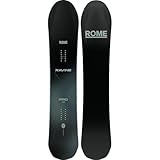
Rough, refrozen run-outs that chattered other boards left the Ride Deep Fake flat and silent, at the price of a muted, heavy feel underfoot. It scores 96 out of 100 and ranks #2 in our best freeride snowboards guide as our best budget freeride snowboard.

What is the best budget freeride snowboard?
The best budget freeride snowboard is the Ride Deep Fake, a budget-tier board that scored 96, with 10.0 for stability, and stayed flat and quiet over the rough, refrozen run-out where other boards chattered.

Ride Deep Fake
- Length tested: 157 cm
- Weight: 3,120 g
- Profile: Standard camber
- Shape: Directional twin
Bottom Line : The most vibration-free board we rode, from the budget tier. It feels muted and heavy underfoot, with little pop.
Pros
- Stability 10.0: flat, silent and glued to the snow on rough, refrozen ice
- Edge Bite 9.5 without an abrupt, catchy feel
- Chop 9.5: the heavy build punched through slush mounds without bouncing
- Quiet underfoot: no foot ache on icy ruts
Cons
- A muted, less lively feel with little ollie pop
- Extra swing weight makes quick kick-turns in tight spots feel heavy
- Second-heaviest board here at 3,120 g
On the Mountain
The rough, refrozen ice run-out is where the Deep Fake made its case. It stayed flat, silent and glued to the surface while other boards chattered, and it scored 10.0 for stability. The testers say it erased foot ache on icy ruts.
Turn initiation was progressive. The board cut into hardpack with no abrupt moment of grab, and carves held their arc, which is how it reached 9.5 for edge bite and 9.5 for deep carving.
In afternoon slush mounds, the heavy construction and directional nose punched cleanly through debris without bouncing or throwing the rider off balance (Chop 9.5).
Where It Asks Something of You
The cost of all that damping is a muted board. It felt "dead" underfoot, and popping a side hit or buttering the tail took real leg effort. If you want a bouncy, playful ride, this isn't it.
The extra swing weight from the metal sidewall also made quick, spontaneous kick-turns in tight spots feel heavy. At 3,120 g it's the second-heaviest board here, and you feel that when you try to flick it around.
The way around both is to keep it for what it does well: long, committed turns on firm, uneven snow. For a lively board, the K2 Alchemist is the better pick.
Spec Sheet vs Our Test
Metal Slim Wall, "dampening, durability, and responsiveness". Dampening is the headline: the maker lists metal in the sidewall to add dampening, durability and responsiveness. We found the dampening in a big way, the most vibration-free ride of the ten. Responsiveness didn't show up, since the board felt muted instead of lively, and durability went untested.
Carbon Array 5 laminates, "control and energy transfer". The maker says the laminates enhance control and transfer more energy into the board. Control held up on rough ice. The energy side didn't: popping and buttering took effort, so the board stores less spring than a stiff build would suggest.
Directional twin standard camber, "more camber than rocker". The maker calls it a directional twin with more camber than rocker. We rode it set up directionally, and the camber held an edge on hardpack. We didn't ride it switch, so the twin side is untested.
Quadratic sidecut, "smooth catch-free turn initiation". The maker lists a quadratic sidecut for smooth, catch-free turn initiation and support through the turn. That matched what we felt: progressive turn entry, no abrupt grab and a steady arc to the exit.
Should You Buy the Ride Deep Fake?
Buy it if firm, uneven snow is your day and you want a calm, chatter-free ride from a budget-tier price. It scored 96, and only the Nitro Pantera, three points higher and in the upper-mid tier, beat it. The only other budget-tier board here, the Lib Tech Dynamiss, scored 82.
Look elsewhere if you want pop and play. The Alchemist is livelier and scored 94 from the mid-price tier. If you'd rather feel the snow and carve for the exit, that's the one to try next.
Compare With
- Nitro Pantera: our best overall freeride snowboard.
- K2 Alchemist: our best freeride snowboard for carving.
- CAPiTA Black Snowboard of Death: our best freeride snowboard for hardpack.
- Jones Flagship: our best big mountain freeride snowboard.
- Jones Stratos: our best agile freeride snowboard.
- Arbor Bryan Iguchi Pro: our best camber freeride snowboard.
- Salomon Highpath: our best eco-friendly freeride snowboard.
- Lib Tech Dynamiss: our best women's freeride snowboard.
- Lib Tech Cold Brew: our best freeride snowboard for intermediate riders.
See all ten, and how we tested them, in our best freeride snowboards of 2026 guide.
Ranked in our Best Freeride Snowboards guide. All our tested picks, guides and reviews are in our Best Snowboards hub.
Editor's Note, 12 November 2026: New review. In June and July 2026 Shaun and James rode the Ride Deep Fake (157 cm) off the T-bar on Horstman Glacier at Whistler Blackcomb, weighed it, and scored it on stability, edge bite on ice, deep carving and chop plow-through.
Our Testers
This review was edited by Sean Williams and tested at Whistler Blackcomb by Shaun and James.
- Sean Williams, Editor-in-Chief. A former commercial outdoor copywriter and gear journalist who now runs Top-Notch Outdoor as an independent publisher. He takes no brand-funded trips and runs no supplied ad copy.
- Shaun Taylor, Freeride Snowboard Tester. Raced banked slalom and halfpipe in the late 1980s and 1990s before turning to backcountry freeriding. A finish carpenter by trade. Shaun led the testing of the Ride Deep Fake.
- James Ward, Alpine Ski & Fat Bike Tester. On skis since he was 3 and a former regional alpine racer. Now a ski tuner and dryland fitness coach. James co-tested the Ride Deep Fake.