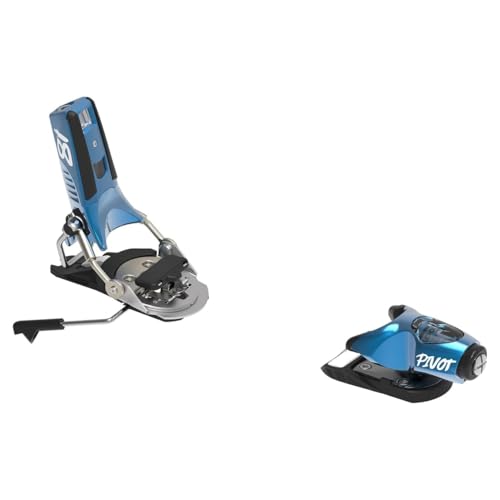
James and Ryan put the Marker Jester X 16 MWerks through 25 park laps at Whistler Blackcomb in May 2026, and it took eight harsh landings into rutted slush with no pre-release. It scores 90.0 out of 100 and ranks #2 in our best park ski bindings guide as our Best Low-Profile Park Ski Binding.

What is the best low-profile park ski binding?
The best low-profile park ski binding is the Marker Jester X 16 MWerks, which tied the Pivot 2.0 15 GW on 90.0, with a 14 mm stand height and a toe at 9 mm, and clicked in in 5.0 seconds.

Marker Jester X 16 MWerks
- Weight: 1,130 g each
- DIN range: 6 to 16
- Brake width: 90 mm
- Step-in time: 5.0 s
Bottom Line : A very low binding that tied the Pivot 2.0 15 on 90.0 and clicked in 2.8 seconds faster. A twisted brake arm means replacing the whole forward heel track.
Pros
- Landing hold 9.5, with no pre-release in 25 laps
- Spin & swing feel 9.0 and rail & box toughness 9.0
- Step-in 8.5, at 5.0 seconds
- Bench check: a 14 mm stand height with a 9 mm toe
Cons
- The brake is molded into the forward heel track, so a twisted brake arm means a whole new track
- Wet, salted slush packed behind the sliding plate and hardened
- Premium tier
Who it's best for
Expert park, pipe and slopestyle riders who want the lowest center of gravity in this guide and a rigid, high-DIN chassis. Riders under 140 lb, and anyone who bends brake arms on urban rails, should look elsewhere.
On the Snow
The test ran in May 2026 on the Catskinner and Glacier park lanes at Whistler Blackcomb. Every binding got exactly 25 park laps on the same ten identical pairs of Armada ARV 88 skis, mounted at true center. The snow changed through the day, from firm, salted takeoffs at 25°F in the morning to heavy slush and rutted landings at 42°F by 1:30 pm.
James led the testing and Ryan co-tested it. Annie sat out, because this binding's lowest DIN setting is 6.0, which sits above her test setting. The Triple Pivot Elite X toe and the short Inter Pivot X heel kept forward pressure locked through eight harsh compression landings into slush. That earned 9.5 for landing hold, with no pre-release in 25 laps. Half a point under the Pivot 2.0 15 GW gave that binding the tie-break on landing hold.
Switch 540s felt lighter underfoot. The single-cast toe and the low carriage cut swing inertia noticeably compared with the standard Jester, and at 1,130 g a single binding it is lighter than both Pivots that weigh over 1,200 g. That gave 9.0 for spin and swing feel.
The low 14 mm stand height kept the base housings away from rail edges, and the magnesium inserts shrugged off hard iron coping hits. Over 25 laps there were zero pre-releases and zero structural damage, which earned 9.0 for rail and box toughness. Clicking in was quick too: three step-ins averaged 5.0 seconds, with one try on the flat and one or two on a chopped spring park deck. The low-profile X-Brake and revised lever pivot cam shut with less downward stomp than the standard Jester, and the toe cleared slush easily. That earned 8.5 for step-in and ice clearing.
Where It Asks Something of You
The brake is the trade-off. To get the stand height down, Marker molded the X-Brake into the forward heel-track plate. On the standard Jester a bent brake arm is a two-screw fix. Here, a twisted brake arm from a rail hit means replacing the whole forward heel track, so if you hit rails hard, ask a shop about that part before you buy.
Wet slush also packs in. Tight gaps around the heel spring guide rods let salted slush pack behind the sliding plate and harden, and it stopped gliding sideways until we rinsed it out. Rinse it off when it packs.
It is premium tier, and it is not for everyone. Its DIN range starts at 6.0, so riders under 140 lb are better served elsewhere in this guide.
Spec Sheet vs Our Test
Triple Pivot Elite X toe and Inter Pivot X heel. The listing names both parts. Our testers found that the pair held forward pressure across eight harsh compression landings, and that is the reason it scored 9.5 for landing hold. For you, that means a firm, locked-in platform on big landings, which is what a park rider needs.
Anti Ice Rail. The listing names an Anti Ice Rail. Our notes do not test that rail on its own, so we do not score it. What the testers did see was wet slush packing behind the sliding plate, which is covered in the flaws above.
Stainless AFD plate. The listing describes a stainless AFD plate. Our notes do not check how the plate holds up to corrosion, so we make no claim about it. What we did find was slush hardening behind the sliding AFD carriage until we rinsed it. For you, rinsing after a wet session is the simple fix.
90 mm brake. The listing gives a 90 mm brake. On our 88 mm Armada ARV waist it cleared with a tight, clean 1 mm of clearance. For you, that means it sits neatly on a ski of this width, and that is what the testers saw.
DIN range of 6.0 to 16.0. The listing gives this range, and our bench notes confirm the DIN floor sits at 6.0. DIN is not advice from us. A certified shop technician sets your DIN, so check the range with a shop before you choose a setting.
Alpine and GripWalk soles. The listing says the binding fits alpine (ISO 5355) and GripWalk (ISO 23223) soles. Our testers clicked in with both, and the 5.0 second average covers those step-ins. For you, that means the fit is not limited to one boot standard.
Should You Buy the Marker Jester X 16 MWerks?
Yes, if you ride park, pipe or slopestyle, want the lowest stand height in this guide, and would rather click in quickly than carry the weight of a Pivot. It gives a rigid, high-load chassis that holds its shape under hard landings. Ask a certified shop technician to set your DIN, and check the range of 6.0 to 16.0 with them.
Skip it if you are under 140 lb, or if you bend brake arms on rails. For lighter riders, the Look Pivot 2.0 11 GW is the better fit in this guide. If you want the firmest landing hold, the Look Pivot 2.0 15 GW scores 10.0 on landing hold against this binding's 9.5, though it weighs more. If you want a conventional step-in, the Marker Jester 16 is the standard option here at 88.0.
Compare With
- Look Pivot 2.0 15 GW: our Best Overall Park Ski Binding.
- Look Pivot 2.0 18 GW: our Best Park Ski Binding for Heavy Skiers.
- Marker Jester 16: our Best Park Ski Binding for Aggressive Riders.
- Tyrolia Attack 14 GW: our Best Park Ski Binding for Easy Step-In.
- Tyrolia Attack LYT 11 GW: our Best Lightweight Park Ski Binding.
- Marker Griffon 13: our Best Budget Park Ski Binding.
- Look Pivot 2.0 11 GW: our Best Park Ski Binding for Lighter Skiers.
- Marker Squire 11: our Best Park Ski Binding for Progressing Skiers.
- Marker Squire 10: our Best Park Ski Binding for Narrow Skis.
See the full field, and how we tested it, in our best park ski bindings guide.
Editor's Note, 24 November 2026: New review, written from the same May 2026 Whistler park tests as our park ski binding guide.
Our Testers
- Ryan Williams, Lead Tester. A heavy fleet equipment mechanic and commercial vehicle technician. At 6 ft 2 and 215 lb, he is our heavy, high-impact user.
- James Ward, Alpine Ski & Fat Bike Tester. On skis since he was 3 and a former regional alpine racer. Now a ski tuner and dryland fitness coach.