

What is the best overall park ski binding?
The best overall park ski binding is the Look Pivot 2.0 15 GW, which took eight backseat slap-downs off the 25-foot kicker with no heel flutter and no pre-release, and scored 10 out of 10 for landing hold.

Look Pivot 2.0 15 GW
- Weight: 1,245 g each
- DIN range: 6 to 15
- Brake width: 95 mm
- Step-in time: 7.8 s
Bottom Line : The firmest landings of the ten, joint-top with the Pivot 2.0 18: no pre-release in 25 laps. It weighs 1,245 g, and the heel took 7.8 seconds to click into.
Pros
- Landing hold 10, with no pre-release in 25 park laps
- Spin & swing feel 9.5 and rail & box toughness 9.5
- 28 mm of elastic travel at the heel
- Rail strikes left only cosmetic paint chips
Cons
- Step-in is slow at 7.8 seconds (7.0)
- Cosmetic plastic heel covers cracked after a pole strike in cold air
- The turntable racks if the forward-pressure arms are turned unevenly
- At 1,245 g it's the second-heaviest here
Who it's best for
Built for dedicated park and slopestyle riders who land heavy off medium-to-large jump lines and want elasticity with little swing weight. James led and Ryan co-tested it; Annie sat out on its DIN 6 floor. Riders under 140 lb and beginners should look elsewhere.
Why we love it
Landing Hold (10). Eight flat, backseat slap-downs into wet May slush off the 25-foot kicker produced no heel flutter and no pre-release. The heel has 28 mm of elastic travel.
Spin & Swing Feel (9.5). The short mount pattern clusters the mass under the boot arch, and the Armada ARV 88 spun without pendulum drag at the tip or tail. It shares the top score with the Pivot 2.0 11, at 235 g more.
Rail & Box Toughness (9.5). Across 25 laps the metal Race toe took direct iron rail strikes with only cosmetic paint chips and no structural deformation.
What we didn't like
Step-in is the Pivot's weak spot (7.0, 7.8 seconds). Only the Pivot 2.0 18 was slower. The turntable spins out of axis on release, so after a tumble on a slushy side hill you have to reach down and center the heel arms by hand.
A pole strike in cold morning air cracked the cosmetic plastic wing covers over the heel, so hand-eject the heel instead of prying it with a pole tip. And when the two forward-pressure arms are turned by different amounts, the turntable racks off-axis on the bench: turn both by the same amount, or have a shop do it.
Should you buy it?
The Pivot 2.0 15 GW is for dedicated park riders who land heavy off medium-to-large jump lines and want the firmest landings in this test. Lighter riders and beginners should look at the Pivot 2.0 11 or Attack LYT 11 instead. It's premium tier, and landing hold is the strength.
Read our full Look Pivot 2.0 15 GW review →

What is the best low-profile park ski binding?
The best low-profile park ski binding is the Marker Jester X 16 MWerks, which tied the Pivot 2.0 15 GW on 90.0, with a 14 mm stand height and a toe at 9 mm, and clicked in in 5.0 seconds.

Marker Jester X 16 MWerks
- Weight: 1,130 g each
- DIN range: 6 to 16
- Brake width: 90 mm
- Step-in time: 5.0 s
Bottom Line : A very low binding that tied the Pivot 2.0 15 on 90.0 and clicked in 2.8 seconds faster. A twisted brake arm means replacing the whole forward heel track.
Pros
- Landing hold 9.5, with no pre-release in 25 laps
- Spin & swing feel 9.0 and rail & box toughness 9.0
- Step-in 8.5, at 5.0 seconds
- The maker lists a 9 mm toe and a 14 mm heel
Cons
- The brake is molded into the forward heel track, so a twisted brake arm means a whole new track
- Wet, salted slush packed behind the sliding plate and hardened
- Premium tier
Who it's best for
Ryan co-tested it with James, and Annie sat out on its DIN 6 floor. Expert park, pipe and slopestyle riders who want the lowest center of gravity and a rigid, high-DIN chassis will like it. Riders under 140 lb, and anyone who mangles brake arms on urban rails, won't.
Why we love it
Landing Hold (9.5). The Triple Pivot Elite X toe and the short Inter Pivot X heel kept forward pressure locked through eight harsh compression landings into rutted slush. Half a point under the Pivot 2.0 15 cost it the tie-break.
Spin & Swing Feel (9.0). The single-cast toe and low carriage noticeably cut swing inertia on switch 540s, compared with the standard Jester. At 1,130 g it's lighter than both Pivots above 1,200 g.
Rail & Box Toughness (9.0). The low stand height kept the base housings away from rail edges, and the magnesium inserts shrugged off hard iron coping hits.
What we didn't like
Mind the brake. To get the stand height down, Marker molded the X-Brake into the forward heel-track plate. On the standard Jester a bent brake arm is a two-screw fix; here a twisted arm from a rail hit means replacing the whole forward heel track. If you hit rails hard, ask a shop about replacing that part before you buy.
Tight gaps around the heel spring guide rods also let wet, salted slush pack behind the sliding plate and harden, which stopped it gliding sideways until it was rinsed. Rinse it off when it packs.
Should you buy it?
Choose the Jester X 16 MWerks if you want the lowest stand height without giving up much landing hold, and you'd rather click in quickly than carry a Pivot's weight. Skip it if you bend brake arms on rails. It's premium tier, and a twisted brake means a whole new heel track.
Read our full Marker Jester X 16 MWerks review →

What is the best park ski binding for heavy skiers?
The best park ski binding for heavy skiers is the Look Pivot 2.0 18 GW, which scored 10 out of 10 for both landing hold and toughness, the only binding to score a 10 for toughness.
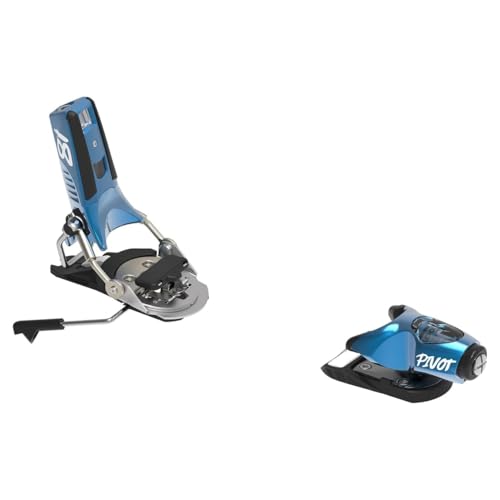
Look Pivot 2.0 18 GW
- Weight: 1,255 g each
- DIN range: 8 to 18
- Brake width: 95 mm
- Step-in time: 9.4 s
Bottom Line : The toughest binding in the test, with zero pre-releases and zero structural damage in 25 laps. It's also the heaviest at 1,255 g and the slowest to click into at 9.4 seconds.
Pros
- Rail & box toughness 10, the only 10 in the test
- Landing hold 10, with no deflection under Ryan's 215 lb
- Spin & swing feel 9.0 at 1,255 g
- DIN range of 8 to 18
Cons
- Slowest step-in here, 9.4 seconds (6.5)
- A false half latch on soft slush landings
- The heel adjustment screw bound after rail slides
- Heaviest binding here at 1,255 g
Who it's best for
James and Ryan tested it; Annie's DIN 5.0 sits below its 8.0 floor. Heavy, high-impact park chargers and pro-level slopestyle skiers launching 40-foot-plus jump lines are the target, and the testers noted it's built for a DIN of 8 and up. A certified shop sets your DIN, so check the range with one.
Why we love it
Landing Hold (10). No deflection and no heel lift under Ryan's 215 lb frame, stomping flat 25-foot kicker landings. It shares the top mark with the Pivot 2.0 15.
Rail & Box Toughness (10). The only perfect toughness score. Over 25 laps its steel and cast-metal build took direct rail slams with only superficial scrapes, with zero structural damage.
Spin & Swing Feel (9.0). A compact footprint keeps the swing weight centralized, though the steel toe adds slightly more pull than the Pivot 2.0 15's.
What we didn't like
Clicking in is a chore, and it's the lowest step-in score here: 6.5, at 9.4 seconds. The steel heel spring needs immense downward leg drive to cam shut, and on soft landings the heel clicked halfway down and looked engaged while forward pressure stayed slack. Check the heel is fully shut before you drop in.
On square down-rails the heel adjustment rods flexed inward and the adjustment screw bound in its collar until it was freed with penetrating lubricant. And its lowest setting is DIN 8, which rules out most lighter riders by design.
Should you buy it?
Heavy riders whose shop sets a DIN of 8 or higher should look at the Pivot 2.0 18 GW first, and its range starts at 8, so check it with a shop. Everyone lighter should look at the Pivot 2.0 15. It's premium tier, and it's the one for big jump lines.
Read our full Look Pivot 2.0 18 GW review →
What is the best park ski binding for aggressive riders?
The best park ski binding for aggressive riders is the Marker Jester 16, which held firm across eight off-axis landings with no toe wing flutter and scored 9.5 for landing hold at 1,080 g.

Marker Jester 16
- Weight: 1,080 g each
- DIN range: 6 to 16
- Brake width: 90 mm
- Step-in time: 5.6 s
Bottom Line : Strong landing hold with a built-in boot scraper, at 1,080 g. Slush packs behind the heel spring, and the heel needs a heavy stomp.
Pros
- Landing hold 9.5, with no pre-release in 25 laps
- Rail & box toughness 9.0 at 1,080 g
- Step-in 8.0, at 5.6 seconds
- An Anti Ice Rail scrapes slush off boot soles
Cons
- The anti-friction height screw backed down half a turn
- Slush packed behind the heel spring cam in the afternoon
- Spin & swing feel is the lowest of the top five at 8.5
Who it's best for
Aggressive, heavier park riders who want a traditional step-in and high release thresholds. James led and Ryan co-tested it; Annie sat out on its DIN 6 floor. Skip it under 140 lb, or if you want a featherweight swing.
Why we love it
Landing Hold (9.5). The Triple Pivot Elite toe and Inter Pivot 3 heel held firm through eight off-axis landings, with no toe wing flutter.
Rail & Box Toughness (9.0). The magnesium heel parts resisted gouging on iron rails. The plastic base housing collected deep cosmetic scratches.
Step-In & Ice Clearing (8.0). The Anti Ice Rail on the toe scraped packed spring slush off the boot soles. At 5.6 seconds it clicks in faster than all three Pivots.
What we didn't like
Watch the height screw. After 15 laps over salted takeoff ramps the manual anti-friction height screw backed down half a turn, dropped the plate 0.6 mm and let the boot slap vertically until it was re-torqued. Have a shop re-torque it after about 15 laps.
In 40°F slush the afternoon snow also packed into the cavity behind the heel spring cam and blocked the heel cup from sliding back to open. And the wide footprint feels blockier in switch spins, which is why spin & swing feel (8.5) is the lowest of the top five.
Should you buy it?
If you ride aggressively and your shop sets a DIN of 6 or higher, the Jester 16 gets you landing hold close to the best here with a conventional step-in. If low stand height matters more, the Jester X 16 MWerks sits lower. It's mid-price tier, a step below the Pivots it chases.
Read our full Marker Jester 16 review →
What is the best park ski binding for easy step-in?
The best park ski binding for easy step-in is the Tyrolia Attack 14 GW, which clicked in in 3.4 seconds, the second-fastest time of the ten, even with wet slush packed on Annie's heel lug.

Tyrolia Attack 14 GW
- Weight: 1,010 g each
- DIN range: 4 to 14
- Brake width: 95 mm
- Step-in time: 3.4 s
Bottom Line : The second-fastest click-in here, at 3.4 seconds, and a 9.0 for spin & swing feel at 1,010 g. Landing hold and toughness trail the Jesters and the top two Pivots.
Pros
- Step-in 9.5, at 3.4 seconds
- Spin & swing feel 9.0 at 1,010 g
- A 17 mm stand height
- DIN range starts at 4
Cons
- Landing hold 8.5 and toughness 8.0 trail the leaders
- The toe-height wedge slipped, leaving a 1.2 mm gap
- A spring-steel lift tab bent when pried with a screwdriver
- Less elastic travel than the Pivots and Jesters
Who it's best for
James and Annie tested it. Park and all-mountain freestyle riders who want rapid step-ins and a low stand height suit it. Heavy riders who stomp 35-foot drops flat onto firm landings don't.
Why we love it
Step-In & Ice Clearing (9.5). The three-piece heel needed very little effort, and it clicked in immediately even with wet slush on Annie's heel lug. A 3.4-second average is beaten only by the Attack LYT 11, and it's more than twice as fast as the Pivot 2.0 15.
Spin & Swing Feel (9.0). The 17 mm stand height keeps the boot close to the ski, and the spins feel intuitive and neutral.
Landing Hold (8.5). Solid on straight landings, with one blemish: slight heel flutter during one severe backseat compression into deep slush. No pre-release in 25 laps.
What we didn't like
Rail laps left marks (toughness 8.0). The metal anti-friction plate took direct iron rail strikes without deforming, but the plastic heel track underneath was grooved. The toe height is set by a wedge on a ramp, and on lap 12 a hard slap-down slipped it and opened a 1.2 mm gap. Have the shop torque the screw with the toe pre-loaded, and re-check it after about 15 rail laps.
Don't pry the spring-steel lift tab with a screwdriver. It bent past 30 degrees, and the detent tooth wouldn't seat until it was tapped flat. It also has less vertical elastic travel than the Pivots or the Jesters.
Should you buy it?
Fast step-in is the Attack 14's job, and it does it better than the heavier bindings above it. Choose it if you click in often and want a low stand height. The Attack LYT 11 clicks in faster still, but it only suits lighter riders, while this one runs from DIN 4 to 14. If you land big, the Jesters and the Pivot 2.0 15 and 18 hold better. It's mid-price, a clear step below the Pivots.
Read our full Tyrolia Attack 14 GW review →
What is the best lightweight park ski binding?
The best lightweight park ski binding is the Tyrolia Attack LYT 11 GW, which weighed 840 g and clicked in in 3.2 seconds, the fastest of the ten.

Tyrolia Attack LYT 11 GW
- Weight: 840 g each
- DIN range: 3 to 11
- Brake width: 95 mm
- Step-in time: 3.2 s
Bottom Line : The fastest click-in here, at 3.2 seconds and 840 g, with a 9.0 for spin & swing feel. It pre-released once under James, and its toe polymer is soft.
Pros
- Step-in 9.5, the fastest at 3.2 seconds
- 840 g, the third-lightest here
- Spin & swing feel 9.0
- DIN range of 3 to 11
Cons
- Landing hold 7.5 and rail & box toughness 7.5
- One pre-release under James on a backseat landing
- Soft toe polymer that gouged on rail edges
- A 1.1 mm gap above the plate with worn GripWalk soles
Who it's best for
Annie led, with James co-testing. Lightweight park beginners, teens and casual freestyle riders who want an easy-clicking, featherweight binding suit it. Adults over 160 lb, and anyone on big jump lines, should skip it.
Why we love it
Step-In & Ice Clearing (9.5). Effortless: it clicks shut instantly with almost no downward leg pressure. The 3.2-second average is the quickest of the ten, 0.2 seconds ahead of the Attack 14.
Spin & Swing Feel (9.0). Very light under the boot, so the skis felt nimble and quick in switch rotations and zero-spin rail slides. Annie's jump landings were clean.
Weight (840 g). It's the lightest binding here that scored above 80, and only the two Squires weigh less.
What we didn't like
Landing hold and toughness are both 7.5. James had a heel pop on a deep backseat landing into heavy wet slush off the 25-foot kicker, its one pre-release. The toe polymer is noticeably softer than the Attack 14's: catching a tip dismounting a flat-down rail shaved a plastic curl off the side of the toe piece.
With Annie's worn GripWalk toes there was also a 1.1 mm vertical gap above the anti-friction plate, which rattled over firm morning chop. Have a shop check the gap with your own boots.
Should you buy it?
Pick the Attack LYT 11 GW if you're light, you click in often and you want the lightest binding that still scored well. By score it's the best lightweight park binding here, though it's only 25 g heavier than the lightest. Skip it if you're over 160 lb or you land big.
Read our full Tyrolia Attack LYT 11 GW review →
What is the best budget park ski binding?
The best budget park ski binding is the Marker Griffon 13, which scored a steady 8.0 to 8.5 on every measure at 1,030 g, with no pre-release in 25 laps.

Marker Griffon 13
- Weight: 1,030 g each
- DIN range: 4 to 13
- Brake width: 90 mm
- Step-in time: 5.3 s
Bottom Line : An even performer: 8.0 or 8.5 on all four scores, at 1,030 g. Its forward-pressure screw strips the plastic track if you turn it under load.
Pros
- Landing hold 8.5 and rail & box toughness 8.5
- No score below 8.0
- DIN range of 4 to 13
- Budget tier
Cons
- The forward-pressure steel worm strips the plastic track ribs if it's adjusted under load
- The heel lever stopped halfway down in wet slush, looking closed
- Spin & swing feel 8.0, the lowest of the ten
Who it's best for
James led, with Annie co-testing. Intermediate-to-advanced park riders who want a dependable, widely serviceable binding that won't break the bank suit it. Lightweight skiers who can't trip a stiff heel lever won't enjoy it.
Why we love it
Landing Hold (8.5). It handled eight flat landings cleanly for James at DIN 8.5 and held Annie securely, with no flutter and no pre-release in 25 laps.
Rail & Box Toughness (8.5). The heavy composite toe carriage shrugged off aluminum box edges, with only minor scuffing on the brake arms.
Value. It's the budget pick: no other budget binding here comes close on landing hold or toughness, and its DIN range of 4 to 13 suits a wide spread of weights.
What we didn't like
Spin & swing feel is the lowest of the ten at 8.0, even though the maker says its centralized swing weight is built for spins. The testers found the chassis mid-weight and slightly bulkier on quick 360 butter pivots than the Attack or the Pivot, so try it before you trust the claim.
Two hardware faults. The forward-pressure screw is a steel worm driving into molded plastic ribs, and if it's turned while the boot is clamped or the lever is closed it strips them clean, so adjust it with the binding unloaded. And on soft snow the Inter Pivot 3 heel lever often stopped halfway down, looking closed but opening when weighted, so check the heel is shut.
Should you buy it?
For a budget park binding the Griffon 13 is the one to buy, because no other budget binding here scored this well on landing hold. If you want the best spin & swing feel, spend more on a Pivot.
Read our full Marker Griffon 13 review →
What is the best park ski binding for lighter skiers?
The best park ski binding for lighter skiers is the Look Pivot 2.0 11 GW, which scored 9.5 for spin & swing feel, the joint-best of the ten, at 1,010 g and a DIN range of 4 to 11.

Look Pivot 2.0 11 GW
- Weight: 1,010 g each
- DIN range: 4 to 11
- Brake width: 95 mm, this listing
- Step-in time: 6.8 s
Bottom Line : Pivot spin & swing feel (9.5) in a lighter 4 to 11 DIN range. The toe wings flexed on the bench near DIN 8, so it's one for lighter riders.
Pros
- Spin & swing feel 9.5, joint-best with the Pivot 2.0 15
- DIN range of 4 to 11
- Rail & box toughness 8.5
- 235 g lighter than the Pivot 2.0 15
Cons
- The toe wings flexed outward on the bench near DIN 8
- A lighter-gauge brake arm bent on a rail
- Landing hold is 8.0, two points under the top two Pivots
- One safety ejection for James
Who it's best for
Annie led, with James co-testing. Lighter park skiers, teens, women and technical rail riders who want the lowest swing weight and the turntable's elasticity suit it. Riders over 165 lb and high-impact chargers should look elsewhere.
Why we love it
Spin & Swing Feel (9.5). Featherlight, and the short turntable footprint let the Armada ARV 88 spin and butter effortlessly. Annie led here, and it held her flawlessly through every medium kicker.
Rail & Box Toughness (8.5). The turntable metal chassis held up through 25 laps. The lighter toe accents picked up edge scratches on flat rails.
Step-In & Ice Clearing (7.5). A lighter heel spring made the turntable noticeably easier to engage than on the Pivot 2.0 15, though it still needed alignment in slush. At 6.8 seconds it beat both bigger Pivots.
What we didn't like
Look at the toe. The testers call it a glass-filled composite toe carriage. The toe wings visibly flexed outward on the bench near DIN 8.0, before the release spring compressed, which the bench inspection linked to a slight delay in edge response on firm lip takeoffs. James, at DIN 8.0, felt that deflection on a heavy off-axis landing in soft slush, and was ejected once on an awkward 270 rail dismount.
The lighter-gauge brake arm also bent on a rail slide and dragged in slush until it was bent back. Landing hold (8.0) sits two points under the top two Pivots, and the testers warn of chassis flutter under riders over 165 lb.
Should you buy it?
Lighter riders who want a Look should choose the Pivot 2.0 11 GW, for spin & swing feel that matches the Pivot 2.0 15. Anyone over about 165 lb who lands big should step up to the Pivot 2.0 15.
Read our full Look Pivot 2.0 11 GW review →
What is the best park ski binding for progressing skiers?
The best park ski binding for progressing skiers is the Marker Squire 11, which weighed 820 g and clicked in in 5.1 seconds, and which the testers pick for intermediate skiers progressing in the park.

Marker Squire 11
- Weight: 820 g each
- DIN range: 3 to 11
- Brake width: 100 mm
- Step-in time: 5.1 s
Bottom Line : A light, low-mass binding for progressing skiers, with a 5.1-second click-in. Its toe released for James on a rotated landing, and the 100 mm brake overhangs the skis.
Pros
- 820 g, the second-lightest here
- Step-in 8.0, at 5.1 seconds
- Spin & swing feel 8.5
- DIN range of 3 to 11
Cons
- The toe released prematurely for James on a rotated landing at DIN 8.0
- A frozen slush pocket stopped the heel lever closing fully
- Landing hold 7.0 and rail & box toughness 7.0
- The 100 mm brake drags in deep slush
Who it's best for
Annie led, with James co-testing. Beginner-to-intermediate park skiers on small jumps and flat boxes suit it. Adults over 160 lb, aggressive rail riders and anyone on medium-to-large kickers should look elsewhere.
Why we love it
Spin & Swing Feel (8.5). The light composite build keeps the swing weight low.
Step-In & Ice Clearing (8.0). A 5.1-second click-in is quicker than the Griffon 13, the Jester 16 and every Pivot, and the toe scraper cleared light snow adequately. The maker says the Hollow Linkage 2 heel cuts step-in force by 30%.
Weight (820 g). Only the Squire 10 weighs less, and the Squire 11's range runs one DIN higher, to 11.
What we didn't like
It let go once. The toe released prematurely when James landed rotated off the 15-foot kicker in heavy slush, at DIN 8.0. Annie, at DIN 5.0, found it reliable on flat boxes, and that's the use it suits.
The 100 mm brake overhangs the 88 mm skis by 6 mm a side and dragged in deep slush ruts. The plastic brake baseplate showed hairline stress marks after a hard rail stomp, and on the bench the snap-in retainer clips are the primary failure point on switch landings. On the bench, wet snow also packed and froze in the pocket under the heel spring, which stopped the lever dropping fully over-center.
Should you buy it?
Progressing skiers who stick to small features and will clear the heel of slush are the Squire 11's riders. Over about 160 lb or on bigger kickers, step up to the Griffon 13, which scored higher, or an Attack.
Read our full Marker Squire 11 review →
What is the best park ski binding for narrow skis?
The best park ski binding for narrow skis is the Marker Squire 10, which weighed 815 g and has an 85 mm brake, the narrowest of the ten, and which the testers say to avoid on skis wider than 84 mm.

Marker Squire 10
- Weight: 815 g each
- DIN range: 3 to 10
- Brake width: 85 mm, this listing
- Step-in time: 5.4 s
Bottom Line : The lightest and narrowest binding here, with an 8.5 for spin & swing feel. Its 85 mm brake had to be bent out to fit our 88 mm skis, so it's for narrow skis only.
Pros
- 815 g, the lightest here
- 85 mm brake, the narrowest
- Spin & swing feel 8.5 and step-in 8.0
- Budget tier
Cons
- The 85 mm brake arms had to be bent out 3 mm a side to fit our skis
- Slush and gravel jammed the brake in the up position
- One box-landing pre-release for Annie, at DIN 5.0
- Landing hold and rail & box toughness 6.5, the lowest here
Who it's best for
Annie led and James sat it out after the first inspection. Junior riders and lightweight entry-level adults under 130 lb on strict budgets, hitting micro-features, suit it. Any adult over 140 lb, aggressive riders and skis wider than 84 mm don't.
Why we love it
Spin & Swing Feel (8.5). Very light, and the tight 85 mm brake hugs the ski sidewalls once it's bent out. At 815 g it's the lightest binding in the test.
Step-In & Ice Clearing (8.0). A 5.4-second click-in is quicker than the Jester 16 and all three Pivots, though lighter riders need deliberate downward force.
What we didn't like
Fit is the problem. On our 88 mm skis the arms needed bending out 3 mm a side, and once the arms pinched the sidewalls, wet slush and gravel jammed the brake in the up position. Keep it to skis 84 mm wide or narrower.
Landing hold and toughness are both 6.5, the lowest here. Annie's box-landing pre-release came at DIN 5.0, on a slightly off-center landing in wet slush. The thin composite toe frame took noticeable gouges from box edges, and the bench inspection found a hole pattern narrower than the Squire 11, Griffon and Jester, so a ski drilled for it can't take a different binding later without new holes.
Should you buy it?
Only buy the Squire 10 for skis 84 mm wide or narrower, if you weigh under 130 lb, and have a shop check the brake before you ski it. On anything wider, choose the Griffon 13 or the Squire 11.
Read our full Marker Squire 10 review →
How did we test the park ski bindings?
We tested the park ski bindings by taking 25 laps on each in the Catskinner and Glacier parks at Whistler Blackcomb, on identical Armada ARV 88 skis, then scoring each on landing hold, spin & swing feel, rail & box toughness and step-in & ice clearing and weighing every one on a bench scale.
A park binding has four jobs: stay closed through landings, let the ski spin, survive rails and boxes, and click in again quickly after a fall. James, a former regional racer who now tunes skis, led the Pivot 2.0 15, Jester X 16, Pivot 2.0 18, Jester 16, Attack 14 and Griffon 13. Annie, who gave us the beginner-to-intermediate baseline, led the Pivot 2.0 11, Attack LYT 11, Squire 11 and Squire 10, with James co-testing. Ryan, our heavy rider, stepped in on the four bindings whose lowest DIN setting was above Annie's: the Pivot 2.0 15, Pivot 2.0 18, Jester 16 and Jester X 16.
The park had a jump line of 15-foot and 25-foot spring kickers with salted takeoffs and soft, slushy landings, plus flat-down boxes, 20-foot flat street rails and round steel D-rails. The snow was coarse and granular at 8:30 am (25°F) and heavy, high-moisture slush with rutted landings by 1:30 pm (42°F). Every binding went on its own pair of Armada ARV 88 skis (176 cm, 120-88-114 mm, 17.5 m radius), mounted at true center. A certified shop technician checked each binding on a release bench. The DIN for each tester is in the table below.
| Tester | Height | Weight | Age | Boots (all GripWalk soles) | Set DIN |
|---|---|---|---|---|---|
| James | 5 ft 10 | 172 lb | 33 | Nordica Promachine 130 | 8.5 (8.0 on the 10 and 11 DIN bindings) |
| Annie | 5 ft 6 | 135 lb | 31 | K2 Anthem 85 MV | 5.0 |
| Ryan | 6 ft 2 | 215 lb | 38 | Dalbello Panterra 130 ID | 10.0 |
A certified shop technician set Annie's DIN at 5.0. Annie sat out the four bindings above, and James sat out the Squire 10 after the first inspection. The four scored qualities:
- Landing Hold: flat, backseat and off-axis landings off the kickers, and any flutter or pre-release
- Spin & Swing Feel: how light and quick the binding felt in switch spins, butters and 360s
- Rail & Box Toughness: what 25 laps of rails and boxes did to it: scratches, deformation, loose or bound hardware
- Step-In & Ice Clearing: a timed average of three step-ins, and how well the binding cleared slush from the boot
- Weight (measured, not scored): one binding with its brake, dry and without screws, on a calibrated bench scale (±0.5 g)
A binding that appears in more than one of our guides has one score everywhere: the average of its results across those guides. The metric bars show this guide's own test. The Pivot 2.0 15 and Jester X 16 tied on 90.0, and the Pivot ranks first because it scored higher for landing hold, 10.0 against 9.5. Specs such as DIN range and the sole standard come from the makers' pages where they state them; boot, DIN, brake width and every result come from our testers. We don't score price; where a binding's value stands out we say so in tiers (premium, upper-mid, mid-price, budget), and the Check Latest Prices button shows the current number. You can meet the testers at the bottom of this page.
Which park ski binding suits your skiing?
The right park ski binding depends on your weight and how big you land: pick by the row that matches you.
| If you're… | Buy |
|---|---|
| A dedicated park rider on medium-to-large jumps who wants the firmest landings | Look Pivot 2.0 15 GW |
| Wanting a low stand height and a quick click-in | Marker Jester X 16 MWerks |
| Heavy, running DIN 8 or higher, and hard on gear | Look Pivot 2.0 18 GW |
| An aggressive, heavier rider who wants a conventional heel | Marker Jester 16 |
| Clicking in and out a lot and wanting a low stand height | Tyrolia Attack 14 GW |
| Light, and wanting the fastest click-in and a low weight | Tyrolia Attack LYT 11 GW |
| Watching the budget and wanting an even performer | Marker Griffon 13 |
| Light, and wanting Pivot spin feel in a lower DIN range | Look Pivot 2.0 11 GW |
| Progressing, and sticking to small jumps and boxes | Marker Squire 11 |
| Skiing narrow skis, 84 mm or under, and weighing under 130 lb | Marker Squire 10 |
What did our park ski binding tests show?
Our park ski binding tests showed that the two Look Pivots won on landing hold and toughness, while the light Tyrolia bindings won on step-in, and spin & swing feel separated the ten least of all.
Where each quality was tested, what separated the bindings, and what the scores show. Each binding's four scores are also in its card above.
How well do park ski bindings hold through landings?
The park ski bindings that held best through landings were the Look Pivot 2.0 15 GW and Pivot 2.0 18 GW, which each scored 10 out of 10 for landing hold.
Where we tested it. The 15-foot and 25-foot kickers at Whistler Blackcomb, with flat, backseat and off-axis landings into salted takeoffs and soft slush decks.
What separated them. The two Pivots scored 10, the two Jesters 9.5, the Attack 14 and Griffon 13 8.5, the Pivot 2.0 11 8.0, the Attack LYT 11 7.5, the Squire 11 7.0 and the Squire 10 6.5. The spread is 3.5 points, the widest of the four scores, tied with toughness.
Four bindings let go once each. The Pivot 2.0 11 ejected James on an awkward 270 rail dismount. The Attack LYT 11 popped a heel for James on a deep backseat landing in heavy wet slush. The Squire 11's toe released for James on a rotated landing at DIN 8.0, and the Squire 10 popped loose for Annie on a slightly off-center box landing at DIN 5.0. The other six had no pre-release in 25 laps, though the Attack 14 fluttered once in a severe backseat compression.
What it felt like. The four that let go hold exactly the four lowest landing hold scores. No binding that scored 8.5 or higher had a pre-release in 25 laps.
| Binding | What we found |
|---|---|
| Look Pivot 2.0 15 GW | Eight backseat slap-downs, no flutter or pre-release |
| Look Pivot 2.0 18 GW | No deflection or heel lift under 215 lb |
| Marker Jester X 16 MWerks | Forward pressure held through eight harsh compressions |
| Marker Jester 16 | Eight off-axis landings, no toe wing flutter |
| Tyrolia Attack 14 GW | Solid on straight landings; slight heel flutter once |
| Marker Griffon 13 | Eight flat landings clean for James at DIN 8.5 |
| Look Pivot 2.0 11 GW | Toe deflection for James off-axis; one safety ejection |
| Tyrolia Attack LYT 11 GW | Heel pop for James on a deep backseat landing |
| Marker Squire 11 | Toe released for James on a rotated landing at DIN 8.0 |
| Marker Squire 10 | Popped loose for Annie on a box landing at DIN 5.0 |
How well do park ski bindings spin?
The park ski bindings with the best spin & swing feel were the Look Pivot 2.0 15 GW and Pivot 2.0 11 GW, which each scored 9.5.
Where we tested it. The park lanes, with switch spins, butters, 360s and 540s, scoring how light and quick each binding felt on the ski.
What separated them. The two Looks scored 9.5, then four bindings at 9.0 (the Jester X, Pivot 2.0 18, Attack 14 and Attack LYT 11), three at 8.5 (the Jester 16, Squire 11 and Squire 10) and the Griffon 13 last at 8.0.
Weight didn't decide it. The Pivot 2.0 15 weighs 1,245 g and scored 9.5, while the Squire 11 and Squire 10 weigh 820 g and 815 g and scored 8.5. The Pivot 2.0 18's steel toe added slightly more pull than the Pivot 2.0 15's, and the Jester 16's wide footprint felt blockier in switch spins. The maker says the Griffon 13 has a centralized swing weight made for spins, and our testers scored it lowest here, at 8.0.
What it felt like. Spin & swing feel was the quality that separated the ten least: every binding scored between 8.0 and 9.5, a spread of 1.5 points against 3.5 for landing hold. Lean on landing hold and toughness first, and use spin & swing feel to break a tie.
| Binding | What we found |
|---|---|
| Look Pivot 2.0 15 GW | Mass under the boot arch; no pendulum drag at 1,245 g |
| Look Pivot 2.0 11 GW | Featherlight; spins and butters effortlessly |
| Marker Jester X 16 MWerks | Cut swing inertia on switch 540s |
| Look Pivot 2.0 18 GW | Centralized, with slightly more pull from the steel toe |
| Tyrolia Attack 14 GW | Low 17 mm stand height; neutral and intuitive |
| Tyrolia Attack LYT 11 GW | Nimble in switch rotations and zero-spin slides |
| Marker Jester 16 | Wide footprint, blockier in switch spins |
| Marker Squire 11 | Light composite build; wide brake dragged in ruts |
| Marker Squire 10 | Very light; tight brake hugs the sidewalls |
| Marker Griffon 13 | Bulkier on quick 360 butter pivots |
How tough are park ski bindings on rails and boxes?
The toughest park ski binding was the Look Pivot 2.0 18 GW, the only one to score 10 for rail & box toughness.
Where we tested it. The boxes, 20-foot street rails and round steel D-rails, over 25 laps per binding, followed by a bench inspection.
What separated them. The Pivot 2.0 18 scored 10 and the Pivot 2.0 15 scored 9.5. The Jester X and Jester 16 followed at 9.0, the Griffon 13 and Pivot 2.0 11 at 8.5, and the Attack 14 at 8.0. The bottom three were the Attack LYT 11 at 7.5, the Squire 11 at 7.0 and the Squire 10 at 6.5.
A heel screw bound on the Pivot 2.0 18 after square down-rails, the Pivot 2.0 15's cosmetic heel covers cracked, and the Jester 16's anti-friction height screw backed down half a turn. The Attack 14's toe wedge slipped, the Squire 11's plastic brake baseplate showed hairline stress marks, and the Squire 10's brake jammed up with slush and gravel.
What it felt like. Every binding showed something, from cosmetic paint chips on the Pivot 2.0 15 to gouged toe frames on the Squire 10. The gap is in how serious it was: the two Pivots at the top showed only paint chips and scrapes.
| Binding | What we found |
|---|---|
| Look Pivot 2.0 18 GW | Only 10; superficial scrapes, one bound heel screw |
| Look Pivot 2.0 15 GW | Paint chips only; cosmetic heel covers cracked |
| Marker Jester X 16 MWerks | Magnesium inserts held; a twisted brake needs a new heel track |
| Marker Jester 16 | Magnesium resisted gouging; cosmetic scratches; height screw backed out |
| Marker Griffon 13 | Composite toe shrugged off box edges; screw strips plastic |
| Look Pivot 2.0 11 GW | Metal chassis held; toe accents scratched; brake arm bent |
| Tyrolia Attack 14 GW | Plate undamaged; plastic heel track grooved; wedge slipped |
| Tyrolia Attack LYT 11 GW | Toe housing gouged; soft polymer shaved off |
| Marker Squire 11 | Baseplate showed hairline stress marks; retainer clips the weak point |
| Marker Squire 10 | Toe frame gouged; brake clip developed play |
How easy are park ski bindings to step into?
The easiest park ski bindings to step into were the Tyrolia Attack LYT 11 GW and Attack 14 GW, which each scored 9.5, in 3.2 and 3.4 seconds.
Where we tested it. The same park laps, timing three step-ins on each binding and averaging them, and noting how well each cleared slush from the boot.
What separated them. The two Tyrolia bindings scored 9.5, and the Jester X scored 8.5 at 5.0 seconds. The Jester 16, Griffon 13, Squire 11 and Squire 10 scored 8.0, at 5.1 to 5.6 seconds. Then came the Pivot 2.0 11 at 7.5 (6.8 seconds), the Pivot 2.0 15 at 7.0 (7.8 seconds) and the Pivot 2.0 18 at 6.5 (9.4 seconds).
The three slowest were the three Look bindings. The Pivot 2.0 18 took 9.4 seconds, nearly three times the Attack LYT 11's 3.2.
What it felt like. Apart from the three Looks, every binding clicked in within 5.6 seconds. If you click in a lot, the Tyrolia bindings and the Jesters save time on every lap, and a Pivot takes the most time.
| Binding | What we found |
|---|---|
| Tyrolia Attack 14 GW | 3.4 seconds, even with slush on Annie's heel lug |
| Tyrolia Attack LYT 11 GW | Fastest, 3.2 seconds; almost no downward pressure |
| Marker Jester X 16 MWerks | 5.0 seconds; less stomp than the standard Jester |
| Marker Jester 16 | 5.6 seconds; heavy stomp, Anti Ice Rail clears slush |
| Marker Griffon 13 | 5.3 seconds; needs a deliberate downward stomp |
| Marker Squire 11 | 5.1 seconds; toe scraper cleared light snow |
| Marker Squire 10 | 5.4 seconds; lighter riders need deliberate force |
| Look Pivot 2.0 11 GW | 6.8 seconds; lighter spring, still needs alignment |
| Look Pivot 2.0 15 GW | 7.8 seconds; heel must be centered by hand |
| Look Pivot 2.0 18 GW | Slowest, 9.4 seconds; immense leg drive needed |
How much do park ski bindings weigh?
The park ski bindings we weighed ranged from 815 g to 1,255 g for one binding with its brake.
Where we tested it. We weighed one binding of each model, dry, with its brake and without screws, on a calibrated bench scale (±0.5 g). Weight is measured, not scored, so it's not in the overall number.
What separated them. The Marker Squire 10 was lightest at 815 g and the Look Pivot 2.0 18 GW heaviest at 1,255 g, a gap of 440 g, so the Pivot weighs about 54% more than the Squire. Three bindings sat under 850 g (the Squire 10, Squire 11 and Attack LYT 11), and the other seven between 1,010 g and 1,255 g. The Jester X 16 matched the Pivot 2.0 15's 90.0 at 1,130 g, 115 g lighter.
What it felt like. Weight bought landing hold: the three lightest scored 7.5 or lower for it, and each pre-released once, while the two heaviest scored 10. It didn't buy spin & swing feel, where the 1,245 g Pivot 2.0 15 matched the Pivot 2.0 11 at the top.
| Binding | What we found |
|---|---|
| Marker Squire 10 | 815 g |
| Marker Squire 11 | 820 g |
| Tyrolia Attack LYT 11 GW | 840 g |
| Tyrolia Attack 14 GW | 1,010 g |
| Look Pivot 2.0 11 GW | 1,010 g |
| Marker Griffon 13 | 1,030 g |
| Marker Jester 16 | 1,080 g |
| Marker Jester X 16 MWerks | 1,130 g |
| Look Pivot 2.0 15 GW | 1,245 g |
| Look Pivot 2.0 18 GW | 1,255 g |
What do people ask about park ski bindings?
These are common questions about park ski bindings, answered from our own test results.
What DIN do park skiers need?
A shop sets your DIN from your weight, height, age, boot sole length and skiing ability, and a park binding doesn't change that. Our testers ran DIN 8.5 for James (8.0 on the 10 and 11 DIN bindings), 5.0 for Annie and 10.0 for Ryan.
What park changes is the range you buy. The Pivot 2.0 18 starts at DIN 8, the Pivot 2.0 15 and both Jesters start at 6, and Annie, at 5.0, sat out all four.
Where should park bindings mount?
Start at true center, the position we tested, and let a shop confirm it for your boot. Each pair of Armada ARV 88 skis (176 cm, 120-88-114 mm) was mounted there. We didn't test a forward mount, so we can't say how these scores would change if you move the binding.
Are lighter park ski bindings safe?
They're safe at the right DIN for the rider, but the lightest let go more often in our test. The three lightest (815 g to 840 g) scored 6.5 to 7.5 for landing hold, and each let go once: the Squire 10 popped loose for Annie on a box landing, the Squire 11's toe released for James on a rotated landing, and the Attack LYT 11 popped a heel for James. If you land big, buy a heavier binding.
Do I need GripWalk or alpine park bindings?
Check the sole standard printed on your boot, then match it. All three testers wore GripWalk soles (ISO 23223). Our testers record both alpine ISO 5355 and GripWalk ISO 23223 for all ten, and the maker pages we read agree. Marker also names touring soles for the Jester 16 and Griffon 13, and the Pivot 2.0 15 doesn't take them.
What brake width do park skis need?
Pick a brake close to the ski waist. On our 88 mm skis the 90 and 95 mm brakes cleared cleanly, with as little as 1 mm to spare on the Jesters. The 85 mm brake on the Squire 10 had to be bent out 3 mm on each arm, and the 100 mm brake on the Squire 11 overhung by 6 mm a side and dragged in deep slush ruts. Avoid the Squire 10 on skis wider than 84 mm.
Our Final Verdict: The Best Park Ski Bindings
The 10 best park ski bindings are the ten ranked above, led by the Look Pivot 2.0 15 GW.
For dedicated park riders who land medium-to-large jumps, buy the Look Pivot 2.0 15 GW if you can live with its 7.8-second step-in. Heavy riders at DIN 8 or higher should look at the Look Pivot 2.0 18 GW, and anyone who wants a low stand height at the Marker Jester X 16 MWerks. For quick click-ins choose the Tyrolia Attack 14 GW, lighter skiers the Look Pivot 2.0 11 GW or Attack LYT 11 GW, and on a budget the Marker Griffon 13.
Editor's Note, 23 November 2026: New guide. In May 2026, James, Annie and Ryan took 25 park laps on each of ten park ski bindings, on identical skis in the Catskinner and Glacier parks at Whistler Blackcomb in spring snow, and scored each on landing hold, spin & swing feel, rail & box toughness and step-in & ice clearing.
Our Testers
This guide was written from the field notes of James Ward, Annie Ward and Ryan Williams.
- Sean Williams, Editor-in-Chief. A former commercial outdoor copywriter and gear journalist who runs Top-Notch Outdoor as an independent publisher, with no brand-funded trips and no supplied ad copy.
- Ryan Williams, co-tester. A heavy fleet equipment mechanic. At 6 ft 2 and 215 lb he is our heavy, high-impact user. Ryan co-tested the Pivot 2.0 15, Jester X 16, Pivot 2.0 18 and Jester 16.
- James Ward, Alpine Ski & Fat Bike Tester. A ski tuner and dryland fitness coach. James led the Pivot 2.0 15, Jester X 16, Pivot 2.0 18, Jester 16, Attack 14 and Griffon 13, and co-tested the Pivot 2.0 11, Attack LYT 11 and Squire 11. He sat out the Squire 10.
- Annie Ward, Women’s All-Mountain Snowboard Tester. She gave us the beginner-to-intermediate ski baseline. Annie led the Pivot 2.0 11, Attack LYT 11, Squire 11 and Squire 10, and co-tested the Attack 14 and Griffon 13.


