Editor's Note, 16 October 2026: We rewrote this review from the bench log John Palmer and Sean Williams submitted on 16 October 2026. It replaces our earlier text, and the scores now come from our testers. The buttons still go to the current Yamaha, the EF2200iS.
Editor's Note, 25 September 2026: The EF2400iSHC we reviewed is no longer sold on Amazon. Yamaha's current portable inverter there is the EF2200iS, and the buttons on this page now go to it. Our review of the EF2400iSHC stands below; here is what changes.
What to Buy Now: Yamaha EF2200iS
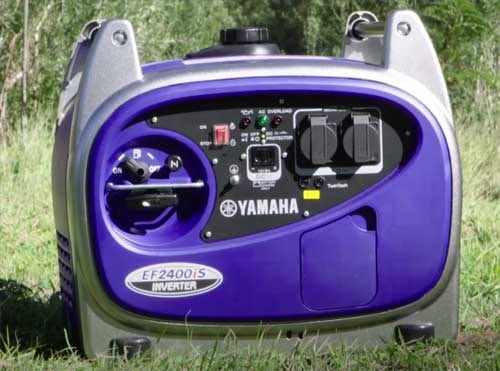
The EF2200iS is Yamaha's current portable inverter on Amazon. It keeps what made the EF2400iSHC a camper favourite: Yamaha Quiet Technology, a Smart Throttle that matches engine speed to the load, and a standard RV outlet so you don't need an adapter.
It adds an illuminated multi-function LED display that shows the generator's status day or night, and a single Smart Dial for starting up. The trade is power: it is a 2200-watt class unit on a 79cc engine, a step down from the 2400, so check your air conditioner or heaviest load before you buy.
Editor's Note, 15 August 2026: Yamaha has retired the EF2400iSHC and the listing is gone. Its replacement in Yamaha's range is the EF2200iS, which we have reviewed separately.
Editor's Note (6 August 2026): The Yamaha EF2400iSHC is no longer available on Amazon. We've left our original review below for reference. If you're shopping now, start with our current picks: Best Quiet Generators.
Our testers started a standard 13,500 BTU Dometic rooftop air conditioner on the Yamaha EF2400iSHC with no soft starter fitted. It scores 79 out of 100 on our five-metric scorecard.
 Built to Start a Stubborn RV Air Conditioner

Yamaha EF2400iSHC
- Output: 2,000 W running, 2,400 W surge
- Our noise reading: 57.5 dBA at 23 ft, quarter load
- Weight: 75.0 lb dry, no wheels
- Tank: 1.6 US gal
Bottom Line : A high-current 2,000 W inverter whose 171cc engine started a 13,500 BTU RV air conditioner with no soft starter, at the cost of 75 lb and no wheels.
Pros
- Started a 13,500 BTU RV air conditioner with no soft starter
- Quiet until pushed past 1,600 W
- 171cc engine with real low-end torque
- Pure sine output
Cons
- 75 lb with no wheels
- 1.6 gal tank drains fast at high loads
- Faulted on a 15,000 BTU air conditioner in 95°F heat
- Premium tier
In the Field
The EF2400iSHC is the high-current version of Yamaha's 2,400 W inverter, and John and Sean tested it for one job: starting a single RV air conditioner. The high-current controller and the 171cc engine absorbed the locked-rotor spike of a 13,500 BTU Dometic without stalling, and it then carried an RV microwave and the 12 V converter on alternating loads.
It is quiet until you load it. At 23 feet John's meter read 57.5 dBA at a quarter load (about 500 W), 64.2 dBA at half load (about 1,000 W) and 68.0 dBA at full load. At 50 feet it read 50.1 and 56.3 dBA. Standing 3 to 5 feet away it read 68 dBA at low idle, a normal conversation, and 76 dBA at half load, where you raise your voice slightly but do not need to shout.
The weight is the problem. It is 75.0 lb dry and 85.2 lb with 1.6 gallons of gas and 0.6 quart of oil, and it has no wheels. The twin die-cast aluminium rails make a short carry possible for one person, but lifting it chest high into Sean's truck bed alone strains the back, so treat it as a two-person lift or buy a wheel cart. From the truck to running took 1 minute 45 seconds, and the recoil with its automatic decompression pulled over on the first or second stroke.
On the 1.6-gallon tank it ran 8.6 hours at 500 W, 5.4 hours at 1,000 W and 3.4 hours at 2,000 W.
Where It Asks Something of You
The tank is small for the engine, and it drains quickly at high amp draws. At a full 2,000 W it lasts 3.4 hours, so a night of cooling on gas means a refill.
It has limits. A 15,000 BTU air conditioner under high head pressure at 95°F made the inverter fault out, and a 1,200 W electric skillet switched on while the 13,500 BTU compressor was starting tripped it instantly.
It has no wheels, so you either dead-lift it everywhere or buy a wheel cart.
Spec Sheet vs Our Test
2,000 W running, 2,400 W surge. These are the ratings we tested to. It held 500 W, 1,000 W and 2,000 W loads for the runtimes above, and it started the 13,500 BTU compressor that the surge rating alone would not suggest it could.
The high-current (HC) controller and 171cc engine. This is what the unit is for. Our testers ran it with no soft starter on a 13,500 BTU rooftop unit and it did not stall; at 5,000 ft they say it would need an aftermarket soft starter, because the running capacity falls.
Power at altitude. By calculation, not measurement, the loss is about 3.5% per 1,000 ft. At 5,000 ft, the elevation of Denver, running capacity drops from 2,000 W to about 1,650 W, which our testers say limits its ability to start a 13,500 BTU air conditioner without a soft starter.
Build quality. John and Sean point to the industrial cast-iron cylinder sleeve in the MZ175 engine and say it is built for 15 or more years of hard camping. That is their judgement from the build, not a durability test we ran.
Should You Buy the Yamaha EF2400iSHC?
This is the one to have if you run a single 13,500 BTU air conditioner and want it started with no soft starter, and you will not mind lifting 75 lb with no wheels. Our testers say it earns its premium tier with commercial-grade parts and clean output.
Skip it if you want something light or you need more than 2,000 W. For a lighter Yamaha with a built-in RV outlet, see the Yamaha EF2200iS.
Compare With
- Yamaha EF2200iS: the current Yamaha, with a built-in 30 amp outlet.
- Honda EU2200i: our best inverter generator overall.
- Best inverter generators: all ten ranked.
For every type of generator, start at our best generators guide.
Our Testers
This review was tested by John Palmer and Sean Williams, and edited by Sean.
- Sean Williams, Editor-in-Chief and Tester. Sean built the team of researchers and testers behind our reviews and edits every guide. His rule: we say what we actually found.
- John Palmer, Tester. John tests our generators alongside Ryan Williams, our lead tester, and ran the meter and oscilloscope work.