Editor's Note, 22 October 2026: The Yamaha EF2200iS Quietness mark is now 9.8, level with the Honda EU2200i, to match our head-to-head, where the two read the same at a quarter load, about 48 to 50 dBA. Its overall 82 is unchanged.
Editor's Note, 17 October 2026: We rewrote this review from the field review Sean Williams and John Palmer supplied on 17 October 2026. It replaces our earlier text and drops the old "quietest" label. The score now comes from our testers' bench marks: 82 out of 100, the same as in our best inverter generators guide. The noise figures are from our earlier side-by-side test with the Honda EU2200i.
Editor's Note, 29 September 2026: The old field-notes quote here was not from a real test, so we swapped it for a summary of what owners say.
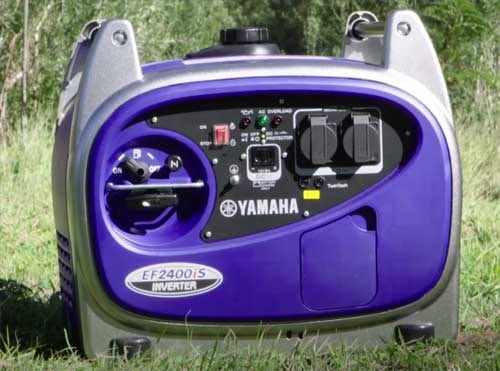
Our testers ran the Yamaha EF2200iS on a travel trailer with a 13,500 BTU rooftop air conditioner, with and without a soft starter, and had it side by side with the Honda EU2200i at about 48 to 50 dBA at a quarter load. It scores 82 out of 100 and ranks #9 in our best inverter generators guide, where it is our best inverter for RVs.
Best Inverter for RVs (Built-In 30 Amp Outlet)

Yamaha EF2200iS
- Output: 1,800 W running, 2,200 W surge
- RV outlet: TT-30R, 30 amp, built in
- Our noise reading: about 48 to 50 dBA, quarter load
- Weight: 55 lb dry, 64 lb fuelled
Bottom Line : A clean-power inverter with a built-in 30 amp RV plug and a Honda-like noise level, but 64 lb fuelled, a messy oil change, and a 13,500 BTU air conditioner it only starts with a soft starter.
Pros
- Built-in TT-30R plug takes a 30 amp RV cord with no adapter
- 0.88% total harmonic distortion at 120 V
- Carburetor drain on the dial empties the bowl in 15 seconds
- About as quiet as the Honda EU2200i at a quarter load
Cons
- 64 lb fuelled, a hard solo carry
- Oil drain sits inside the hatch and spills into the cowl
- Tripped on a 13,500 BTU air conditioner with no soft starter
In the Field
Sean Williams and John Palmer tested the EF2200iS in the field and on the bench, after reading what owners say about it. Owners split into two camps. The happy ones praise the built-in RV plug and say it starts on the first pull after six months in a shed. The unhappy ones say it tripped their camper air conditioner, call the oil change messy and call it heavy. Our testers found something behind each complaint and each compliment. Sean scored it 80 on usability and John scored it 84 on the bench, which averages to the 82 above.
Sean found it heavy for a suitcase inverter. It weighs 64 lb with fuel and oil, and he felt every pound lifting it onto the test truck's tailgate. The tri-handle roll bar is brilliant when two people carry it or strap it down, he says, but a one-armed solo carry left him with a bruised shin and a sore shoulder. For comparison, the WEN 56235i weighs 39 lb, and the Honda EU2200i is lighter than the Yamaha. The carburetor drain is the best mechanical feature: the multi-function dial has a float bowl drain, and Sean ran the engine dry and emptied the bowl in 15 seconds before storing it. The oil change is the opposite. The drain port sits flush inside the plastic maintenance hatch, and on the first break-in oil change dirty 10W-30 ran down inside the cowl and onto the shop floor, so bring an extended funnel or make a chute.
On noise, our side-by-side test with the Honda EU2200i is the benchmark: at a quarter load the two were almost identical, about 48 to 50 dBA. At about 8,000 ft in the Rockies, in eco mode, the Yamaha read about 53 dBA with a low, pleasant exhaust note, and under a heavy 1,500 W load its tone was slightly lower pitched than the Honda's crisper sound. On John's oscilloscope the total harmonic distortion was 0.88% at 120 V, clean enough for a CPAP, laptop chargers and audio gear.
The RV air conditioner test explains the complaints. Sean and John connected the Yamaha to a travel trailer with a standard Dometic 13,500 BTU rooftop unit and no soft starter. When the thermostat called for cooling, the compressor pulled a starting surge above 2,500 W, the engine bogged, the frequency dipped to 52 Hz and the overload tripped within 400 milliseconds. They then fitted a Micro-Air EasyStart to the same compressor. The starting spike fell to about 1,450 W, the Yamaha took it with a smooth throttle blip, and the air conditioner ran all afternoon at about 1,250 W.
Where It Asks Something of You
It is heavy to carry alone. At 64 lb with fuel and oil it is a two-person lift or a hand-truck job, and the tri-handle roll bar helps a pair more than it helps one person.
The oil drain is badly placed. It sits inside the maintenance hatch and spills into the cowl, so an oil change needs an extended funnel and patience.
A 13,500 BTU RV air conditioner needs a soft starter. The built-in 30 amp plug suggests it will run one, and Sean and John say Yamaha sets expectations too high by putting that plug on an 1,800 W generator.
Spec Sheet vs Our Test
1,800 W running, 2,200 W surge. Yamaha rates it at 1,800 W continuous and 2,200 W maximum. A 13,500 BTU rooftop air conditioner pulled more than 2,500 W to start with no soft starter, so the generator tripped. With a soft starter the start fell to about 1,450 W and the air conditioner then ran at about 1,250 W, which is well inside the rating.
Built-in 30 amp RV outlet (TT-30R). True, and Sean likes it: a 30 amp RV shore cord plugs straight into the faceplate, with no adapter to lose and one less failure point. It is also why buyers expect it to run a rooftop air conditioner, which it will only do with help.
Quiet running with Smart Throttle. Yamaha rates it 57 to 65 dBA depending on load, and its Smart Throttle matches engine speed to the load. Our testers read about 48 to 50 dBA at a quarter load, level with the Honda EU2200i, and about 53 dBA in eco mode at 8,000 ft. The tone under a heavy load was lower pitched than the Honda's.
Clean power. The inverter output measured 0.88% total harmonic distortion at 120 V on the oscilloscope. That is why it is safe for sensitive gear, and it is the strongest part of John's 84.
Fuel valve with carburetor drain. It works as described. Sean ran the engine dry and drained the float bowl in 15 seconds, which is the easiest way to avoid a gummed carburetor after a season in storage. Our testers' earlier log has the tank lasting about 10 hours at a quarter load.
Should You Buy the Yamaha EF2200iS?
Buy it if you plug into an RV often, want clean power for a CPAP or electronics, and will keep a soft starter on hand for the air conditioner. The built-in 30 amp plug is the best reason to pick it over the Honda, and the carburetor drain makes storage easy.
Skip it if you carry your generator alone, or if you expect it to run a 13,500 BTU air conditioner with no soft starter. The Honda EU2200i is lighter, and the WEN 56235i weighs 39 lb. We ran the Yamaha and Honda together in Honda EU2200i vs Yamaha EF2200iS.
Compare With
- Honda EU2200i: our best inverter generator for camping.
- Honda EU2200i vs Yamaha EF2200iS: the pair tested side by side.
- WEN 56235i: about 39 lb and our best inverter generator for the money.
- Yamaha EF2400iSHC: the high-current Yamaha that starts an air conditioner with no soft starter.
- Best inverter generators: all ten ranked.
For every type of generator, start at our best generators guide.
Our Testers
This review was tested by John Palmer and Sean Williams, and edited by Sean.
- Sean Williams, Editor-in-Chief and Tester. Sean built the team of researchers and testers behind our reviews and edits every guide. His rule: we say what we actually found.
- John Palmer, Tester. John tests our generators alongside Ryan Williams, our lead tester, and ran the meter and oscilloscope work.