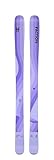
Tom and James took the Volkl Peregrine 80 Lowride through firm morning corduroy, icy pitches and afternoon chopped snow at Whistler Blackcomb in March and May 2026. It scores 86.5 out of 100 and ranks #5 in our best carving skis guide as our Best On-Piste Carving Skis for Changing Turn Shapes.
What are the best on-piste carving skis for changing turn shapes?
The best on-piste carving skis for changing turn shapes are the Volkl Peregrine 80 Lowride, which scored 9.0 out of 10 for speed stability and let the testers vary the turn shape from short 14.0 m arcs to long, fast turns.

Volkl Peregrine 80 Lowride
- Length tested: 172 cm
- Weight: 2,890 g, one ski with binding
- Waist: 80 mm
- Sold as: Ski + binding
Bottom Line : A multi-radius carver with a low stand height that stays calm at speed and in chop. It lacks the ice bite of the narrow slalom skis and feels grabby when you ski slowly.
Pros
- Speed stability 9.0 and steady edge grip, 8.5
- A radius that changes along the ski: 25 m tip, 14.0 m center, 22 m tail
- A low binding rail that keeps the boot close to the snow
- A calm, composed ride through afternoon chop
Cons
- The long-radius tip feels grabby at very slow speeds
- The shallow shovel sinks in deep afternoon slush
- Gives up some ice bite to the narrow slalom skis
Who it's best for
Tom led the Peregrine 80, with James co-testing, and found a refined, low-fatigue all-day carver that handles afternoon chop. It fits intermediate to expert skiers. Ice-carving purists who want the snap of a 66 to 68 mm ski, and slow-speed cruisers, will want something else.
Why we love it
Speed Stability (9.0). The long tip and tail radii, 25 m and 22 m, tracked steadily at speed on open runs and sliced through afternoon chopped snow with calm composure.
Edge Grip on Firm Snow (8.5). The full sidewalls, a titanal band under the boot and a 14.0 m center radius held crisp carves on morning snow. It gave up a little on boilerplate ice to the narrower double-titanal carvers.
Quickness (8.5) and Energy (8.5). The carbon-tipped shovel trimmed swing weight, so the 80 mm waist rolled smoothly between short and medium turns. The rebound out of the tail was smooth and progressive, and it let the testers vary the turn shape from 14 m carves to longer arcs. The low-profile Lowride binding in the box kept the boot soles close to the snow.
What we didn't like
At slow speeds the long-radius tip can feel slightly grabby if you aren't driving forward, and in soft afternoon piles the shallow shovel tends to submarine rather than plane; keep it moving on firm snow and it shines.
Tom, in the testers' notes
The feel comes from the sidecut. Because it stretches the tip radius to 25 m and the tail to 22 m around a 14.0 m center radius, the 172 cm ski skis longer and faster than a traditional 14 m carver.
That's also why it's grabby at slow speeds, and it sinks in soft afternoon piles. It lacks the sharp ice bite of the narrower full-camber slalom carvers.
Should you buy it?
For one carver that handles short arcs and fast, long turns and stays calm in afternoon chop, the Volkl Peregrine 80 Lowride is the pick, if you ski with some pace. If maximum ice bite matters more, take the Head Supershape e-Original.
On the Snow
The Peregrine got its laps in March and May 2026. Tom led the pair and James co-tested it, on the same lanes as every other ski in the guide: the Upper and Lower Dave Murray Downhill for 8:30 AM corduroy, the steep, wind-scoured icy pitch on Ego Bowl and Ptarmigan for edge tests, and the Lower Olympic and Garbanzo run-out once the afternoon chop set in. We skied it as sold, with its Marker Lowride 12 TCX GW binding, in the 172 cm length.
Edge grip came in at 8.5. The full sidewalls, the central titanal band and a 14.0 m center radius held crisp carves on the morning corduroy. On boilerplate ice it gave up a slight edge to the dual-titanal 66 to 74 mm carvers in the guide, which is why it did not take the top mark there.
Quickness edge to edge also scored 8.5. The 80 mm waist rolled smoothly between short and medium turns, and the tailored carbon tips took some of the swing weight out of the shovel. On a calibrated bench scale (±0.5 g), one ski with its binding weighs 2,890 g.
Speed stability was its best score, at 9.0. The long tip and tail radii tracked steadily on open runs and sliced through afternoon chop with calm composure. Tom's bench note puts it plainly: "Because the 3D Radius Sidecut stretches the tip radius out to 25 m and the tail to 22 m around a 14.0 m waist, the 172 cm Peregrine 80 skis longer and faster than a traditional 14 m carver."
The rebound out of the tail scored 8.5 for energy out of the turn. It was smooth and progressive, and it let the testers move from tight 14 m carves to longer GS-style arcs without changing the ski.
Where It Asks Something of You
The long tip is its main trade-off. At slow speeds it can feel slightly grabby if you are not driving forward, so this ski wants you moving. Tom found that the shallow shovel tends to submarine in soft afternoon piles rather than plane, and keeping the ski moving on firm snow is how it shines.
It also gives up some ice bite. Testers found it lacks the razor-sharp grip of narrower, full-camber carvers. If you want that snap, the Head Supershape e-Original is the ski built for it, with its 66 mm waist.
Slow cruising is the other weak point. The ski is happiest at speed, and a skier who wants a gentle, low-speed ride will feel the long radii more than they enjoy them.
Spec Sheet vs Our Test
3D Radius Sidecut. The listing gives a radius of 25 m at the tip, 14.0 m at the center and 22 m at the tail. Our testers saw that shape in use. Tom's bench check notes that the tip and tail stretch the ski's turn radius well past a traditional 14 m carver, and the speed stability score of 9.0 reflects it. For you, the practical result is a ski that changes shape with your input: short arcs when you want them, and long, fast turns when you open it up.
Full Sidewalls and Central Titanal Band. Our notes record full sidewalls and a central titanal band under the boot. On firm morning corduroy, that construction gave a crisp, trustworthy edge, and the testers scored edge grip at 8.5. It is not the sharpest ice tool in the guide, but it holds its line when the surface is a carving surface.
Lowride Binding Rail. The Peregrine is sold with the Lowride binding system, and our testers found the low interface kept the boot close to the snow. That gave a direct edge feel, and quick heel and toe adjustments. Compared with taller race plates, the boot soles sit closer to the snow.
Should You Buy the Volkl Peregrine 80 Lowride?
Yes, if you are an intermediate to expert frontside skier who wants a refined, low-fatigue carver for the whole day. Tom and James both found it calm at speed and steady in afternoon chop, and it lets you change your turn shape without changing skis. It is a premium-tier ski, and it earns that tier on the ski itself.
Skip it if you are an ice-carving purist who wants the snap of a 66 to 68 mm ski, or if you mostly cruise slowly. For the ice-carving purist, the Head Supershape e-Original is the better match. For the slow cruiser, look at a ski built for low speed instead.
A certified shop technician should set the binding for your boots and your ability. We skied the 172 cm length, picked from the listing options, so check the length with a shop before you buy.
Compare With
- Head Supershape e-Original: our Best Overall Carving Skis.
- Rossignol Hero Elite ST Ti Konect: our Best Slalom Carving Skis for Short Turns.
- Atomic Redster Q9.8 Revoshock S: our Best Frontside Carving Skis for Firm Mornings and Afternoon Chop.
- Nordica Dobermann Multipista 74 DC: our Best Smooth Race-Style Carving Skis.
- Rossignol Arcade 84: our Best Carving Skis for Your Own Flat-Ski Binding.
- Fischer The Curv GT 76: our Best Carving Skis for Lighter Skiers.
- Elan Wingman 86 Black Edition: our Best Short Carving Skis for Smaller Advanced Skiers.
- Atomic Redster Q6: our Best Carving Skis for Intermediates.
- Blizzard Stormbird 76 CA: our Best Lightweight Carving Skis for Easy Turns.
See the full field, and how we tested it, in our best carving skis guide.
Editor's Note, 17 November 2026: New review, written from the same March and May 2026 Whistler Blackcomb tests as our carving ski guide.
Our Testers
- Tom Harris, All-Mountain Ski Tester. A ski shop service manager and boot fitter. A strong advanced skier who loves bowls and glades.
- James Ward, Alpine Ski & Fat Bike Tester. On skis since he was 3 and a former regional alpine racer. Now a ski tuner and dryland fitness coach.