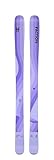
Libby and Annie carved the Fischer The Curv GT 76 down firm morning corduroy at Whistler Blackcomb, and its edge held clean while its turns came quick. It scores 79.5 out of 100 and ranks #7 in our best carving skis guide as our Best Carving Skis for Lighter Skiers. It also ranks #9 in our best women's skis guide as our Best Women's Skis with Bindings Included.
What are the best carving skis for lighter skiers?
The best carving skis for lighter skiers are the Fischer The Curv GT 76, which scored 8.5 out of 10 for quickness in a light 2,540 g set, with a binding in the box.

Fischer The Curv GT 76
- Length tested: 159 cm
- Weight: 2,540 g, one ski with binding
- Waist: 76 mm
- Sold as: Ski + binding
Bottom Line : An approachable carving set for lighter skiers, with a binding included. It runs out of speed stability sooner than the heavier skis, and its 10 DIN binding caps out for heavy skiers.
Pros
- Quickness 8.5 in a 2,540 g set
- Edge grip 8.0, clean and predictable without feeling hooky
- A forgiving rebound for developing carvers
- A binding comes in the box, budget tier
Cons
- Speed stability 7.5: the tip flutters in afternoon ruts when pushed
- A 10 DIN binding and 159 cm length cap out for heavier skiers
- The flat tail feels planky in firm bumps
On the Snow
We tested the set as sold, with its Fischer RSW 10 GW binding on the Twin Powerrail track. Our testers set the binding at DIN 6.5 for the test. A certified shop sets the DIN for you, not us. Libby led the 159 cm pair and Annie co-tested it, across March and May 2026 at Whistler Blackcomb, on the same firm morning corduroy, icy patches and afternoon chop that every carving ski in the guide saw.
Quickness is the first thing you notice. The 13.5 m E-Triple Radius rolled from edge to edge with little effort in short turns. The set weighs 2,540 g per ski with its binding attached, measured on a calibrated bench scale (±0.5 g). That light weight is part of why quickness scored 8.5, the highest of the four scores on this ski.
Edge grip on firm snow scored 8.0. The titanal reinforcement and full sidewalls held a clean, predictable edge on morning corduroy without feeling hooky. Energy out of the turn also scored 8.0. The rebound was lively and friendly, and it rewards a developing carver without punishing a small balance slip.
Speed stability scored 7.5, the lowest of the four. The ski stays calm at moderate to brisk recreational speeds. When the testers pushed it hard through afternoon ruts, the tip fluttered. The 159 cm length suited Libby at 5 ft 7 and Annie at 5 ft 6, and our notes say taller skiers would size up to 166 cm.
The same ski also came to us as a 152 cm women's pair with the binding included. Amy led that pair and Annie co-tested it. Weighed as sold, the pair came to 5,060 g: 3,220 g of bare skis plus 1,840 g of bindings. Edge hold and ease of turning both scored 8.5 in that test, and chop stability scored 7.0.
Where It Asks Something of You
The flat tail is the thing testers kept coming back to. Our bench check describes it as squared-off and flat, and Libby's field note says it feels planky once you sit back or ride into firm moguls. The fix is simple: stay forward over the shovel.
Stay forward over the shovel on smooth groomers and it carves clean, energetic arcs; but if you sit backseat or venture into firm moguls, that flat tail feels noticeably planky.
Libby, in the testers' notes
The binding sets the limit for heavier skiers. The RSW 10 GW is rated to DIN 10 and rides on a composite rail, and neither is meant for heavy or aggressive skiers. If that is you, ask a certified shop to choose a binding with a higher range before you buy.
In the women's pair, chop is the weak point. The 76 mm waist and 152 cm length got bounced around in deep afternoon slush and ruts, and chop stability scored 7.0 there.
Spec Sheet vs Our Test
E-Triple Radius sidecut. The maker's listing names an E-Triple Radius sidecut, and our bench note describes tighter tip and tail radii with a longer radius underfoot. The listing gives a 13.5 m turn radius at 159 cm, and the women's pair at 152 cm is listed at 13.0 m. Our testers found the claim holds up where it matters: the ski rolled quickly from edge to edge in short turns, which earned the 8.5 for quickness. If you ski tight, quick turns on packed snow, this is the claim that pays off.
Titanal reinforcement. The listing names titanal reinforcement in the build. On firm morning corduroy, the edge held clean and predictable, and the grip scored 8.0. Our notes do not separate the reinforcement from the sidewalls, so we report the result for the whole edge, not for the metal alone.
Sidewall construction. The listing describes full sidewalls. Our testers said the sidewalls helped the edge bite on morning hardpack, and the women's pair scored 8.5 for edge hold on the same kind of snow. The sidewalls are the reason the ski grips without feeling overly hooky, so this claim does real work on the snow.
Diagofiber. The listing names Diagofiber reinforcement. Our testers report a clean, predictable edge on firm corduroy, which fits the claim. We did not measure Diagofiber on its own, so the grip score is the result we can stand behind, not the material name.
Poplar woodcore. The listing names a poplar woodcore. Our tests did not isolate the core from the rest of the ski, so we do not score it separately. For you, the number to trust is the weight: 2,540 g per ski with the binding, and 3,220 g a bare pair in the women's test.
On-Piste Rocker. The listing calls the shape on-piste rocker. Our bench note describes a squared-off, flat tail, and our testers found that tail planky in firm bumps. The shape suits groomed runs. It is not built for bumps.
Sintered base. The listing claims a sintered base. After our women's test, the pair showed no damage to its edges, base or topsheet. Our notes do not score the base on its own, so take that result as a sign of durability, not a grip rating.
Should You Buy the Fischer The Curv GT 76?
Yes, if you are a lighter, advancing skier who wants a quick, friendly carver with a binding in the box. On a firm morning it grips, turns quickly and asks little of you. It is our verdict for the packed runs most skiers spend their mornings on, and that is the job it was built for.
Skip it if you are heavy, ski hard, or spend your afternoons in chop. Speed stability scored 7.5, and the 10 DIN binding caps out for aggressive experts. For that rider, the Atomic Redster Q9.8 Revoshock S is the better buy. It scored 90.0 in our carving guide, and it is built for skiers who want more speed and more damping.
If you want a women's ski with the binding included, this set is the one to test against your own weight and terrain. If you want a ski alone, our women's guide points to the Blizzard Black Pearl 88, our top-ranked women's ski at 89.0.
Compare With
- Head Supershape e-Original: our Best Overall Carving Skis.
- Rossignol Hero Elite ST Ti Konect: our Best Slalom Carving Skis for Short Turns.
- Atomic Redster Q9.8 Revoshock S: our Best Frontside Carving Skis for Firm Mornings and Afternoon Chop.
- Nordica Dobermann Multipista 74 DC: our Best Smooth Race-Style Carving Skis.
- Volkl Peregrine 80 Lowride: our Best On-Piste Carving Skis for Changing Turn Shapes.
- Rossignol Arcade 84: our Best Carving Skis for Your Own Flat-Ski Binding.
- Elan Wingman 86 Black Edition: our Best Short Carving Skis for Smaller Advanced Skiers.
- Atomic Redster Q6: our Best Carving Skis for Intermediates.
- Blizzard Stormbird 76 CA: our Best Lightweight Carving Skis for Easy Turns.
See the full field, and how we tested it, in our best carving skis guide.
Editor's Note, 17 November 2026: New review, written from the same March and May 2026 Whistler Blackcomb carving and women's ski tests as our guides.
Our Testers
- Libby Smith, Freeride Ski & Fat Bike Tester. A seasonal mountain bike trail builder and winter ski patroller, with several seasons of freeriding behind her.
- Annie Ward, Women’s All-Mountain Snowboard Tester. A freelance graphic designer and committed weekend all-mountain rider.
- Amy Carter, Freestyle Snowboard Tester. An action sports videographer and terrain park builder, and our strongest snowboarder.