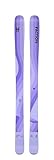
James and Ryan took the Nordica Dobermann Multipista 74 DC through firm corduroy, icy patches and chopped afternoon snow at Whistler Blackcomb in March and May 2026, and its 9.0 edge grip on firm snow was the headline. It scores 87.5 out of 100 and ranks #4 in our best carving skis guide as our Best Smooth Race-Style Carving Skis.
What are the best smooth race-style carving skis?
The Nordica Dobermann Multipista 74 DC is our pick, scoring 9.0 out of 10 for both edge grip and speed stability, in a forgiving 74 mm waist.

Nordica Dobermann Multipista 74 DC
- Length tested: 170 cm
- Weight: 2,050 g (one ski with plate)
- Waist: 74 mm
- Turn radius: 15.0 m
Bottom Line : A race-room edge and calm speed in a 74 mm waist that stays easy on groomers. It is less settled in choppy off-piste snow.
Pros
- Edge grip 9.0 on firm snow, with factory bevels that held icy lanes
- Speed stability 9.0, dead quiet at high speed on firm groomers
- A 74 mm waist with subtle rocker for all-day piste skiing
Cons
- Sold as a ski with an FDT plate, so it needs an FDT-compatible binding
- Harsh in choppy off-piste snow, where the stiff Double Core shows
- Quickness and energy out of the turn both score 8.5
Who it's best for
James led and Ryan co-tested the Dobermann, which suits advanced to expert frontside skiers who want something smoother and slightly wider than a twitchy 68 mm slalom ski.
Why we love it
Edge Grip on Firm Snow (9.0). The Energy 2 Ti Double Core, two Titanal sheets around dual wood cores with an elastomer layer, gripped the icy lanes tenaciously, helped by factory bevels of 0.9° at the base and 87.5° at the side.
Speed Stability (9.0). Dual Titanal damping kept the ski quiet at high speed on firm groomers and composed through the afternoon push piles.
That slightly forward stance makes it unusually easy to throw the tail sideways and scrub speed on groomers for a Dobermann.
Ryan, in the testers' notes
What we didn't like
The narrow 74 mm waist and stiff Double Core felt harsh when the snow turned choppy and off-piste. The plate also means a binding decision comes first: the FDT plate needs an FDT-compatible binding, and the testers mounted a Marker TPX 13 FDT GW that was not in the box.
Should you buy it?
Buy it if you ski on piste at an advanced or expert level and want a smoother ski than a short slalom ski. Read the rest of this review before you commit to a binding.
On the Snow
Firm morning corduroy is where this ski makes the most sense. James and Ryan skied it in March and May 2026 on the same three runs as every ski in our best carving skis guide: firm corduroy on the Dave Murray Downhill, an icy, wind-scoured pitch on Ego Bowl and Ptarmigan, and the chopped afternoon run-out on Olympic and Garbanzo.
The edge is what you notice first. The Energy 2 Ti Double Core and its factory bevels scored 9.0 for edge grip on firm snow, and the ski kept its line through the icy patches without skating.
At speed it stays calm. Dual Titanal damping kept the 170 cm ski dead quiet on firm groomers, and it stayed composed through the afternoon push piles, which is why it scored 9.0 for speed stability. Turn-in was quick and predictable through medium-radius carves (8.5), and the rebound out of the turn was clean and controlled (8.5).
Weight matters on a plated ski. Tom's bench sheets put one ski with the FDT Race Plate Pro N at 2,050 g on a calibrated bench scale (±0.5 g). Once the Marker TPX 13 FDT binding was mounted, the same ski weighed 2,750 g.
Where It Asks Something of You
The plate is the first decision. The ski ships with an integrated FDT plate and no binding, so you need an FDT-compatible binding to use it. Tom's bench note says the plate sits the boot slightly forward compared with traditional race plates, so the pairing matters.
Off-piste is its weak spot. Ryan found the narrow waist and the stiff Double Core harsh in choppy off-piste snow, which is why the ski trails on variable terrain.
Quickness and energy out of the turn both score 8.5, a half point under its edge grip and speed stability. It rewards a skier who drives the ski through the apex.
Spec Sheet vs Our Test
Energy 2 Ti Double Core. The listing describes two Titanal sheets around dual wood cores, with an elastomer layer. In our test that build showed up as 9.0 for edge grip and 9.0 for speed stability, the two scores that matter most on a race-style ski.
On-piste precision. The listing describes the ski as built for on-piste precision. Our testers found it quick and predictable through medium-radius carves, and they scored it 8.5 for quickness, so the claim holds on groomers without a top score.
Dynamic Race Shovel and carbon reinforcement. The listing names a Dynamic Race Shovel and says the ski is titanal and carbon reinforced. Our notes do not test the shovel or the carbon on their own, so we give no separate score for either.
Should You Buy the Nordica Dobermann Multipista 74 DC?
Yes, if you ski advanced to expert on piste and want a race-style ski that grips and stays quiet at speed. Its 9.0 scores for edge grip and speed stability are strong numbers, and the 74 mm waist keeps it easier to live with than a narrow race ski.
Skip it if you are a developing intermediate who wants a lighter, softer-flexing ski, or if most of your skiing is choppy off-piste. For the top-scoring ski in this guide, read our Head Supershape e-Original review, our Best Overall Carving Skis at 94.0.
Have a certified shop technician set the binding and confirm that an FDT-compatible binding fits this plate before you buy.
Compare With
- Head Supershape e-Original: our Best Overall Carving Skis.
- Rossignol Hero Elite ST Ti Konect: our Best Slalom Carving Skis for Short Turns.
- Atomic Redster Q9.8 Revoshock S: our Best Frontside Carving Skis for Firm Mornings and Afternoon Chop.
- Volkl Peregrine 80 Lowride: our Best On-Piste Carving Skis for Changing Turn Shapes.
- Rossignol Arcade 84: our Best Carving Skis for Your Own Flat-Ski Binding.
- Fischer The Curv GT 76: our Best Carving Skis for Lighter Skiers.
- Elan Wingman 86 Black Edition: our Best Short Carving Skis for Smaller Advanced Skiers.
- Atomic Redster Q6: our Best Carving Skis for Intermediates.
- Blizzard Stormbird 76 CA: our Best Lightweight Carving Skis for Easy Turns.
See the full field, and how we tested it, in our best carving skis guide.
Editor's Note, 17 November 2026: New review, written from the same March and May 2026 Whistler tests as our best carving skis guide.
Our Testers
- James Ward, Alpine Ski & Fat Bike Tester. On skis since he was 3 and a former regional alpine racer. Now a ski tuner and dryland fitness coach.
- Ryan Williams, Lead Tester. A heavy fleet equipment mechanic and commercial vehicle technician. At 6 ft 2 and 215 lb, he is our heavy, high-impact user.