Editor's Note, 16 October 2026: We rewrote this review from the bench log John Palmer and Sean Williams submitted on 16 October 2026. It replaces our earlier text, and the scores now come from our testers. The EF4500iSE was listed as temporarily out of stock on 16 October.
Our testers ran a 15,000 BTU RV air conditioner, a residential fridge, a 12 V converter and a shop dust collector off the Yamaha EF4500iSE at the same time, and at a quarter load it read 58.2 dBA at 23 feet. It scores 78 out of 100 on our five-metric scorecard.
 Quiet 4,000 W for Stationary Power

Yamaha EF4500iSE
- Output: 4,000 W running, 4,500 W surge, 120 V only
- Our noise reading: 58.2 dBA at 23 ft, quarter load
- Weight: 194.0 lb dry, 226.5 lb fuelled
- Tank: 4.5 US gal
Bottom Line : The quietest 4,000 W unit our testers ran, with marathon runtime and clean power, but it weighs 194 lb and has no 240 V.
Pros
- 58.2 dBA at 23 ft at a quarter load
- 15.2 hours at 1,000 W on one tank
- Ran a 15,000 BTU RV air conditioner, fridge and dust collector together
- Four-wheel cart with parking brake
Cons
- 194 lb dry, a two-person lift with ramps
- 120 V only, no 240 V
- Tripped on a 240 V compressor through a step-up transformer
- Solid wheels drag in deep gravel
In the Field
John and Sean tested the EF4500iSE on Sean's utility trailer and through John's home backup transfer switch. It started and ran a 15,000 BTU RV air conditioner, the onboard 12 V converter and charger, a residential refrigerator and a full shop dust collector simultaneously, and the pure sine output held under 1.5% total harmonic distortion.
It is quiet for 4,000 W. At 23 feet the meter read 58.2 dBA at a quarter load (about 1,000 W), 61.4 dBA at half load (about 2,000 W) and 65.0 dBA at full load. At 50 feet it read 50.5 and 53.8 dBA. Standing 3 to 5 feet away it read 67 dBA at low idle, and you could talk comfortably next to it even with a 1,500 W load running. Our testers credit the 357cc engine turning at about 2,600 rpm, which gives a low bass hum rather than the scream of a small high-revving motor.
The tank is what makes it a marathon machine. On 4.5 gallons it ran 15.2 hours at 1,000 W, 9.4 hours at 2,000 W and 6.1 hours at the full 4,000 W.
Then there is the weight. It is 194.0 lb dry and 226.5 lb with 4.5 gallons of fuel and 1.1 quart of oil. One person cannot lift it, and John and Sean needed steel loading ramps to roll it into a pickup bed even with two of them. The integrated four-wheel cart with its parking brake rolls well on concrete and hard dirt, though the solid rubber wheels drag in deep gravel. From the ramps to running took 3 minutes 30 seconds, and the electric key start fired the engine instantly.
Where It Asks Something of You
It is immovable without help. At 194 lb dry it needs two people and ramps, which makes it a stationary unit in practice.
It has no 240 V. Any 240 V load is out: a 5 HP commercial air compressor run through an external step-up transformer tripped the breaker immediately.
This model was listed as temporarily out of stock on 16 October 2026, so check the button before you plan around it.
Spec Sheet vs Our Test
4,000 W running, 4,500 W surge, 120 V only. These are the ratings we tested to. It held the RV air conditioner, converter, fridge and dust collector together, and tripped only when we asked for 240 V.
Pure sine output. The oscilloscope held under 1.5% total harmonic distortion with the full load running, which is clean enough for electronics.
Power at altitude. By calculation, not measurement, running capacity drops about 17.5% at 5,000 ft, to roughly 3,300 W continuous. Our testers say that is still enough to run a whole RV.
Longevity. John and Sean call the low-revving engine virtually unkillable. That is their judgement of the build, not a durability test we ran.
Should You Buy the Yamaha EF4500iSE?
Buy it for stationary power: a food truck, a toy hauler, a shop or home backup through a transfer switch, where quiet and runtime matter more than carrying it. Our testers rated it top premium tier.
Skip it if you carry your generator. A 194 lb machine that needs ramps is the wrong choice for most campers; the WEN DF680iX gives more power, including 240 V, at 94.8 lb dry, though it is louder.
Compare With
- WEN DF680iX 6800-Watt: more power and 240 V, much lighter, louder.
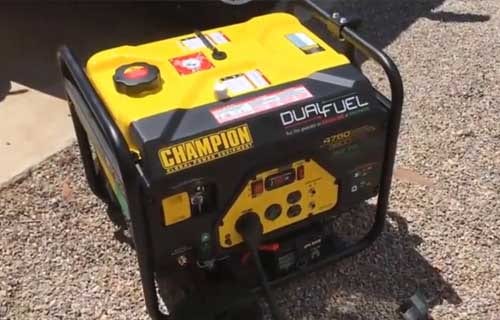
- Champion 4500-Watt Dual Fuel: the 4,500 W class we tested on an RV.
- Best generators for RVs: ten units tested on two RVs at Lake Tahoe.
For every type of generator, start at our best generators guide.
Our Testers
This review was tested by John Palmer and Sean Williams, and edited by Sean.
- Sean Williams, Editor-in-Chief and Tester. Sean built the team of researchers and testers behind our reviews and edits every guide. His rule: we say what we actually found.
- John Palmer, Tester. John tests our generators alongside Ryan Williams, our lead tester, and ran the meter and oscilloscope work.