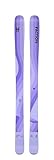
James and Tom took the Volkl Revolt 96 through 12 park laps at Whistler Blackcomb, and it came off 36 steel rail hits with clean edges and a clean base. It scores 86.5 out of 100 and ranks #4 in our best park skis guide as our Best All-Mountain Park Skis.
What are the best all-mountain park skis?
The best all-mountain park skis are the Volkl Revolt 96, which tied the Prodigy 1 for the top landing stability score, 9.0 out of 10, on both firm morning landings and afternoon slush ruts.

Volkl Revolt 96
- Length tested: 173 cm
- Weight: 1,830 g (one ski)
- Waist: 96 mm
- Turn radius: 19.9 / 17.0 / 18.6 m
Bottom Line : The stable, all-mountain choice: it stays planted when you land big and still carves the rest of the mountain. It takes more effort to spin on flat ground than the lighter skis.
Pros
- Landing stability 9.0 on firm snow and in slush ruts
- No score under 8.5
- Full sidewall construction came through 36 rail hits with clean edges and base
- Early tip and tail taper made popping from forward to switch easy
Cons
- Swing weight 8.5: at 1,830 g a ski it takes more effort to spin than the 1,580 to 1,810 g skis
- Minor cosmetic scuffing on the tail bevel
- Not the lightest for flat-ground spins
Who it's best for
James led and Tom co-tested the Revolt 96, which suits park skiers who want landing composure and an all-mountain ski for the rest of the day. A lightweight jibber who puts flat-ground spins first will want a lighter pair.
Why we love it
Landing Stability (9.0). The dense woodcore and 96 mm waist absorbed heavy impacts on firm morning landings and in afternoon slush ruts without washing out.
Pop (8.5) and Rail & Box Durability (8.5). Smooth, predictable pop off the 40 ft jump, and a full sidewall that handled 36 rail laps with no edge dings, just minor scuffs on the topsheet bevel.
Swing Weight & Spins (8.5). Slightly heavier than the 88 to 92 mm skis, yet the compact 173 cm length and early tip and tail taper kept 180s and 360s balanced.
That early taper makes popping from forward to switch effortless and makes 173 cm ski slightly shorter than stamped, while the dense woodcore keeps big jump landings rock-solid.
James, in the testers' notes
What we didn't like
At 1,830 g a ski, the Revolt took slightly more rotational effort on flat-ground spins than the 1,580 to 1,810 g skis.
The listing's 3D Radius Sidecut runs 19.9 m at the tip, 17.0 m at the waist and 18.6 m at the tail. It's a ski that carves the mountain, so it's less loose than a dedicated butter ski.
Should you buy it?
Choose the Volkl Revolt 96 if you want one ski for park laps and the rest of the mountain, and you value landings over spins. We skied 173 cm.
On the Snow
James rode six laps and Tom rode six, in March and May 2026, on the Highest Level and Habitat Park lanes at Blackcomb Terrain Park. Every ski in the guide got the same line: two tabletop kickers, a 25 ft and a 40 ft; two boxes, a 20 ft flat box and a 24 ft down box; and three steel rails, a 22 ft flat round bar, a 24 ft kinked rail and a 20 ft battleship rail. March meant firm, groomed hardpack in the morning. May started on refrozen takeoffs and turned into spring slush by early afternoon.
The Revolt pops the way a dense ski should. Its poplar and beech woodcore and full-length sidewalls loaded smoothly into the kicker lip and delivered solid, predictable pop off the 40 ft jump. That is the work behind its 8.5 for pop.
At 1,830 g a ski bare, it weighs more than several lighter skis in the guide. The compact 173 cm length and an early tip and tail taper kept 180s and 360s balanced and easy to release, so it scored 8.5 for swing weight and spins. Tom's bench check, on a calibrated bench scale (±0.5 g), measured the weight, and the taper gives the tip and tail a deeper start than most skis here.
Rails were clean. Across 36 steel rail hits, the full sidewall construction and P-Tex 2100 base took no edge dings. The only mark was a minor cosmetic scuff on the topsheet along the cap bevel, and that is why it scored 8.5 for rail and box durability.
Landings were the Revolt's best result. It tied for the top landing score in the guide, 9.0, on firm morning landings and on afternoon slush ruts alike. The dense woodcore and the 96 mm waist absorbed heavy impacts without washing out.
That early taper makes popping from forward to switch effortless and makes 173 cm ski slightly shorter than stamped, while the dense woodcore keeps big jump landings rock-solid.
James, in the testers' notes
Where It Asks Something of You
Spins are the trade-off. At 1,830 g, the Revolt takes a little more rotational effort on flat-ground spins than the lighter skis here, which weigh 1,580 to 1,810 g. If your day is flat-ground jibbing, that weight will show up in your spins before it shows up anywhere else.
It is also a carver. The 3D radius sidecut runs 19.9 m at the tip, 17.0 m at the waist and 18.6 m at the tail, and that shape grips well on the mountain. It makes the Revolt less loose than a dedicated butter ski, so the Line Blend will suit a looser, spin-first rider better.
Spec Sheet vs Our Test
Sintered base. The listing describes a sintered high-density polyethylene base with great gliding characteristics and high durability. Our notes record the base clean after 12 laps and 36 steel rails, with no base separation. We report that as an observation, and we do not score glide on its own.
Full sidewall construction. The listing says a mini cap overlaps the sidewall for the best durability. Our testers saw no edge dings after 36 steel rail hits. The one mark was a cosmetic scuff along the cap bevel. For a rail rider, the claim that matters held up.
Camber in the middle. The listing says the ski bends up only in the shovel and tail, with camber through the middle. Our testers scored the pop at 8.5 and the landings at 9.0 on this shape. They did not separate the camber from the woodcore, so we report the scores as they came in.
3D radius sidecut. The listing gives a 19.9 m tip, 17.0 m waist and 18.6 m tail radius at 173 cm. On firm morning snow and slush our testers called the result all-mountain carving grip in a 96 mm park twin. Their notes do not give a separate carving score.
Should You Buy the Volkl Revolt 96?
Choose the Revolt if you want one ski for park laps and the rest of the mountain, and you care more about landings than spins. It tied for the steadiest landings in the guide and came through 36 steel rails with clean edges. Have a certified shop technician set the binding, because that setting matters more than the ski's number.
Skip it if you are a lightweight jibber who puts flat-ground spins first. For a lighter, looser ski, read our Line Blend review, which scored 9.5 for spins. If you want the top jump-line pick, the Faction Prodigy 1 matches the Revolt's landing score and scores higher overall.
We skied the 173 cm length, and our testers found it slightly shorter than stamped. If you are between lengths, ask a certified shop to check the length that suits your height and riding before you buy.
Compare With
- Atomic Bent Decode: our Best Overall Park Ski.
- Faction Prodigy 1: our Best Park Skis for Jumps.
- Armada Edollo 91: our Best Park Skis for Rails.
- Faction Prodigy 2: our Best Park Skis for Everyday Laps.
- Line Chronic 101: our Best Budget Park Skis.
- Fischer Nightstick 97: our Best Park Skis for Smaller Skiers.
- K2 Reckoner 102: our Best Park Skis with Bindings.
- Line Honey Badger: our Best Park Skis for Lighter Skiers.
- Line Blend: our Best Park Skis for Spins.
See the full field, and how we tested it, in our best park skis guide.
Editor's Note, 17 November 2026: New review, written from the same March and May 2026 Whistler park tests as our park ski guide.
Our Testers
- James Ward, Alpine Ski & Fat Bike Tester. On skis since he was 3 and a former regional alpine racer. Now a ski tuner and dryland fitness coach.
- Tom Harris, All-Mountain Ski Tester. A ski shop service manager and boot fitter. A strong advanced skier who loves bowls and glades.