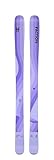
Ryan led the K2 Reckoner 102 through 12 park laps at Whistler Blackcomb, and it came off 36 steel rail hits with no edge pullout or core splitting, only light topsheet nicks. It scores 81.5 out of 100 and ranks #8 in our best park skis guide as our Best Park Skis with Bindings.
What are the best park skis with bindings?
The best park skis with bindings are the K2 Reckoner 102, which comes as a ski-and-binding set and scored 8.5 out of 10 for landing stability on a wide, forgiving platform.

K2 Reckoner 102
- Length tested: 177 cm
- Weight: 2,040 g (one ski)
- Waist: 102 mm
- Turn radius: 17.7 m
Bottom Line: A ready-to-ski park set: the binding is included and park-ready. The wide 102 mm waist is bulky on technical rail swaps and heavy to spin.
Pros
- A complete, mounted set: the included binding is genuinely park-ready
- Landing stability 8.5 on soft spring slush
- No core splitting or edge pullout after 36 box and rail hits
- A soft, surfy flex for playful skiers
Cons
- Bulky on technical rail swaps and 360s next to the 88 to 96 mm skis
- At 2,040 g a ski bare, the heaviest ski here
- Mild tip slap on firm morning landings
Who it's best for
Ryan led and Tom co-tested the Reckoner 102 set. It suits advanced freestyle skiers who want one wide twin for park laps and the rest of the mountain, plus a binding they do not have to buy separately. A technical rail-first skier should look at a narrower ski such as the Armada Edollo 91.
Why we love it
The set. Our notes record the ski sold mounted with a Marker Griffon 13 ID binding, and the testers skied it exactly as sold. The binding held up on heavy kicker landings, so the package works out of the box.
Rail and Box Durability (8.0). Across 36 steel rail hits, the Reckoner showed zero core splitting and zero edge pullout, with only light cosmetic topsheet nicks. Our notes record TwinTech Sidewalls and updated bio-resin construction, and the testers' rail results are the proof of that claim.
Pop (8.0) and Swing Weight & Spins (8.0). The Aspen Micro Block core and Carbon Boost stringers gave lively spring on kickers and rollers. The Griffon's compact mass kept spins predictable.
Awesome ready-to-rip all-mountain freestyle package with a legit 13-DIN binding, though its wide 102 mm waist feels bulkier on technical rail swaps than 88 to 96 mm park twins.
Ryan, in the testers' notes
What we didn't like
The 102 mm waist is the main trade-off. It feels bulky on technical rail swaps and on 360s, next to the 88 to 96 mm skis in this guide.
Landing stability is strong at 8.5 on soft spring slush, but on firm morning landings the wide tip slaps a little. The softer tips also absorbed slightly more of the energy on kickers than the cambered skis did.
Should you buy it?
Buy the K2 Reckoner 102 if you want one ski for park laps and the rest of the resort, and you want the binding included. We skied it at 177 cm. Ask a certified shop technician to set the binding DIN, because the Griffon 13 ID's range runs from 4 to 13 and the setting is theirs to make.
On the Snow
Ryan skied six of the 12 laps and Tom skied the other six, in March and May 2026 on the Highest Level and Habitat Park lanes at Blackcomb Terrain Park. Every lap hit two kickers, a 25 ft and a 40 ft tabletop, two boxes, a 20 ft flat box and a 24 ft down box, and three steel rails of 22, 24 and 20 ft. Every ski in the guide got the same line and the same lap count.
March was firm, machine-groomed hardpack on the inruns and chalky landings in the morning, softening into packed snow by the afternoon. May brought firm refrozen takeoffs and landings that softened into spring slush by early afternoon. The Reckoner was mounted at -1.5 cm from true center, as sold, and the Griffon 13 ID was not swapped.
On the bench, a calibrated bench scale (±0.5 g) put one bare ski at 2,040 g. That is the heaviest ski in the guide, and the testers felt it in the air. The wide platform held firm, though, and the Reckoner stomped soft spring slush landings with no fuss.
Where It Asks Something of You
The Reckoner asks you to accept width. At 102 mm under the foot it is bulkier on rail swaps and on 360s than the Armada Edollo 91, which is the narrower pick for rails.
It is also the heaviest ski in the guide at 2,040 g bare. Heavier skis are slower to spin, and the testers said the feel was obvious on the spins.
Spec Sheet vs Our Test
The ski-and-binding package. The listing says the set is sold mounted and ready to ride, with the binding included. In our test the Marker Griffon 13 ID held every landing and no binding was swapped, so the package claim held. For a reader who wants to skip buying a binding, that is the claim that matters most.
Aspen Micro Block core. The listing says the core gives a soft, surfy flex for playful skiers. Our notes record the tips as soft, in line with the listing. They also found the softer tips absorbed a little more energy on kickers than cambered skis did, which is why Pop scored 8.0.
Spectral Braid and triaxial construction. The listing says the braid and triaxial core dial in flex and torsional stiffness for an energetic, dependable ride. Our rail test backs up the durability side. After 36 steel rail hits there was no core splitting and no edge pullout, so Rail and Box Durability scored 8.0.
The 17.7 m turn radius. The listing gives a 17.7 m radius for the 177 cm length. We skied that length, and our notes do not test the radius on its own, so we report the length we skied and the scores that came with it.
Should You Buy the K2 Reckoner 102?
Yes, if you want one wide twin for park laps and the rest of the mountain, and you would rather not buy a binding on top of the ski. It came through 36 steel rail hits with no damage that matters, and its 8.5 for landing stability is the best landing score among the skis that ship with bindings in this guide.
No, if you are a technical rail-first skier who wants a narrow, lighter ski. Go with the Armada Edollo 91, our Best Park Skis for Rails. If you want the best park ski overall, the Atomic Bent Decode scored 90.0 and is our Best Overall Park Ski, but you will need to buy its binding separately.
Compare With
- Atomic Bent Decode: our Best Overall Park Ski.
- Faction Prodigy 1: our Best Park Skis for Jumps.
- Armada Edollo 91: our Best Park Skis for Rails.
- Volkl Revolt 96: our Best All-Mountain Park Skis.
- Faction Prodigy 2: our Best Park Skis for Everyday Laps.
- Line Chronic 101: our Best Budget Park Skis.
- Fischer Nightstick 97: our Best Park Skis for Smaller Skiers.
- Line Honey Badger: our Best Park Skis for Lighter Skiers.
- Line Blend: our Best Park Skis for Spins.
See the full field, and how we tested it, in our best park skis guide.
Editor's Note, 17 November 2026: New review, written from the same March and May 2026 Whistler park tests as our park ski guide.
Our Testers
- Ryan Williams, Lead Tester. A heavy fleet equipment mechanic and commercial vehicle technician. At 6 ft 2 and 215 lb, he is our heavy, high-impact user.
- Tom Harris, All-Mountain Ski Tester. A ski shop service manager and boot fitter. A strong advanced skier who loves bowls and glades.