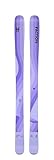
James and Annie tested the Head Unicorn JRS on the gentle Magic Chair learning slope at Whistler Blackcomb in March and May 2026, with a parent scoring every run. It scores 81.5 out of 100 and ranks #8 in our best skis for kids under 6 guide as our Best Budget Ski for Toddlers.
What is the best budget ski for toddlers?
The best budget ski for toddlers is the Head Unicorn JRS, which is the shortest and lightest real metal-edge set we tested, at 67 cm and 1,820 g a pair, and let a child aged 2 to 3 pivot wedge turns without tangling tails.

Head Unicorn JRS
- Length tested: 67 cm
- Weight: 1,820 g (pair, with bindings)
- Waist: 64 mm
- Sold as: Ski + binding set
Bottom Line : The smallest real ski we could find, at a budget tier, with a binding that takes every common boot sole. A child outgrows it once they pass about 100 cm.
Pros
- 67 cm and 1,820 g a pair, the shortest and lightest real ski here
- Turn ease 8.5 on the shortest real ski
- A binding the maker lists for alpine and GripWalk soles, types A and C
- The only budget-tier real ski in the test
Cons
- Straight-line stability 7.5, the lowest of the real skis
- A narrow 64 mm waist and 67 cm length outgrown once a child nears 100 cm
- Listing is in white and pink
Who it's best for
Parents of children aged 2 to 4 who want a budget-tier real metal-edge starter ski. Skip it for a child over about 102 cm.
Why we love it
Turn Ease (8.5). At 67 cm the Unicorn is the shortest real ski in the test. The tip rocker let a child aged 2 to 3 pivot wedge turns without tangling tails.
Edge Grip on Firm Snow (8.0). The camber underfoot held firm morning snow in slow wedge stops, something the edgeless plastic sets couldn't do.
The JRS binding. Head's JRS 4.5 GW CA binding lowered the heel step-in force for small children, and Tom's bench check says it accepts alpine ISO 5355 and GripWalk ISO 23223 soles, types A and C. That widens your choice of used boots, but have a shop check any hand-me-down boot against the binding. Tom measured a 1,820 g pair.
Ideal entry point for tiny 2 to 3 year-olds whose legs get tangled on 70 to 80 cm skis.
James, in the testers' notes
What we didn't like
Stability is where the short length shows. Straight-Line Stability scored 7.5, the lowest of the real skis: the narrow 64 mm waist and 67 cm length wiggled sooner on steeper traverses than the 70 cm Blizzard Anomaly JR.
It's outgrown fast. A child who has grown a lot will need a longer ski, and an older child shouldn't start on it at all.
Should you buy it?
Buy the Head Unicorn JRS for a child aged 2 to 4 if you want a real ski, not a toy. For a premium-tier set, the Blizzard Anomaly JR grips harder, and the Elan Sky turns more easily.
On the Snow
The Head Unicorn ran in two sessions. In March the Magic Chair pitch was cold corduroy at -4 to -1 °C, smooth and firm at 9:00 AM and chalky by midday. In May, at +2 to +5 °C, the morning surface refroze, then turned to spring corn by 11:30 AM. The eight alpine sets in the guide ran on that same slope.
Turn ease is where this ski earns its place. At 67 cm it is the shortest real ski in the test, and its 3.8 m turn radius let the two-to-three-year-old tester pivot wedge turns without tangled tails. Turn Ease scored 8.5.
On firm morning corduroy the camber underfoot held in slow wedge stops, and Edge Grip on Firm Snow scored 8.0. Our notes call that stop dramatically safer and more controlled than the plastic strap-on skis, which have no metal edges at all.
Stability is the one soft spot. At walking and gliding speeds the ski is very nimble, but on steeper traverses its narrow 64 mm waist and short length wiggled sooner than on the 70 cm Blizzard Anomaly JR. Straight-Line Stability scored 7.5.
Getting in and out was the easy part. The EASY4 rail's soft heel spring made step-in effortless for light toddlers, and the binding fitted every boot sole without changing the height on a screwdriver. Boot and Binding Ease scored 8.5.
Ideal entry point for tiny 2 to 3 year-olds whose legs get tangled on 70 to 80 cm skis. Just expect to size up once they are nearly 100 cm tall.
James, field note
Where It Asks Something of You
This is an early-years ski. The short length and narrow waist make it turn easily, and they are also why it is outgrown fast. Plan on the next size once a child nears 100 cm.
It only comes as a set. The ski and its binding are sold together, so the binding is part of what you buy, and it needs a certified shop to set it before the first run.
Our notes cover groomed learning terrain only. Do not read this review as a verdict on soft or ungroomed snow.
Spec Sheet vs Our Test
Jr. Power Frame. The listing names a Jr. Power Frame construction. Our testers did not score the frame on its own. What they scored was edge grip on firm snow, 8.0. For a parent, that is the number that matters, because it is how the ski holds on the first cold morning.
E Base Black. The listing describes a black E Base. Our notes do not score the base on its own, but they record no damage to the edges, base, topsheet or binding after the test. For a ski a toddler will carry and drag around, that is the part that matters.
Structured Surface. The listing describes a structured topsheet. Our notes say it resisted scratches cleanly. For a ski that will see a few seasons, that is the claim to trust.
Junior Rocker. The listing says Junior Rocker. Our notes measure it at 15% tip rocker. That is the reason the ski pivots so easily for a tiny rider, while the camber underfoot still holds on firm snow. Check it against the child's first wedge turns.
JRS 4.5 GW CA binding. The listing names a JRS 4.5 Gripwalk binding. Our testers confirmed it takes all four boot sole norms, ISO 5355 Type A and C alpine plus ISO 23223 Type A and C GripWalk. Our bench note puts the pair at 1,820 g with bindings, or 910 g per ski, the lightest real metal-edge package in the test. For a parent carrying skis to the car, that weight is the claim that counts.
Should You Buy the Head Unicorn JRS?
Yes, if you want a real metal-edge ski for a toddler in the early years and you want to stay in the budget tier. It is the shortest and lightest real set we tested, and its binding takes the hand-me-down boots a family already owns. Have a certified shop set the release. We do not give a DIN number, and a shop should choose it for your child.
Skip it if the child is already nearing 100 cm, or if you want a ski for steep traverses. For a child who is growing into a longer ski, the Blizzard Anomaly JR is our Best Overall Ski for Kids Under 6, and it grips harder on firm snow. For a child aged 5 to 6, read the Atomic Maverick J and the K2 Indy first. The plastic strap-on sets are backyard toys, not ski-slope gear.
Compare With
- Blizzard Anomaly JR: our Best Overall Ski for Kids Under 6.
- Elan Sky: our Best First Ski for Kids.
- Atomic Maverick J: our Best Ski for Kids Under 6 Who Are Linking Turns.
- Rossignol Rallybird Kid Team 4: our Best Kids Ski for Mixed Snow.
- K2 Indy: our Best Ski for a Confident 5 to 6 Year Old.
- Nordica Team G: our Best Mid-Price Kids Ski for Learning to Carve.
- Volkl Mini Revolt JR: our Best Twin-Tip Ski for Kids Under 6.
- Little Skiers Plastic Starter Set: ranked #9 in our guide, a plastic backyard toy.
- Crescent Moon Plastic Starter Set: ranked #10 in our guide, a plastic backyard toy.
See the full field, and how we tested it, in our best skis for kids under 6 guide.
Editor's Note, 17 November 2026: New review, written from the same March and May 2026 Whistler Blackcomb tests as our kids under 6 ski guide.
Our Testers
- James Ward, Alpine Ski & Fat Bike Tester. On skis since he was 3 and a former regional alpine racer. Now a ski tuner and dryland fitness coach.
- Annie Ward, Women's All-Mountain Snowboard Tester. A freelance graphic designer and committed weekend all-mountain rider.
- Tom Harris, All-Mountain Ski Tester. A ski shop service manager and boot fitter who set and release-tested the bindings on the bench.