Editor's Note, 4 October 2026: We rewrote this guide from scratch. The old version never gave you a number. This one sizes a generator by hookup, by air conditioner and by altitude, and every figure links to the maker or regulation it comes from.
Most campers need a generator between 2,000 and 3,500 watts. A 30 amp camper can never draw more than 3,600 watts, so a generator that runs 3,000 to 3,500 covers almost everything it can plug in. A 50 amp RV can draw up to 12,000 watts, though almost nobody comes close.
The figure that actually decides it is what your air conditioner needs in the first second it starts. Get that right and the rest is arithmetic.
Table of Contents
- The Quick Answer, by Rig
- What 30 Amp and 50 Amp Actually Mean
- The Air Conditioner Is the Whole Question
- Can a 2,000 Watt Generator Run an RV Air Conditioner?
- Two Small Generators Instead of One Big One
- Add Up Everything Else
- Altitude Takes Power Away
- How Loud Is Too Loud at a Campground?
- What We'd Buy for Each Rig
- Generator Size FAQ
The Quick Answer, by Rig
| Your rig | Hookup | Most it can draw | Generator to look at |
|---|---|---|---|
| Tent or car camping, no shore power | None | Lights, phones, a 12V fridge | 1,000 to 2,000 watts |
| Pop-up or teardrop, no air conditioner | 15 or 30 amp | Lights, fridge, microwave | About 2,000 watts |
| Travel trailer or pop-up with one rooftop AC | 30 amp | 3,600 watts | 3,000 to 3,500 watts, or 2,000 with a soft starter |
| Fifth wheel or motorhome with two ACs | 50 amp | 12,000 watts | 7,000 watts and up, or two units in parallel |
Not sure which row you're in? Our generator size calculator adds up what you actually run, starting watts included.
What 30 Amp and 50 Amp Actually Mean
A 30 amp RV is a camper wired with a single 120 volt circuit limited to 30 amps. That limit caps the whole rig at 3,600 watts, because watts are volts multiplied by amps (120 × 30). Its shore-power plug is a TT-30 with three prongs, and a generator needs a matching TT-30R outlet to take it without an adapter.
A 50 amp RV is wired with two 120 volt legs, each good for 50 amps. That adds up to 12,000 watts (2 × 50 × 120), more than three times a 30 amp rig. Its plug is a 14-50 with four prongs.
Here's the part most sizing charts skip: those are ceilings, not targets. The breaker is sized for headroom. What you need from a generator is what you run at the same time, which for most 30 amp trailers is one air conditioner, a fridge and a few lights.
The Air Conditioner Is the Whole Question
A rooftop air conditioner draws far more in the second it starts than in the hours it runs. That start-up surge, not the running load, is what stalls an undersized generator.
The running side is modest. Coleman's Mach 15, a common 15,000 BTU rooftop unit, is rated at 1,560 running watts and 14.8 amps on high, according to its published specifications.
The start is the problem. Air conditioner makers typically recommend a generator of 4,000 watts or more, even though the unit runs on less than 1,900, RV PRO reported. The gap between those two numbers is the start-up surge.
A soft starter closes that gap. It's a small module wired into the air conditioner that ramps the compressor up instead of slamming it on. Micro-Air's EasyStart 364 cuts start-up current by 60 to 75 percent, according to the same RV PRO report, which is enough to start a rooftop unit on a 2,000 watt generator.
Can a 2,000 Watt Generator Run an RV Air Conditioner?
Usually not on its own, and often yes with a soft starter.
A 2,000 watt class inverter has enough for the running load. Honda's EU2200i delivers 1,800 running watts, which clears the Mach 15's 1,560. What it lacks is the surge to start the compressor, so without help it will often trip the moment the compressor kicks in.
Two fixes work: fit a soft starter, or run two 2,000 watt generators together in parallel. Turning everything else off helps the running load, not the start.
Two Small Generators Instead of One Big One
Two inverter generators can be linked with a parallel kit and run as one. Honda lists the EU2200i as parallel capable, and two of them give 3,600 running watts, exactly the ceiling of a 30 amp camper.
The case for it is weight. An EU2200i weighs about 47 lb. The single Honda that matches the pair, the EU3000iS, weighs about 131 lb. Two small units are two easy lifts instead of one hard one, and on a weekend that only needs lights and the fridge you take one and leave the other at home.
Our Honda EU2200i review and Honda EU3000iS review cover both in detail.
Add Up Everything Else
Once the air conditioner is sorted, the rest of a camper is light work. LED lights, phone chargers, a fan and a 12 volt fridge together barely register on a 2,000 watt generator.
The loads that do register are the ones that make heat. Typical draws for an electric kettle, a hair dryer or a fan heater run from 1,500 to 1,800 watts, about the same as the air conditioner itself. Put a kettle on while a Mach 15 is cooling and you need around 3,360 running watts, more than a 3,000 watt generator can give.
Our calculator lists typical draws for 26 common camp loads and works out running and starting watts for your own list.
Altitude Takes Power Away
A generator loses power as you climb, because thinner air gives the engine less oxygen. Honda's owner's manual puts the loss at about 3.5 percent of engine horsepower for every 1,000 feet, even after the carburettor is rejetted for altitude, and more if it isn't.
At a 6,000 foot campground that is roughly a fifth of the engine's power. A generator that only just starts your air conditioner at the coast may not start it in the mountains. Honda recommends having the carburettor rejetted if you always run above 6,000 feet.
How Loud Is Too Loud at a Campground?
National parks set a hard limit. Under federal rules a generator can't exceed 60 decibels on the A-weighted scale, measured 50 feet away (36 CFR 2.12). Many campgrounds add quiet hours on top.
Most makers rate noise at 23 feet rather than 50, and some quote it at idle. Our generator noise database lists the rated figure for every generator we've reviewed alongside the load it was rated at, so you can see which claims are like for like. For the rules site by site, see can I use a generator on a campsite?
What We'd Buy for Each Rig
If you've read this far, here's how we'd spend the money.
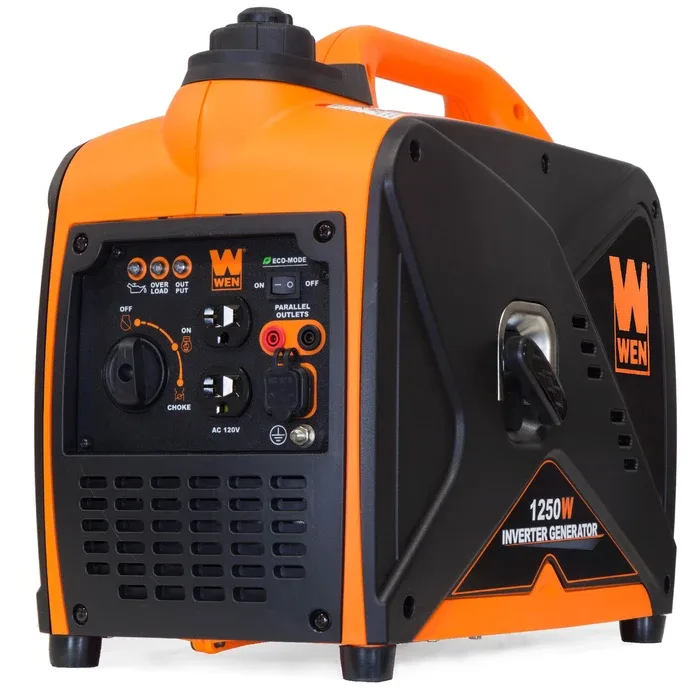
No air conditioner, or a tent. A quiet 2,000 watt class inverter. It's the right size, it's light, and it's the one the next pitch won't complain about. Start with our best quiet generators, where the Honda EU2200i is our top pick.
A 30 amp trailer with one air conditioner. Either a 3,000 to 4,000 watt inverter with a TT-30R outlet, or a 2,000 watt unit plus a soft starter. The first is simpler. The second is lighter and quieter, and costs you an afternoon fitting the soft starter. Our best camping generators cover both kinds, and the Champion 4000 Dual Fuel RV is the bigger-unit route.
A 50 amp rig with two air conditioners. A 7,000 watt class generator, or two mid-size inverters in parallel. Our testers ran two air conditioners from one WEN DF680iX 6800-Watt with soft starters. Soft starters on both rooftop units cut the start-up surge further. For everything else we've reviewed, start with our best generators guide.
Once you know the size you need, our best generators for RVs guide shows which ones started a 15,000 BTU AC at 6,225 ft.
Generator Size FAQ
Will a 3,000 watt generator run a 30 amp RV?
Yes, for most 30 amp trailers. A 30 amp RV can draw at most 3,600 watts, and a generator that runs 3,000 watts handles one rooftop air conditioner plus a fridge and lights. It won't run the air conditioner and an electric kettle at the same time.
What size generator do I need for a 50 amp RV?
Most 50 amp RVs need 7,000 watts or more to run two air conditioners at once. Each rooftop unit runs on roughly 1,600 watts, and the generator has to start the second one while the first is already running. With one air conditioner in use, a 4,000 watt class generator is usually enough.
Can I plug a 30 amp RV into a generator's household outlet?
Yes, with a 30 amp to 15 amp adapter, often called a dogbone. You're then limited to what that outlet can supply, 20 amps or 2,400 watts at most. That covers lights and the fridge; whether it starts the air conditioner depends on the generator behind it.
Does a generator lose power at altitude?
Yes. Honda puts the loss at about 3.5 percent of engine horsepower per 1,000 feet, even with the carburettor rejetted for altitude. At 6,000 feet that's roughly 21 percent.