

What is the best overall freeride ski binding?
The best overall freeride ski binding is the Atomic Strive 16 MN, which scored 92.5 out of 100, held through six flat drop landings with no unwanted release, and clicked shut with moderate force on steep traverses.

Atomic Strive 16 MN
- Weight: 1,125 g each
- DIN range: 7 to 16
- Brake width: 115 mm
- Boot soles: Alpine, GripWalk, touring
Bottom Line : The best freeride binding we tested: a low toe, a metal heel and a crisp click-in, with no unwanted release in six drops. The sliding plate wants to stay clear of grit.
Pros
- Hold 9.5: no unwanted release in six flat drop landings
- Power transfer & edge feel 9.5 from a very low toe
- Step-in 9.0, with moderate force on a steep traverse
- Takes alpine, GripWalk and touring boot soles
Cons
- The 115 mm brake overhangs a 102 mm waist by 6.5 mm a side
- The sliding plate needs to be kept clear of fine grit
- Nothing under DIN 7
Who it's best for
Tom led and Ryan co-tested, at DIN 8.0 and 10.0. Aggressive freeriders who want a low stand height, metal retention and the option of touring boots suit it. Skiers who want a turntable heel, or whose binding needs a DIN range that starts below 7, should look at the Look Pivot 2.0 15 GW instead. A certified shop sets the DIN.
Why we love it
Hold on Hard Landings (9.5). The metal-reinforced Low Drive Toe carriage and the metal heel held through six flat drop landings with no unwanted release and no forward-pressure drift under heavy compressions.
Power Transfer & Edge Feel (9.5). The very low toe puts the boot sole almost on the topsheet. The testers noted fine edge detail and quick edge roll-over on firm snow.
Chop Damping (9.0). The low center of gravity and the metal in the heel track calmed chopped spring snow without making the ski feel dead or stiff.
Step-In & Ice Clearing (9.0). The heel snapped shut crisply with moderate force on steep traverses, and the sliding plate cleared wet slush.
What we didn't like
Mind the brake width. The 115 mm brake overhangs a 102 mm waist by 6.5 mm on each side. Atomic also lists a 100 mm brake, which we didn't test and which would need spreading a little on 102 mm skis, so match the brake to your own waist.
The sliding plate needs a clean track. Fine parking-lot grit stops it centering cleanly, so keep the track clean. It has no turntable heel, and its DIN range starts at 7.
Should you buy it?
Pick the Strive 16 MN if you ski hard and want the best all-round freeride binding we tested, at a mid-price. If you want a turntable heel, or a DIN range that starts below 7, look at the Look Pivot 2.0 15 GW instead. Have a shop check the range against your own setting.
Read our full Atomic Strive 16 MN review →

What is the best freeride ski binding for heavy skiers?
The best freeride ski binding for heavy skiers is the Marker Jester 18 Pro, which scored 10 out of 10 for hold, tied with the two Look Pivots, with no pre-release under Ryan's 215 lb on 6 to 8 foot drops.

Marker Jester 18 Pro
- Weight: 1,110 g each
- DIN range: 8 to 18
- Brake width: 110 mm
- Boot soles: Alpine, GripWalk, touring
Bottom Line : A tied-top hold, with no pre-release under 215 lb on 6 to 8 foot drops, and a heavy magnesium build that quiets chop. It needs a hard stomp to close and starts at DIN 8.
Pros
- Hold 10.0: no pre-release in 6 to 8 foot drops under 215 lb
- Power transfer 9.5, with quick tip response on firm snow
- Chop damping 9.5 from heavy magnesium parts
- Anti Ice Rail scrapes slush off the boot
Cons
- Step-in 7.5: the heel needs a hard downward stomp
- The lowest DIN is 8, which rules out lighter skiers
- The anti-friction height screw needed a feeler-gauge re-check after day three
Who it's best for
Ryan led and James co-tested, at DIN 10.0 and 8.5. Heavy, high-impact freeriders and former racers on high-consequence terrain, who like the direct feel of a conventional heel, suit it. Its DIN range starts at 8, and it isn't for easy cruising.
Why we love it
Hold on Hard Landings (10.0). The Triple Pivot Elite 3 toe with its heavy horizontal spring and magnesium parts showed no side play or toe-wing flutter under Ryan's 215 lb on 6 to 8 foot drops into firm-to-slush compressions. There were no pre-releases.
Power Transfer & Edge Feel (9.5). The broad magnesium toe gave quick lateral response across the 102 mm waist on the firm morning snow of the Glacier headwall, with no lag at the tip.
Chop Damping (9.5). The heavy magnesium toe and heel quieted tip chatter and high-frequency buzz through frozen afternoon ruts at speed.
What we didn't like
Closing the heel takes effort (7.5). The stiff Inter Pivot 3 heel needs a hard stomp to cam shut, and on a soft side hill that means planning your leg drive. The Anti Ice Rail on the toe does clear packed slush well.
Watch the height screw, and the floor. The manual anti-friction height screw wanted a feeler-gauge re-check after day three, to be sure vibration hadn't crept it. The scale starts at DIN 8.0, so average-weight and lighter skiers can't use it at all.
Should you buy it?
Heavy freeriders who want a 10.0 hold with a magnesium build should start with the Jester 18 Pro. It's premium, and it scores higher than the Jester 16 and held firmer in our test. Its DIN range starts at 8, so skiers who need a lower range, or who want an easy click-in, should choose the Atomic Strive 16 MN or the Tyrolia Attack 14 GW.
Read our full Marker Jester 18 Pro review →

What is the best freeride ski binding for drops?
The best freeride ski binding for drops is the Look Pivot 2.0 15 GW, which scored 10 out of 10 for retention in our all-mountain test and for landing hold in our park test.

Look Pivot 2.0 15 GW
- Weight: 1,245 g each (park test)
- DIN range: 6 to 15
- Brake width: 95 and 105 mm (other tests)
- Tested in: Two other guides
Bottom Line : The firmest landings in two of our tests, and an all-metal turntable that damps chatter. It's heavy and slow to click into.
Pros
- Retention 10.0 in our all-mountain test; Landing Hold 10.0 in our park test
- Damping 9.5 in the all-mountain test, over refrozen wind ruts
- No pre-release off 5-foot drops under 215 lb
- A short mounting footprint leaves the ski free to flex
Cons
- Step-in 7.0 in both tests, and 7.8 seconds in the park test
- Cosmetic heel covers cracked in the cold
- Heavy: 1,245 g each
Who it's best for
Tom and Ryan used it in our all-mountain test, and James and Ryan in our park test. Heavy, hard-charging freeriders who land drops and don't mind a slow click-in suit it. It's the wrong binding under 140 lb, because its DIN starts at 6.
Why we love it
All-mountain test (105 mm brake). It held Ryan's 215 lb off 5-foot drops with zero unwanted pre-release and scored 10.0 for retention. Its heavy steel turntable and cast-aluminum toe soaked up chatter across refrozen wind ruts.
Park test (95 mm brake). It took eight backseat slap-downs off a 25-foot kicker with no heel flutter and no pre-release, and scored 10.0 for landing hold.
What we didn't like
The click-in is where the Pivot loses points. In the all-mountain test the rotating heel needed the boot lined up exactly, and on a 28-degree slope it took 5 of 10 tries. Step in on flat ground, or drop the pole tip dead center into the metal notch.
A pole used to pry the heel in 11°F air cracked a plastic heel cover, which Tom says is cosmetic. It was the heaviest binding in our all-mountain test.
Should you buy it?
If you land big drops and never want to think about pre-release, the Pivot 2.0 15 GW is the premium pick, and it ranks above the Atomic Strive 14 GW on hold. Lighter skiers under 140 lb should look elsewhere. Our brake widths were 105 mm in the all-mountain test and 95 mm in the park test, on 88 mm skis.
Read our full Look Pivot 2.0 15 GW review →
What is the best freeride ski binding for advanced skiers?
The best freeride ski binding for advanced skiers is the Atomic Strive 14 GW, whose low toe gave our all-mountain testers a close-to-the-snow edge on firm snow, at 265 g per binding under the Look Pivot 2.0 15 GW.

Atomic Strive 14 GW
- Weight: 980 g (half the all-mountain pair weight)
- DIN range: 5 to 14
- Brake width: 100 mm (other test)
- Tested in: All-mountain guide
Bottom Line : A close-to-the-snow edge and an easy click-in at a mid-price. A plastic clip under the sliding plate can pop out in wet snow and fail the release test, so have a shop check it.
Pros
- Edge Hold 9.5 in our all-mountain test
- Step-In 9.0: 3 of 3 on a 28-degree pitch
- Held through hard carves and released in a deliberate tip-cross test
- Lighter than the Pivot
Cons
- Damping 8.5, a step behind the metal bindings
- A small plastic clip hopped out on the shop bench with wet-slush boots
- The heel track showed 0.75 mm of fore-aft play after 18 hard days
Who it's best for
Advanced skiers on 88 to 100 mm skis who want a sharp, close-to-the-snow feel and an easy click-in suit it; Tom and James skied it in our all-mountain test, at DIN 8.0 and 8.5. It's the wrong binding for skiers who want a heavy metal turntable.
Why we love it
All-mountain test (100 mm brake). The toe sits low, and our testers called the micro-edging on firm snow exceptional. The heel funnel steered the boot into the toe jaws, and it made all 10 flat tries and 3 of 3 on the steep pitch.
What we didn't like
Check the plastic. Tom found a small clip under the sliding plate that hopped out in wet slush, and the binding failed the sideways release test until he popped it back. After 18 hard days James measured 0.75 mm of fore-aft play in the heel track, so have a shop check it once a season.
Its damping scored 8.5, a step behind the Look Pivot (9.5) and the Marker Jester 16 (9.0) in the same test.
Should you buy it?
Advanced skiers who want a lighter, sharper binding than a Pivot should look at the Strive 14 GW, at a mid-price. If you drop cliffs, choose the Pivot or the Atomic Strive 16 MN, which scored higher here, and have a shop check the sliding-plate clip before you ski wet snow. Our brake width was 100 mm.
Read our full Atomic Strive 14 GW review →
What is the best freeride ski binding for durability?
The best freeride ski binding for durability is the Look Pivot 2.0 18 GW, which was the toughest binding in our park test, with 10 out of 10 for toughness and no structural damage in 25 laps.
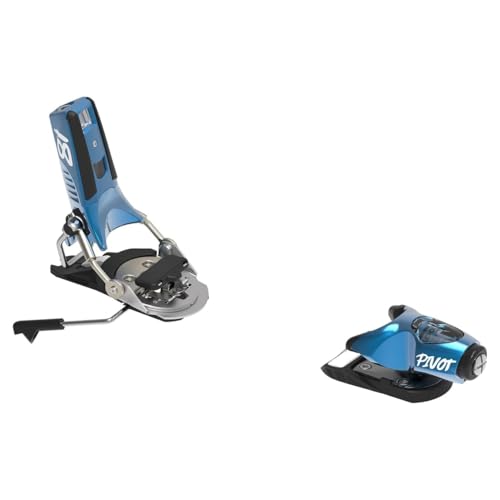
Look Pivot 2.0 18 GW
- Weight: 1,255 g each (park test)
- DIN range: 8 to 18
- Brake width: 95 mm (other test)
- Tested in: Park guide
Bottom Line : The toughest binding in our park test, with no pre-release and no structural damage in 25 laps. It's also heavy, and the slowest of the ten park bindings to click into.
Pros
- Landing Hold 10.0 and Rail & Box Toughness 10.0 in our park test
- No deflection under 215 lb
- A DIN range of 8 to 18
- Zero structural damage in 25 laps
Cons
- Step-in 6.5, and 9.4 seconds in the park test
- A false half-latch on soft landings
- A heel screw bound after square rails
- 1,255 g each
Who it's best for
James and Ryan used it in our park test, and a lighter tester sat out because her DIN was under its floor of 8. Heavy, high-impact skiers suit it. Its DIN range starts at 8, so have a certified shop check that range against your own setting.
Why we love it
Park test (95 mm brake). It showed no deflection and no heel lift under Ryan's 215 lb on flat 25-foot kicker landings, and was the only binding to score 10 for rail and box toughness, with only superficial scrapes in 25 laps.
What we didn't like
The Pivot 2.0 18 is slow to close. In the park test it scored 6.5 and took 9.4 seconds, because the steel heel spring needs a lot of downward leg drive. On soft landings the heel can click halfway and look engaged while forward pressure stays slack, so check it's fully shut before you drop in.
On square down-rails the heel adjustment screw bound in its collar until it was freed with penetrating lubricant.
Should you buy it?
Skiers who wear out gear get the most durable binding we've tested here, if a certified shop confirms its 8 to 18 DIN range fits them. Skiers who need a lower range should look at the Look Pivot 2.0 15 GW. It's premium, and the brake we tested was 95 mm on an 88 mm ski.
Read our full Look Pivot 2.0 18 GW review →
What is the best freeride ski binding for charging chop?
The best freeride ski binding for charging chop is the Marker Jester 16, whose magnesium parts quieted refrozen crust and heavy chop in our all-mountain test, with 9.0 for damping.

Marker Jester 16
- Weight: 1,080 g each (park test)
- DIN range: 6 to 16
- Brake width: 90 mm (other tests)
- Tested in: Two other guides
Bottom Line : Strong retention and damping for a heavy skier, in a binding 165 g lighter per side than the Look Pivot 2.0 15 GW. The step-in is stiff.
Pros
- Retention 9.5 and Damping 9.0 in our all-mountain test
- Landing Hold 9.5 in our park test
- Magnesium parts and an Anti Ice Rail
- 1,080 g each
Cons
- Stiff step-in: the heel needs a hard stomp
- The toe height screw backed down in three days
- Slush froze behind the heel cam and locked it
Who it's best for
Heavy, aggressive skiers who charge chop suit it. Ryan led and Tom co-tested in our all-mountain test, and James led and Ryan co-tested in our park test. It's the wrong binding under 140 lb, because DIN starts at 6.
Why we love it
All-mountain test (90 mm brake). It held Ryan's 215 lb through deep drops and hard compressions, and the magnesium parts quieted refrozen sun crust and heavy chop.
Park test (90 mm brake). It held firm through eight off-axis landings with no toe-wing flutter and scored 9.5 for landing hold.
What we didn't like
A hard stomp closes the Jester 16's heel. The heel needs an aggressive downward stomp, and the testers say the force is high for lighter skiers. In wet snow that froze, ice packed behind the heel rollers and the heel cup couldn't slide back to open until Ryan chipped it out with a screwdriver.
The manual toe height screw backed down a quarter turn in three days, leaving a 0.4 mm gap, so check it with a feeler gauge every couple of weeks.
Should you buy it?
Hard-charging skiers over 140 lb get most of the Pivot's retention here, in a lighter binding, at a mid-price. For a DIN above 16 or a firmer hold, step up to the Marker Jester 18 Pro.
Read our full Marker Jester 16 review →
What is the best freeride ski binding for easy step-in?
The best freeride ski binding for easy step-in is the Tyrolia Attack 14 GW, which scored 9.5 for step-in in both our all-mountain and park tests, and clicked in in 3.4 seconds in the park.

Tyrolia Attack 14 GW
- Weight: 1,010 g each (park test)
- DIN range: 4 to 14
- Brake width: 95 mm (other tests)
- Tested in: Two other guides
Bottom Line : The easiest click-in of the 14-DIN bindings in both earlier tests, at a mid-price. It passes more buzz on blue ice, and it scored lower for rail toughness, than the heavier bindings.
Pros
- Step-In 9.5 in both earlier tests
- Edge Hold 9.0 from a wide sliding plate in the all-mountain test
- DIN range of 4 to 14
- 1,010 g each
Cons
- Damping 8.0 in the all-mountain test: sharp buzz on blue ice
- The toe height screw needs a careful hand
- The heel lift tab bends if it's pried
Who it's best for
Freeriders who click in a lot and want a low-effort heel suit it; Tom and James used it in our all-mountain test, and James in our park test. It's wrong for hard-charging skiers who want an ultra-damp all-metal chassis.
Why we love it
All-mountain test (95 mm brake). The three-piece heel needed the lowest downward force of any 14-DIN binding, and the wide sliding plate turned high-angle edge changes straight into the ski.
Park test (95 mm brake). It clicked in in 3.4 seconds, even with wet slush on the heel lug, and had no pre-release in 25 laps.
What we didn't like
Frozen chop is where it loses ground. The composite toe drives well, but sharp vibration passes into the boot on blue ice, and it has less mass than the Pivot or Jester to calm frozen ruts (damping 8.0).
Set the toe height with care. If whoever tightens it doesn't push down on the toe while tightening, the wedge binds without seating. In the park test a hard slap-down on lap 12 let the wedge slip back, leaving a 1.2 mm gap underfoot. Don't pry the heel lift tab past 30 degrees in the cold.
Should you buy it?
If you click in often and want the easiest heel at this DIN, the Attack 14 GW is the freeride pick, at a mid-price. For frozen chop and big drops, choose the Marker Jester 16 or the Look Pivot 2.0 15 GW.
Read our full Tyrolia Attack 14 GW review →
What is the best hybrid freeride ski binding for high DIN?
The best hybrid freeride ski binding for high DIN is the Marker Duke PT 16, which tops out at DIN 16, has a convertible toe for skinning, and held through hard drop landings with no pre-release at DIN 10.0 for Ryan.

Marker Duke PT 16
- Weight: 1,350 g each
- Max DIN: 16
- Brake width: 100 mm
- Mode ridden: Alpine only
Bottom Line : A DIN 16 hold with a toe that converts for touring. We rode it in alpine mode only, and at 1,350 g it's the heaviest binding here.
Pros
- Hold 9.5: no pre-release in hard drop landings
- Max DIN of 16 with a convertible toe
- Power transfer 9.0 on firm snow
- Heavy enough to calm chatter in afternoon chop
Cons
- Heaviest binding here, 1,350 g in ski mode
- Step-in 7.5: packed ice must be cleared from the toe lock
- The convertible toe feels less solid than a plain Jester's
- A 24 mm stand height filters some snow feel
Who it's best for
Ryan led and Tom co-tested, at DIN 10.0 and 8.0, with the toe locked in ski mode. Aggressive freeriders who want alpine hold now and the option to skin outside the gates later suit it. Skiers who only ski inside the resort boundary, or who count grams, don't.
Why we love it
Hold on Hard Landings (9.5). The toe and the Inter Pivot 3 heel held Ryan through hard drop landings with no pre-release and no play at the toe.
Power Transfer & Edge Feel (9.0). The wide stance gave solid lateral support on firm snow. The 24 mm stand height filters a little of the fine feedback that the lower Strive bindings pass on.
Chop Damping (8.5). The mass absorbed high-speed chatter in afternoon chop well, though the multi-part toe feels less solid than a standard Jester's.
What we didn't like
At 1,350 g in ski mode the Duke is the heaviest binding here. The convertible toe can pack with slush in freeze-thaw spring snow, so the toe lock has to be cleared of ice before it will latch back into ski mode (7.5).
We rode it only in alpine mode, so we can't say how it climbs. These hybrids can also need a different boot sole: touring (ISO 9523) or alpine and GripWalk.
Should you buy it?
This is the one for freeriders who want DIN 16 hold in bounds and may skin beyond the gates. It's upper-mid. Resort-only skiers whose DIN falls in its range, which a certified shop checks, can save the weight and choose the Marker Jester 18 Pro, and skiers who want a lighter hybrid should look at the Atomic Shift2 13 MN.
Read our full Marker Duke PT 16 review →
What is the best budget freeride ski binding?
The best budget freeride ski binding is the Marker Griffon 13, which scored 8.0 to 8.5 on every quality and had no pre-release in 25 laps of our park test, at the budget tier.

Marker Griffon 13
- Weight: 1,030 g each (park test)
- DIN range: 4 to 13
- Brake width: 90 mm (other test)
- Tested in: Park and teens guides
Bottom Line : An even performer: no score below 8.0, and no pre-release in 25 laps of our park test. It's the budget pick, and it tops out at DIN 13.
Pros
- Landing Hold 8.5 and Rail & Box Toughness 8.5 in our park test
- No score below 8.0
- DIN range of 4 to 13
- The budget pick here
Cons
- Tops out at DIN 13
- The heel lever stopped halfway in wet slush
- The forward-pressure screw strips its plastic track if turned under load
Who it's best for
Intermediate-to-advanced skiers who want a dependable, widely serviced binding on a budget suit it; James led it in our park test. Its DIN range tops out at 13, so heavier freeriders should check the range with a shop.
Why we love it
Park test (90 mm brake). It handled eight flat landings cleanly for James at DIN 8.5, with no flutter and no pre-release in 25 laps. Its composite toe carriage shrugged off aluminum box edges.
What we didn't like
Two hardware faults. The forward-pressure screw is a steel worm driving into plastic ribs, and if it's turned while the boot is clamped it strips them, so adjust it with the binding unloaded. And on soft snow the heel lever often stopped halfway down, looking closed but opening when weighted, so check it's shut.
Its spin and swing feel was the lowest of the park ten, at 8.0. It's the budget pick, and its hold is a step below the 10.0 bindings.
Should you buy it?
For a freeride binding on a budget, the Griffon 13 is the one we've tested. It scores 84.0, ahead of the Atomic Shift2 13 MN at 82.5, and its alpine chassis is simpler. If you need a DIN range above 13, look at the Marker Jester 16, and have a shop check it. We tested the newer model, with a 90 mm brake.
Read our full Marker Griffon 13 review →
What is the best lightweight hybrid freeride ski binding?
The best lightweight hybrid freeride ski binding is the Atomic Shift2 13 MN, which weighed 920 g, the lightest of the ten, and still held through 4-foot drops with no pre-release.

Atomic Shift2 13 MN
- Weight: 920 g each
- DIN range: Up to 13
- Brake width: 100 mm
- Mode ridden: Alpine only
Bottom Line : A light hybrid that held through 4-foot drops with no pre-release. It's less damp than a full alpine binding, and the brake needed spreading to clear a 102 mm waist.
Pros
- Hold 8.5: no pre-release in 4-foot drops
- 920 g, 430 g under the Duke PT 16
- Step-in 8.0, with a redesigned brake lever
- A DIN range of 6 to 13 suits lighter skiers too
Cons
- Less damp than an alpine binding at speed
- A little high-frequency buzz on refrozen morning snow
- The 100 mm brake needed spreading by 1 mm an arm
- DIN tops out at 13
Who it's best for
James led and Libby co-tested, at DIN 8.5 and 6.5, in alpine mode. Skiers who split their days between the resort and the backcountry, and want a lighter binding than the Duke PT 16, suit it. Heavy riders on big cliffs should look elsewhere.
Why we love it
Hold on Hard Landings (8.5). The toe, with its redesigned aluminum Power Block insert, held through 4-foot drops with no unwanted pre-release.
Power Transfer & Edge Feel (8.5). The Micro AFD, a height adjustment that mates the toe to the boot sole, gave a precise fit and direct power on firm snow, though it felt less damp than a solid metal alpine chassis.
Step-In & Ice Clearing (8.0). The redesigned brake lever and the toe both worked well, provided the boot welt was clean enough for the toe wings to snap fully over center.
What we didn't like
It's the least damp of the four new bindings. The carbon-filled polyamide body deadened moderate chatter well, but it passed a slight high-frequency buzz through refrozen morning snow, and it's the lowest of the four on hold.
The Shift2 asks for some fiddling. The 100 mm brake had to be spread by 1 mm on each arm to clear the 102 mm waist. We rode it in alpine mode only, so the touring side is untested, and a different boot sole (touring ISO 9523 or alpine and GripWalk) may be needed.
Should you buy it?
For 50/50 resort and backcountry days at a light weight, choose the Shift2 13 MN. It's premium, and it scores 82.5, just behind the Marker Griffon 13. Heavy skiers and cliff drops belong on the Jester 18 Pro or the Duke PT 16 instead.
Read our full Atomic Shift2 13 MN review →
How did we test the freeride ski bindings?
We tested four of the ten freeride ski bindings here, running 20 laps on each at Whistler Blackcomb between 12 and 18 May 2026 on identical Blizzard Rustler 10 skis, scoring each on hold on hard landings, power transfer & edge feel, chop damping and step-in & ice clearing and weighing each on a calibrated bench scale (±0.5 g). The other six carry their scores from our all-mountain and park guides.
A freeride binding has four jobs: stay closed on a hard landing, pass your edge to the ski on firm snow, stay calm in chop, and close again after a fall on a slope. Ryan, our heavy rider, led the Jester 18 Pro and Duke PT 16. Tom led the Strive 16 MN, and James led the Shift2 13 MN, with a different co-tester on each: James on the Jester 18 Pro, Ryan on the Strive 16 MN, Tom on the Duke PT 16 and Libby on the Shift2 13 MN. The other six (the Look Pivot 2.0 15 GW and 18 GW, Atomic Strive 14 GW, Marker Jester 16, Tyrolia Attack 14 GW and Marker Griffon 13) were tested in our all-mountain and park guides, and their scores here are the sitewide scores from those guides. The park test used 25 laps. Their write-ups below come from those tests.
Each of the four new bindings went on its own pair of Blizzard Rustler 10 skis (180 cm, 134-102-123 mm, 17.5 m radius) on the factory mount line, four pairs in all, ground flat and waxed alike. A certified shop technician calibrated each DIN, and all four testers rode GripWalk soles (ISO 23223). Testing ran over six testing days between 12 and 18 May 2026, and each of the four got 20 laps: five early-morning carves on salted hardpack down the Glacier headwall, ten chop runs down Jersey Cream and into the lower Glacier transition (refrozen ruts and heavy slush from 1:30 pm), and five impact landings off Secret Bowl wind-lips and rock drops of 5 to 8 feet. For step-in we made five clicks on flat ground at the glacier hut deck and five on a 30-degree pitch. The DIN for each tester is in the table below.
| Tester | Height | Weight | Age | Set DIN (shop) |
|---|---|---|---|---|
| Tom | 5 ft 11 | 178 lb | 36 | 8.0 |
| James | 5 ft 10 | 172 lb | 33 | 8.5 |
| Libby | 5 ft 7 | 142 lb | 30 | 6.5 |
| Ryan | 6 ft 2 | 215 lb | 38 | 10.0 |
The Duke PT 16 and Shift2 13 MN were mounted and skied in alpine (downhill) mode for all 20 laps, so we didn't test their climbing. These two may need a different boot sole (touring ISO 9523, or alpine and GripWalk). A certified shop can check the sole against your boots before you buy. The 110 and 115 mm brakes overhung the 102 mm waist by 4 and 6.5 mm a side, and the 100 mm brakes needed spreading by 1 mm an arm. The four scored qualities:
- Hold on Hard Landings: impact landings off wind-lips and rock drops, and any pre-release, toe flutter or play
- Power Transfer & Edge Feel: how directly the binding passed edge pressure to the ski on the salted hardpack of the Glacier headwall
- Chop Damping: how much tip chatter and buzz reached the boot through refrozen ruts and heavy slush at speed
- Step-In & Ice Clearing: how easily the heel and toe closed on slushy, icy boots, flat and on the 30-degree pitch
- Weight (measured, not scored): one binding with its brake installed, dry and without screws, on a calibrated bench scale (±0.5 g)
A binding that appears in more than one of our guides has one score everywhere: the average of its results across those guides. The metric bars show this guide's own test. For the four bindings new to this guide, the overall is the average of the four scores times 10, rounded to the nearest half point. Six of the ten here (the Look Pivot 2.0 15 GW and 18 GW, Atomic Strive 14 GW, Marker Jester 16, Tyrolia Attack 14 GW and Marker Griffon 13) also appear in our all-mountain and park guides, so their score is that one score, and their cards show the brake width and weight from the tests there. The Pivot 2.0 15 and Atomic Strive 14 tie on 90.0, and the Pivot ranks first because it held better, 10.0 for hold against 9.0. Specs such as DIN range and boot soles come from the product listings; boot, DIN, brake width and every result come from our testers. We don't score price; where a binding's value stands out we say so in tiers (premium, upper-mid, mid-price, budget), and the Check Latest Prices button shows the current number. You can meet the testers at the bottom of this page.
Which freeride ski binding suits your skiing?
The right freeride ski binding depends on your weight, your terrain and whether you tour: pick by the row that matches you.
| If you're… | Buy |
|---|---|
| Wanting the best all-round freeride binding with a low toe | Atomic Strive 16 MN |
| Heavy, with a shop-set DIN inside the 8 to 18 range, and wanting a 10.0 hold with an easier click-in than the Pivot 18 | Marker Jester 18 Pro |
| Landing big drops and willing to live with a slow click-in | Look Pivot 2.0 15 GW |
| Advanced, on 88 to 100 mm skis, and wanting a low toe and an easy click-in | Atomic Strive 14 GW |
| Heavy, hard on gear, and wanting the only 10.0 for toughness | Look Pivot 2.0 18 GW |
| Charging chop and heavier than 140 lb | Marker Jester 16 |
| Clicking in often and wanting an easy heel | Tyrolia Attack 14 GW |
| Wanting DIN 16 in bounds with the option to skin out of the gates | Marker Duke PT 16 |
| Watching the budget | Marker Griffon 13 |
| Splitting days between the resort and the backcountry, and wanting a light binding | Atomic Shift2 13 MN |
What did our freeride ski binding tests show?
Our freeride ski binding tests showed that every binding over 1,100 g held at 9.5 or better, that the Atomic Strive 16 MN was the best all-rounder, and that step-in ease separated the ten more than anything else.
Where each quality was tested, what separated the ten bindings, and what the scores show. Each binding's four scores are also in its card above. The comments in the tables come from our testers' results for this guide (the Jester 18 Pro, Strive 16 MN, Duke PT 16 and Shift2 13 MN) or, for the other six, from the guide where each was first tested.
How well do freeride ski bindings hold through hard landings?
The freeride ski bindings that held best through hard landings were the Marker Jester 18 Pro, Look Pivot 2.0 15 GW and Look Pivot 2.0 18 GW, which each scored 10 out of 10.
Where we tested it. The five impact laps per binding off Secret Bowl wind-lips and rock drops of 5 to 8 feet.
What separated them. Three bindings scored 10, three (the Strive 16 MN, Duke PT 16 and Jester 16) 9.5, the Atomic Strive 14 GW 9.0, and the Attack 14, Griffon 13 and Shift2 13 MN 8.5. The spread is 1.5 points. The four bindings new to this guide had no pre-release.
What it felt like. The five heaviest bindings (1,110 g and up) all scored 9.5 or higher, and the three that scored 8.5 each weigh 1,030 g or less. Weight isn't the whole story, though: the 1,080 g Jester 16 also scored 9.5.
| Binding | What we found |
|---|---|
| Marker Jester 18 Pro | No side play or toe-wing flutter under 215 lb on 6 to 8 foot drops |
| Look Pivot 2.0 15 GW | Earlier tests: no pre-release off 5-foot drops under 215 lb (105 mm brake) |
| Look Pivot 2.0 18 GW | Earlier test: no deflection or heel lift under 215 lb (95 mm brake) |
| Atomic Strive 16 MN | Six flat drops, no unwanted release or forward-pressure drift |
| Marker Duke PT 16 | Hard drop landings, no pre-release or play at the toe |
| Marker Jester 16 | Earlier tests: held 215 lb through deep drops (90 mm brake) |
| Atomic Strive 14 GW | Earlier test: held through hard, loaded turns (100 mm brake) |
| Tyrolia Attack 14 GW | Earlier tests: solid on straight landings (95 mm brake) |
| Marker Griffon 13 | Earlier test: eight flat landings, no pre-release (90 mm brake) |
| Atomic Shift2 13 MN | Held 4-foot drops with no pre-release |
How well do freeride ski bindings pass edge feel to the ski?
The freeride ski bindings with the best power transfer and edge feel were the Atomic Strive 16 MN, Marker Jester 18 Pro, Look Pivot 2.0 15 GW and 18 GW and Atomic Strive 14 GW, which each scored 9.5.
Where we tested it. The five early-morning carves per binding on the salted hardpack of the Glacier headwall.
What separated them. Five bindings scored 9.5, three (the Duke PT 16, Jester 16 and Attack 14) 9.0, and the Griffon 13 and Shift2 13 MN 8.5. The spread is 1.0 point, the narrowest of the four qualities.
The Strive 16 MN got there with a very low toe, and the Jester 18 Pro with a broad, heavy magnesium toe. The Duke PT 16's 24 mm stand height filtered a little fine feedback, and the Shift2 felt less damp than a solid metal alpine chassis.
What it felt like. A low toe and a heavy toe both worked on firm snow. What lost points was a taller stand height (the Duke) or a lighter polyamide body (the Shift2).
| Binding | What we found |
|---|---|
| Atomic Strive 16 MN | Very low toe; fine edge detail and quick roll-over |
| Marker Jester 18 Pro | Broad magnesium toe, quick lateral response, no lag at the tip |
| Look Pivot 2.0 15 GW | Earlier test: short footprint, instant lateral drive (105 mm brake) |
| Look Pivot 2.0 18 GW | Score from our ranking table; no separate edge-feel note from the park test (95 mm brake) |
| Atomic Strive 14 GW | Earlier test: low toe, exceptional micro-edging (100 mm brake) |
| Marker Duke PT 16 | Wide stance, solid lateral support; 24 mm stand height filters some feel |
| Marker Jester 16 | Earlier test: no twisting lag (90 mm brake) |
| Tyrolia Attack 14 GW | Earlier test: wide sliding plate, clean edge changes (95 mm brake) |
| Marker Griffon 13 | Score from our ranking table; no separate edge-feel note from the park test (90 mm brake) |
| Atomic Shift2 13 MN | Precise fit from the Micro AFD; less damp than metal |
How well do freeride ski bindings damp chop?
The freeride ski bindings that damped chop best were the Marker Jester 18 Pro, Look Pivot 2.0 15 GW and Look Pivot 2.0 18 GW, which each scored 9.5 for chop damping.
Where we tested it. The ten chop runs per binding down Jersey Cream and into the lower Glacier transition: refrozen ruts and heavy afternoon slush, ridden at speed.
What separated them. Three bindings scored 9.5, the Strive 16 MN and Jester 16 9.0, the Duke PT 16 and Strive 14 8.5, and the Attack 14, Griffon 13 and Shift2 13 MN 8.0. The spread is 1.5 points.
Mass and metal helped most. The Jester 18 Pro's magnesium toe and heel quieted tip chatter, and the Strive 16 MN's low center of gravity muted the chop without feeling stiff. The Shift2's carbon-filled polyamide body let a slight buzz through on refrozen snow.
What it felt like. Mass wasn't the whole story. The 1,350 g Duke PT 16 scored 8.5, below the 1,125 g Strive 16 MN at 9.0, because its multi-part toe felt less solid.
| Binding | What we found |
|---|---|
| Marker Jester 18 Pro | Heavy magnesium toe and heel deadened frozen-rut buzz |
| Look Pivot 2.0 15 GW | Earlier test: cast-aluminum toe and steel heel soaked up wind ruts (105 mm brake) |
| Look Pivot 2.0 18 GW | Score from our ranking table; no separate chop note from the park test (95 mm brake) |
| Atomic Strive 16 MN | Low center of gravity and metal heel muted chopped snow |
| Marker Jester 16 | Earlier test: magnesium parts quieted refrozen crust (90 mm brake) |
| Marker Duke PT 16 | Mass absorbed chatter; multi-part toe less solid |
| Atomic Strive 14 GW | Earlier test: polymer body, a step behind the metal bindings (100 mm brake) |
| Tyrolia Attack 14 GW | Earlier test: sharp vibration on blue ice (95 mm brake) |
| Marker Griffon 13 | Score from our ranking table; no separate chop note from the park test (90 mm brake) |
| Atomic Shift2 13 MN | Slight high-frequency buzz on refrozen snow |
How easy are freeride ski bindings to step into?
The easiest freeride ski binding to step into was the Tyrolia Attack 14 GW, which scored 9.5 for step-in & ice clearing.
Where we tested it. Five clicks on flat ground at the glacier hut deck, then five on a 30-degree pitch, on slushy and icy boots.
What separated them. The Attack 14 scored 9.5, the Strive 16 MN and Strive 14 9.0, the Shift2 13 MN and Griffon 13 8.0, the Jester 16, Jester 18 Pro and Duke PT 16 7.5, the Pivot 2.0 15 7.0 and the Pivot 2.0 18 6.5. The spread is 3.0 points, the widest of the four qualities.
The Jester 18 Pro's heel needed a hard downward stomp, and the Duke PT 16's toe lock had to be cleared of packed ice before it would latch. The two Look Pivots were the hardest to close, because the turntable heel needs the boot lined up exactly.
What it felt like. If you click in often, the Attack 14 and the two Strive bindings save you the most effort, and the Pivots ask the most of you.
| Binding | What we found |
|---|---|
| Tyrolia Attack 14 GW | Earlier tests: lowest downward force of any 14-DIN binding (95 mm brake) |
| Atomic Strive 16 MN | Crisp heel snap with moderate force on steep traverses |
| Atomic Strive 14 GW | Earlier test: light, positive snap; 3 of 3 on a steep pitch (100 mm brake) |
| Atomic Shift2 13 MN | Redesigned brake lever; needs a clean boot welt |
| Marker Griffon 13 | Earlier test: needs a deliberate downward stomp (90 mm brake) |
| Marker Jester 16 | Earlier tests: heavy stomp; Anti Ice Rail clears slush (90 mm brake) |
| Marker Jester 18 Pro | Stiff heel needs a hard stomp; Anti Ice Rail clears slush |
| Marker Duke PT 16 | Toe lock must be cleared of ice to latch |
| Look Pivot 2.0 15 GW | Earlier tests: heel must be centered by hand (105 and 95 mm brakes) |
| Look Pivot 2.0 18 GW | Earlier test: immense leg drive needed (95 mm brake) |
How much do freeride ski bindings weigh?
The freeride ski bindings we weighed ranged from 920 g to 1,350 g for one binding with its brake.
Where we tested it. We weighed one binding of each model, dry, with its brake and without screws, on a calibrated bench scale (±0.5 g). Weight is measured, not scored, so it's not in the overall number. The six bindings that also appear in our other guides show the weight from those tests, with the brake width tested there.
What separated them. The Atomic Shift2 13 MN was lightest at 920 g and the Marker Duke PT 16 heaviest at 1,350 g in ski mode, a gap of 430 g. The Jester 18 Pro (1,110 g) and Strive 16 MN (1,125 g) weighed almost the same.
What it felt like. Weight helped hold, but metal and a rigid toe mattered more: the 1,110 g Jester 18 Pro out-held the 1,350 g Duke PT 16, 10.0 to 9.5.
| Binding | What we found |
|---|---|
| Atomic Shift2 13 MN | 920 g |
| Atomic Strive 14 GW | 980 g (half the pair weight from the all-mountain test, 100 mm brake) |
| Tyrolia Attack 14 GW | 1,010 g (95 mm brake, park test) |
| Marker Griffon 13 | 1,030 g (90 mm brake, park test) |
| Marker Jester 16 | 1,080 g (90 mm brake, park test) |
| Marker Jester 18 Pro | 1,110 g (110 mm brake) |
| Atomic Strive 16 MN | 1,125 g (115 mm brake) |
| Look Pivot 2.0 15 GW | 1,245 g (105 mm brake, park test) |
| Look Pivot 2.0 18 GW | 1,255 g (95 mm brake, park test) |
| Marker Duke PT 16 | 1,350 g in ski mode (100 mm brake) |
What do people ask about freeride ski bindings?
These are common questions about freeride ski bindings, answered from our own test results.
What DIN do freeride skiers need?
A certified shop technician sets your DIN from your weight, height, age, boot sole length and skiing ability, and a freeride binding doesn't change that. Our testers ran DIN 10.0 for Ryan (215 lb), 8.5 for James, 8.0 for Tom and 6.5 for Libby.
What freeride changes is the range you buy. The Jester 18 Pro starts at DIN 8, so Libby, who skied at 6.5, couldn't test it, and anyone who needs a lower range should check with a shop. The Strive 16 MN starts at 7, the Look Pivot 2.0 15 and Jester 16 at 6, and the Attack 14 and Griffon 13 at 4.
Do I need a touring binding to freeride?
No. Eight of the ten here are alpine bindings with no touring mode, and all four new to this guide took our testers' GripWalk soles. The Duke PT 16 and Shift2 13 MN convert for skinning, but we rode them in alpine mode for all 20 laps, so we can't say how they climb. Choose one only if you plan to skin.
Do I need GripWalk or alpine bindings?
Check the sole standard printed on your boot, then match it. All four testers wore GripWalk soles (ISO 23223). The Strive 16 MN is listed for alpine (ISO 5355), GripWalk and touring (ISO 9523) soles, and the Jester 18 Pro for GripWalk, alpine and touring. The Duke PT 16 and Shift2 13 MN may need a different sole, touring ISO 9523 or alpine and GripWalk, so have a shop check them against your boots.
How wide should the brake be on freeride skis?
Pick a brake close to the ski waist. On our 102 mm skis the 100 mm brakes needed spreading by 1 mm an arm, the 110 mm brake of the Jester 18 Pro overhung by 4 mm a side, and the 115 mm brake of the Strive 16 MN overhung by 6.5 mm a side. Atomic also lists a 100 mm Strive 16 MN brake, which we didn't test. The six bindings from our other guides were tested with 90 to 105 mm brakes, so on 102 mm skis ask for the wider brake size.
Are high-DIN freeride bindings overkill?
A high maximum DIN matters only if your shop sets you high. Tom ran 8.0 and James 8.5. One of the three 10.0 holds came from the Jester 18 Pro at DIN 10.0 for Ryan, and the Strive 16 MN held through six flat drops. If your shop sets you under 7, the Strive 16 MN is out too, and the Look Pivot 2.0 15 and Tyrolia Attack 14 go lower.
What are the 10 best freeride ski bindings?
The 10 best freeride ski bindings are the ten ranked above, led by the Atomic Strive 16 MN.
For most freeriders, buy the Atomic Strive 16 MN. Heavy skiers whose shop-set DIN falls in its 8 to 18 range should look at the Marker Jester 18 Pro, anyone landing big drops at the Look Pivot 2.0 15 GW, anyone hard on gear at the Look Pivot 2.0 18 GW, and anyone charging chop at the Marker Jester 16. For advanced skiers who want a low toe at a lower weight choose the Atomic Strive 14 GW, for an easy click-in the Tyrolia Attack 14 GW, and on a budget the Marker Griffon 13. Skiers who skin should look at the Marker Duke PT 16 for DIN 16 hold, or the lighter Atomic Shift2 13 MN.
Editor's Note, 23 November 2026: New guide. From 12 to 18 May 2026 at Whistler Blackcomb, Ryan, James, Tom and Libby ran 20 laps on each of four new freeride ski bindings on identical skis, and scored each on hold on hard landings, power transfer & edge feel, chop damping and step-in & ice clearing. Six more bindings carry the sitewide scores from our all-mountain and park guides.
Our Testers
This guide was written from the testing by Ryan Williams, James Ward, Tom Harris and Libby Smith, and from our all-mountain and park guides.
- Sean Williams, Editor-in-Chief. A former commercial outdoor copywriter and gear journalist who runs Top-Notch Outdoor as an independent publisher, with no brand-funded trips and no supplied ad copy.
- Ryan Williams, Lead Tester. A heavy fleet equipment mechanic and commercial vehicle technician. At 6 ft 2 and 215 lb he is our heavy, high-impact user. Ryan led the Jester 18 Pro and Duke PT 16, and co-tested the Strive 16 MN.
- Tom Harris, All-Mountain Ski Tester. A ski shop service manager and boot fitter, and a strong advanced skier who loves bowls and glades. Tom led the Strive 16 MN and co-tested the Duke PT 16.
- James Ward, Alpine Ski & Fat Bike Tester. On skis since he was 3 and a former regional alpine racer, now a ski tuner and dryland fitness coach. James led the Shift2 13 MN and co-tested the Jester 18 Pro.
- Libby Smith, Freeride Ski & Fat Bike Tester. A seasonal mountain bike trail builder and winter ski patroller, with several seasons of freeriding behind her. Libby co-tested the Shift2 13 MN.


