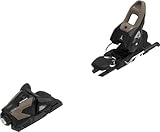
What is the best overall beginner ski binding?
The best overall beginner ski binding is the Look NX 11 GW, which clicked in with a long heel lever, even with packed snow on Annie's boot heel, and scored 9.5 for both step-in and step-out.

Look NX 11 GW
- Weight: 895 g (one)
- DIN range: 3.5 to 11
- Brake width: 90 mm
- Slope step-ins: 5 of 5
Bottom Line : Forgiving in and out, with a toe that releases upward in several directions. The plastic brake tabs can shear on a bench, and a cold, brittle length-adjust lever needs warming.
Pros
- Step-in ease 9.5 and step-out ease 9.5
- A long heel lever needs very little muscle
- No pre-release
- A budget tier
Cons
- The plastic tabs holding the brake arms can shear if a brake catches on a bench
- The length-adjust lever went brittle at 19°F
- A little lateral play in the heel under heavy loads
Who it's best for
Budget-tier buyers who want forgiving entry and exit will like it. The testers say advanced or heavy skiers who need rigid energy transfer on firm, aggressive carves should look elsewhere.
Why we love it
Step-In Ease (9.5). It scored 5 of 5 on the flat and on the slope. The long heel lever means a pole presses it shut with little force.
Step-Out Ease (9.5). A generous pole notch on the lever kept the tip from skidding off, and it released smoothly with light pressure.
Hold at Low DIN (8.5). The toe held through all five runs with no unwanted release and let go cleanly in a slow snowplow stumble.
The heel lever is nice and long, so pushing it down with a ski pole takes almost no muscle. Even when my boots had cold, packed snow on the heel lug, it snapped closed without forcing me to stomp repeatedly.
Annie, in the testers' notes
What we didn't like
Molded plastic tabs hold the brake arms in the composite heel body, James found, and in the shop a skier who catches a brake arm on a bench while stepping out backward can shear one. Step out forward when you're near a bench.
In 19°F air the length-adjust lever at the rear of the track went brittle, and it took careful warming to avoid bending its locking teeth. The heel also showed slight lateral play under heavier loads.
Should you buy it?
The Look NX 11 GW is the pick if you want forgiving click-ins and a toe that releases upward in several directions. Aggressive or heavy skiers who need rigid energy transfer on firm, aggressive carves should skip it.
Read our full Look NX 11 GW review →

What is the best budget beginner ski binding?
The best budget beginner ski binding is the Atomic Stage 10 GW, which scored 9.5 for step-in ease with 5 of 5 slope step-ins and no pre-release over five runs at DIN 4.0.

Atomic Stage 10 GW
- Weight: 855 g (one)
- DIN range: 3 to 10
- Brake width: 100 mm
- Slope step-ins: 5 of 5
Bottom Line : A budget binding that clicks in instantly and seats GripWalk soles on its own. Road grit in the toe tracks threw its release off by 1.2 DIN on one side until it was flushed.
Pros
- Step-in ease 9.5, with 5 of 5 clicks on the flat and the slope
- The toe adapts to the boot with no screwdriver
- No pre-release over five runs
- A budget tier, at 855 g
Cons
- Road grit raised the toe's release by 1.2 DIN on the left side
- The heel track bows slightly when the ski flexes hard
- Chatter on icy morning patches
Who it's best for
A new skier in the budget tier who wants a quick click-in. The testers say it's wrong for anyone who walks through gritty parking lots without wiping their boot soles.
Why we love it
Step-In Ease (9.5). It scored 5 of 5 on both the flat and the slope. The testers say the toe adapts automatically to GripWalk soles, and a light heel cup engaged straight away.
Step-Out Ease (9.0). A deep heel-lever recess took the pole tip cleanly, and it released with light downward pressure.
Boot Fit & Walking (9.0). The toe set its own height against GripWalk soles with no screwdriver work, and the boot sat snug on the slider.
It feels very light underfoot when carrying the skis, and clicking in is immediate. I didn't have to balance precariously on one foot while stomping to engage the heel.
Annie, in the testers' notes
What we didn't like
Road grit hurt this one. After walking through road-grit slush in the parking lot, fine particles worked into the toe wing tracks, and on the bench the left side's release torque was 1.2 DIN higher until the track was flushed with compressed air. Wipe your boot soles and clean the toe tracks if you walk on roads.
The thin plastic heel track also bowed 0.5 mm upward when the ski was fully flexed flat in a turn, and the light body passed chatter into the boots on icy morning patches.
Should you buy it?
The Atomic Stage 10 GW suits a new skier in the budget tier who wants a quick click-in and wipes their soles. The NX 11 scores higher in the same tier, but this one is the budget pick for its 9.5 step-in. Anyone who walks gritty parking lots in ski boots should pick another binding.
Read our full Atomic Stage 10 GW review →

What is the best beginner ski binding with a self-setting toe?
The best beginner ski binding with a self-setting toe is the Salomon Stage 11 GW, which the testers say adjusts its toe wings by itself, clicked in 5 of 5 times on the slope and scored 9.5 for both step-in and step-out.

Salomon Stage 11 GW
- Weight: 860 g (one)
- DIN range: 3.5 to 11
- Brake width: 90 mm
- Slope step-ins: 5 of 5
Bottom Line : Easy to click in and out of, with a toe that adapts to the boot so there's no manual toe setting to get wrong. Wet slush froze in the toe wings, and the light body buzzes on hard, icy snow.
Pros
- Step-in ease 9.5 and step-out ease 9.5
- The testers credit the toe wings with adjusting to the boot automatically
- No pre-release
- A budget tier
Cons
- Slush froze in the toe wings and locked them until the skis came indoors
- The light body buzzes on scraped ice
- Not for skiers who want a heavy, damp chassis
Who it's best for
The testers credit the self-setting toe most, and new skiers who don't want to touch a screwdriver will too. Skiers who want a heavy, damp feel on hard, icy snow, or who like to adjust the boot pad by hand, won't.
Why we love it
Step-In Ease (9.5). It scored 5 of 5 on the flat and 5 of 5 on the slope. The testers credit the toe wings, which adjust to the boot automatically, and a low-resistance heel latch for the quick, reliable click on every slope angle.
Step-Out Ease (9.5). The wide heel-lever recess takes a pole tip easily, and the boot comes out with a light push and no loss of balance.
Hold at Low DIN (9.0). No pre-release, and it kept forward pressure over firm, scraped patches.
Stepping out at the lift corral is completely effortless. You barely tap the heel lever with your pole tip and the boot releases without pushing you off balance.
Annie, in the testers' notes
What we didn't like
In wet afternoon slush, James's bench check found packed slurry in the cavities behind the toe wings. It froze when the skis were left on the rack in freezing air, and it locked the wings open until the skis came indoors. Bring the skis inside, or knock the slush out first.
James also noted that the stripped-down body sends a high-frequency buzz into the boots on scraped ice.
Should you buy it?
Go for the Salomon Stage 11 GW if you want a binding that sets its own toe. Skiers who spend afternoons on hard, icy snow will feel the buzz, so they should also try the Look SPX 11 GW. It's a budget-tier pick, and its card score blends this test with our teen guide, so it sits lower than its bars suggest.
Read our full Salomon Stage 11 GW review →
What is the best beginner ski binding for wide skis?
The best beginner ski binding for wide skis is the Tyrolia Attack 11 GW, which made 5 of 5 slope step-ins with no pre-release, on a 110 mm brake that needs skis 95 mm or wider.

Tyrolia Attack 11 GW
- Weight: 910 g (one)
- DIN range: 3 to 11
- Brake width: 110 mm
- Slope step-ins: 5 of 5
Bottom Line : Easy to step into, but the 110 mm brake overhangs an 88 mm ski by 11 mm a side and snags in the lift line.
Pros
- Step-in ease 9.0, with 5 of 5 on the slope
- Step-out ease 9.0, even with wet slush around the housing
- No pre-release
- Solid power transfer on firm patches
Cons
- The 110 mm brake overhangs an 88 mm ski by 11 mm per side and snags in the lift line
- The height wedge can slip under vibration if torqued without boot pressure
- Solid power transfer on firm patches
Who it's best for
New skiers on skis 95 mm at the waist or wider. On narrower skis it only suits skiers willing to have a shop swap the brake arms.
Why we love it
Step-In Ease (9.0). It scored 5 of 5 on the flat and on the slope. The three-piece heel snapped shut with little resistance.
Step-Out Ease (9.0). A smooth pole press popped it open cleanly, even with wet spring slush around the housing.
Hold at Low DIN (8.5). No pre-release, with solid power transfer across firm patches.
What we didn't like
The binding clicks in easily without having to stomp hard. But when I was walking in the lift line and skating to the chair, the wide metal brake arms kept bumping into each other and snagging my snow pants.
Annie, in the testers' notes
A 110 mm brake on an 88 mm ski leaves 11 mm of steel arm sticking out on each side, and the arms clicked together while Annie walked and skated in the lift line. Boot fit & walking scored 8.0, the lowest here. In a beginner snowplow stance, James says the arms drag on the snow of a firm run.
James also found that the height wedge, which moves up an inclined ramp by a screw, slipped back under vibration when torqued without downward pressure on the boot, which adds vertical play. Press down on the boot while you tighten it.
Should you buy it?
The Tyrolia Attack 11 GW only makes sense on skis 95 mm or wider, where its very easy click-in pays off. On narrower skis, choose the Attack LYT 11 GW.
Read our full Tyrolia Attack 11 GW review →
What is the best beginner ski binding for easy step-in?
The best beginner ski binding for easy step-in is the Tyrolia Attack LYT 11 GW, which made 5 of 5 slope step-ins, needed no running stomp on a 20° side-slope and scored 10 out of 10 for step-in ease.

Tyrolia Attack LYT 11 GW
- Weight: 840 g (one)
- DIN range: 3 to 11
- Brake width: 95 mm
- Slope step-ins: 5 of 5
Bottom Line : The easiest binding to step into in the test, with no pre-release in five runs. James found no way to shim the boot pad if the lugs wear, and the toe housing shaved plastic when tips crossed.
Pros
- Step-in ease 10, with 5 of 5 first-try clicks on the flat and on the slope
- Step-out ease 9.5 and boot fit & walking 9.5
- No pre-release over five runs on hardpack and slush
- A light 840 g
Cons
- James found no height screw, so worn boot lugs can't be shimmed
- The toe housing shaved off plastic curls when tips crossed
- The testers say it's wrong for aggressive adults over 160 lb on frozen chop
Who it's best for
Annie led and James co-tested it. New skiers who dread re-stomping a heel while sliding backward on a slope are its audience, and it's the testers' own pick for a first binding, though its score here is the average of four guides. The testers say aggressive adults over 160 lb who charge frozen afternoon chop need something heavier.
Why we love it
Step-In Ease (10). It had the lowest heel-entry resistance of the ten: five out of five first-try clicks on the flat and five out of five on the slope, with Annie stepping in on a 20° side-slope without a running stomp.
Step-Out Ease (9.5). It released under light pole pressure on the heel lever, and Annie tripped the lever with the sole of her opposite boot and no pole at all.
Hold at Low DIN (9.0). No pre-release in five runs across hardpack and slush, and it released smoothly in a simulated slow snowplow twist.
When you're learning on a slope, nothing kills your confidence faster than stomping five times trying to get your heel to lock while sliding backward. The Attack LYT clicks shut with just a gentle push.
Annie, in the testers' notes
What we didn't like
James found no manual height adjustment on the binding. After Annie walked 50 paces across a paved parking lot, a 0.8 mm gap opened where her boot lugs had worn, and it can't be adjusted out. The listing calls the toe piece adjustable, so ask a shop what it can do, and don't walk on pavement in your ski boots.
The toe housing is the other weak spot. When tips crossed, James saw noticeable curls of plastic shaved off the outer wing of the toe.
Should you buy it?
The Attack LYT 11 GW is the one to get if you want the easiest click-in on any slope. Its card score blends this test with three other guides, so it sits lower than its bars suggest. Heavier, aggressive skiers who charge frozen chop should look at the Look SPX 11 GW instead.
Read our full Tyrolia Attack LYT 11 GW review →
What is the best beginner ski binding for shock absorption?
The best beginner ski binding for shock absorption is the Look SPX 11 GW, which scored 9.5 for hold, with no pre-release and a heel that soaked up rough, icy bumps, at 1,055 g.

Look Pivot 2.0 11 GW
- Weight: 1,055 g (one)
- DIN range: 3.5 to 11
- Brake width: 90 mm
- Slope step-ins: 4 of 5
Bottom Line : The best-holding binding here, tied with the Pivot, and quiet over bumps. It's also the heaviest at 1,055 g, and the heel needs a firm stomp.
Pros
- Hold at Low DIN 9.5, with no pre-release
- Boot fit & walking 9.0
- Quiet over bumpy, icy patches
- A mid-price tier
Cons
- The heaviest here at 1,055 g
- The heel needs a firm, deliberate stomp, 4 of 5 on the slope
- The pole pocket is shallow and a wet pole tip slipped off twice
- Step-in ease 6.5, with 2 of 5 on the slope
- The heel spun off-axis after a fall and had to be reset by hand
- 1,010 g and an upper-mid tier
Who it's best for
It's for the skier who puts hold above easy entry. It's wrong for beginners who want a quick, hassle-free step-in and a light binding.
Why we love it
Hold at Low DIN (9.5). It tied the SPX for the best hold, with no pre-release. The testers record 28 mm of vertical elasticity in the heel, and it absorbed every bump without flutter.
Boot Fit & Walking (8.5). The boot seated firmly in the toe, and the short mounting zone lets the ski flex underfoot.
Step-Out Ease (7.5). A pole tip releases it, but only with firm downward force.
What we didn't like
When I fell on the green run, the rear piece spun sideways. When I tried to step back in, my boot heel kept pushing the rotated arms around instead of clicking down.
Annie, in the testers' notes
After a fall the turntable heel spun off-axis, and step-in scored 6.5, the lowest here, with 4 of 5 on the flat but 2 of 5 on the slope. Annie had to take her glove off, sit in the snow and turn the heel arms straight by hand before she could click in.
James calls it an elite binding that's mismatched for beginners, because slow snowplow falls can spin the heel 45 degrees off-axis and a novice doesn't have the technique to kick it straight. Stepping out on a slope needs the ski held still, so it doesn't twist out early.
Should you buy it?
Skip the Look Pivot 2.0 11 GW for a first pair. Take the Attack LYT 11 GW for ease, or the Look SPX 11 GW for the same hold.
Read our full Look Pivot 2.0 11 GW review →
What is the best low-profile beginner ski binding?
The best low-profile beginner ski binding is the Atomic Strive 10 GW, which put the boot close to the ski, so Annie found slow turns on an easy run much less intimidating, and scored 9.0 on all but hold.

Atomic Strive 10 GW
- Weight: 825 g (one)
- DIN range: 3 to 10
- Brake width: 100 mm
- Slope step-ins: 4 of 5
Bottom Line : A low binding that gives new skiers a grounded, balanced feel. A small spring clip under the toe plate can unseat on an off-angle entry, and the 100 mm brake hangs wide on an 88 mm ski.
Pros
- Boot fit & walking 9.0, with the boot close to the ski
- Step-in ease 9.0 and step-out ease 9.0
- No pre-release on green and blue terrain
- One of the three lightest, at 825 g
Cons
- A spring clip under the sliding plate unseated on an off-angle entry
- The 100 mm brake overhangs an 88 mm ski
- Not for skiers who want heavy vibration damping
Who it's best for
New skiers learning to tip a ski onto its edge, who want to feel close to the snow. Skiers who want heavy vibration damping won't like it.
Why we love it
Boot Fit & Walking (9.0). The maker names a low toe, and the testers found the binding kept the boot close to the ski, low and balanced, with GripWalk soles fitting without binding.
Step-In Ease (9.0). It scored 5 of 5 on the flat and 4 of 5 on the slope, with a clean, low-effort snap from the Mono Heel Light.
Hold at Low DIN (8.5). No pre-release on any green or blue terrain, and the low position gave a reassuring, grounded feel.
Standing on the ski feels much more natural and flat than on the taller Look bindings. Because you're so close to the snow, balancing while sliding through slow turns on Easy Street was much less intimidating.
Annie, in the testers' notes
What we didn't like
Snow on the boot welt tripped it up. When Annie kicked into the toe at a 30° angle with snow caked on it, a small spring clip under the sliding plate popped out of its slot, and the plate stayed cocked to one side until James reseated it with an awl. Scrape your boots before you step in.
The 100 mm brake also hangs wide on an 88 mm ski, and in Annie's snowplow turns the inner brake elbow brushed close to the snow crust.
Should you buy it?
Pick the Atomic Strive 10 GW when balance and edge control matter more to you than heavy damping. Skiers who want a heavy feel should ask a shop about the Look SPX 11 GW.
Read our full Atomic Strive 10 GW review →
What is the best beginner ski binding for clearing boot snow?
The best beginner ski binding for clearing boot snow is the Marker Squire 11, which has a metal scraper on the toe for clearing boot snow and made no pre-release on green and blue terrain.

Marker Squire 11
- Weight: 820 g (one)
- DIN range: 3 to 11
- Brake width: 100 mm
- Slope step-ins: 4 of 5
Bottom Line : A light binding with a toe scraper and no pre-release. The heel needs a straight downward step, and slush in an open pocket gave a false latch.
Pros
- Boot fit & walking 9.0, with the sole clearing the toe wings
- No pre-release on green and blue terrain
- A light 820 g
- A scraper bar on the toe clears boot snow
Cons
- The heel needs a straight downward stomp, and one re-stomp on an off-camber slope
- Frozen slush in an open heel pocket gave a false latch
- The brake baseplate tabs can shear on a hard backward hit
Who it's best for
New skiers who step in straight down and like an easy carry. Skiers over 160 lb should look elsewhere, and so should skiers under 110 lb, who lack the leg mass to snap the heel shut on uneven ground (a step-in strength point, not a release one).
Why we love it
Boot Fit & Walking (9.0). The boot sat level on the anti-friction pad, and the GripWalk sole cleared the toe wings while walking and shuffling in the lift line, with no scuffing.
Hold at Low DIN (8.5). No false ejections in five runs on green and blue terrain, and it released predictably in Annie's slow, twisting forward wedge fall.
Step-Out Ease (8.5). A firm push of a pole tip on the lever released it cleanly.
The metal scraper on the toe is really handy for scraping snow clumps off my boot before clicking in. But on a slope, if you don't step straight down into the heel cup, it won't latch on the first try.
Annie, in the testers' notes
What we didn't like
Off-camber slopes were the problem: the heel needs a direct downward stomp, and Annie had to re-stomp once, so step-in scored 8.5 with 4 of 5 on the slope. It's firmer to latch than the Attack LYT or the Stage bindings.
James also found an open pocket under the heel spring pivot where wet slush packed and froze. Annie stepped in and the lever snapped down, but the heel wasn't fully latched: the forward-pressure screw sat 2 mm proud. The brake baseplate snaps into its track on molded plastic tabs that aggressive backward impacts in the lift line could shear.
Should you buy it?
Buy the Marker Squire 11 if you step in straight down and like a light carry. Anyone who steps in on side-slopes should choose the Attack LYT 11 GW.
Read our full Marker Squire 11 review →
What is the best beginner ski binding for carrying skis?
The best beginner ski binding for carrying skis is the Marker Squire 10, which was the lightest here at 815 g and held Annie through every green run, though it let James out once.

Marker Squire 10
- Weight: 815 g (one)
- DIN range: 3 to 10
- Brake width: 100 mm (this listing)
- Slope step-ins: 3 of 5
Bottom Line : The lightest binding of the ten at 815 g. It took three tries on the slope and popped a heel for James once.
Pros
- The lightest of the ten at 815 g
- Boot fit & walking 8.5, with the GripWalk sole flush on the pad
- Held Annie securely through all green runs
- A deep pole notch on the heel lever
Cons
- Only 3 of 5 on the slope, with Annie stomping three times on one side-hill
- One pre-release for James, on a firm patch
- A narrow four-hole pattern complicates a future remount
Who it's best for
The lightest binding here suits a new skier who carries skis a lot and sticks to flat snow and gentle slopes, because the heel is stiff to latch on a slope. The testers say it's wrong for progressing skiers over 140 lb and for anyone who may remount to a bigger binding later.
Why we love it
Boot Fit & Walking (8.5). The GripWalk sole sat flush on the anti-friction plate, and the light body was comfortable over 50 steps across the parking lot.
Hold at Low DIN (8.0). It held Annie securely through all the green runs.
Step-Out Ease (8.0). The deep pole notch on the heel lever released cleanly, though pressing it down by hand felt awkward.
What we didn't like
On flat snow it was fine, but on the slope outside the mid-mountain lodge, I had to stomp three times to get the heel to click shut. It felt significantly stiffer to step into than the Attack LYT or Stage.
Annie, in the testers' notes
Step-in made 5 of 5 on the flat but only 3 of 5 on the slope, and Annie struggled to latch the compact heel on a soft side-hill. James says the heel's spring has a steep angle that asks for high entry force even at this low DIN ceiling.
It also let go once. James took one premature heel release when he hit an unexpected hard compression rut on the firm patch, the only pre-release in the ten. The drill pattern is the last flaw: James found a narrow four-hole pattern that, he says, would clash with the holes for a bigger binding later.
Should you buy it?
Marker Squire 10 buyers should be light, new to skiing and happy to carry their skis a lot. If you may move to a bigger binding next season, pick another model.
Read our full Marker Squire 10 review →
How did we test the beginner ski bindings?
We tested the beginner ski bindings by clicking into each one five times on the flat and five times on a slope, skiing green and blue terrain and firm patches, walking in boots, and scoring each on step-in ease, step-out ease, hold at low DIN and boot fit & walking, then weighing every one.
A beginner binding has four jobs: let you click in without a fight, let you out again, stay shut until a fall, and let your boot sit and walk properly. Annie, who gave us the beginner-to-intermediate view, led the testing of all ten. James, a former regional racer who now tunes skis, co-tested and ran the bench inspection on every binding.
The testers spent about a week on one trip to Whistler Blackcomb in May 2026, and no binding was tied to a single day. Every binding went on an Elan Ripstick 88, a ski with an 88 mm waist. A certified shop technician set the DIN for each tester, then checked it on a Montana Vermont release test bench. Annie skied at a shop-set 4.0. James co-tested and inspected each binding on the bench, at a shop-set 6.0. Ask a shop to check the DIN range of any binding against your own skiing. DIN is the setting that decides how hard a fall has to be before the binding lets go, and a pre-release is a binding letting go when it shouldn't. The boots, heights and DINs are in the table below. Step-in meant five clicks on flat snow and five on a slope. We stepped out with a pole on the heel lever (and, on the Attack LYT 11, with the other boot), ran five runs per binding across green and blue terrain and firm, scraped or wind-scoured patches, and counted every unwanted release. Annie walked in her boots through the lodge area and the lift line, and across a paved parking lot on some bindings (50 paces on the Attack LYT 11 and Squire 10), and James checked each binding on the bench.
| Tester | Height | Weight | Age | Boots | Set DIN | Role |
|---|---|---|---|---|---|---|
| Annie | 5 ft 6 | 135 lb | 31 | GripWalk soles | 4.0 | Lead on all ten |
| James | 5 ft 10 | 172 lb | 33 | Nordica Promachine 130, GripWalk soles | 6.0 | Co-tester and bench inspector on all ten |
The four scored qualities:
- Step-In Ease: five first-try clicks on the flat and five on a slope, and how much stomp the heel wanted
- Step-Out Ease: how easily a pole, or the other boot, released the heel
- Hold at Low DIN: unwanted releases at the shop-set DIN, and whether it still let go in a slow fall
- Boot Fit & Walking: how the boot seated, and how the binding behaved while walking and around the lift line
- Weight (measured, not scored): one binding with its brake, dry and without screws, on a calibrated bench scale (±0.5 g)
A binding that appears in more than one of our guides has one score everywhere: the average of its results across those guides. The Attack LYT 11, SPX 11, Strive 10, Stage 11, Pivot 2.0 11, Squire 11 and Squire 10 are blended this way. The metric bars show this guide's own test, so a bar can sit above or below the score on the card. Some of these bindings also appear in our all-mountain ski binding guide and our park guide. In this page, the toe wings are the side jaws that grip the front of the boot, and the anti-friction pad is the plate the boot sole slides on. Specs such as DIN range and the sole standard are the ranges printed on each binding and read by the testers, and listing or maker pages where they state them; the DIN set, the step-in counts and every result come from our testers. We don't score price; where a binding's value stands out we say so in tiers (budget, mid-price, upper-mid), and the Check Latest Prices button shows the current number. You can meet the testers at the bottom of this page.
Which beginner ski binding suits your skiing?
The right beginner ski binding depends on how you step in and how much you weigh: pick by the row that matches you.
| If you're… | Buy |
|---|---|
| New to skiing and wanting the easiest click-in on any slope | Tyrolia Attack LYT 11 GW |
| Wanting forgiving entry, exit and release | Look NX 11 GW |
| Wanting a binding that sets itself to your boot | Salomon Stage 11 GW |
| On a tight budget | Atomic Stage 10 GW |
| Learning to tip a ski onto its edge and wanting to feel the snow | Atomic Strive 10 GW |
| Heavier or progressing fast, with the leg strength to stomp a heel | Look SPX 11 GW |
| Light and careful, and wanting a scraper on the toe | Marker Squire 11 |
| Skiing wide skis, 95 mm at the waist or more | Tyrolia Attack 11 GW |
| Light, carrying your skis a lot and not planning to remount | Marker Squire 10 |
| Wanting the firmest hold, tied with the SPX, and willing to reset the heel after a fall (the SPX is easier to step into) | Look Pivot 2.0 11 GW |
What did our beginner ski binding tests show?
Our beginner ski binding tests showed that the Tyrolia Attack LYT 11 GW won on step-in and boot fit, the two heaviest Looks won on hold, and step-in ease separated the ten more than any other quality.
Each binding's four scores are also in its card above.
How easy are beginner ski bindings to step into?
The easiest beginner ski binding to step into was the Tyrolia Attack LYT 11 GW, the only one to score 10 for step-in ease.
Where we tested it. Five click-ins on flat snow and five on a slope per binding, including a 20° side-slope for the Attack LYT 11.
What separated them. The Attack LYT 11 scored 10, then the Stage 11, NX 11 and Stage 10 at 9.5, the Attack 11 and Strive 10 at 9.0, the Squire 11 at 8.5, the SPX 11 and Squire 10 at 8.0, and the Pivot 2.0 11 last at 6.5. The spread is 3.5 points, the widest of the four scores.
On the slope, five bindings made 5 of 5 (Attack LYT 11, Stage 11, NX 11, Stage 10 and Attack 11). The Strive 10, SPX 11 and Squire 11 made 4 of 5, the Squire 10 made 3 of 5 and the Pivot 2.0 11 only 2 of 5.
What it felt like. The three that needed a firm, straight stomp, the SPX 11, Squire 11 and Squire 10, scored 8.5 or lower, and the Pivot's turntable heel needed the arms squared by hand. If you step in on slopes, buy for this score first.
| Binding | What we found |
|---|---|
| Tyrolia Attack LYT 11 GW | 5 of 5 on the slope; lowest heel-entry resistance |
| Look NX 11 GW | 5 of 5; long heel lever, little downward force |
| Atomic Stage 10 GW | 5 of 5; light heel cup engages at once |
| Salomon Stage 11 GW | 5 of 5 on the slope; toe wings adjust by themselves |
| Tyrolia Attack 11 GW | 5 of 5; the three-piece heel snaps shut easily |
| Atomic Strive 10 GW | 4 of 5 on the slope; a clean, low-effort snap |
| Marker Squire 11 | 4 of 5; one re-stomp on an off-camber slope |
| Look SPX 11 GW | 4 of 5; needed full weight over the back heel |
| Marker Squire 10 | 3 of 5; three stomps on a soft side-hill |
| Look Pivot 2.0 11 GW | 2 of 5; the turntable had to be squared by hand |
How easy are beginner ski bindings to step out of?
The easiest beginner ski bindings to step out of were the Tyrolia Attack LYT 11 GW, Salomon Stage 11 GW and Look NX 11 GW, which each scored 9.5.
Where we tested it. The same flat and slope spots, stepping out with a pole tip on the heel lever, and with the opposite boot sole on the Attack LYT 11.
What separated them. Three bindings scored 9.5 and the Stage 10, Strive 10 and Attack 11 scored 9.0. The SPX 11 and Squire 11 scored 8.5, the Squire 10 8.0 and the Pivot 2.0 11 7.5, a spread of 2.0 points.
Annie also released the Attack LYT 11 with the sole of her other boot and no pole at all. The Pivot 2.0 11 needed firm downward force and a ski held still, so it didn't twist out early.
What it felt like. Step-out was easy for most. If you step out on a slope, look for a generous pole notch or a wide lever recess, as the NX 11 and Stage 11 have.
| Binding | What we found |
|---|---|
| Look NX 11 GW | A generous pole notch stops the tip skidding off |
| Salomon Stage 11 GW | A wide lever recess; a tap of the pole tip |
| Tyrolia Attack LYT 11 GW | Light pole pressure; Annie used her other boot |
| Atomic Stage 10 GW | A deep recess takes the pole tip cleanly |
| Tyrolia Attack 11 GW | Popped open even with wet slush on the housing |
| Atomic Strive 10 GW | A wide recess; the tip stayed put when wet |
| Look SPX 11 GW | Takes a pole well, but needs more force than light heels |
| Marker Squire 11 | Clean with a firm pole push; hand release is awkward |
| Marker Squire 10 | A deep notch, but awkward by hand |
| Look Pivot 2.0 11 GW | Firm force, and the ski held still |
How well do beginner ski bindings hold at low DIN?
The beginner ski bindings that held best at low DIN were the Look SPX 11 GW and Look Pivot 2.0 11 GW, which each scored 9.5.
Where we tested it. Five runs per binding across green and blue terrain and firm, scraped or wind-scoured patches at the shop-set DIN, counting every unwanted release.
What separated them. The two Looks scored 9.5, the Attack LYT 11 and Stage 11 9.0, five bindings 8.5 (NX 11, Stage 10, Strive 10, Squire 11 and Attack 11) and the Squire 10 8.0. The spread is 1.5 points, tied with boot fit & walking for the narrowest.
Nine of the ten had no pre-release. The Squire 10 had one: James took a premature heel release when he hit an unexpected hard compression rut on the firm patch. The testers also ran a slow snowplow twist or stumble on the Attack LYT 11, NX 11 and Squire 11, and each released as expected.
What it felt like. The two highest scores belong to the two heaviest bindings, at 1,010 g and 1,055 g, and neither is easy to step into: the Pivot scored 6.5 and the SPX 8.0. If you worry most about the binding letting go, weigh that trade.
| Binding | What we found |
|---|---|
| Look SPX 11 GW | No pre-release; the heel soaked up chop |
| Look Pivot 2.0 11 GW | Flawless; the heel absorbed every bump |
| Salomon Stage 11 GW | No pre-release; steady forward pressure on firm patches |
| Tyrolia Attack LYT 11 GW | No false ejections; released in a slow snowplow twist |
| Look NX 11 GW | No pre-release; released cleanly in a slow stumble |
| Atomic Stage 10 GW | No pre-release at DIN 4.0 over scraped patches |
| Tyrolia Attack 11 GW | No pre-release; solid power transfer on firm patches |
| Atomic Strive 10 GW | No pre-release; a grounded, low feel |
| Marker Squire 11 | No false ejections; released in a slow, twisting wedge fall |
| Marker Squire 10 | One premature heel release for James on a firm patch |
How well do beginner ski bindings fit and walk?
The beginner ski binding with the best boot fit & walking was the Tyrolia Attack LYT 11 GW, which scored 9.5.
Where we tested it. Walking and shuffling through the lodge area and the lift line, plus paces across a paved parking lot (50 on the Attack LYT 11 and Squire 10), with a bench check by James afterward.
What separated them. The Attack LYT 11 scored 9.5, six bindings scored 9.0 (Stage 11, NX 11, Stage 10, Strive 10, SPX 11 and Squire 11), the Pivot 2.0 11 and Squire 10 8.5, and the Attack 11 last at 8.0.
The Attack LYT 11's wide anti-friction pad took GripWalk soles without binding. The Attack 11 lost points for width: its 110 mm brake arms clicked together and snagged Annie's snow pants.
What it felt like. This was the score with the least spread, so use it to break a tie. Pavement did hurt one binding: 50 paces eroded Annie's boot lugs and opened a 0.8 mm gap on the Attack LYT 11.
| Binding | What we found |
|---|---|
| Tyrolia Attack LYT 11 GW | A wide pad; GripWalk soles slide without binding |
| Look NX 11 GW | A clean sole interface; natural, drag-free walking |
| Atomic Stage 10 GW | The toe set its own height; no screwdriver work |
| Salomon Stage 11 GW | The boot sat level; no snags in the lodge or lift line |
| Look SPX 11 GW | The toe held the sole firmly; a clean seat |
| Atomic Strive 10 GW | The boot sat close to the ski; soles fit without binding |
| Marker Squire 11 | The sole cleared the toe wings; no scuffing |
| Look Pivot 2.0 11 GW | A firm seat in the toe; a short mounting zone |
| Marker Squire 10 | Flush on the plate; comfortable over 50 steps |
| Tyrolia Attack 11 GW | A 110 mm brake overhung and clicked together |
How much do beginner ski bindings weigh?
The beginner ski bindings we weighed ranged from 815 g to 1,055 g for one binding with its brake.
Where we tested it. We weighed one binding of each model, dry, with its brake and without screws, on a calibrated bench scale (±0.5 g). Weight is measured, not scored, so it's not in the overall number.
What separated them. The Marker Squire 10 was lightest at 815 g and the Look SPX 11 GW heaviest at 1,055 g, a gap of 240 g, so the SPX weighs about 29% more than the Squire 10. Eight bindings sat between 815 g and 910 g, and the two Looks above 1,000 g.
What it felt like. The two heaviest bindings also scored 9.5 for hold, though the testers credit heel travel, not weight. Light didn't mean easy to step into: the lightest, the Squire 10, scored 8.0, while the 840 g Attack LYT 11 scored 10.
| Binding | What we found |
|---|---|
| Marker Squire 10 | 815 g |
| Marker Squire 11 | 820 g |
| Atomic Strive 10 GW | 825 g |
| Tyrolia Attack LYT 11 GW | 840 g |
| Atomic Stage 10 GW | 855 g |
| Salomon Stage 11 GW | 860 g |
| Look NX 11 GW | 895 g |
| Tyrolia Attack 11 GW | 910 g |
| Look Pivot 2.0 11 GW | 1,010 g |
| Look SPX 11 GW | 1,055 g |
What do people ask about beginner ski bindings?
These are common questions about beginner ski bindings, answered from our own test results.
What DIN do beginner skiers need?
A shop sets your DIN from your weight, height, age, boot sole length and skiing ability, and a beginner binding doesn't change that. A shop set Annie's at 4.0 and James's at 6.0 for this test.
What a beginner changes is the range you buy. All ten bindings list a lowest setting of 3 to 4 DIN and a top of 10 or 11, and the shop decides where in that range you sit. Don't set it yourself.
Do beginners need GripWalk bindings?
Check the sole standard printed on your boot, then match it. The testers read alpine ISO 5355 and GripWalk ISO 23223 printed on all ten bindings. Some makers name only GripWalk, so if your boots have alpine soles, confirm the standard printed on the binding itself.
Are low-DIN bindings safe for beginners?
A shop sets the DIN for you, and nine of ten had no pre-release. The tenth, the Squire 10, let James out once on a firm patch, and the Attack LYT 11, NX 11 and Squire 11 each released as expected in a slow snowplow twist or stumble. A binding set too low can pop off, so let the shop set it and don't turn it down yourself.
What brake width do beginner skis need?
Pick a brake close to the ski waist. On our 88 mm skis the 90 mm brakes stuck out 1 mm a side and the 95 mm brakes 3.5 mm. The 100 mm brakes (the Stage 10, Strive 10, Squire 11 and the Squire 10 listing) stuck out 6 mm, and the 110 mm brake on the Attack 11 stuck out 11 mm a side, enough to snag in the lift line. Avoid the Attack 11 on skis narrower than 95 mm.
| Binding | Brake width | Brake extends past an 88 mm ski, per side |
|---|---|---|
| Tyrolia Attack LYT 11 GW | 95 mm | 3.5 mm |
| Salomon Stage 11 GW | 90 mm | 1 mm |
| Look NX 11 GW | 90 mm | 1 mm |
| Atomic Stage 10 GW | 100 mm | 6 mm |
| Atomic Strive 10 GW | 100 mm | 6 mm |
| Look SPX 11 GW | 90 mm | 1 mm |
| Marker Squire 11 | 100 mm | 6 mm |
| Tyrolia Attack 11 GW | 110 mm | 11 mm |
| Marker Squire 10 | 100 mm | 6 mm |
| Look Pivot 2.0 11 GW | 95 mm | 3.5 mm |
Can I upgrade my bindings later?
Yes, but remounting needs fresh holes if the pattern doesn't match. James found the Squire 10 has a narrower, four-hole pattern that, he says, would clash with the holes for a bigger binding such as a larger Marker or Tyrolia model, so ask a shop before you plan an upgrade.
What are the 10 best beginner ski bindings?
The 10 best beginner ski bindings are the ten ranked above, led by the Salomon Stage 11 GW.
The best overall pick is the Look NX 11 GW, with forgiving entry and exit. Anyone on a budget should look at the Atomic Stage 10 GW, and skiers who want a toe that sets itself at the Salomon Stage 11 GW. For the easiest click-in on any slope buy the Tyrolia Attack LYT 11 GW, for a low, balanced feel the Atomic Strive 10 GW, and for the best hold over bumps the Look SPX 11 GW. Skip the Look Pivot 2.0 11 GW for a first pair.
Editor's Note, 23 November 2026: New guide. On a week-long trip in May 2026 at Whistler Blackcomb, Annie and James tested ten beginner ski bindings on Elan Ripstick 88 skis with shop-set DIN, scoring each on step-in ease, step-out ease, hold at low DIN and boot fit & walking, and weighing every one.
Our Testers
This guide was written from the field notes of Annie Ward and James Ward.
- Sean Williams, Editor-in-Chief. A former commercial outdoor copywriter and gear journalist who runs Top-Notch Outdoor as an independent publisher, with no brand-funded trips and no supplied ad copy.
- James Ward, Alpine Ski & Fat Bike Tester. James, 5 ft 10 and 172 lb, co-tested all ten bindings and ran the bench inspections, at a shop-set DIN of 6.0.
- Annie Ward, Women’s All-Mountain Snowboard Tester. Annie, 5 ft 6 and 135 lb, led the testing of all ten bindings at a shop-set DIN of 4.0.