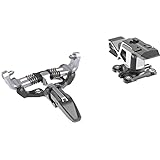
What is the best overall backcountry ski binding?
The best overall backcountry ski binding is the ATK Raider 13 EVO, which weighed 390 g a foot with brakes, switched modes in 18 seconds and still scored 8.5 for downhill power.

ATK Raider 13 EVO
- Type: Pin
- DIN range: Not listed
- Brake width: 102 mm
- Weight: 780 g pair
Bottom Line : A climb that feels almost weightless, with a descent that stays calm, and the fastest switch of the ten at 18 seconds. It's in the premium tier, and on a 102 mm ski the testers fitted ATK's spacer.
Pros
- Fastest mode switch of the ten: 18 seconds
- 390 g a foot with 102 mm brakes (780 g a pair)
- The notes credit 14 mm of heel travel for a calm descent
- Open spring slots shed slush
Cons
- Premium tier
- Needed ATK's aftermarket spacer for full heel response on the 102 mm skis
- The toe cam needed a quarter-turn for James's scuffed boot lugs
- No full alpine toe elasticity
Who it's best for
James led the Raider 13 EVO test and Tom co-tested it. It suits dedicated backcountry skiers who want a very light climb without the harsh, rigid descent of a typical tech binding. It's the wrong buy for anyone who wants full alpine toe elasticity.
Why we love it
Uphill Efficiency (9.5). At 390 g a foot with brakes, the notes say skinning felt frictionless. The listing says 370 g and our bench scale read 390 g with brakes fitted, and the notes add that the magnetic heel flaps flip over with the handle of a ski pole.
Transitions (9.0). Eighteen seconds was the fastest switch in the test. Turning the heel engages the brake automatically, which the notes say removes the fiddly brake stopper other bindings need.
Downhill Power (8.5) and Step-In (9.0). The notes credit a 14 mm elastic response in the heel with soaking up ski flex, and they say the toe pulls the boot into place with little downward force. Tom called the 14 mm of spring travel exceptional engineering, and with the spacer on he called it the closest thing to an alpine feel in an ultralight package.
Mechanically, the Raider EVO 13 is a masterclass in CNC machining. 14 mm of true longitudinal spring travel in a 390-gram binding is exceptional engineering.
Tom, in the testers' notes
What we didn't like
On the 102 mm skis James felt a slight dead band in heel power before the edge bit on firm snow. Fitting ATK's aftermarket composite spacer under the heel lug removed it, so plan for that part if your skis are wider than 100 mm.
The toe also needs a careful first adjustment. On the bench Tom found James's moderately scuffed Lange toe lugs slipped out during a hard kick turn until the front cam was adjusted by a quarter turn. Worn boot lugs and this binding want a shop check together.
Should you buy it?
Choose it if you tour most days and want the best balance here of climbing weight and downhill feel. Skip it if you want a full alpine toe. If you ski a ski wider than 100 mm, plan on the spacer, and have a shop set the toe tension to your boot lugs. The listing is titled "ATK Raider EVO Free Touring Binding".
Read our full ATK Raider 13 EVO review →

What is the best lightweight backcountry ski binding?
The best lightweight backcountry ski binding is the Marker Alpinist 12, which weighed 362 g a foot with the testers' 105 mm brakes fitted and scored 9.5 for uphill efficiency, with only the Superlite 150 lighter.

Marker Alpinist 12
- Type: Pin
- DIN range: 6 to 12
- Brake width: 105 mm (added)
- Weight: 724 g pair
Bottom Line : A 724 g pair with brakes that makes a 1,000 m climb feel easy. It rattles the boots on frozen debris, and its listing comes without a brake.
Pros
- Uphill Efficiency 9.5 at 362 g a foot with brakes
- Fast 180 degree heel twist to switch modes: 25 seconds
- A wide 38 mm hole pattern held an edge in soft snow
- Visual guide stops help the toe find the pins
Cons
- The listing has no brake, so the testers fitted Marker's 105 mm brake as an extra
- Harsh chatter through frozen chop
- The notes say the stiff heel spring wears boot heel inserts
- Heel riser flexed 1.2 mm under load
Who it's best for
Libby led and Tom co-tested the Alpinist 12. It suits dedicated backcountry skiers, ski mountaineers and fitness climbers who rank vertical gain first. Pass on it if you want elastic travel for landing drops or calm in hard chop.
Why we love it
Uphill Efficiency (9.5). Libby said that on a long skin track she forgot she was wearing skis. The notes say the 362 g braked setup changes the feel of 1,000 m approaches.
Transitions (8.0) and Step-In (8.0). A 180 degree twist of the heel turret switches between walking and skiing in 25 seconds, and rubber guide stops sit the boot's toe inserts over the pins.
Downhill Power (7.5). It was predictable in smooth corn and soft snow, helped by the wide 38 mm mounting base.
What we didn't like
When Libby skied Peruvian Cirque frozen solid, the lack of suspension sent sharp shock into the boots. The heel spring is also heavy: after 10 hard descents, Tom's bench check found burnishing and small gouges on the steel heel inserts of Libby's boots.
The riser gives a little too. With a 35 lb rescue pack at Sunshine Village, Libby noticed the medium riser flex, and on the bench Tom measured 1.2 mm of downward flex under 80 kg, a slightly spongy feel on firm steeps.
Coming down Peruvian Cirque when it was frozen solid, though, the lack of suspension rattled my fillings. Treat it like a precision touring instrument, not an in-bounds charger.
Libby, in the testers' notes
Should you buy it?
Pick it when vertical gain is your priority and you ski mostly corn and soft snow on the way down. Skip it if you charge frozen chop. Add a brake: the listing has none, and we used a 105 mm Marker brake. Watch the heel inserts on lightweight boots.
Read our full Marker Alpinist 12 review →

What is the best backcountry ski binding for 50/50 skiing?
The best backcountry ski binding for 50/50 skiing is the Atomic Shift2 13 MN, whose lateral power transfer the notes call flawless, with a pin-toe climb, and which scored 9.5 for downhill power.

Atomic Shift2 13 MN
- Type: Hybrid
- DIN range: Up to 13
- Brake width: 100 mm
- Weight: 1,856 g pair
Bottom Line : One binding for a resort day and a touring day, with the best descent of the ten (tied with the Duke PT 13 at 9.5). At 928 g a foot it climbs like a heavy binding.
Pros
- Downhill Power 9.5: tied for the best descent in the test
- Step-in feels like an alpine binding (8.5)
- The notes say the redesigned toe block removed the vertical rattle of the first Shift
- Works for a 50/50 resort and touring setup
Cons
- 928 g a foot (1,856 g a pair) makes long climbs tiring
- Low heel risers on steep skin tracks
- The rear brake lock caught on an icy snowbank and dropped the brake
- Premium tier
Who it's best for
Tom led the Shift2 13 MN test and Ryan co-tested it. It suits skiers who split their days between the resort and the backcountry and want one setup with no compromise on the descent. Pure human-powered tourers who count grams on big days should look at the Raider 13 EVO or the Alpinist 12.
Why we love it
Downhill Power (9.5). The notes call the lateral power transfer flawless, and they say the updated aluminum block under the toe removed the vertical play and rattle that the first Shift had. Tom's feeler gauge stayed at 0.5 mm all week.
Step-In (8.5). The step-in action is the alpine one, and the notes say clear snow pathways around the front spring housing kept ice from building up.
Transitions (8.0). The mode lever at the toe took less thumb force than the original Shift's, and the toe wings opened cleanly. The switch still took 42 seconds, which kept the score at 8.0.
Atomic resolved the first Shift's major headache. The new aluminum Power Block under the toe eliminates AFD height screw drop
Tom, in the testers' notes
What we didn't like
At 928 g a foot, the notes say long climbs took noticeably more effort than on a dedicated tech binding, and the heel risers were low for steep, technical skin tracks (Uphill 7.0).
The rear brake also needs care. On a frozen crust track at Snowbird, Tom's ski brushed an icy snowbank on a kick turn and jarred the brake catch, which dropped the brake arms and dragged mid-stride. At -10°C the brake needed an open-palm strike to reseat, and Tom added a light film of synthetic grease to the latch rails.
Should you buy it?
One binding has to cover the resort and the backcountry? This is the one, as long as most of your days aren't long climbs. For a lighter skier the Shift2 10 MN is the same idea at a lower release range.
Read our full Atomic Shift2 13 MN review →
What is the best backcountry ski binding for firm snow descents?
The best backcountry ski binding for firm snow descents is the Marker Kingpin 13, whose alpine-style heel gave James direct edge power on firm snow and scored 8.5 for downhill power.

Marker Kingpin 13
- Type: Hybrid
- DIN range: Up to 13
- Brake width: 100 to 125 mm
- Weight: 1,420 g pair
Bottom Line : A pin-toe climb with an alpine heel that drives the ski on firm snow, switched underfoot in 32 seconds. The toggle can freeze in slush, and the heel spring is heavy.
Pros
- Downhill Power 8.5: edge bite well beyond a twin-pin heel on firm snow
- Underfoot lever switches modes with the boot still in the pins: 32 seconds
- 710 g a foot with brake (1,420 g a pair)
- Carbon-reinforced toe, per the listing
Cons
- The underfoot toggle froze in slush and needed a pole handle to open
- 0.3 mm of side play appeared in the heel after 18 hard runs
- Heavy swing weight on long flats
- No certified lateral toe elasticity
Who it's best for
James led the Kingpin 13 test and Ryan co-tested it. It suits aggressive tourers who want a pin-toe climb with an alpine heel on firm, technical descents. It's wrong for ultralight ski mountaineers or anyone who wants certified lateral toe elasticity.
Why we love it
Downhill Power (8.5). James called the edge bite on hard snow far ahead of a standard twin-pin heel: you can drive the shovel without the tail washing out. The notes credit the wide heel pressing on the boot sole.
Transitions (8.0). A central underfoot lever switches modes without unclicking the toe, in 32 seconds.
Step-In (8.0). The toe towers line the boot's tech inserts up quickly, though the heel needs a forceful stomp to compress its dual spring.
What we didn't like
During spring laps at Sunshine Village, wet snow packed round the underfoot lever, froze, and James couldn't flip the binding into ski mode until he levered the cam with a pole handle.
Wear showed up after 18 fast runs through Peruvian Cirque chop: a bench teardown found 0.3 mm of side play between the baseplate and the sliding heel housing, which gave a faint click on firm edge changes. The notes call it no structural failure.
Just keep a plastic scraper handy, because if that underfoot toggle gets frozen slush packed inside, you're stuck in tour mode.
James, in the testers' notes
Should you buy it?
It's the right call if you climb with pins and want an alpine-style heel for firm, technical descents. Skip it if you count grams or want certified lateral toe elasticity. Carry a plastic scraper for the lever, and check the brake: the notes give a 100 to 125 mm brake for this listing.
Read our full Marker Kingpin 13 review →
What is the best backcountry ski binding for everyday touring?
The best backcountry ski binding for everyday touring is the Dynafit ST Radical, whose toe guides Annie found painless to click into, and which comes with brakes.

Dynafit ST Radical
- Type: Pin
- DIN range: Not listed
- Brake width: 100 mm
- Weight: 1,070 g pair
Bottom Line : A light, balanced tech binding that's easy to click into and comes with brakes. Its heel only turns one way, and slush can jam the brake.
Pros
- Uphill Efficiency 8.5 at 535 g a foot with brakes (1,070 g a pair)
- Toe guides line the boot up with the pins, so there's no hunting
- Heel risers flip with a pole basket
- Comes with brakes, unlike the Alpinist and Superlite
Cons
- Per the notes, the heel must turn clockwise only, or the internal ratchet deforms
- Slush under the brake plate stopped the brake locking up
- Flexes a little in hard, frozen ruts
- Not for skiers who want alpine release elasticity
Who it's best for
Annie led the ST Radical test, with Libby co-testing. It suits tourers who want a dependable, easy-to-use daily binding that comes with brakes. It's the wrong buy for hard-charging resort skiers who want alpine elasticity in rutted snow.
Why we love it
Uphill Efficiency (8.5). Light and balanced. The heel risers deploy cleanly when you flick them with a pole basket on steep kick turns.
Step-In (8.0). Annie, who came to touring from resort bindings, said the toe guides made clicking into the pins painless. The notes say they remove pin hunting for intermediate tourers.
Transitions (8.0). The rear turret turns into walk mode in 28 seconds, and the brake lockout is part of the same turn.
What we didn't like
At Whistler, Annie twisted the heel the wrong way in a freezing transition and the turret resisted. Tom stopped her before anything broke, and the bench teardown showed the ratchet teeth are angled for clockwise turns, so forcing it counter-clockwise bends the plastic.
Slush also got the brake. In freeze-thaw cycles water froze under the brake plate and the arms wouldn't lock up, dragging on the climb until Libby chipped the ice out.
Just remember: always spin the heel clockwise, or you'll risk locking the turret up.
Annie, in the testers' notes
Should you buy it?
Go for it if you want a reliable everyday tech binding and a factory brake. Skip it if you charge frozen ruts. Learn the clockwise-only heel before you tour, and carry something to chip ice from the brake.
Read our full Dynafit ST Radical review →
What is the best hybrid backcountry ski binding for lighter skiers?
The best hybrid backcountry ski binding for lighter skiers is the Atomic Shift2 10 MN, which gave Annie an alpine-feeling descent at a lower release range, and scored 9.0 for downhill power.

Atomic Shift2 10 MN
- Type: Hybrid
- DIN range: Up to 10
- Brake width: 100 mm
- Weight: 1,840 g pair
Bottom Line : The Shift2's resort-binding descent for lighter skiers, with a lower release range. It carries the full 920 g a foot, so it's still a heavy climb.
Pros
- Downhill Power 9.0: full alpine feel with no vibration
- Alpine-style step-in (8.5)
- Release range tuned for lighter skiers, up to 10
- Multi Norm Certified, per the listing
Cons
- 920 g a foot (1,840 g a pair) is hard work past 600 m of climbing
- The toe lever took two hands in the cold
- No higher release option in this model
- Scuffed GripWalk pads needed a clean and polish on the bench
Who it's best for
The Shift2 10 MN was Annie's lead test, with Tom co-testing. It suits lighter skiers who want one 50/50 setup (half resort, half touring) and won't trade away release safety. Dedicated tourers who put lightness first should look elsewhere.
Why we love it
Downhill Power (9.0). The notes call it full alpine performance, with high torsional rigidity and steady edge hold in chop and on firm slopes. Annie said it skis like her resort setup, with no vibration and no pin flex.
Step-In (8.5). The step-in is the classic alpine one, which the notes say gives instant reassurance to skiers coming from resort equipment.
Transitions (7.5). It took 44 seconds in a cold wind. The front mechanism switches between pin and alpine modes smoothly.
What we didn't like
At -12°C Annie couldn't push the toe lever down fully with cold gloves and used two hands to open the wings. The notes say it shares its linkage with the Shift2 13.
At 920 g a foot it's the weight of a heavy freeride binding without a higher release option, and Annie found climbs over 600 vertical meters exhausting (Uphill 7.0). On the bench, scuffed GripWalk pads on her boots dragged across the sliding plate, so Tom cleaned and polished them to restore clean release.
But pushing down that front lever to open the pins when my fingers were freezing took all my strength.
Annie, in the testers' notes
Should you buy it?
Lighter or intermediate, and want one ski for the resort and short tours without giving up certified release? It fits. Skip it for big climbing days. If you weigh more or ski harder, the Shift2 13 MN has the higher range.
Read our full Atomic Shift2 10 MN review →
What is the best backcountry ski binding for short laps from the resort?
The best backcountry ski binding for short laps from the resort is the Marker Kingpin 10, whose alpine-style heel gave Annie a safe, familiar feel on icy snow, and which scored 8.0 for downhill power.

Marker Kingpin 10
- Type: Hybrid
- DIN range: 5 to 10
- Brake width: 125 mm
- Weight: 1,390 g pair
Bottom Line : The Kingpin's alpine heel in a 10-DIN version for lighter and intermediate skiers. Its 125 mm brake is too wide for a 102 mm ski, and it has the same heavy chassis as the 13.
Pros
- Alpine-style heel feels familiar and safe on ice
- Underfoot lever works with medium gloves: 34 seconds
- Release range tuned to 5 to 10
- Toe towers guide the boot
Cons
- The 125 mm brake arms flared past a 102 mm ski and dragged on sidehills
- Dry facets packed the toe spring cavities
- Same heavy chassis as the 13: 695 g a foot
- Closing the heel took a heavy stomp
Who it's best for
Annie led the Kingpin 10 test and Libby co-tested it. Annie, an intermediate skier, found the alpine-style heel familiar. It suits lighter or intermediate skiers who want that heel for short, resort-side backcountry laps. Skip it with the 125 mm brake on a 95 to 105 mm ski, if you want a fast-and-light setup, or if you want a higher release range.
Why we love it
Downhill Power (8.0). Annie called the alpine heel safe and familiar, without the twitchy feel of a basic pin heel on ice. The notes say edge hold on hardpack and wind-buff was confident for intermediates.
Transitions (8.0). The central lever works with medium gloves, and the toe doesn't need unclicking, in 34 seconds.
Step-In (7.5) and Uphill (7.5). The toe towers guide the boot easily. Uphill the pin toe gives a natural stride, but the notes say 695 g a foot tires you over long ascents.
What we didn't like
On our 102 mm skis, the 125 mm brake arms flared well past the edges: on steep sidehills in Banff the inside arm dragged on the slope and brushed Annie's other boot cuff. The notes say a 100 mm brake is a must for this ski waist.
Dry snow caused a second problem. At -16°C, sugar facets packed into the open toe spring cavities and stopped the jaws closing fully until Libby brushed them clear. Closing the heel also took Annie's full weight on soft snow.
But the wide brake arms kept catching the crust on sidehills, and kicking the heel shut on soft snow took all my weight.
Annie, in the testers' notes
Should you buy it?
Take it if you're a lighter or intermediate skier who wants an alpine heel for short laps from the resort. Skip it with the 125 mm brake on a 95 to 105 mm ski, and skip it if you want a higher release range. Our brake was 125 mm; a 100 mm one is the better match.
Read our full Marker Kingpin 10 review →
What is the best ski mountaineering binding?
The best ski mountaineering binding is the Dynafit Superlite 150, which weighed 264 g a foot with the optional brakes and was the only binding to score 10.0 for uphill efficiency.

Dynafit Superlite 150
- Type: Pin
- DIN range: 4 to 13
- Brake width: 105 mm (added)
- Weight: 528 g pair
Bottom Line : The lightest climb in the test at 528 g a pair with brakes, and the harshest descent. The listing comes without brakes, and release can't be changed in the field.
Pros
- Uphill Efficiency 10.0: the only perfect score of the test
- 179 g a foot bare, 264 g with the optional brakes
- The notes say the toe release goes up to 13
- Open aluminum body leaves no pockets for snow
Cons
- The listing has no brake: the testers fitted Dynafit's optional 105 mm brake
- Vertical release means taking the heel tower apart to swap a spring
- No forward elasticity, so shock goes into the boots and shins
- Narrow toe jaws need exact alignment
Who it's best for
Libby led the Superlite 150, and James skied it too. It suits ski mountaineers, skimo racers and fast-and-light tourers who count every gram. It's wrong for recreational resort-crossover skiers or anyone who charges chop.
Why we love it
Uphill Efficiency (10.0). The notes call it the pinnacle of uphill speed: almost weightless and frictionless over 1,500 vertical meters. Bare, the pair weighed 358 g with screws. James said the power-to-weight ratio is unmatched for fitness laps and couloirs.
Downhill Power (6.5). It connects the boot straight to the ski for precise steering in smooth snow.
Step-In (7.5) and Transitions (7.0). The open machined aluminum body gives snow no pockets to pack, but the toe jaws are narrow and the heel plate and brake catch need dexterity in thick gloves (30 seconds).
What we didn't like
To match Libby's weight, the bench job meant taking the heel tower fully off its track to swap the stock steel U-spring for the soft one. The notes say you can't do that in the field, so it's a poor binding to lend to a partner of a different build, since changing the spring means a bench job.
There's no give either. The heel is fixed to the ski with no forward spring travel, and when James landed a 5-foot drop in firm snow the ski bowed against the boot sole and sent shock through the toe wings and boot lugs. In hard chop, James said, every undulation hits your shins and knees.
But make no mistake: there is zero forward elasticity. In hard chop, every undulation in the snowpack hits your shins and knees.
James, in the testers' notes
Should you buy it?
Grams are the whole point here: skimo, long approaches and fast mountaineering days. Skip it if you charge chop, share skis, or want one ski for the resort and the backcountry. Add a brake, since the listing has none, and expect a shop to change the vertical release spring.
Read our full Dynafit Superlite 150 review →
What is the best backcountry ski binding for sidecountry laps?
The best backcountry ski binding for sidecountry laps is the Marker Duke PT 13, which Ryan called a 10 out of 10 alpine clamp in Peruvian Cirque chop, and which scored 9.5 for downhill power.

Marker Duke PT 13
- Type: Hybrid
- DIN range: 4 to 13
- Brake width: 125 mm
- Weight: 2,600 g pair
Bottom Line : The best descent of the ten (tied with the Shift2 13 at 9.5) and the worst climbing trade-off of the hybrids. Snow packs its toe tracks, and its toe took 58 seconds to switch.
Pros
- Downhill Power 9.5: the notes call it complete alpine security
- Accepts alpine, touring and GripWalk soles, per the listing
- 2,000 g a pair in tour mode with the toe pieces in the pack
- Budget tier
Cons
- Toe tracks packed with snow and the toe came off the ski on a jump turn
- The brake froze up in wet slush
- 1,000 g a foot even in tour mode: tiring past 400 vertical meters
- 58 seconds to switch, with mitts off
Who it's best for
At 215 lb and hard on gear, Ryan led the Duke PT 13 test, with James co-testing. It suits aggressive freeriders on short sidecountry skin laps (under 600 vertical meters) or sled-access drops, who put landing safety ahead of climbing efficiency. It's wrong for multi-day, high-mileage ascents.
Why we love it
Downhill Power (9.5). Ryan called it a 10 out of 10 alpine clamp. The notes say it kills chatter through frozen chop, with no side-to-side heel squirm, and has the elasticity of an alpine binding when you land at speed.
Step-In (8.0). The notes say the heel step-in is identical to a Marker Griffon or Jester.
Weight. Ski mode is 2,600 g a pair (1,300 g a foot with the 125 mm brake). Take the two removable toe housings off and stow them, and it's 2,000 g a pair on the ski, with the 300 g housings in your pack.
What we didn't like
In fine chalk at -12°C, drifting snow packed the slider tracks on the baseplate. Ryan slid the toe on and the lever clicked shut, but the front jaw sat 1.5 mm proud, and on his first jump turn the toe came off the ski. He cleared the channels with an angled steel pick before it would lock.
The brake also froze. In wet coastal slush at Whistler, water got into the brake mechanism, and when Ryan switched out of tour mode the spring couldn't push the frozen arms down. He knocked the ski tail on his boot to free them. Taking the toe off at -14°C on an exposed shoulder meant removing heavy mitts, and Ryan called it brutal.
But taking that toe off at -14°C on an exposed shoulder with freezing wind is brutal. If you don't clean the slide tracks with a dental pick, you're skiing on a prayer.
Ryan, in the testers' notes
Should you buy it?
Ski the sidecountry and land drops on short skin tracks? Then it fits. Skip it for big days of climbing. Clean the toe tracks before every click-in, and keep a pick in your pack.
Read our full Marker Duke PT 13 review →
Which backcountry ski binding should you skip?
The backcountry ski binding to skip is the Marker Baron EPF 13, a frame binding that scored 4 for uphill efficiency and only suits skiers who wear non-tech alpine boots.

Marker Baron EPF 13
- Type: Frame
- DIN range: Up to 13
- Brake width: 110 mm
- Weight: 2,780 g pair
Bottom Line : A frame binding that skis well and tours badly: 1,390 g a foot, 68 seconds to switch, and a forward pivot. It's only for skiers on non-tech boots.
Pros
- Downhill Power 8.5: heavy, damp edge hold on firm snow
- Works with standard non-tech alpine boots
- Budget tier
Cons
- Uphill Efficiency 4.0: 1,390 g lifted every stride
- 68 seconds to switch, with the boot off
- Snow packs under the frame rails and blocks closing
- The front pivot developed 0.4 mm of play and a clack
Who it's best for
Ryan led the Baron EPF 13 test and Tom co-tested it. It suits skiers on standard non-tech alpine boots who want a resort setup with the odd 15-minute sidecountry hike. It's wrong for anyone with tech-fitting boots or anyone who plans real backcountry touring.
Why we love it
Downhill Power (8.5). The wide frame drove the edge on firm snow, which Ryan described as a bulldozer, with heavy, damp control.
Step-In (7.5). It's a standard alpine step-in, though packed snow under the rails kept getting in the way of closing it.
Boot choice. It's the one binding here that suits a standard non-tech alpine boot.
What we didn't like
Lifting 1,390 g of plastic frame, steel rails and heel with every step gave an unnatural, forward pivot and heavy legs (Uphill 4.0), and a mode switch took 68 seconds with the boot off, snow cleaned from the rails and the heavy center lever pulled down.
Wear came fast. After the test block, a bench teardown found 0.4 mm of play in the steel cross-pivot at the toe, which had started deforming its plastic housing and clacked on every uphill stride. At Whistler, wet slush gathered inside the frame cavity and the binding wouldn't latch flush until Ryan banged the ski on a bench and scraped out the frozen core.
But dragging that heavy frame uphill feels like hiking in concrete boots. If you have tech inserts on your boots, there is zero reason to own this today.
Ryan, in the testers' notes
Should you buy it?
Skip it for touring: with a 4.0 for uphill efficiency, there's no reason to buy it if your boots have tech inserts. It only makes sense for a skier on non-tech alpine boots who wants a resort binding for the odd short hike. The listing is the 2020 model, and the testers found it dated and heavy for touring.
Read our full Marker Baron EPF 13 review →
How did we test the backcountry ski bindings?
We tested the backcountry ski bindings by skiing all ten on new Blizzard Rustler 10 skis over three test blocks, then scoring each on uphill efficiency, transitions, downhill power and step-in, and weighing every binding on a bench scale.
A touring binding has four jobs: let you climb without dragging weight, switch between climbing and skiing quickly, hold and drive the ski on the way down, and click in and shed snow in the cold. Five testers skied them, from a heavy, hard-charging fleet mechanic to a ski patroller, a former alpine racer, a ski shop service manager and a recreational crossover skier.
We used three test blocks. One was from 14 January to 12 February 2026 at Snowbird and Alta in Utah (dry packed powder, wind-buff and chalk, -12°C to -4°C, or 10°F to 25°F). One was in March 2026 at Sunshine Village in Banff (faceted cold snow and refrozen hardpack, -16°C to -8°C, or 3°F to 18°F). One ran from 12 to 18 May 2026 at Whistler Blackcomb (freeze-thaw crust turning to wet coastal slush, -2°C to +6°C, or 28°F to 43°F).
The climb was the Peruvian Cirque shoulder at Snowbird: 650 vertical meters over 3.2 km at a sustained 14 to 22 degrees, checked against the Standish ridge track at Sunshine Village (450 vertical meters, 2.1 km). The descent was Peruvian Cirque into upper Gad Valley: wind-scoured chalk and firm wind-buff up top, frozen chopped debris in the middle, and cold settled powder or spring corn at the bottom. Every tester used Pomoca Climb Pro S-Glide skins and Leki Tour Stick V Carbon poles.
Every binding went on its own new pair of Blizzard Rustler 10 skis (102 mm waist): five pairs in 186 cm, for Ryan and James, and five in 180 cm, for Tom, Libby and Annie, all mounted on fresh topsheets with no re-drills. Tom, who manages a ski shop, ran the bench mounting and calibration. Two terms: DIN is the release setting a shop picks for your weight and ability, and tour mode frees the heel for walking while ski mode locks it for the descent. A certified shop technician checked the DIN and release settings. Release values weren't scored, and a certified shop should mount and set any binding you buy.
| Tester | Height | Weight | Age | Boots (size, sole) |
|---|---|---|---|---|
| Ryan | 6 ft 2 (188 cm) | 215 lb (97.5 kg) | 38 | Tecnica Cochise 130 DYN GW, 28.5 (GripWalk, ISO 23223, tech inserts) |
| James | 5 ft 10 (178 cm) | 172 lb (78 kg) | 33 | Lange XT3 Tour Pro, 27.5 (touring sole, ISO 9523, tech inserts) |
| Tom | 5 ft 11 (180 cm) | 178 lb (81 kg) | 36 | Dalbello Lupo Factory, 27.5 (touring sole, ISO 9523, tech inserts) |
| Libby | 5 ft 7 (170 cm) | 142 lb (64.5 kg) | 30 | Tecnica Zero G Tour Pro, 24.5 (touring sole, ISO 9523, tech inserts) |
| Annie | 5 ft 6 (168 cm) | 135 lb (61 kg) | 31 | Atomic Hawx Prime XTD 105 W GW, 24.5 (GripWalk, ISO 23223, tech inserts) |
Each binding was skied by a lead tester and a co-tester, listed in each card above, and scored out of 10. Four scored qualities, plus one measured number:
- Uphill Efficiency: how freely the binding climbs over the same skin track, in weight, pivot and riser height
- Transitions: how quickly and easily it switches between ski and tour mode in the cold, with the time clocked in seconds
- Downhill Power: how solid the binding feels, and how well it drives the ski, on firm snow and frozen chop
- Step-In & Snow: how easily the boot goes in, and how well the binding copes with ice and packed snow
- Weight (measured, not scored): each pair as tested, with brakes fitted, on a calibrated bench scale (±0.5 g)
The overall score out of 100 is the plain average of the four scored qualities, times ten. A binding that appears in more than one of our guides has one score everywhere: the average of its results across those guides. The metric bars show this guide's own test. The Atomic Shift2 13 MN is also in our freeride ski binding guide, and scored the same 82.5 there. Ties rank on the higher lowest score, then on downhill power. The Marker Alpinist 12 and Atomic Shift2 13 MN tied on 82.5, and the Alpinist ranks first because its lowest score (7.5) beats the Shift2's (7.0). The same rule orders the three bindings tied on 80.0 (Kingpin 13, ST Radical, Shift2 10 MN) and the pair tied on 77.5 (Kingpin 10, Superlite 150). Specs such as DIN range come from the listing, and where it gives only a maximum we print only that. Brake width, boot, weight and every result come from the testers' notes. We don't score price; where a binding's value stands out we say so in tiers (premium, mid, budget), and the Check Latest Prices button shows the current number. You can meet the testers at the bottom of this page.
Which backcountry ski binding suits your skiing?
The right backcountry ski binding depends on how much of your day is climbing: pick by the row that matches you.
A pin (tech) binding clips the boot at the toe and heel with pins and is the light choice. A hybrid pairs a pin toe with an alpine-style heel, and a frame binding is a heavier chassis for standard alpine boots, now rare.
| If you're… | Buy |
|---|---|
| A dedicated tourer who wants a light climb and a calm descent | ATK Raider 13 EVO |
| Splitting your days between the resort and the backcountry | Atomic Shift2 13 MN |
| Putting vertical gain first, and skiing mostly corn and soft snow down | Marker Alpinist 12 |
| Light, and wanting one 50/50 setup with a lower release range | Atomic Shift2 10 MN |
| Climbing with pins but wanting an alpine heel on firm descents | Marker Kingpin 13 |
| Wanting a reliable daily tech binding with brakes included | Dynafit ST Radical |
| An intermediate skier doing short laps from the resort | Marker Kingpin 10 |
| Racing or counting every gram on fast mountaineering days | Dynafit Superlite 150 |
| Landing sidecountry drops on short skin tracks | Marker Duke PT 13 |
| On non-tech alpine boots and happy with an occasional short hike | Marker Baron EPF 13 |
What did our backcountry ski binding tests show?
Our backcountry ski binding tests showed that weight and downhill power pull in opposite directions, and that the ATK Raider 13 EVO was the one binding to score 8.5 or better on both uphill efficiency and downhill power.
How well do backcountry ski bindings climb?
Backcountry ski bindings climb best when they weigh under about 400 g a foot: the Dynafit Superlite 150 scored 10.0, then the ATK Raider 13 EVO and Marker Alpinist 12 at 9.5.
Where we tested it. The Peruvian Cirque skin track at Snowbird (650 vertical meters), checked against the Standish ridge track at Sunshine Village, on the same skis, skins and poles.
What separated them. Weight sorted the field. The three lightest bindings (264, 362 and 390 g a foot with brakes) scored 9.5 or 10.0, and the Dynafit ST Radical (535 g a foot) scored 8.5. The four hybrids with an alpine-style heel, from 695 to 928 g a foot, scored 7.0 to 7.5, and the Duke PT 13 (1,000 g a foot in tour mode) scored 6.0.
The Marker Baron EPF 13 scored 4.0. It's a frame binding, and the testers lifted 1,390 g with every stride on a forward-biased pivot.
What it felt like. The notes describe the Superlite as nearly weightless and the Raider EVO as frictionless, and Libby said that on a long climb with the Alpinist she forgot she was wearing skis. The Shift2 and Kingpin bindings let a pin toe pivot freely, but the notes say the Kingpin 13's heavy alpine heel tired James on long flats.
| Binding | What we found |
|---|---|
| Dynafit Superlite 150 | Almost weightless; frictionless over 1,500 vertical meters |
| ATK Raider 13 EVO | 390 g a foot; frictionless skinning, heel flaps flip with a pole |
| Marker Alpinist 12 | 362 g a foot braked; effortless rhythm on 1,000 m approaches |
| Dynafit ST Radical | Light and balanced; risers deploy with a pole basket |
| Marker Kingpin 13 | Natural pin pivot; heavy alpine heel tires on flats |
| Marker Kingpin 10 | Natural stride; 695 g a foot tires over long ascents |
| Atomic Shift2 13 MN | No toe drag; 928 g a foot takes more effort |
| Atomic Shift2 10 MN | Natural stride; exhausting past 600 vertical meters |
| Marker Duke PT 13 | Zero-friction pin toe; 1,000 g a foot tires past 400 m |
| Marker Baron EPF 13 | Lifts 1,390 g a stride; forward-biased pivot |
How fast do you switch backcountry ski bindings between tour and ski mode?
The fastest switch was the ATK Raider 13 EVO, clocked at 18 seconds, with a 9.0 for transitions.
Where we tested it. On the test route in the cold, with the time of each binding's switch clocked in seconds. The Duke PT 13's 58 seconds was on an exposed, windy ridge, and the Shift2 10 MN's 44 was in a cold wind.
What separated them. The Raider EVO was fastest at 18 seconds, ahead of the Alpinist 12 (25 seconds), the ST Radical (28) and the Superlite 150 (30). The Kingpin 13 (32 seconds) and Kingpin 10 (34) followed. The two Shift2 bindings (42 and 44 seconds), the Duke PT 13 (58) and the Baron EPF 13 (68) were slowest.
The scores don't follow the clock exactly. The Superlite scored 7.0 because its minimal heel plate and brake catch need dexterity in thick gloves, even at 30 seconds.
What it felt like. The Raider EVO's brake engages when you turn the heel, so the testers had no brake stopper to fiddle with. The Baron needed the boot taken out, the rails cleaned of snow and the heavy lever pulled down.
| Binding | What we found |
|---|---|
| ATK Raider 13 EVO | 18 seconds; brake engages as the heel turns |
| Marker Alpinist 12 | 25 seconds; a 180 degree twist of the heel |
| Atomic Shift2 13 MN | 42 seconds; lighter toe lever than the first Shift |
| Marker Kingpin 13 | 32 seconds; underfoot lever, boot stays in |
| Dynafit ST Radical | 28 seconds; brake lockout is part of the turn |
| Marker Kingpin 10 | 34 seconds; lever works with medium gloves |
| Atomic Shift2 10 MN | 44 seconds; the toe lever took deliberate finger strength |
| Dynafit Superlite 150 | 30 seconds; brake catch needs dexterity in thick gloves |
| Marker Duke PT 13 | 58 seconds on an exposed ridge; mitts off for the toe |
| Marker Baron EPF 13 | 68 seconds; boot out, rails cleaned |
How well do backcountry ski bindings ski downhill?
The best backcountry ski bindings for the descent were the Atomic Shift2 13 MN and Marker Duke PT 13, which each scored 9.5 for downhill power.
Where we tested it. The Peruvian Cirque descent: wind-scoured chalk and firm wind-buff, frozen chopped debris, then settled powder or spring corn.
What separated them. The two heavy hybrids tied at 9.5, ahead of the Shift2 10 MN (9.0), the Kingpin 13 and Raider 13 EVO (8.5 each) and the Baron EPF 13 (8.5). The Superlite 150 was last at 6.5.
Mass and heel travel stand out. The Raider EVO was the one light binding to score 8.5, and the notes credit 14 mm of heel travel. The Alpinist 12 and Superlite 150, which the notes say have a fixed steel heel with no forward travel, sent frozen-chop shock into the boots (7.5 and 6.5).
What it felt like. The Duke PT 13 damped chop "like a tank", in Ryan's words. At the other end, Libby said the Alpinist rattled her fillings on frozen snow, and James said every bump in hard chop hit his shins on the Superlite.
| Binding | What we found |
|---|---|
| Atomic Shift2 13 MN | Flawless lateral power; no rattle |
| Marker Duke PT 13 | Alpine security; no heel squirm in frozen chop |
| Atomic Shift2 10 MN | Full alpine performance; steady edge hold in chop |
| ATK Raider 13 EVO | 14 mm heel travel; calm for its weight |
| Marker Kingpin 13 | Edge bite well beyond a twin-pin heel on firm snow |
| Marker Baron EPF 13 | Wide frame drives the edge like a bulldozer on firm snow |
| Marker Kingpin 10 | Confident hold on hardpack and wind-buff |
| Marker Alpinist 12 | Good in corn; shock through frozen debris |
| Dynafit ST Radical | Firm in settled snow; a little deflection in hard ruts |
| Dynafit Superlite 150 | Precise in smooth snow; unyielding in ruts |
Which backcountry ski bindings step in best, and cope with snow?
The best bindings for step-in and snow were the ATK Raider 13 EVO at 9.0, then the Shift2 13 MN and Shift2 10 MN at 8.5.
Where we tested it. Stepping in on the slopes, in fresh, dry, wet and refrozen snow, noting any ice or snow that blocked a toe, heel or brake.
What separated them. The Raider EVO scored 9.0, and the notes say its open spring slots shed slush. The two Shift2 bindings scored 8.5 for an alpine step-in. The Duke PT 13, Alpinist, Kingpin 13 and ST Radical followed at 8.0, and the Kingpin 10, Superlite 150 and Baron EPF 13 at 7.5.
Snow was the common failure. In the notes, snow or ice blocked a mechanism on the Duke PT 13 (toe tracks and brake), Kingpin 13 (underfoot lever), ST Radical (brake plate), Kingpin 10 (toe springs) and Baron EPF 13 (frame rails), and the notes say it caused an unplanned toe release on the Duke.
What it felt like. The notes say the Shift2's clear snow paths kept ice off the front spring, while Ryan had to clear the Duke PT 13's toe tracks with an angled steel pick. Annie liked the ST Radical's toe guides because they stopped her hunting for the pins.
| Binding | What we found |
|---|---|
| ATK Raider 13 EVO | Pulls the toe in easily; spring slots shed slush |
| Atomic Shift2 13 MN | 100% alpine step-in; clear snow paths |
| Atomic Shift2 10 MN | Alpine step-in that feels familiar |
| Marker Alpinist 12 | Rubber guide stops line the toe over the pins |
| Marker Kingpin 13 | Toe towers align fast; heel needs a forceful stomp |
| Dynafit ST Radical | Toe guides remove pin hunting; slush jams the brake |
| Marker Duke PT 13 | Same heel step-in as a Griffon; toe tracks must be cleared |
| Marker Kingpin 10 | Toe towers guide; heel needs a heavy stomp; facets pack springs |
| Dynafit Superlite 150 | No pockets for snow; narrow jaws need exact alignment |
| Marker Baron EPF 13 | Alpine step-in; snow under the rails blocks closing |
How much do backcountry ski bindings weigh?
The backcountry ski bindings we weighed ranged from 528 g to 2,780 g a pair with brakes fitted.
Where we tested it. We weighed each pair on a calibrated bench scale (±0.5 g), with the brakes the testers fitted. Weight is measured, not scored, so it's not in the overall number. The notes give weights as a pair and as one binding.
What separated them. The Dynafit Superlite 150 was lightest at 528 g a pair with brakes (358 g bare), and the Marker Baron EPF 13 heaviest at 2,780 g, a gap of 2,252 g. The Alpinist 12 (724 g) and Raider 13 EVO (780 g) were the other bindings under 1,000 g. The ST Radical weighed 1,070 g. Four hybrids weighed 1,390 to 1,856 g, and the Duke PT 13 weighed 2,600 g in ski mode or 2,000 g in tour mode, with its two 300 g toe housings stowed in the pack.
What it felt like. The light bindings climbed best, and the Raider 13 EVO was the one that skied well at that weight. The Alpinist 12 and Superlite 150 were also the two listings that came without a brake, so their weights include the testers' 105 mm brakes.
| Binding | One binding | Pair |
|---|---|---|
| Dynafit Superlite 150 | 264 g (179 g bare) | 528 g (358 g bare) |
| Marker Alpinist 12 | 362 g (272 g bare) | 724 g (544 g bare) |
| ATK Raider 13 EVO | 390 g | 780 g |
| Dynafit ST Radical | 535 g | 1,070 g |
| Marker Kingpin 10 | 695 g | 1,390 g |
| Marker Kingpin 13 | 710 g | 1,420 g |
| Atomic Shift2 10 MN | 920 g | 1,840 g |
| Atomic Shift2 13 MN | 928 g | 1,856 g |
| Marker Duke PT 13 | 1,300 g ski mode; 1,000 g tour mode | 2,600 g ski mode; 2,000 g tour mode |
| Marker Baron EPF 13 | 1,390 g | 2,780 g |
What do people ask about backcountry ski bindings?
These are common questions about backcountry ski bindings, answered from our own test results.
What is the difference between pin, hybrid and frame backcountry ski bindings?
A pin (tech) binding holds the boot at the toe with two pins and at the heel with a light, spring-loaded or fixed unit. A hybrid has a pin toe with an alpine-style heel, and a frame binding is a heavier chassis that holds a standard alpine boot. In our test the four pin bindings (Raider 13 EVO, Alpinist 12, ST Radical and Superlite 150) weighed 264 to 535 g a foot, the five hybrids 695 to 1,300 g, and the one frame binding 1,390 g.
Do I need a brake on my backcountry ski bindings?
Yes. The Alpinist 12 and Superlite 150 listings come without a brake, and the testers fitted 105 mm brakes. Match the brake to your ski: on our 102 mm skis the 125 mm Kingpin 10 brake flared past the edges and dragged on sidehills, so the notes call a 100 mm brake a must in that waist class.
Do I need tech-compatible boots for backcountry ski bindings?
For every binding here except the Baron EPF 13, yes: all five testers wore boots with tech inserts, three with a touring sole (ISO 9523) and two with GripWalk (ISO 23223). The Baron is the one binding the notes recommend for non-tech alpine boots, and it only suits short hikes. Check your boot's sole standard against the binding page before you buy.
Who should set the DIN on my backcountry ski bindings?
A certified shop technician, and check a binding's range with a shop before you buy. One checked the DIN and release settings on ours. We didn't score release, and the Superlite 150 needs a bench job to change its vertical release.
Is a lighter backcountry ski binding always better?
No. Weight won on the climb and lost on the descent. The three lightest scored 9.5 or 10.0 uphill, but two of them, the Alpinist 12 and Superlite 150, scored 7.5 and 6.5 downhill. The ATK Raider 13 EVO is the exception, with an 8.5 downhill at 390 g a foot, which the notes credit to 14 mm of heel travel.
What are the 10 best backcountry ski bindings?
The 10 best backcountry ski bindings are the ten ranked above, led by the ATK Raider 13 EVO.
For most tourers, buy the ATK Raider 13 EVO, and plan on ATK's spacer if your skis are wider than 100 mm. If you split your days with the resort, the Atomic Shift2 13 MN (or the Shift2 10 MN if you're lighter) gives you the descent of an alpine binding. Vertical-gain fans should look at the Marker Alpinist 12 and, for skimo, the Dynafit Superlite 150, and both need a brake. Everyday tourers should look at the Dynafit ST Radical, firm-snow skiers at the Marker Kingpin 13 and sidecountry laps at the Marker Duke PT 13. Skip the Marker Baron EPF 13 for touring.
Editor's Note, 23 November 2026: New guide. Between January and May 2026, Ryan, James, Tom, Libby and Annie skied ten backcountry ski bindings on new skis at Snowbird and Alta, Sunshine Village and Whistler Blackcomb, and scored each on uphill efficiency, transitions, downhill power and step-in.
Our Testers
This guide was written from the field notes of Ryan Williams, James Ward, Tom Harris, Libby Smith and Annie Ward.
- Sean Williams, Editor-in-Chief. A former commercial outdoor copywriter and gear journalist who runs Top-Notch Outdoor as an independent publisher, with no brand-funded trips and no supplied ad copy.
- Ryan Williams, Lead Tester. A heavy fleet equipment mechanic and commercial vehicle technician. At 6 ft 2 and 215 lb, he is our heavy, high-impact user. Ryan led the testing on the Marker Duke PT 13 and Marker Baron EPF 13 and co-tested the Atomic Shift2 13 MN and Marker Kingpin 13.
- James Ward, Alpine Ski & Fat Bike Tester. On skis since he was 3 and a former regional alpine racer. Now a ski tuner and dryland fitness coach. James led the testing on the ATK Raider 13 EVO and Marker Kingpin 13 and co-tested the Dynafit Superlite 150 and Marker Duke PT 13.
- Tom Harris, All-Mountain Ski Tester. A ski shop service manager and boot fitter. A strong advanced skier who loves bowls and glades. He ran the bench mounting and calibration for this test. Tom led the testing on the Atomic Shift2 13 MN and co-tested the ATK Raider 13 EVO, Marker Alpinist 12, Atomic Shift2 10 MN and Marker Baron EPF 13.
- Libby Smith, Freeride Ski & Fat Bike Tester. A seasonal mountain bike trail builder and winter ski patroller, with several seasons of freeriding behind her. Libby led the testing on the Marker Alpinist 12 and Dynafit Superlite 150 and co-tested the Dynafit ST Radical and Marker Kingpin 10.
- Annie Ward, Women's All-Mountain Snowboard Tester. A freelance graphic designer and committed weekend all-mountain rider. Annie led the testing on the Dynafit ST Radical, Atomic Shift2 10 MN and Marker Kingpin 10.