Editor's Note, 17 October 2026: Two competitor links in this 2020 review went to units that are no longer available, the Goal Zero Yeti 400 and the Jackery 240. They now open our reviews of the current models, the Goal Zero Yeti 700 and the Jackery Explorer 300. The text still describes the older units. The links on the word Renogy went to an unavailable listing and have been removed.
Editor's Note, 16 October 2026: The Renogy Phoenix we reviewed is no longer sold on Amazon. The buttons and links on this page now go to the Jackery Explorer 300. The review below is of the Renogy Phoenix.
This is the Ultimate TopNotch Renogy Phoenix 150w Solar Generator Review 2026….
In this comprehensive review we’ll cover:
- Overall performance
- Best Features
- Comparison with the competitors
- Lots more...
So if you’re looking for a solar generator with TopNotch portability, you’ll love this guide.
Let’s start the show.
 Top-Notch Choice
Renogy Phoenix Solar 150w Generator
- Manufacturer: Renogy
- Dimensions: 3.90 x 13.80 x 13.10 in
- Weight: 12.80 lbs
- Load Run Time: 6h+
- Wattage: 150 watt
Bottom Line : The innovative design of this generator makes it a great choice both for tackling outages or powering gadgets on a camping trip
Pros
- Uses high quality built-in solar panels
- Compact and lightweight design
- A replaceable battery
- The recharging time is short
- Excellent safety features
- Pure sine wave inverter
Cons
- Best suited for smaller equipment
- Not ideal for use in high temperatures
- The price is on the higher side
Our Analysis, Comparisons, and Test Results
To tell you the truth, the TopNotch team likes innovative designs. With the combination of solar panels and a top-quality battery, the Renogy Phoenix 150w solar generator is the perfect plug-and-play panel.
Interestingly, Renogy was started as a small enterprise by students at Louisiana State University.
Now it’s a flourishing brand.
Definitely, innovation is an integral part of this youthful company.
While we loved the sleek design and all the features, the overall price to performance ratio was not on par with our Top Picks.
Shall we look into the details?
Here goes.
Value for Money
This is one area where the Renogy phoenix excels.
Why?
The reason is the excellent packaging.
Just think about this…
If your power requirements are low, this is the perfect all-in-one option that combines solar panels with a battery.
Value for Money Rating
Also, intelligent features make this perfect for on-the-go applications.
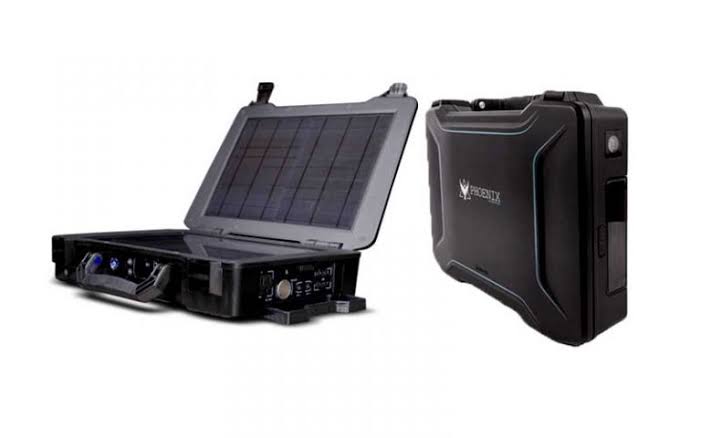
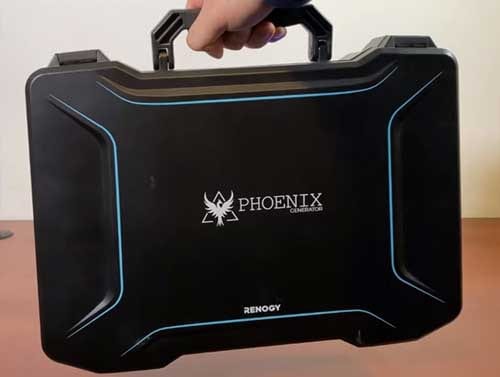
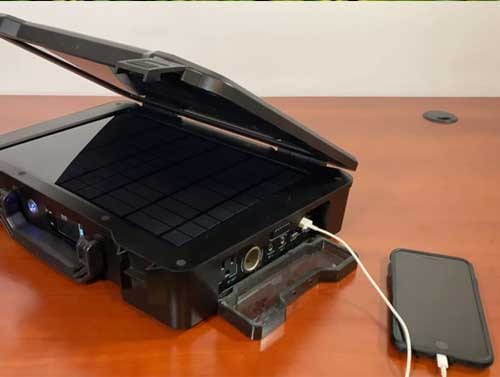
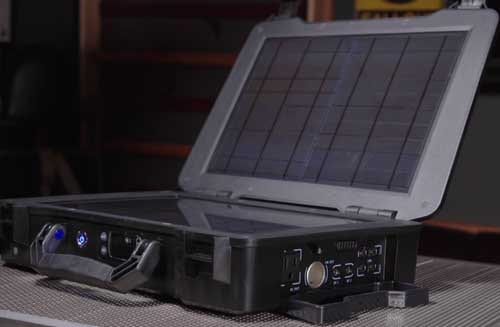
The Renogy Phoenix 150w generator packs a pair of 10W monocrystalline solar panels with a 17.1Ah lithium-ion battery.
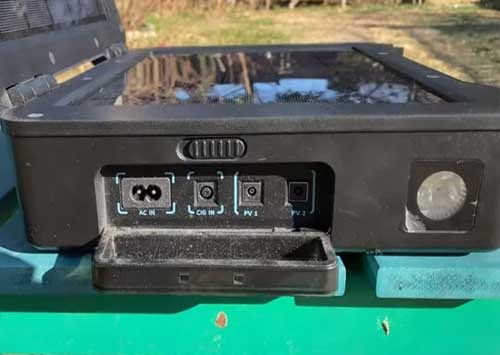
Apart from solar, you can use AC power or your car battery for charging it up.
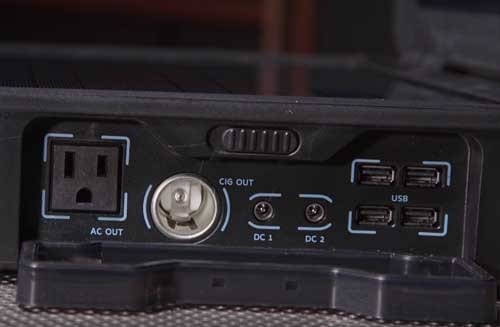
Moreover, you get an excellent range of options for connectivity - four USB ports, two DC ports, and one AC port.
With 150 watts of continuous output, it can easily supply juice to all the smaller appliances like phones, laptops, and cameras.
Another TopNotch feature- You can add solar panels of up to 100 Watt capacity to speed up the charging.
The ABS suitcase provides sufficient rigidity to the product.
It can handle rough outdoor use - no sweat.
While the overall efficiency isn’t as good as the TopNotch Top Picks, it packs great value with its excellent features.
All in all, its lightweight versatility for camping and other outdoor pursuits is hard to beat.
Output Power
The overall output is on the lower end.
Charged by the 20W solar panels, 150 watts of continuous output is what you get.
The best part is, the output is a pure sine-wave through the inverter.
We tested the generator through a laptop, three different smartphones and a tablet.
Output Power Rating
The battery charged up the laptop 3 times before running out.
The other devices came with varying battery capacities and we charged them multiple times without any issues.
What about the charging options?
You get three charging options- an AC plug, a 12V input, and two ports for additional solar panel inputs.
As per the product description, the battery will be charged with 6 hours of good sunlight.
However, the overall charging time of the monocrystalline solar panels will depend on the light conditions.
We used an additional 100 W solar panel to power it up.
The result?
A fully charged battery in just 4 hours.
Not to forget, there’s an MPPT charge controller for optimizing the charging time.
One more thing…
Unfortunately, the inverter will cause power loss that limits the overall performance. You can’t expect 150 Watts at all times.
Our top picks, the Goal Zero Yeti 1400 and the Goal Zero Yeti 400 were better performers in this regard.
On the whole, the Renogy Phoenix 150w panel is a solid plug-and-play option. But if you need more power, there are better choices out there.
Durability & Workmanship
The overall durability of the Renogy is TopNotch.
The outer casing is a combination of ABS and aluminum.
We loved the solid feel.
On top of that, there are rubber stoppers to protect it from knocks and bumps.
Durability & Workmanship Rating
Also, there are covers on every port.
A nice touch.
Unfortunately, the covers didn’t feel very durable though.
Next, it comes with a fan that helps convection cooling.
The overall cooling efficiency is good. Even while delivering close to 100 Watts it never overheated.
Let’s not forget you can connect it with 100 Watt solar panels.
A big plus.
A word of caution - it can heat up a little while charging on a hot day.
We connected our solar panels with all our testing generators including the Jackery 240 and the Goal Zero Yeti 1400.
But none of them heated up like this (solar generator).
Also, the battery pack with monocrystalline solar panels has an estimated lifespan of 1500 cycles.
And another thing…
The battery pack is also replaceable. Adding a new one is pretty simple.
Here’s something else we liked…
The addition of four USB ports makes charging small electronics super easy.
But there’s one problem…
The spacing between the ports is tight. So plugging in multiple electronics at a time can be an issue.
In the end, the generator came up with a lower rating under this metric.
Dependability & Reliability
When you’re heading off-grid you just can’t overlook the dependability of any product.
The overall reliability of the Renogy is good but not great.
Dependability & Reliability Rating
There’s an LCD display for highlighting all the important information.
And there’s even more.
The monocrystalline solar panels come with a 25-year warranty and an efficiency rate of 80%.
Plus point - there’s a 5-year warranty on the craftsmanship and material.
Now, while the overall build quality is good we couldn’t say the same about the plastic latches of the case.
Setting up the Renogy Phoenix 150 solar panel generator is a breeze.
Just prop open the lid and it's ready for solar charging.
Beyond all that, there’s protection for overloading, overheating and short circuits.
Actually, we tried car-charging it on our way back from Sawtooth National Forest but we gave up. The charging speed through the 12 volt car adapter was painfully slow.
Remember it doesn’t have an IPX rating.
So using it in wet weather isn’t an option.
The good thing is Renogy includes quite a few cables with the generator. But you can’t store them in the case and there was no bag provided for them.
Now we do think that’s an oversight.
For the overall reliability and attention to detail, the Goal Zero Yeti 1400 was our Top Pick.
Noise
Needless to say, low noise is one big strength of all solar-powered generators.
The product description doesn’t mention noise levels.
But the noise factor was never an issue during our tests.
Still, with a comparative analysis, we felt the Renogy generator was on par with our chart toppers in this segment.
Noise Rating
Quite simply, it lacked the ultra-quiet performance that keeps products like the Yeti 400 and the Jackery 240 in a separate league of their own.
We noticed some noise while charging from an external solar panel. At times when it got overheated, the noise levels also increased to some extent.
Now don’t get me wrong here.
This solar generator will be a good choice in any place where sound restrictions are in place.
However, if you want the very best options under this metric, stick to the TopNotch Top Picks.
Our Final Verdict: Renogy Phoenix 150w Portable Solar Generator
Conclusion: Renogy Phoenix 150W Portable Solar Generator
Renogy Time to sum up the detail...
I have to say this.
Whatever the rating, the Renogy is the most ingeniously designed product in our list.
Honestly, we loved the cool styling.
It combines a 17.1Ah battery with 20W solar panels to give a great option for off-grid campers.
Add to that a whole range of outlets for topping up all your smaller appliances.
You can attach a 100W external solar panel for faster charging.
It comes with an inverter for clean power delivery and has all the necessary safety features.
Even though it’s not the lightest product we tested, the overall portability was TopNotch.
Consider your power requirements and then make a choice.
Now it’s your call - over to you.
Looking at the wider field? Our guide to the 10 Best Camping Generators: Definitive Review (Buyer’s Guide) 2026 ranks the ones worth your money.