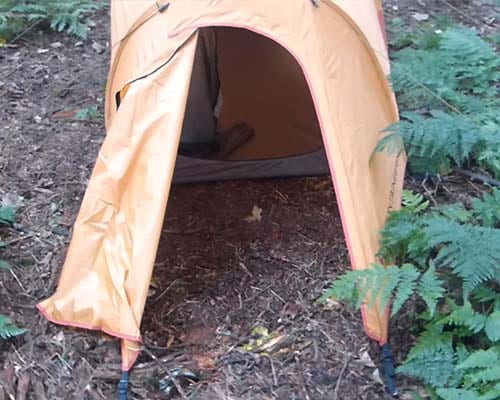
 Best Overall Emergency Bivvy
SOL Escape Bivvy
- Weight (our scale): 8.5 oz
- Packed size: about a water bottle
- Breathable: yes
- Coldest night: 22°F
Bottom Line : The only bivvy here that breathes: Ryan's down bag stayed bone dry inside it at 22°F in the Frank Church Wilderness.
Pros
- Virtually zero condensation: it breathes
- Added about 10 to 12°F to his sleep system
- Windproof
- Side zip and hood drawstring
Cons
- Heaviest and bulkiest bivvy here at 8.5 oz
- Reflects 70% of body heat, less than the foil types
Who it's best for
Anyone who might spend a whole night in it, or wants a bivvy that doubles as a sleeping bag cover. Ryan used it in the Frank Church Wilderness, Idaho, on an early November hunting trip.
Why we love it
Every other bivvy we tested left Ryan damp with his own sweat. This one didn't. Used over his sleeping bag under a floorless tarp at 22°F, it let his sweat out as vapor while reflecting body heat, and his down bag stayed bone dry.
It added roughly 10 to 12°F to his sleep system and blocked every draft. It survived cot edges, boots and pine needles without a puncture, and the side zip and hood drawstring make it easy to get in and out of.
What we didn't like
It's the heaviest and bulkiest here, 8.5 oz and about the size of a water bottle, so it's a pack item rather than a pocket one. It also reflects 70% of body heat rather than the 90% the foil bivvies claim.
Should you buy it?
Yes. If you could end up in it for a whole night, breathability matters more than a few extra degrees of reflection. If it has to fit in a pocket, the SOL Emergency Bivvy is half the weight.
Read our full SOL Escape Bivvy review →
 Best Pocket Bivvy
SOL Emergency Bivvy
- Weight (our scale): 3.8 oz
- Packed size: about a soda can
- Breathable: no
- Coldest night: 34°F at 6,200 ft
Bottom Line : Soda-can small and warm within a minute on an unplanned night on Mount Hood. It doesn't breathe, so expect to be damp by morning.
Pros
- Warm within 60 seconds
- Completely windproof
- Soda-can size, 3.8 oz
- Stretched rather than tore under boots
Cons
- Severe condensation: base layers damp in 90 minutes
- Leaves you damp after a long night
Who it's best for
Day hikers and climbers who want a real emergency shelter in a jacket pocket. Ryan used it for an unplanned bivouac on Mount Hood, Oregon, in late October.
Why we love it
An equipment delay forced Ryan into a rock nook at 6,200 ft on Mount Hood at 34°F. He was noticeably warmer within 60 seconds of sliding in, and the welded seams stopped every cold downdraft.
It packs to the size of a soda can at 3.8 oz, so it fits a jacket pocket. The film stretched under his boots rather than shredding like thin foil, and it came through the night intact.
What we didn't like
It doesn't breathe. Within 90 minutes Ryan's base layers were damp, and by hour four sweat had pooled around his socks. It will keep you alive, but not dry.
Should you buy it?
Yes, as the bivvy you always carry. It's the best weight-to-warmth here. If you expect a long cold night, carry the breathable SOL Escape Bivvy instead.
Read our full SOL Emergency Bivvy review →
 Best Survival Extras
Go Time Gear Life Bivy
- Weight (our scale): 4.1 oz
- Packed size: 4.5 x 2.5 in
- Breathable: no
- Coldest night: 38°F
Bottom Line : Tough for a foil bivvy, with a loud whistle and paracord that earn their place. Damp inside by morning in a Bighorn trench shelter.
Pros
- Remarkably puncture resistant for foil
- 120 dB whistle and paracord drawstring
- Airtight and windproof
- Small: 4.5 x 2.5 in
Cons
- Heavy condensation, like any non-breathable bivvy
- Damp pant legs by morning
Who it's best for
Anyone building a survival kit who wants a whistle and cord in the same bag. Ryan used it at a September survival skills workshop in the Bighorn Mountains, Wyoming.
Why we love it
Ryan spent the night in a trench shelter on damp forest floor at 38°F. The reflective shell returned heat straight away, and the sealed bottom and sides left no drafts.
He pushed it through gravel and sticks and it only stretched. The 120 dB whistle and paracord drawstring on the stuff sack are genuinely useful extras.
What we didn't like
Condensation was heavy, the same as any non-breathable foil bivvy: moisture collected on the inner lining and dampened his pant legs by morning.
Should you buy it?
Yes, if you want the extras in one package. For pure pocket size, the SOL Emergency Bivvy is lighter; for a dry night, the SOL Escape.
Read our full Go Time Gear Life Bivy review →
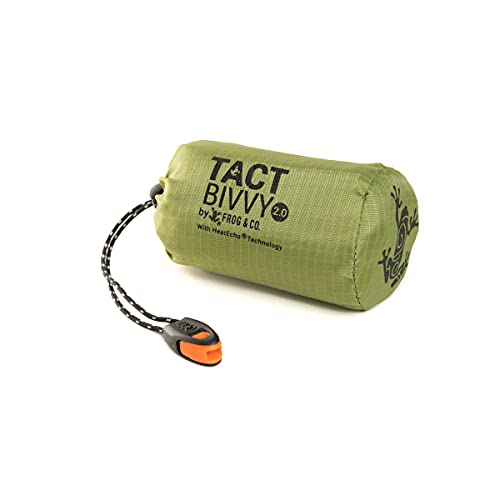
Tact Bivvy 2.0
- Weight (our scale): 4.8 oz
- Packed size: about a hockey puck
- Breathable: no
- Coldest night: 18°F
Bottom Line : Kept Ryan's core warm in a Black Hills snow trench at 18°F, and the seams held. Frost formed inside by 4 AM.
Pros
- Kept his core warm at 18°F
- 100% windproof
- Seams held against boots and thrashing
Cons
- Extreme condensation: frost inside by 4 AM
- A little harder to use than the others
Who it's best for
Winter hikers who want a light backup bivvy with seams that hold up to rough use. Ryan used it in a snow trench in the Black Hills, South Dakota, during a March cold-weather drill.
Why we love it
At 18°F with wind-driven flurries, the reflective film kept Ryan's chest and core warm inside a snow trench, and the sealed seams stopped the freezing wind dead.
He thrashed around in it and the reinforced seams held against his boot soles without splitting.
What we didn't like
In sub-freezing air, his breath and sweat condensed on the lining and froze into a frost glaze on the silver lining by 4 AM. It also scored lowest here for ease of use.
Should you buy it?
Yes, as a light backup in a winter pack. For a long night, or a car kit, the breathable SOL Escape is the better bivvy; it's what Ryan carries in his own car.
Read our full Tact Bivvy 2.0 review →
How We Tested
An emergency bivvy has one job: get you through a night you didn't plan for. So Ryan used each one for a real night outdoors, in the cold, rather than on a living room floor.
He slept in them on Mount Hood at 6,200 ft (34°F), in the Bighorn Mountains (38°F), in the Frank Church Wilderness (22°F) and in a Black Hills snow trench (18°F), and weighed each on his own scale. We scored five things out of 10:
- Warmth (30%): how fast it warmed him and how warm it kept him
- Weather Protection (25%): wind, and moisture from outside and in
- Durability (20%): boots, gravel, sticks and seams
- Packability (15%): weight on our scale and packed size
- Ease of Use (10%): getting in and out in the cold
The overall score out of 100 weights those marks as above. Heat-reflection figures are the makers' claims; the weights, temperatures and what happened overnight are Ryan's. You can meet the testers at the bottom of this page.
Which Emergency Bivvy Suits You?
| If you are… | Buy |
|---|---|
| Likely to spend a whole night out, or want a sleeping bag cover | SOL Escape Bivvy |
| Wanting one in your jacket pocket every day | SOL Emergency Bivvy |
| Building a survival kit with a whistle and cord | Go Time Gear Life Bivy |
| Wanting a light backup for a winter pack | Tact Bivvy 2.0 |
Our Analysis & Test Results
Warmth
Where we tested it. Four cold nights from 38°F down to 18°F.
What separated them. The SOL Emergency warmed Ryan within 60 seconds. The breathable SOL Escape reflects less heat, but he stayed dry all night and it added about 10 to 12°F to his sleep system.
What it felt like. In the foil bivvies he was warm and then damp. In the Escape he was warm and dry.
| Bivvy | What we found |
|---|---|
| SOL Escape Bivvy | added 10 to 12°F to his sleep system at 22°F |
| SOL Emergency Bivvy | warm within 60 seconds at 34°F |
| Go Time Gear Life Bivy | instant heat return at 38°F |
| Tact Bivvy 2.0 | kept his core warm at 18°F |
Weather Protection
Where we tested it. Wind on Mount Hood and in the Black Hills; moisture from Ryan himself every night.
What separated them. All four were windproof. Moisture split them: the Escape breathed and stayed dry inside, while all three foil bivvies trapped sweat. The Tact's froze into frost by 4 AM.
What it felt like. Condensation, not wind, decided this test.
| Bivvy | What we found |
|---|---|
| SOL Escape Bivvy | windproof; virtually no condensation |
| SOL Emergency Bivvy | windproof; base layers damp in 90 minutes |
| Go Time Gear Life Bivy | airtight; damp trouser legs by morning |
| Tact Bivvy 2.0 | windproof; frost inside by 4 AM |
Durability
Where we tested it. Boots, gravel, sticks, cot edges and pine needles.
What separated them. The Escape's fabric took cot edges and boots without a puncture. The foil types stretched rather than tore, and the Tact's reinforced seams held against hard thrashing.
What it felt like. None of the four tore in Ryan's test.
| Bivvy | What we found |
|---|---|
| SOL Escape Bivvy | no punctures from cot edges, boots or needles |
| Go Time Gear Life Bivy | pushed through gravel; only stretched |
| SOL Emergency Bivvy | stretched under boots; intact |
| Tact Bivvy 2.0 | seams held against boots and thrashing |
Packability
Where we tested it. Weighed on Ryan's own scale and packed in its own sack.
What separated them. The SOL Emergency was smallest, soda-can size at 3.8 oz. The Go Time Gear (4.1 oz) and Tact (4.8 oz) are close behind. The Escape, at 8.5 oz, is more than double the SOL Emergency.
What it felt like. Three of them live in a jacket pocket; the Escape lives in a pack.
| Bivvy | What we found |
|---|---|
| SOL Emergency Bivvy | 3.8 oz, soda can |
| Go Time Gear Life Bivy | 4.1 oz, 4.5 x 2.5 in |
| Tact Bivvy 2.0 | 4.8 oz, hockey puck |
| SOL Escape Bivvy | 8.5 oz, water bottle |
Ease of Use
Where we tested it. Getting in, out and comfortable on cold nights.
What separated them. The Escape's side zip and hood drawstring made it far the easiest. The foil bags are simple sacks; the Tact scored lowest.
What it felt like. With its side zip, the Escape was the easiest to get in and out of.
| Bivvy | What we found |
|---|---|
| SOL Escape Bivvy | side zip and hood drawstring |
| SOL Emergency Bivvy | simple sack |
| Go Time Gear Life Bivy | simple sack |
| Tact Bivvy 2.0 | lowest score here |
Emergency Bivvy FAQ
Is an emergency bivvy better than a space blanket?
For a night out, yes. A bivvy wraps all of you and seals out wind, while a thin space blanket flaps uncontrollably in a 10 mph wind. In Ryan's test, all four bivvies blocked the wind.
Why do I get wet inside an emergency bivvy?
Because foil bivvies don't breathe, so your sweat condenses inside. Ryan's base layers were damp within 90 minutes in the SOL Emergency. A breathable bivvy like the SOL Escape lets that moisture out.
Can I use an emergency bivvy with a sleeping bag?
Yes. Ryan used the SOL Escape over his down bag at 22°F and it added about 10 to 12°F of warmth while keeping the bag dry. A non-breathable bivvy over a down bag is likely to dampen it with trapped sweat.
Our Final Verdict: Best Emergency Bivvy 2026
Buy the SOL Escape Bivvy if you might spend a whole night in it: it's the only one that keeps you dry. For a bivvy you always carry, the 3.8 oz SOL Emergency Bivvy. Want a whistle and cord too? The Go Time Gear Life Bivy. For a tough winter kit, the Tact Bivvy 2.0.
Editor's Note, 17 October 2026: New guide. Ryan spent real nights in four emergency bivvies, from Mount Hood to a Black Hills snow trench, and weighed every one on his own scale.
Our Testers
This guide was edited by Sean Williams and tested by Ryan Williams.
- Sean Williams, Editor-in-Chief. Sean built the team of researchers and testers behind our reviews and sets the rule the site runs on: we buy what we test, and we say what we found.
- Ryan Williams, Lead Tester. A heavy fleet equipment mechanic by trade, Ryan tests our generators, family tents and emergency gear.
![10 Best Inflatable Tents (Airbeam) [Tested 2026] Definitive Review](/images/2020/04/Inflatable-Tent-img-01op.jpg)
![10 Best Wall Tents [UPDATED] 2026: Definitive Review](/images/2020/05/Best-Wall-Tent-opt.jpg)