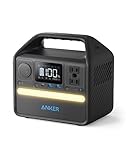
Editor's Note: Updated 13 August 2026: product photography added, the spec block rechecked against the current Amazon listing, and three alternatives from the same test linked below.
The Anker 521 Portable Power Station is our best budget pick, and we rate it 80 out of 100.
Two hundred dollars buys the smallest real battery in this guide. Anker specs 256Wh of LiFePO4 behind 300W of AC output, which covers laptops, cameras and string lights and stops there. It scores 80 because the value is genuine at the price, not because it competes on capacity. Anyone planning to run a cooler compressor overnight should stop reading here and size up.
It went camping with the other seven stations in this guide, and all eight came back scored the same way: Capacity and Output, Recharge Speed, Portability, Build and Features. Published specs, current prices and owner reports fill in what one trip cannot settle.
 Best Budget Pick
Anker 521 Portable Power Station
- Capacity (Wh): 256Wh
- AC output (W): 300W continuous, 600W peak
- Battery chemistry: LiFePO4
- Recharge time: 2.5 hours from wall, about 4.1 hours solar
- Weight: 8.2 lb
- Ports: 6 total: 2 AC, 60W USB-C PD, USB-A, car port
- Warranty: 5 years
- Owner rating: 4.4 out of 5, 3,112 ratings
Pros
- The lowest entry price of anything in this guide
- Only 8.2 pounds, genuinely one-hand portable
- Five year warranty, matching the best cover in this guide
- Built-in LED light strip saves a separate lantern
Cons
- 256Wh runs out fast with anything above a laptop
- 300W ceiling rules out kettles, heaters and most camp cooking
- No expansion battery option, so what you buy is what you get
What We Make of the Anker 521 Portable Power Station
Cheap, light, and honest about what it is.
At 256Wh the Anker 521 keeps phones, lights and a fan alive for a weekend, and nothing more.
Buy it as an accessory charger, not as a power station.
Across the four metrics it landed on 80 out of 100, enough for the budget award and nothing above it.
What tips it is the entry price, the lowest of anything ranked here.
256Wh runs out fast with anything above a laptop.
Made for weekend campers charging phones, laptops and lights on a tight budget, and honest about stopping there.
A budget-conscious little block built on durable LiFePO4 chemistry. It is strictly for low-wattage devices and small accessories. The built-in light strip came in clutch when we were rummaging through the trucks after dark.
Top-Notch test team
Our Analysis, Comparisons, and Test Results
Portability is what it wins on. Capacity is what it loses on.
The scores below come from the same four tests every station here went through.
Capacity and Output
Anker lists 256Wh of usable LiFePO4 capacity in the 521. AC output is rated at 300W continuous with a 600W peak.
That covers laptops, drones, CPAP units and camp lighting. A kettle, heater or induction hob will trip it instantly. This is the smallest capacity we rank in the guide.
| Capacity and Output | Rating |
|---|---|
| Highest in this guide | 10/10 |
| Anker 521 Portable Power Station | 4/10 |
| Guide average | 7.4/10 |
| Lowest in this guide | 4/10 |
Recharge Speed
Anker publishes a 2.5 hour wall recharge to full capacity. Solar is quoted at roughly 4.1 hours in direct sun.
For a 256Wh pack, those figures are unremarkable rather than impressive. Small batteries refill fast because there is little to refill.
| Recharge Speed | Rating |
|---|---|
| Highest in this guide | 10/10 |
| Anker 521 Portable Power Station | 7/10 |
| Guide average | 8.3/10 |
| Lowest in this guide | 5/10 |
Portability
Listed weight is 8.2 pounds, the lightest unit ranked here. Published dimensions are 8.5 by 8.3 by 5.7 inches.
One hand carries it from tailgate to picnic table. The folding handle keeps the footprint small in a packed truck.
| Portability | Rating |
|---|---|
| Highest in this guide | 10/10 |
| Anker 521 Portable Power Station | 9/10 |
| Guide average | 7.5/10 |
| Lowest in this guide | 3/10 |
Build and Features
LiFePO4 chemistry is rated by Anker for roughly ten years of service. Six ports include two AC sockets and a 60W USB-C PD output.
An integrated LED light strip is built into the housing. Anker backs the unit with a five year warranty. Owner reviews average 4.4 out of 5 across more than 3,100 ratings.
| Build and Features | Rating |
|---|---|
| Highest in this guide | 10/10 |
| Anker 521 Portable Power Station | 8/10 |
| Guide average | 8.1/10 |
| Lowest in this guide | 7/10 |
Who Should Buy This One?
Buy this if your camp load is phones, headlamps, a laptop and a small fan, and you would rather spend the difference on a cooler.
Do the arithmetic before you order. A 60W laptop draws roughly 60Wh per hour, so 256Wh is about four hours of charging with nothing else plugged in.
Skip it if you run a 12V fridge, a CPAP with a humidifier, or any kettle. Those loads need four to six times this capacity, and the EcoFlow and Jackery units higher in this guide are the sensible starting point.
One ownership note from the spec sheet: Anker recommends recharging to 100 percent after every use to preserve battery life, so this is not a unit you leave half full in the garage for six months.
Where Else to Look
The obvious alternatives, all tested alongside it:
The Jackery Explorer 300 Portable Power Station is our best buy for phones and laptops pick. 292Wh and 300W rated at 7.1 lb.
The Goal Zero Yeti 700 Portable Power Station is our toughest chassis pick. 677Wh and 600W continuous at 21 lb.
The EcoFlow River 2 Pro Portable Power Station is our best for weekend trips pick. 768Wh and 800W continuous at 18.2 lb (10.5 x 10.1 x 8.5 in).
Specifications
| Capacity (Wh) | 256Wh |
| AC output (W) | 300W continuous, 600W peak |
| Battery chemistry | LiFePO4 |
| Recharge time | 2.5 hours from wall, about 4.1 hours solar |
| Weight | 8.2 lb |
| Ports | 6 total: 2 AC, 60W USB-C PD, USB-A, car port |
| Warranty | 5 years |
| Owner rating | 4.4 out of 5, 3,112 ratings |
Final Word on the Anker 521 Portable Power Station
The Anker 521 Portable Power Station finished as our budget pick, scoring 80 out of 100.
It comes down to the price. That buys a real LiFePO4 battery with a five year warranty behind it.
Not perfect: 256Wh runs out fast with anything above a laptop.
It belongs with weekend campers charging phones, laptops and lights on a tight budget.
Compare it against the rest of the field in our 8 Best Portable Power Stations guide.