Editor's Note, 7 October 2026: We rewrote this guide from scratch. The old version never named a single generator. This one names the smallest models you can actually buy, gives each weight from the maker's own manual or spec sheet, and says plainly where a "world's smallest" claim is only marketing.
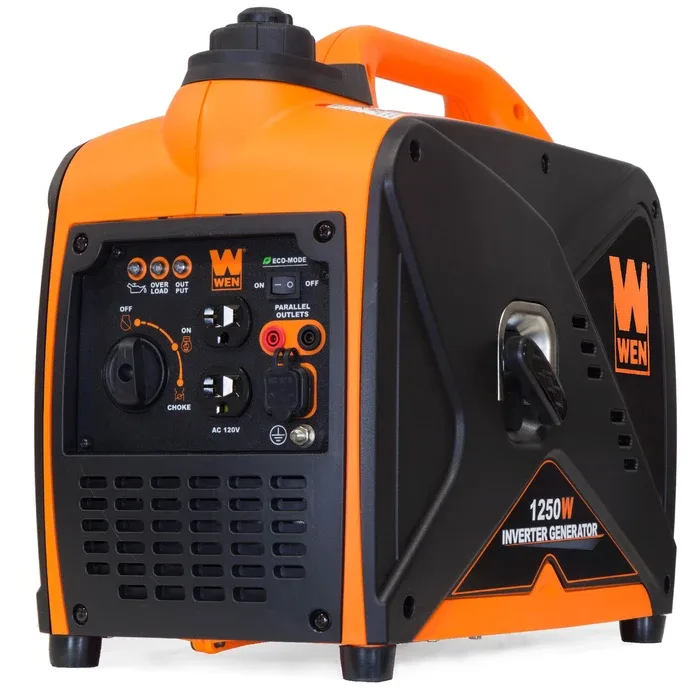
The smallest gas generators you can buy weigh between 25 and 30 pounds and make about 1,000 watts. In the US, the lightest we could verify is the GENMAX GM1200i at 25.3 lb, followed by the Honda EU1000i at 29.5 lb and the WEN 56125i at 31.6 lb. For 240 volt markets, the Yamaha EF1000iS at 12.7 kg and the Honda EU10i at 13 kg are the smallest.
Go any smaller and you are no longer buying a generator. You are buying a battery.
Want the best small generator rather than just the lightest? Our small generator guide ranks the ones we tested, and our best generators guide names a winner for every use.
Table of Contents
The Smallest Generators You Can Buy (120V, US)
A 1,000 watt inverter generator is the smallest size most major generator brands still make. Every unit below is an inverter, small enough to carry in one hand and quiet enough for most campgrounds.
| Model | Weight | Running / starting watts | Size (L x W x H) | Fuel tank |
|---|---|---|---|---|
| GENMAX GM1200i | 25.3 lb | 1,000 / 1,200 | 16.5 x 9.4 x 15.7 in | 0.66 gal |
| Honda EU1000i | 29.5 lb | 900 / 1,000 | 17.8 x 9.5 x 14.9 in | 0.55 gal |
| WEN 56125i | 31.6 lb | 1,000 / 1,250 | 17.25 x 9 x 15 in | 0.7 gal |
Weights are dry, as each maker publishes them. Honda's figure comes from the EU1000i owner's manual; some older Honda pages say 28.7 lb, and we've used the manual. GENMAX lists the GM1200i as a "25-pound" unit on its product page. WEN's sizes and tank are on its spec page.
Here's the thing: the differences on that table are small. Six pounds separates the lightest from the heaviest, and all three fit in the footwell of a car. The real choice between them is noise, parts support and how far you'll carry it, which is what our best small generators guide weighs up.
The Smallest 240V Generators (UK, Australia, Europe)
A 240 volt 1 kW inverter is the same size class built for mains voltage outside North America. The figures below come from each maker or its national distributor.
| Model | Weight | Running / max output | Size (L x W x H) | Fuel tank |
|---|---|---|---|---|
| Yamaha EF1000iS | 12.7 kg | 900 W / 1,000 W | 450 x 240 x 380 mm | 2.5 L |
| Honda EU10i | 13 kg | 900 W / 1,000 W | 451 x 242 x 379 mm | 2.1 L |
| Westinghouse iGen1200 (Australia) | 15 kg | 1,000 W / 1,200 W | Not published by the retailer | 2.8 L |
Sources: Yamaha's global spec page, Honda Australia and an Australian Westinghouse stockist. Hyundai's HY1000Si (14 kg) used to sit on this list, but it shows as sold out on Hyundai's UK site and at least one retailer lists it as discontinued.
So What Is the World's Smallest Generator?
Nobody can honestly tell you. No standards body measures or ranks generator size, so every "world's smallest" or "lightest in class" line you read is a maker's own claim.
The lightest claim we found is an 8.5 kg, 800 watt unit sold in Eastern Europe and marketed as the lightest generator in the world. That figure only appears on retail listings, not on a spec sheet we could check, so we won't repeat the brand as fact.
What we can say: among generators with a spec sheet we could check from an established maker, nothing fuel-burning is meaningfully smaller than the 1,000 watt class above. Below that size, the engine stops making sense and the market has moved to batteries.
What a 1,000 Watt Generator Will and Won't Run
A 1,000 watt generator runs phones, laptops, lights, a fan and a small fridge. A full-size electric kettle or hair dryer usually draws more than it makes, so check the label first. It will not start a rooftop RV air conditioner. A common 15,000 BTU unit needs about 1,560 watts just to keep running, before the extra surge it pulls in the first second.
That's the trade you make for a 25 to 30 pound generator. If an air conditioner, a microwave or a coffee maker is on your list, size up to the 2,000 watt class. Our guide to what size generator a camper needs walks through the numbers, and the camp power calculator adds up your own list, starting watts included.
Look: most people searching for the smallest generator would be happier with the next size up. A 2,000 watt class inverter weighs around 35 to 50 pounds, handles nearly double the load, and is still easy to lift into a truck bed.
Smaller Still: Battery Power Stations
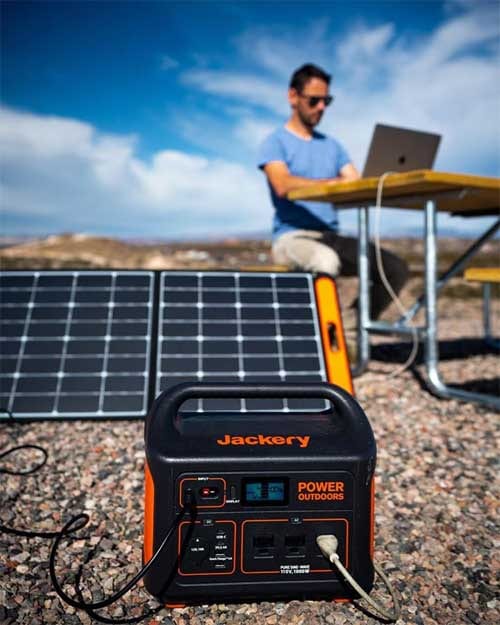
A portable power station is a battery pack with an inverter and outlets built in. It has no engine, burns no fuel and makes no exhaust, which is why it can be far smaller than any gas generator.
The EcoFlow River 3 Plus weighs 10.4 lb, less than half the lightest gas unit above. The catch is capacity. Its 286 Wh battery runs a 100 watt load for under three hours, where a gas generator keeps going as long as you keep pouring fuel in. Read our River 3 Plus review for what that means over a weekend.
Pick a power station if you mostly charge devices and want silence. Pick a small gas generator if you need power for days without a hookup or a solar panel.
Before You Buy a Tiny Generator
Check the campground rules. National parks cap generator noise at 60 dB(A) measured at 50 feet under 36 CFR 2.12, and many campgrounds add their own quiet hours. Our guide to using a generator on a campsite covers the rest.
Look for a CO shutoff. A small generator makes the same deadly exhaust as a big one. The US Consumer Product Safety Commission says to run it outside only, at least 20 feet from the house, and to look for models with a carbon monoxide shutoff. The GENMAX GM1200i has one built in. Never run any generator in a tent, van, awning or garage.
Mind the tiny tank. Half a gallon or so is normal at this size. Plan on refuelling during a long evening if you're running near full load.
What We'd Buy
For a weekend of lights, phones and a laptop, a 1,000 watt inverter is plenty, and the WEN 56125i is the one we've reviewed in full. See our WEN 56125i review.
If you want headroom for a kettle, a microwave or several things at once, step up. Our best quiet generators guide leads with the Honda EU2200i, and our best small generators ranks ten compact generators against each other.
Smallest Generator FAQ
What is the smallest generator you can buy?
The smallest gas generators on sale weigh about 25 to 30 pounds and make around 1,000 watts. In the US, the GENMAX GM1200i (25.3 lb) and Honda EU1000i (29.5 lb) are the lightest with published specs. Battery power stations go smaller, down to about 10 pounds, but hold far less energy.
What is the smallest 240V generator?
The Yamaha EF1000iS at 12.7 kg and the Honda EU10i at 13 kg are the smallest widely sold 240 volt generators. Both are 1 kW inverters with roughly 2 to 2.5 litre tanks.
Will a 1,000 watt generator run a camper?
It will run a camper's lights, water pump, fridge and device charging, but not its air conditioner. A rooftop RV air conditioner needs about 1,560 running watts plus a start-up surge, so plan on 2,000 watts or more with a soft starter, or 3,000 watts without one.
Is a small generator quiet?
Small inverter generators are among the quietest you can buy, because the engine slows down when the load is light. WEN quotes the 56125i at 51 dBA and GENMAX quotes the GM1200i at 58 dBA, both at quarter load and roughly 22 to 23 feet. Check the distance and load behind any figure; our noise and runtime database shows the condition next to each claim.