![10 Best Hydration Vests of 2026 [Ultrarunner Tested]](https://m.media-amazon.com/images/I/51GaA2174OL._SL1000_.jpg)





 Best Vest for 100-Mile Races
Salomon ADV Skin 12 Set
- Capacity: 12 L
- Our measured weight: 277 g, dry
- Hydration: 2 x 500 mL soft flasks included; takes a 1.5 L bladder
- Best for: 50-milers, 100-milers and cold-weather kit lists
Bottom Line : The vest we reached for when the kit list was long and the race was longer. Buy it in exactly the right size.
Pros
- No bounce, even fully loaded
- Rear tunnel pocket takes a shell on the move
- Soft, wrap-around Sensifit mesh
Cons
- Phone and full flask crowd one front pocket
- Fussy bladder hook inside the rear sleeve
- Unforgiving if you pick the wrong size
- Zippers need rinsing after salty runs
Who it's best for
Runners training for 50-mile and 100-mile races, especially ones with a long mandatory kit list or cold-weather layers to carry. This was the heavy hauler for Annie and James's longest efforts.
Why we love it
The Sensifit stretch mesh wraps round your torso like a second layer. Even stuffed full of cold-weather layers and mandatory kit, it didn't bounce.
The rear pass-through "tunnel" pocket is the standout. You can reach back and pull out a rain shell, or stuff one away, without undoing the chest straps. In a long race, that saves you from stopping every time the weather turns.
The included flasks slide into the chest sleeves easily when full. As they empty, hook the elastic loop at the top over the valve so the flask doesn't slump to the bottom of the pocket.
What we didn't like
A large smartphone in the front zip pocket next to a full 500 mL flask made a pressure point against the ribs. Put the phone in the back if you can.
Sweat salt builds up quickly in the front zipper tracks. Rinse the vest by hand after hot summer runs, or the zippers will start to seize over time.
The plastic hook inside the rear hydration sleeve is awkward to thread a bladder loop onto in a hurry, and it feels fragile. If you mostly use the flasks, you'll barely notice it.
Should you buy it?
Yes, if you are racing ultras and can get the size exactly right. It is the vest we reached for when the race was longest. Measure your chest properly first: too small and the mesh binding cuts into your lats under the armpits; too big and you end up pulling the sternum cords until the front panels meet, which bunches the harness. A women's ADV Skin 12 set is on Amazon here.
Read our full Salomon ADV Skin 12 review →
 Best Women's Fit and Easiest Access
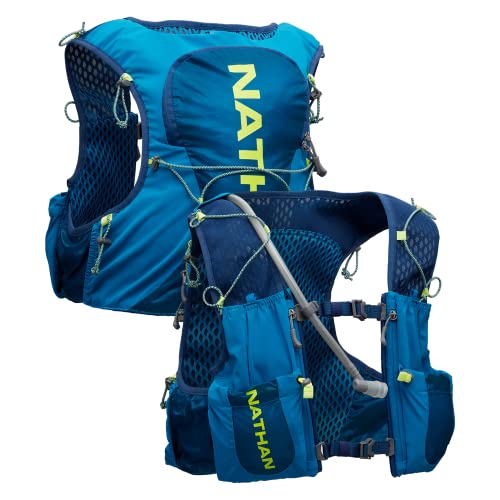
Nathan Pinnacle 12L
- Capacity: 12 L
- Our measured weight: 204 g (women's), 212 g (men's)
- Hydration: 1.6 L insulated hourglass bladder included; takes flasks
- Best for: Long mountain runs where you don't want to stop
Bottom Line : The most shirt-like vest we tested, and the one where you can reach almost everything mid-stride.
Pros
- Wraps the torso like a shirt
- Women's cut sits well around the bust
- About 80% of your kit reachable on the move
- Two rear kangaroo pockets
Cons
- Bladder hose needs trimming
- Velcro tab snags hair and knit shirts
- Long poles wobble in the rear sleeve
Who it's best for
Women who have struggled to fit unisex vests, and anyone who wants to eat, drink and change layers without stopping on long mountain runs.
Why we love it
Annie ran the women's Pinnacle on mountain runs of 30 miles and more, and it fit her chest better than most unisex packs she has tried. It sits comfortably round the bust without squashing, and she didn't get any raw spots. The fabric is fine and soft, so the whole vest feels closer to a shirt than a pack.
Access is the other reason it ranks this high. We could reach roughly 80% of our food, kit and rubbish without taking the vest off. One of the two rear kangaroo pockets opens from the side only, and the other opens from the top and the side, so you can grab a mid-layer or headlamp without looking.
What we didn't like
The hose on the included 1.6 L bladder comes too long. We cut about 2.5 inches off so the valve sat flat on the sternum magnet instead of looping across the chest. It's a five-minute job.
The small Velcro tab on the upper rear stash pocket catches loose ponytails and pulls threads on fine technical shirts if you leave it open.
The rear vertical pole pocket suits ultralight folding carbon poles. Longer three-section trekking poles swing against the neck unless the main compartment is packed full enough to hold them still.
Should you buy it?
Yes, especially if you are a woman who hasn't found a vest that fits. Trim the hose, keep the Velcro closed, carry light poles, and it is the easiest vest here to live with on a long day.
Read our full Nathan Pinnacle 12L review →
 Best for Wet Weather
Ultimate Direction Ultra Vest 6.0 / Ultra Vesta 6.0
- Capacity: 10.3 L
- Our measured weight: 184 g
- Hydration: 2 x 500 mL Body Bottle III soft flasks included
- Best for: Wet races, technical descents, runners who like structure
Bottom Line : A structured vest that keeps electronics dry and bottles high enough to drink on a technical descent. Size down if you're between sizes.
Pros
- Weatherproof shoulder zip pockets
- High flask holsters, easy to sip
- Comfort Cinch pulls the load into your lower back
Cons
- Cinch needs shoulder mobility to adjust
- Cords fray if tightened when gritty
- Runs larger than the 5.0
Who it's best for
Runners who race in the rain, run a lot of technical descents, or prefer a structured vest that feels like a light backpack over a stretchy one.
Why we love it
The weatherproof zip pockets on the shoulders are brilliant for keeping your phone and other electronics dry in heavy rain.
The flask holsters sit high, so on a technical descent you can sip by tilting your head slightly instead of bending your neck and taking your eyes off your feet.
The Comfort Cinch 3.0 cord system at the lower back pulls the bottom of the pack tight against your lumbar spine. The ripstop mesh is stiffer than the Salomon's or the Nathan's. If you like knowing exactly where the load sits, that structure is a plus.
What we didn't like
Adjusting the Comfort Cinch on the move takes decent shoulder mobility. Over hundreds of miles on dusty singletrack, grit worked into the cord channels, and tightening the cords while they were dirty started to fray them. Rinse it now and then, and the cords last.
The 6.0 series also runs bigger than the old 5.0.
On weight, our vest came in at 184 g. Ultimate Direction's Amazon listing gives 223 g without bottles, so expect some variation between samples and sizes.
Should you buy it?
Yes, if you run in wet weather or want a vest that feels structured and stays put. If your chest measurement is right on the border between Small and Medium, buy the Small. The women's Ultra Vesta 6.0 is on Amazon here.
Read our full Ultimate Direction Ultra Vest 6.0 review →
Salomon Active Skin 8 (and Active Skin 4)
- Capacity: 8 L (4 L for the Active Skin 4)
- Our measured weight: about 195 g
- Hydration: 2 x 500 mL soft flasks included
- Best for: Everyday training, from a 10k to a 50k
Bottom Line : About 85% of the ADV Skin's performance for a lot less money. The workhorse to train in.
Pros
- Shrinks for a 10k, expands for a 50k
- Twin elastic sternum cords don't restrict breathing
- Thicker fabric shrugs off trail abrasion
Cons
- Flasks sit lower, so you bow your head to drink
- No pole loops at all
- Holds sweat on humid days
Who it's best for
Runners who want one vest for most of their training, from a quick 10k on the road to a 50k trail race, without paying race-vest money.
Why we love it
The Active Skin 8 cinches down small enough for a 10k, then stretches to hold nearly 10 liters of kit, food and water for a 50k. The stretch fabric is forgiving, and the twin elastic sternum cords never felt like they were stopping us taking a deep breath.
By our reckoning it gives you about 85% of what the ADV Skin 12 does, for a much lower price. The materials are a little thicker too, which makes them more resistant to trail abrasion.
What we didn't like
The flask holsters sit about 1.5 inches lower on the chest than the ADV Skin's, so you have to bow your head further to drink on the run.
There are no built-in trekking pole loops. To carry poles, you have to buy Salomon's Pole Quiver separately and clip it to the rear attachment points.
On humid days, the thicker mesh back soaks up sweat and holds it longer than the race vests do.
Should you buy it?
Yes, if you want the workhorse to train in and don't need poles. It is the best value vest here. For short runs only, the Active Skin 4 is the smaller version.
Read our full Salomon Active Skin 8 review →
Nathan VaporAir 3.0 / VaporAiress 3.0
- Capacity: 7 L
- Hydration: 2 L bladder included, with quick-release hose and sternum magnet
- Fit system: CinchFit straps hidden in the front pockets
- Best for: Runners who drink from a hose, not flasks
Bottom Line : Built around the bladder. The hidden CinchFit straps let you re-fit the vest mid-race as your body and your layers change.
Pros
- Rides high, no lower-back rubbing
- Rib and waist adjust separately
- Water-resistant pill pocket
Cons
- Heavier than minimalist race vests
- A full 2 L bladder eats the back compartment
Who it's best for
Runners who would rather sip from a hose than juggle chest flasks, and 100-mile runners whose fit changes as the race goes on.
Why we love it
It sits high on the upper back, which keeps the weight off your lumbar spine and stopped any lower-back rubbing.
The "CinchFit" straps are hidden inside the front pockets, and they let you tighten or loosen the ribcage and waist separately. In a 100-miler, when your body swells or you add and remove layers, you can re-fit the vest without stopping.
The small, water-resistant "pill pocket" on the chest kept our electrolyte tablets dry and free of sweat all day.
What we didn't like
It is noticeably heavier empty than a minimalist race vest, because of the adjustment hardware and padded spine board. Nathan lists 8.8 oz without the bladder.
Fill the 2 L bladder all the way and it takes up a good chunk of the main rear compartment.
Should you buy it?
Yes, if you drink from a bladder and value a fit you can change mid-race over saving grams. If you prefer flasks, pick one of the vests above. We tested the earlier 2.0 generation; Amazon now sells the 3.0, which Nathan describes as the next generation of the same series. The women's VaporAiress 3.0 is on Amazon here.
Read our full Nathan VaporAir 3.0 review →
Osprey Duro 6
- Capacity: 6 L (also sold as Duro 1.5 and Duro Pro 10)
- Hydration on this listing: 2 x 500 mL soft flasks; reservoir compatible
- Harness: Dual sternum straps on vertical sliding tracks
- Best for: Heavy loads and runners who are hard on gear
Bottom Line : Feels like a micro-backpack, rides like one, and has hardware that shrugs off abuse. Needs a few long runs to soften.
Pros
- Very stable under weight
- Precise strap height adjustment
- Buckles and zippers built to last
Cons
- Stiff until broken in
- High chest pockets can bounce flasks toward the jaw
Who it's best for
Runners carrying heavy loads, and runners who are hard on gear and want a vest that won't wear out.
Why we love it
The Duro feels more like a small backpack harness than a flexible garment. Its twin chest straps slide along vertical plastic tracks, so you can set their height exactly, and it held a heavy load more steadily than almost anything else we tested.
The version we ran came with Osprey's 1.5 L Hydraulics LT reservoir, which has a stiff plastic spine. That spine stops the water from pooling into a ball at the bottom as you drink, so the bladder stays flat against your back.
The buckles, hardware and heavy zippers are practically indestructible next to ultralight stretch-mesh vests.
What we didn't like
On the latest models, the front chest pockets sit high, near the collarbones. On fast downhills, full soft flasks can bounce up toward your jaw unless you strap them down tight.
The harness material starts off stiff and took several long runs to soften.
Should you buy it?
Yes, if stability and durability matter more to you than a stretchy, shirt-like feel. Note that the current Duro 6 on Amazon ships with two soft flasks, not the reservoir we tested. If you want the flat-back bladder we liked, buy the reservoir separately.
Read our full Osprey Duro 6 review →
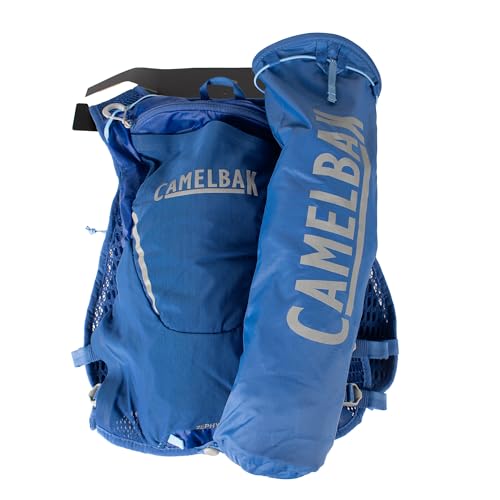
CamelBak Nano Vest and Zephyr Pro Vest
- Capacity: Nano 3.5 L, Zephyr Pro 11 L
- Weight: Nano 120 g, Zephyr Pro 200 g
- Hydration: 2 x 500 mL Quick Stow soft flasks included
- Best for: Summer speed work (Nano), hot long runs (Zephyr Pro)
Bottom Line : The Nano is our hot-weather pick. It covers so little of your back that it barely adds any heat. The Zephyr Pro brings the same cooling idea to a full-size vest.
Pros
- Nano leaves most of your back open to the air
- Zephyr Pro mesh dries fast
- Side webbing adjusts the torso fit
Cons
- Nano doesn't stretch past 3.5 L
- Zephyr pole quiver wobbles on fast descents
Who it's best for
Runners in hot climates. The Nano suits summer speed work and hot-weather marathons; the Zephyr Pro suits longer, hot trail runs where you need more kit.
Why we love it
For hot-weather marathons and summer speed work, the Nano was our first choice. It covers very little of your back, so more of you stays open to the air, and that helped keep our core temperature down in serious heat.
The Zephyr Pro's body-mapped 3D mesh dried quickly and didn't hold sweat, and side webbing lets you adjust the torso fit over different layers. Its clip-on trekking pole quiver can be set up for left- or right-hand access.
What we didn't like
The Nano is exactly 3.5 liters, and it stays that size. The rear compartment has no stretch at all, so an unexpected extra jacket or anything bulky won't fit.
On fast technical descents, the Zephyr Pro's pole quiver wobbled from side to side unless we cinched it right down.
Should you buy it?
Yes, if heat is your main problem. Buy the Nano for short, fast runs and pack for the run you're actually doing. Buy the Zephyr Pro when you need more room. A women's Zephyr Pro, with an S-curved harness and a shorter torso, is on Amazon here.
Read our full CamelBak Zephyr Pro and Nano review →
Black Diamond Distance 8
- Capacity: 8 L (also sold as the Distance 15)
- Fabric: UHMWPE 100d nylon ripstop
- Carry: Integrated Z-pole sleeves; dual ice axe carry
- Hydration: Front flask pockets, flasks not included
- Best for: Ridge traverses, scrambles and fastpacking
Bottom Line : The toughest fabric here, and the best pole carry. Built for days when running turns into climbing.
Pros
- Fabric shrugs off granite, thorns and scree
- Cinch-top holds bulky, rigid kit
- Stow or grab poles mid-stride
Cons
- No padding on the shoulder straps
- Narrow front pockets
- Gels can pop out when you take it off
Who it's best for
Mountain runners whose routes turn into climbing: alpine ridges, scrambles and fastpacking, usually with poles.
Why we love it
The UHMWPE fabric is practically bulletproof against sharp granite, thorns and scree, and it took scrapes that would have shredded a stretch-mesh vest.
The main compartment closes with a cinch top, like a climbing haul bag. It swallows bulky, rigid things like microspikes, a camera or a first aid kit without them poking into your back.
The diagonal Z-pole sleeves let us stow or pull out trekking poles mid-stride in seconds. Nothing else we tested carries poles as well.
What we didn't like
The shoulder harness has no padding at all, which saves weight and helps it last. Wearing a thin singlet with more than about 10 lb on board, the narrow straps started to press over long distances.
The front pockets are narrow and tight against the chest, so fitting gels or a phone in beside full flasks is fiddly. Loose gels can also pop out if you take the pack off carelessly.
Should you buy it?
Yes, if your runs involve rock, scree and poles. For smooth trails and road, a stretch vest will be more comfortable. Flasks aren't included, so budget for a pair. The women's Distance 8 is on Amazon here.
Read our full Black Diamond Distance 8 review →
UltrAspire Alpha 5.0
- Capacity: 6 L
- Fit system: Max O2 elastic sternum cord
- Hydration: Lower-chest bottle holsters
- Best for: Long, steep climbs where you are breathing hard
Bottom Line : The sternum cord stretches as your lungs do, so it never feels tight on a climb. Use UltrAspire's own bottles.
Pros
- Chest never feels restricted
- Low bottles keep the weight centered
- Magnetic rear pocket works one-handed
Cons
- Dense items can pop the magnets on big drops
- Tall, narrow flasks flop in the holsters
Who it's best for
Mountain runners who spend a lot of time on long, steep climbs and hate feeling constricted across the chest.
Why we love it
UltrAspire's Max O2 sternum uses an elastic hook-and-cord system that stretches with your chest as your lungs work on steep climbs. We never got that tight, constricted feeling on the long grinds.
The bottles sit low on the chest harness, which keeps the weight of the water closer to your center of gravity.
The "passage pocket" at the bottom of the back closes with strong magnets, so you can grab a rain shell or headlamp one-handed without looking.
What we didn't like
The magnets held through normal running. Jumping down steep drops with something dense inside, like a heavy aluminum battery pack, forced them open.
The front holsters are short and wide, shaped for UltrAspire's own flat-bottomed bottles. Tall, narrow soft flasks, such as Salomon's, flop around in them.
Should you buy it?
Yes, if breathing room on climbs is your priority. Use UltrAspire's own bottles, and keep heavy items out of the magnetic pocket.
Read our full UltrAspire Alpha 5.0 review →
AONIJIE 5L
- Capacity: 5 L
- Construction: Standard nylon mesh
- Hydration: Rear bladder sleeve (this listing includes a 1.5 L bladder) plus front flask pockets
- Best for: First vest, races up to 50k
Bottom Line : The cheapest vest here, and a properly usable one up to 50k. Break it in, and use better flasks.
Pros
- Little bounce up to 50k
- Zip side pockets reachable on the move
- Body and zippers held up past 250 miles
Cons
- Scratchy until washed a few times
- No pull tabs on the flask sleeves
- Bundled flasks developed slow leaks
Who it's best for
Runners buying their first vest, or anyone who wants a working vest for races up to 50k without spending much.
Why we love it
It held water and basic race kit securely, with very little bounce, over distances up to 50k. The zipped side pockets are easy to reach on the move, and the stretchy main compartment at the back takes an extra layer.
After roughly 250 miles, the vest itself and the zippers were holding up surprisingly well.
What we didn't like
Out of the box, the mesh binding on the inside feels stiff and scratchy against bare skin. It took two or three washes and a few sweaty runs to soften up.
The front flask sleeves have no elastic pull tabs, which made getting full bottles back in slow at crowded aid stations.
The flasks bundled with it developed small, slow leaks around the bite valves.
Should you buy it?
Yes, as a first vest, as long as you wash it a few times before a long run and pair it with better third-party flasks. With those two fixes, it's a real bargain.
Read our full AONIJIE 5L review →
How We Tested
A hydration vest is a running vest with built-in water carry: soft flasks in chest pockets, a bladder in a back sleeve, or both. The job is to hold water, food and kit against your body so nothing moves when you run.
Annie and James are ultramarathon runners. They tested these vests over a block of 100k and 100-mile race preparation that included self-supported mountain long runs, hot-weather tempo sessions and technical trail scrambles. Each vest got somewhere between 200 and 500+ miles, on rocky mountain climbs, singletrack, rolling dirt roads and plain pavement.
Every vest was packed to capacity with a full mandatory ultra kit: headlamp, emergency shell, first aid, gloves, food and electronics. The flasks and bladders were drained and refilled at speed, over and over, because that is where a vest either helps you or starts a fight with you at an aid station.
We scored each vest out of 10 on four metrics:
- Fit: bounce, chafing and all-day comfort when fully loaded
- Capacity: how much it really carries, and how well it carries a full load
- Features: pockets you can reach on the move, hydration, pole carry and adjustment
- Materials & Quality: fabrics, zippers and hardware after hundreds of miles
The overall score out of 100 is the average of the four. Each score is the team's judgement from Annie and James's field notes, not a lab measurement, and the bars under every vest show where it earned or lost points. You can meet Annie and James at the bottom of this page.
Which Vest Suits Your Running?
| If you are… | Buy |
|---|---|
| Training for a 100-miler with a long mandatory kit list | Salomon ADV Skin 12 |
| A woman who has never found a unisex vest that fits | Nathan Pinnacle 12L |
| Racing somewhere it rains | Ultimate Direction Ultra Vest / Vesta 6.0 |
| Looking for one vest to train in, 10k to 50k | Salomon Active Skin 8 |
| Happier drinking from a hose | Nathan VaporAir 3.0 / VaporAiress 3.0 |
| Carrying heavy loads, and hard on gear | Osprey Duro 6 |
| Running in serious heat | CamelBak Nano (short) or Zephyr Pro (long) |
| Heading onto ridges and scrambles with poles | Black Diamond Distance 8 |
| Short of breath on long climbs | UltrAspire Alpha 5.0 |
| Buying your first vest | AONIJIE 5L |
Our Analysis & Test Results
Here is how each metric was tested, what separated the vests, and the score each one earned. The tables list the vests our notes say the most about for that metric; every vest's full set of scores is in its product box above.
Fit
Where we tested it. On long mountain runs and back-to-back training days, with every vest packed to capacity. A vest that rides well empty tells you nothing, because the bounce starts when it's loaded.
What separated them. Stretch-mesh vests that wrap the whole torso, like the Salomon ADV Skin 12 and the Nathan Pinnacle, stayed put when full, and the Pinnacle's women's cut was the best fit Annie found around the bust. The UltrAspire's elastic sternum cord never felt tight on a climb.
Points were lost to chafing and pressure. The Black Diamond's unpadded straps pressed through a thin singlet under a heavy load, the Osprey needed several long runs to soften and let full flasks bounce toward the jaw, and the AONIJIE's binding was scratchy until washed.
What it felt like. In the best-fitting vests, you forget about the vest after the first mile. In the rest, a pressure point that seems like nothing at mile 5 is all you can think about by mile 40.
| Vest | Score | What we found |
|---|---|---|
| Nathan Pinnacle 12L | 9.5/10 | Most shirt-like; best women's fit |
| Salomon ADV Skin 12 | 9/10 | No bounce fully loaded; size-sensitive |
| UltrAspire Alpha 5.0 | 9/10 | Sternum cord stretches with your breathing |
| Salomon Active Skin 8 | 9/10 | Forgiving stretch fabric |
| Osprey Duro 6 | 7/10 | Stiff at first; flasks bounce on descents |
| Black Diamond Distance 8 | 6/10 | Unpadded straps press under heavy loads |
Capacity
Where we tested it. Every vest was packed to capacity with a full mandatory ultra kit: headlamp, emergency shell, first aid, gloves, food and electronics, plus full flasks or a full bladder.
What separated them. The listed liters are only half the story. The Salomon ADV Skin 12 carried cold-weather layers and a 100-mile kit list without complaint, and the Salomon Active Skin 8 stretched to hold nearly 10 liters. The CamelBak Nano holds exactly 3.5 liters and will not stretch at all, and filling the Nathan VaporAir's 2 L bladder eats a good chunk of its rear compartment.
What it felt like. A vest with real capacity lets you pack for the whole race at the start line. A small or rigid one means deciding at every aid station what you can do without.
| Vest | Score | What we found |
|---|---|---|
| Salomon ADV Skin 12 | 9.5/10 | 12 L; swallowed a full 100-mile kit list |
| Nathan Pinnacle 12L | 9/10 | 12 L with a 1.6 L bladder |
| Salomon Active Skin 8 | 8/10 | 8 L listed; stretched to nearly 10 |
| Black Diamond Distance 8 | 7.5/10 | Cinch top takes bulky, rigid kit |
| Nathan VaporAir 3.0 | 7/10 | A full 2 L bladder eats rear space |
| AONIJIE 5L | 6.5/10 | 5 L; fine for races up to 50k |
Features
Where we tested it. On race-pace long runs, reaching for food, layers, headlamps and poles without breaking stride, and draining and refilling flasks and bladders at speed.
What separated them. The Nathan Pinnacle let us reach roughly 80% of what we carried with the vest on. The Salomon ADV Skin 12's rear tunnel pocket takes a shell on the move, the Ultimate Direction's weatherproof shoulder pockets kept phones dry, and its high holsters made sipping on descents easy. The Nathan VaporAir's hidden CinchFit straps let you re-fit it mid-race.
Vests lost points for what they left out or got wrong: no pole loops on the Salomon Active Skin 8, flask sleeves without pull tabs on the AONIJIE, a wobbly pole quiver on the CamelBak Zephyr Pro, and a magnetic pocket on the UltrAspire that dense items can force open.
What it felt like. On the best vests, eating and drinking on the move just happened. On the rest, every gel and every refill cost a few seconds of fiddling.
| Vest | Score | What we found |
|---|---|---|
| Ultimate Direction Ultra Vest 6.0 | 9/10 | Dry shoulder pockets; high holsters |
| Salomon ADV Skin 12 | 9/10 | Tunnel pocket; crowded front pocket |
| Nathan Pinnacle 12L | 9/10 | About 80% of kit reachable on the move |
| Nathan VaporAir 3.0 | 8.5/10 | CinchFit re-fit mid-race; dry pill pocket |
| Salomon Active Skin 8 | 7/10 | No pole loops; low holsters |
| AONIJIE 5L | 6.5/10 | No pull tabs on flask sleeves |
Materials & Quality
Where we tested it. Over the whole block, 200 to 500+ miles per vest, in dust, summer sweat, rain and scree.
What separated them. The heavier-built vests outlasted the light ones. The Osprey's buckles, hardware and zippers and the Black Diamond's UHMWPE fabric were the toughest here. The light vests wore out in specific places: salt seized the Salomon ADV Skin's front zippers if we skipped rinsing, grit frayed the Ultimate Direction's cinch cords, and the AONIJIE's bundled flasks leaked, even though the vest itself held up past 250 miles.
What it felt like. Most of these failures are slow, and most can be prevented. Rinse the vest after salty or dusty runs and it lasts a lot longer.
| Vest | Score | What we found |
|---|---|---|
| Osprey Duro 6 | 9.5/10 | Hardware practically indestructible |
| Black Diamond Distance 8 | 9.5/10 | Fabric shrugs off granite and scree |
| Salomon Active Skin 8 | 8.5/10 | Thicker fabric resists abrasion |
| Salomon ADV Skin 12 | 8.5/10 | Zippers seize if salt is not rinsed out |
| Ultimate Direction Ultra Vest 6.0 | 7.5/10 | Cinch cords fray when tightened gritty |
| AONIJIE 5L | 7/10 | Vest fine past 250 miles; flasks leaked |
Hydration Vest FAQ
Should I use soft flasks or a bladder?
Use soft flasks if you want to see how much you're drinking and refill quickly at aid stations. Use a bladder if you'd rather sip from a hose and carry more water in one go. Most of our top picks take both. The Nathan VaporAir is built round a 2 L bladder, and a full one takes up a lot of the back compartment, so leave room for kit.
How should a hydration vest fit?
A hydration vest should fit snugly enough that it doesn't bounce when it's full, without the binding cutting in under the armpits. If you have to pull the sternum cords until the front panels touch, it is too big. Measure your chest and check the brand's chart, because some sizes run large: the Ultimate Direction 6.0 runs bigger than the 5.0.
How do I stop my vest's zippers seizing?
Rinse the vest by hand after hot or salty runs. Dried sweat salt builds up in the zipper tracks, and on the Salomon ADV Skin 12 it will seize the front zippers over time if you leave it.
How big a vest do I need for an ultramarathon?
For 100k and 100-mile races with a full mandatory kit, our testers used 10 to 12 liter vests such as the Salomon ADV Skin 12 and Nathan Pinnacle 12L. A 5 to 8 liter vest covers most training and races up to 50k. Check your race's kit list first, because that decides the volume.
Our Final Verdict: Best Hydration Vests
For long ultras, buy the Salomon ADV Skin 12 in exactly the right size. If you want a vest that fits like a shirt and lets you reach almost everything on the move, especially if you have found unisex vests hard to fit, get the Nathan Pinnacle 12L. And if you want one vest for most of your training, the Salomon Active Skin 8 is the smart buy.
Our Testers
This guide was edited by Sean Williams and tested by our ultrarunning team.
- Sean Williams, Editor-in-Chief. Sean built the team of researchers and testers behind our reviews and edits every guide. His rule: we say what we actually found.
- Annie Brown, Tester. An ultramarathon runner, Annie tested these vests through 100k and 100-mile race preparation, including the women's Nathan Pinnacle on mountain runs of 30 miles and more.
- James Brown, Tester. An ultramarathon runner, James ran these vests through the same block of self-supported mountain long runs, hot-weather tempo sessions and technical scrambles.
![Nathan Pinnacle 12L Review [Ultrarunner Tested]](https://m.media-amazon.com/images/I/41WB-cSBxnL._SL1000_.jpg)
![Ultimate Direction Ultra Vest 6.0 Review [Ultrarunner Tested]](https://m.media-amazon.com/images/I/41EMmEN-hWL._SL1000_.jpg)
![Salomon Active Skin 8 Review [Ultrarunner Tested]](https://m.media-amazon.com/images/I/516XZeDuOSL._SL1000_.jpg)
![Nathan VaporAir 3.0 Review [Ultrarunner Tested]](https://m.media-amazon.com/images/I/51TGtzfaCSL._SL1000_.jpg)
![Osprey Duro 6 Review [Ultrarunner Tested]](https://m.media-amazon.com/images/I/31N2wuaiVpL._SL1000_.jpg)
![CamelBak Zephyr Pro and Nano Vest Review [Ultrarunner Tested]](https://m.media-amazon.com/images/I/41YMCgC5kAL._SL1000_.jpg)
![Black Diamond Distance 8 Review [Ultrarunner Tested]](https://m.media-amazon.com/images/I/51JQ1m228ZL._SL1000_.jpg)